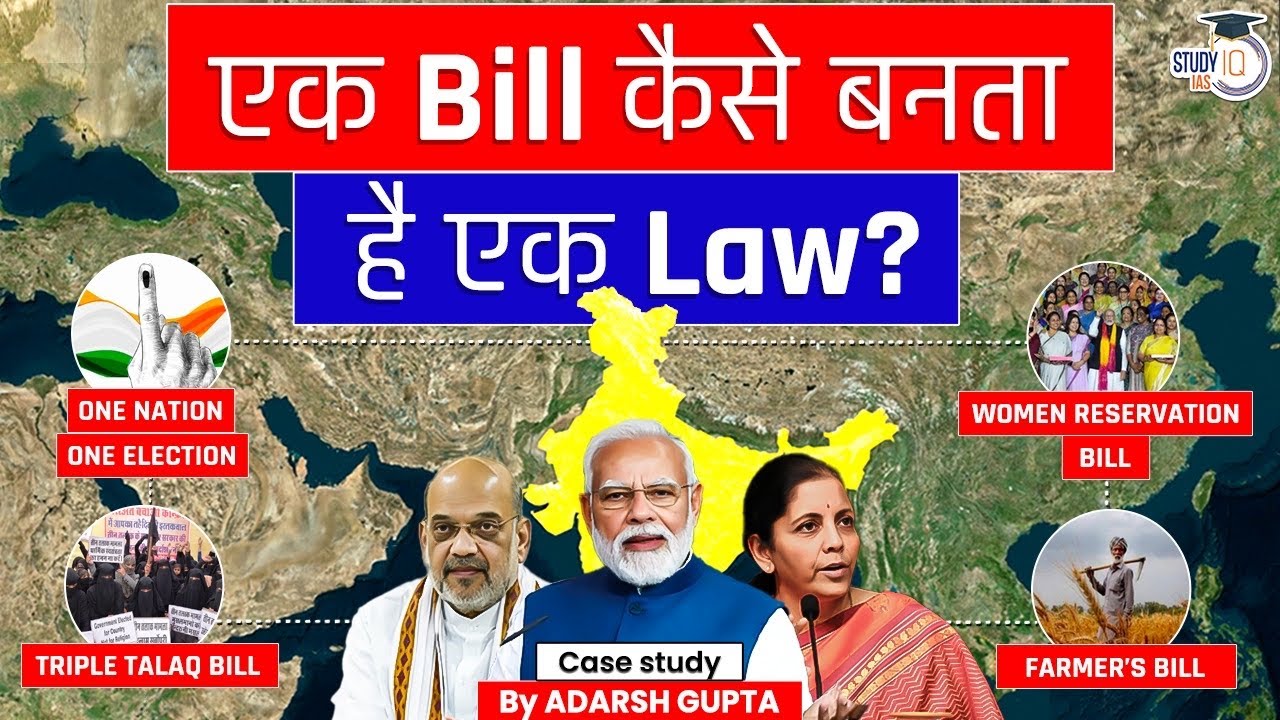
This detailed overview explores the intricate Legislative Procedure in Parliament, highlighting how a formal written suggestion turns into a powerful, legally binding Act. Understanding the supreme rulebook called the Constitution of India and the specific roles of government Ministers versus private members is essential for students preparing for competitive exams and pursuing excellence in political science.
🎯 In this chapter, you will understand:
- The step-by-step journey of a proposed law through the Lok Sabha and Rajya Sabha.
- The key differences between a Public Bill introduced by a Minister and a Private Bill.
- The four main categories of bills including Ordinary, Money, Financial, and Constitutional Amendment Bills.
- How law-making reflects government stability and the system of checks and balances.
💡 Why this topic matters: Every rule and law that governs our daily life starts as a simple document in Parliament. Knowing how laws are made helps us understand how democracy works and how leaders make big decisions for the nation.
🧠 Core Idea: A Bill is just a draft or proposal for a law. It becomes an official Act only after both Houses of Parliament discuss it, vote on it, and the President gives final approval.
Legislative Procedure in Parliament: The Path from Bill to Act
The journey of making laws inside the official halls of Parliament follows a clear and step-by-step set of democratic rules. These steps make sure that every new rule is studied carefully, discussed openly, and checked thoroughly before it affects millions of citizens across the country.
Every legislative proposal begins its life as a formal document called a Bill. This written document must go through matching stages in both houses—the lower house known as the Lok Sabha and the upper house known as the Rajya Sabha. After crossing both houses, it goes to the President of India. Once the President approves it, the proposal changes into a real law called an Act. This detailed step-by-step process keeps democracy alive by ensuring that every part of our governance stays aligned with the supreme law found in the Constitution.
- (i) A bill serves as a formal written proposal or blueprint for creating new rules and guiding future government decisions.
- (ii) The total transformation from a simple draft bill into a binding Act happens only when all official steps in Parliament are completed properly.
- (iii) Having identical rules in both Houses ensures that no law gets passed in a hurry without proper debate and thoughtful review.
Classification and Types of Bills Introduced in the House
To help Parliament manage its work smoothly, bills are divided into different groups. They are sorted based on who brings them into the house and what topic or subject matter they cover. This sorting helps everyone know what rules the bill must follow on its path to becoming a law.

The Distinction Based on Introduction: Public vs. Private
When looking at who presents the draft law, the background of that person matters a lot. Whether the person is an official government Minister or a member who is not in the cabinet changes how much political backing and parliamentary confidence the bill carries.
- (i) Public Bills: These are also known as Government Bills. They are the main tools used by the ruling party to put its promises and plans into action.
- (ii) Private Bills: These are known as Private Members’ Bills. They give individual lawmakers a chance to bring up important ideas or regional issues, though they rarely turn into real laws.
Categories of Bills Based on Subject Matter
Apart from who introduces the bill, the actual information inside the document decides its exact category. The Constitution lays down four distinct pathways based on these topics:
Ordinary Bills
Ordinary bills deal with general everyday matters of governance that do not involve money collections, taxes, or changes to the fundamental rules of the Constitution.
Money Bills
Money bills strictly handle financial topics like setting taxes, managing government loans, spending public revenue, and handling money inside the official Consolidated Fund of India.
Financial Bills
Financial bills also touch upon money matters and government expenditure, but they have slightly different special rules compared to strict Money Bills.
Constitution Amendment Bills
These are the most important and formal bills of all. Their purpose is to change, add, or update any rule or provision written inside our supreme book, the Constitution.
Comparative Analysis: Public Bill vs. Private Bill
Examining how government-backed bills differ from proposals brought by individual members helps us see how power works inside Parliament. It shows us who drives the national agenda and how the ruling party maintains its strength.
The Mechanics of a Public Bill
A Public Bill carries the official government policy. It represents the shared commitment of the Prime Minister and cabinet ministers, reflecting their grand vision for running the country.
- (i) It can only be introduced in the house by an appointed Minister of the government.
- (ii) It directly reflects the official programs, policies, and political goals of the ruling Government.
- (iii) Because the ruling party has the most votes in the house, this type of bill has a very high chance of being approved.
- (iv) If the house votes against and rejects a public bill, it shows that the government may have lost its majority support or parliamentary confidence, which can force the entire government to resign.
- (v) To introduce a public bill, the minister must give a advance notice of at least .
- (vi) Writing and drafting this bill is a complex task done by government experts in the respective ministry along with legal experts from the official Law Department.
The Nature of a Private Bill
On the other hand, a Private Bill gives an important voice to opposition members and MPs who are not ministers. It lets them shine a light on public issues that the ruling government might have missed or put on hold.
- (i) It is introduced by any Member of Parliament (MP) who is not a government minister.
- (ii) It reflects the personal views, constituency needs, or opposition party opinions on public matters.
- (iii) Historically, it has a very low chance of passing all votes to become a final Act.
- (iv) If the house rejects a private member's bill, it has zero impact on government stability and does not affect parliamentary confidence.
- (v) It requires a longer advance notice period of before it can be brought to the floor of the house.
- (vi) The entire responsibility of writing and drafting the bill rests on the individual member, without direct drafting help from the government's Law Department.
⚡ Quick Revision Capsule: Public Bill vs. Private Bill
Here is a side-by-side snapshot comparison summarizing the key differences between Public and Private Bills in Parliament:
| Feature / Aspect | Public Bill (Government Bill) | Private Bill (Private Member's Bill) |
|---|---|---|
| Introduced By | Introduced exclusively by a government Minister. | Introduced by any MP who is not a minister. |
| Political Stance | Reflects official government policy and political agenda. | Reflects individual MP or opposition viewpoint. |
| Chance of Passing | High chance of approval due to majority support. | Low chance of being passed into law. |
| Government Impact | Rejection may lead to loss of parliamentary confidence and resignation. | Rejection has no impact on government stability. |
| Notice Period | Requires an advance notice of . | Requires an advance notice of . |
| Drafting Assistance | Drafted by ministry officials with help from the Law Department. | Drafted entirely by the individual member proposing it. |
📝 Summary
The Constitution of India outlines a step-by-step system for creating laws so that every proposed rule is checked thoroughly. Whether dealing with Ordinary Bills, Money Bills, Financial Bills, or Constitutional Amendment Bills, each must face strict parliamentary review. For students, mastering these fundamental concepts helps explain how democratic systems maintain balance, how taxation policies are authorized, and how the ruling government maintains its authority while building nationwide agreement over of law-making history.
🚀 Quick Revision Points
Essential facts to review before examinations:
- (i) Every law starts as a draft called a Bill and ends up as an official Act after approval.
- (ii) Public Bills are backed by ministers and have a high success rate, whereas Private Bills come from non-minister MPs.
- (iii) The four core types of bills are Ordinary, Money, Financial, and Constitutional Amendment Bills.
- (iv) A Money Bill strictly deals with financial matters like taxation and spending from the Consolidated Fund of India.
- 💡 Exam Tip: Pay special attention to notice periods for exams! Public Bills require 7 days of advance notice, while Private Member's Bills require 1 full month of notice. Rejection of a Public Bill can sink a government, but rejection of a Private Bill does not affect government stability.
❓ Frequently Asked Questions (FAQ)
Q1: What is the main difference between a Bill and an Act?
A1: A Bill is a proposed law being debated in Parliament, while an Act is a completed bill that has been passed by both Houses and signed by the President of India.Q2: What happens if a Public Bill gets defeated in the Lok Sabha?
A2: If a Public Bill is defeated, it signals that the ruling government has lost its majority or parliamentary confidence, which usually forces the government to resign.Q3: Who can introduce a Private Member's Bill?
A3: Any Member of Parliament (MP) in the Lok Sabha or Rajya Sabha who is not holding a position as a government Minister can introduce a Private Member's Bill.