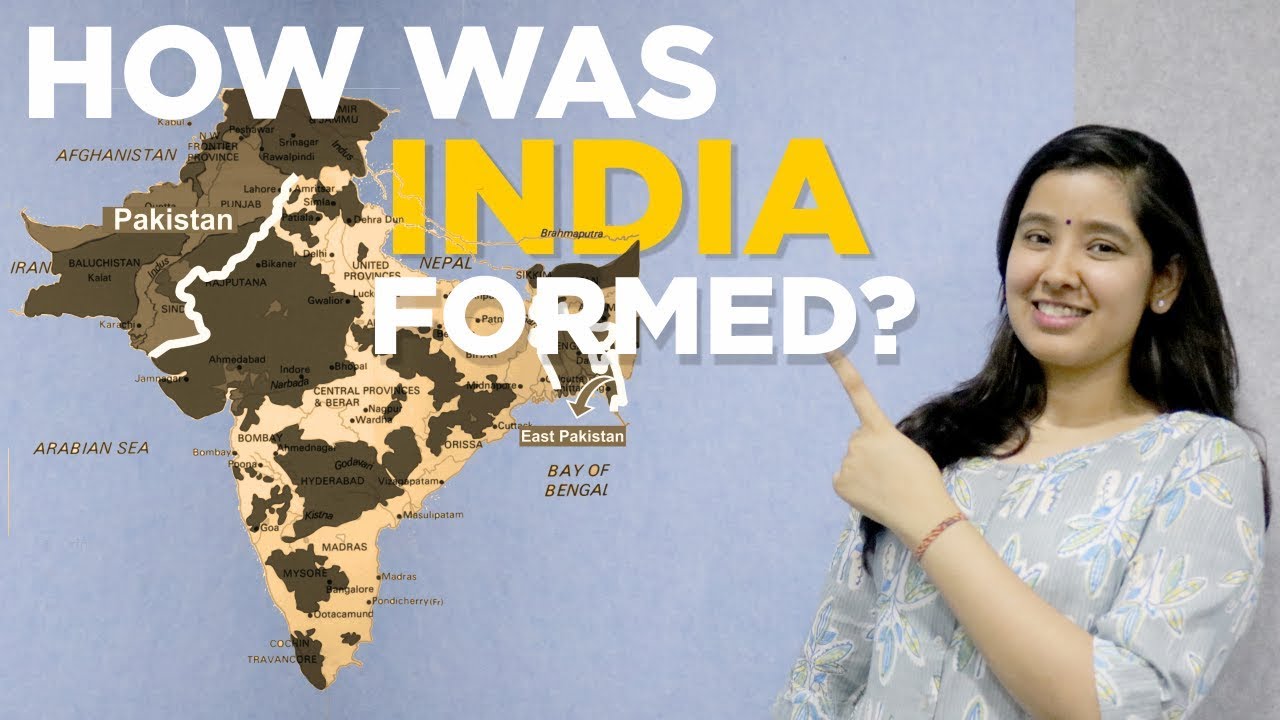
The evolution of states and union territories in India is a remarkable story of integration, reorganisation, and nation-building after . From the unification of princely states to the States Reorganisation Act, 1956, the process reflected India’s commitment to administrative efficiency, linguistic identity, and national unity. This topic holds immense relevance for students and civil services aspirants seeking to understand the constitutional evolution of modern India.
🎯 In this chapter, you will understand:
- How India integrated more than 500 princely states after independence.
- Why linguistic demands became important in the reorganisation of states.
- The role of the Dhar Commission, JVP Committee, and Fazl Ali Commission.
- How the States Reorganisation Act, 1956 changed India’s political map.
💡 Why this topic matters: The creation of modern Indian states was not only an administrative exercise. It was also a careful effort to respect India’s many languages and cultures while keeping the country united, secure, and easy to govern.
🧠 Core Idea: India moved from a complicated system of provinces and princely states to a clearer federal structure. Language became an important basis for creating states, but national unity, security, and administrative convenience remained equally important.
Integration of Princely States and Early State Classification
The journey of India’s political integration began with the unification of over 500 princely states into a single sovereign nation. After , the country inherited a complex political structure consisting of British provinces and princely states. Through decisive leadership and diplomatic skill, these diverse territories were gradually integrated into the Union of India to ensure a stable and unified democratic fabric.
Linguistic Demands: Dhar Commission and JVP Committee ()
The demand for linguistic reorganisation of Indian states gained strength soon after independence, reflecting the people’s desire for cultural and linguistic identity over inherited colonial boundaries. Many people believed that governing people in their own language would make administration easier and help citizens feel more connected to the state.
- (i) The British provinces were directly ruled by the British Government, while the princely states were governed by native rulers under the paramountcy of the British Crown.
- (ii) The Indian Independence Act, 1947 gave princely states the freedom to join India, join Pakistan, or remain independent, creating a potential geographical challenge for the new nation.
- (iii) Out of the 552 princely states, 549 acceded to India. The exceptions — Hyderabad, Junagarh, and Kashmir — were integrated through various strategic means:
- (a) Hyderabad was annexed through ‘police action’ known as Operation Polo.
- (b) Junagarh merged after a public referendum favoured the Indian Union.
- (c) Kashmir joined India via the Instrument of Accession signed by Maharaja Hari Singh.
- (iv) By , the Constitution classified Indian states into a fourfold system:
- (a) Part A — 9 former governor’s provinces.
- (b) Part B — 9 princely states with legislatures.
- (c) Part C — 10 chief commissioner’s provinces and some princely states.
- (d) Part D — the Andaman and Nicobar Islands, treated as a separate category.
The Dhar Commission () and Administrative Perspective
In , the Linguistic Provinces Commission headed by S. K. Dhar was appointed to examine the feasibility of reorganising states on linguistic lines. The Commission submitted its report in , suggesting that administrative convenience should take precedence over language-based reorganisation to maintain the nation’s fragile stability.
- (i) Reported that linguistic divisions could weaken national unity and socio-economic progress.
- (ii) Recommended reorganisation primarily based on administrative efficiency and geographical contiguity.
- (iii) The report disappointed those who sought linguistic autonomy, leading to further political pressure.
The JVP Committee () and National Security
Following public dissatisfaction with the Dhar Commission, the government appointed a three-member committee — Jawaharlal Nehru, Vallabhbhai Patel, and Pattabhi Sitaramayya — known as the JVP Committee in . The committee’s report reiterated that language should not be the sole criterion for state formation during the early years of nation-building.
- (a) It emphasized national unity and security over regional linguistic interests.
- (b) Suggested that linguistic demands could be reconsidered in the future when stability was achieved and emotions cooled.
- (c) Despite the rejection, the linguistic movement continued to grow stronger, particularly in the south.
Formation of Andhra State (): A Linguistic Turning Point
The movement reached a turning point after Potti Sriramulu’s 56-day hunger strike demanding a Telugu-speaking state. His death triggered widespread agitation, compelling the government to form Andhra State in by separating Telugu-speaking areas from Madras State.
- (i) Marked the birth of India’s first linguistic state, changing the political landscape forever.
- (ii) Set a precedent for future state reorganisations across the entire subcontinent.
- (iii) Proved that linguistic identity had become a strong political force that the Union Government could no longer ignore.
Fazl Ali Commission and States Reorganisation ()
The success of Andhra State intensified demands across India for linguistic-based states, leading to the establishment of the States Reorganisation Commission in to provide a comprehensive solution. The government realised that a permanent and balanced policy was needed, rather than responding to each linguistic movement separately.

Composition and Mandate of the Commission
The Commission was chaired by Fazl Ali, with K. M. Panikkar and H. N. Kunzru as members. Their task was to study and recommend a balanced structure for the Indian Union that respected both linguistic aspirations and the paramount need for national unity.
- (i) The report was submitted in after extensive surveys.
- (ii) Accepted language as an important factor but rejected the theory of “one language–one state.”
- (iii) Prioritised India’s integrity and administrative viability above all other factors.
Key Recommendations and Guiding Principles
The Fazl Ali Commission laid down guiding principles for state formation to balance regional identity with the broader national interests of the newly independent republic. Its approach was practical: language mattered, but a state also needed secure borders, workable administration, and the ability to support development.
- (a) Preservation of national unity and security as the primary concern.
- (b) Promotion of linguistic and cultural homogeneity to ensure smoother governance.
- (c) Ensuring economic and administrative efficiency for long-term development.
- (d) Welfare and development of the people through rational territorial planning.
Implementation of the States Reorganisation Act ()
The Government of India accepted the Commission’s recommendations with minor modifications. The States Reorganisation Act, 1956 and the 7th Constitutional Amendment came into effect on , creating 14 states and 6 union territories.
- (i) The original fourfold classification of states (Part A, B, C, D) was completely abolished.
- (ii) The new administrative framework strengthened federal unity and simplified the constitutional map.
- (iii) Marked a turning point in India’s constitutional geography and political administration.
Major Territorial Changes in : Redefining the Indian Map
The States Reorganisation Act brought sweeping territorial adjustments across India, shaping the modern map of the country through linguistic and administrative consolidation. These changes joined areas with shared language and culture, while also removing many older and confusing administrative divisions.
Summary of Evolution of States and Union Territories
The evolution of India’s states and union territories reflects the nation’s commitment to unity in diversity and democratic resilience. From the integration of princely states () to the transformative States Reorganisation Act (), each phase strengthened federal balance and administrative efficiency. For students and aspirants, this journey is crucial for understanding the political consolidation and constitutional development that defines modern India today.
- (i) Kerala: Formed by merging Travancore–Cochin State with Malabar District and Kasargod of South Canara.
- (ii) Andhra Pradesh: Created by merging Telugu-speaking areas of Hyderabad State with the existing Andhra State.
- (iii) Madhya Pradesh: Formed from Madhya Bharat, Vindhya Pradesh, and Bhopal to create a central administrative heart.
- (iv) Bombay State: Expanded by adding Saurashtra and Kutch, creating a massive bilingual state.
- (v) Mysore State: Incorporated Coorg and Kannada-speaking areas of other provinces.
- (vi) Punjab: Merged with Patiala and East Punjab States Union (PEPSU) to unify the region.
- (vii) Rajasthan: Absorbed Ajmer State to complete its regional integration.
- (viii) Union Territory: The Laccadive, Minicoy, and Amindivi Islands were created as a distinct administrative unit.
⚡ Quick Revision Capsule: State Reorganisation in India
This capsule helps you revise the major committees, events, and outcomes connected with the evolution of Indian states and union territories.
| Event / Body | Key Details | Outcome |
|---|---|---|
| Integration of Princely States | 549 of 552 princely states acceded to India after . | Hyderabad, Junagarh, and Kashmir were integrated through special measures. |
| Dhar Commission | Appointed in ; report submitted in . | Recommended administrative convenience over language-based reorganisation. |
| JVP Committee | Comprised Nehru, Patel, and Pattabhi Sitaramayya; reported in . | Gave priority to national unity and security rather than language alone. |
| Andhra State | Formed in after Potti Sriramulu’s hunger strike and death. | Became India’s first linguistic state. |
| States Reorganisation Act | Based on the Fazl Ali Commission report; effective from . | Created 14 states and 6 union territories; abolished the Part A, B, C, D classification. |
📝 Summary
After , India had to bring together British provinces and hundreds of princely states into one united country. Most princely states joined India, while Hyderabad, Junagarh, and Kashmir were integrated through special political and administrative actions. Although early committees advised patience on language-based state formation, the creation of Andhra State in showed that linguistic identity could not be ignored. The Fazl Ali Commission then prepared a balanced plan, and the States Reorganisation Act, 1956 created 14 states and 6 union territories, giving India a clearer federal structure.
🚀 Quick Revision Points
Essential facts to review before examinations:
- (i) India had 552 princely states, of which 549 acceded to the Indian Union.
- (ii) The Dhar Commission preferred administrative convenience over linguistic reorganisation.
- (iii) The JVP Committee included Jawaharlal Nehru, Vallabhbhai Patel, and Pattabhi Sitaramayya.
- (iv) Andhra State, formed in , was India’s first linguistic state.
- (v) The States Reorganisation Act, 1956 created 14 states and 6 union territories.
- 💡 Exam Tip: Remember the sequence: integration of princely states → Dhar Commission → JVP Committee → Andhra State → Fazl Ali Commission → States Reorganisation Act, 1956. This order is frequently asked in polity examinations.
❓ Frequently Asked Questions (FAQ)
Q1: How many princely states joined India after independence?
A1: Out of 552 princely states, 549 acceded to India. Hyderabad, Junagarh, and Kashmir were integrated through separate strategic and political processes.Q2: Why was Andhra State important?
A2: Andhra State was formed in after the movement led by Potti Sriramulu. It became India’s first linguistic state and encouraged demands for language-based states across the country.Q3: What did the States Reorganisation Act, 1956 do?
A3: Based on the Fazl Ali Commission’s recommendations, the States Reorganisation Act, 1956 abolished the fourfold classification of states and created 14 states and 6 union territories.