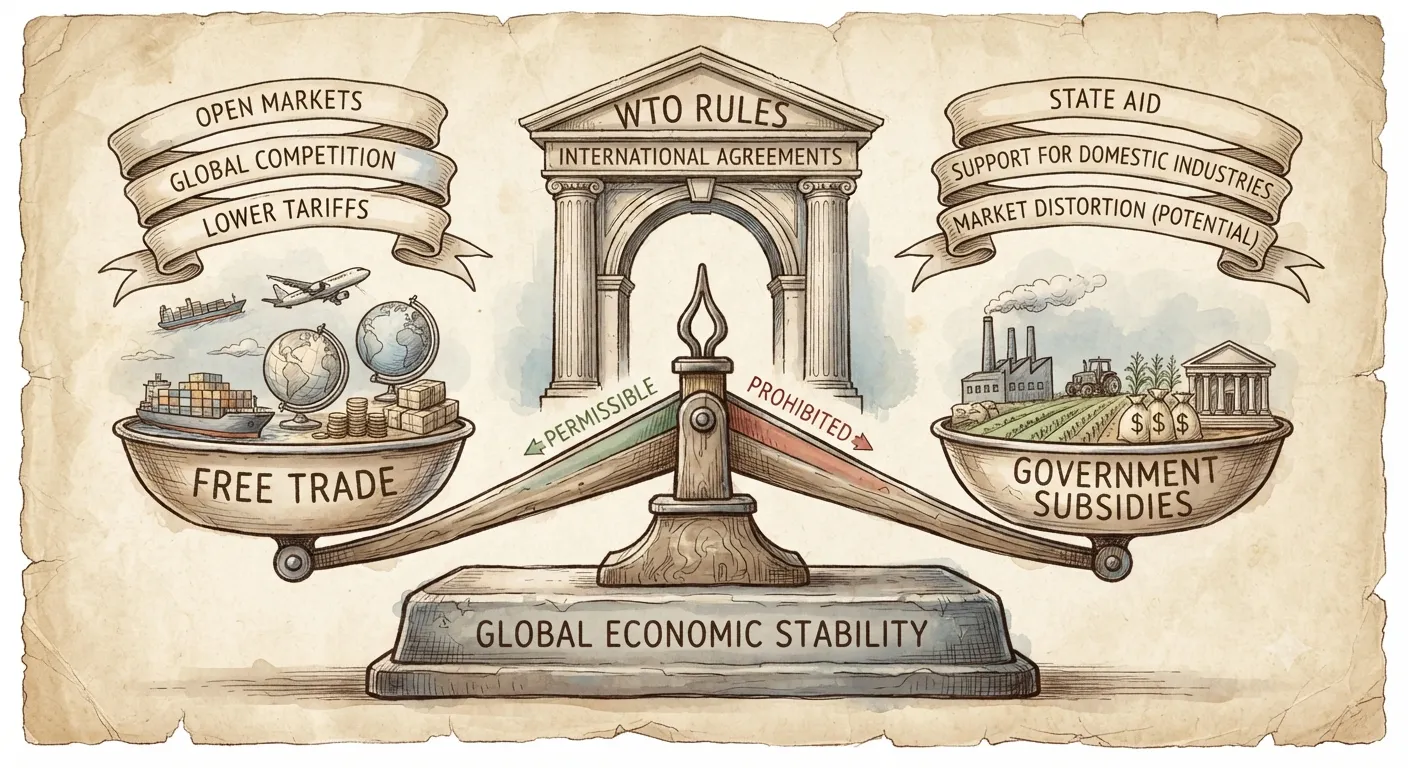
The principle of free trade and fair competition sits at the very core of international commerce. Ideally, companies should win customers based on the true value and quality of their products, without governments tipping the scales. However, market distortions like subsidies and dumping frequently disrupt this balance. Because these mechanisms act as unfair trade practices, the World Trade Organization (WTO) enforces strict rules to keep the global marketplace honest and competitive for everyone.
WTO Subsidy Regulations and Unfair Trade Practices in Global Commerce
When governments step in to artificially lower production costs or protect domestic firms from foreign rivals, open markets break down. To prevent trade wars, international agreements focus heavily on neutralizing these imbalances.
- Balancing the Global Playing Field
True economic integration depends on a transparent environment where cross-border transactions happen naturally. When a government underwrites its domestic enterprises, it directly compromises the commercial integrity of international competitors who receive no such safety nets.
Subsidy Provisions under WTO
The WTO Agreement on Subsidies and Countervailing Measures (SCM) acts as the primary rulebook here. It clearly defines what constitutes an illegal government handout versus what is simply regular economic support across industrial and agricultural sectors.
Types of Subsidies
The system splits these financial benefits into two clear categories based on how heavily they distort international sales patterns.
- (i) Prohibited Subsidies: These are flat-out banned. They include direct incentives tied specifically to export performance, or measures designed to block imports by favoring domestic goods over foreign ones (import substitution).
- (ii) Permitted Subsidies: These are general, broad-based forms of internal backing that do not target a specific industry, often called non-specific subsidies.
- (iii) Exemptions: To keep growth equitable, Least Developed Countries (LDCs) and developing economies with a GNP per capita below US$ 1000 get a special pass to use export assistance that would otherwise be restricted.
Specific vs Non-Specific Subsidy
The core distinction comes down to target selection. Non-specific subsidies offer broad structural help to all businesses equally, using objective benchmarks like company size. On the flip side, specific subsidies single out explicit industries, meaning they require close oversight to prevent economic damage overseas.
- (a) Broad-based policy initiatives aim to boost domestic industry across the board without picking winners or losers.
- (b) Targeted industry funding is only acceptable if it avoids causing material injury or creating serious prejudice for trade partners.
- (c) To prove market damage, investigators look directly at declining domestic output, falling sales numbers, shrinking profits, low investment returns, drops in factory utilization, job cuts, and dipping wages.
Relief Against Harmful Subsidies
When an economy faces illegal foreign trade benefits, it has two primary defense paths. It can implement local border adjustments via countervailing duties, or escalate the issue directly to the multi-nation dispute settlement mechanism at the WTO.
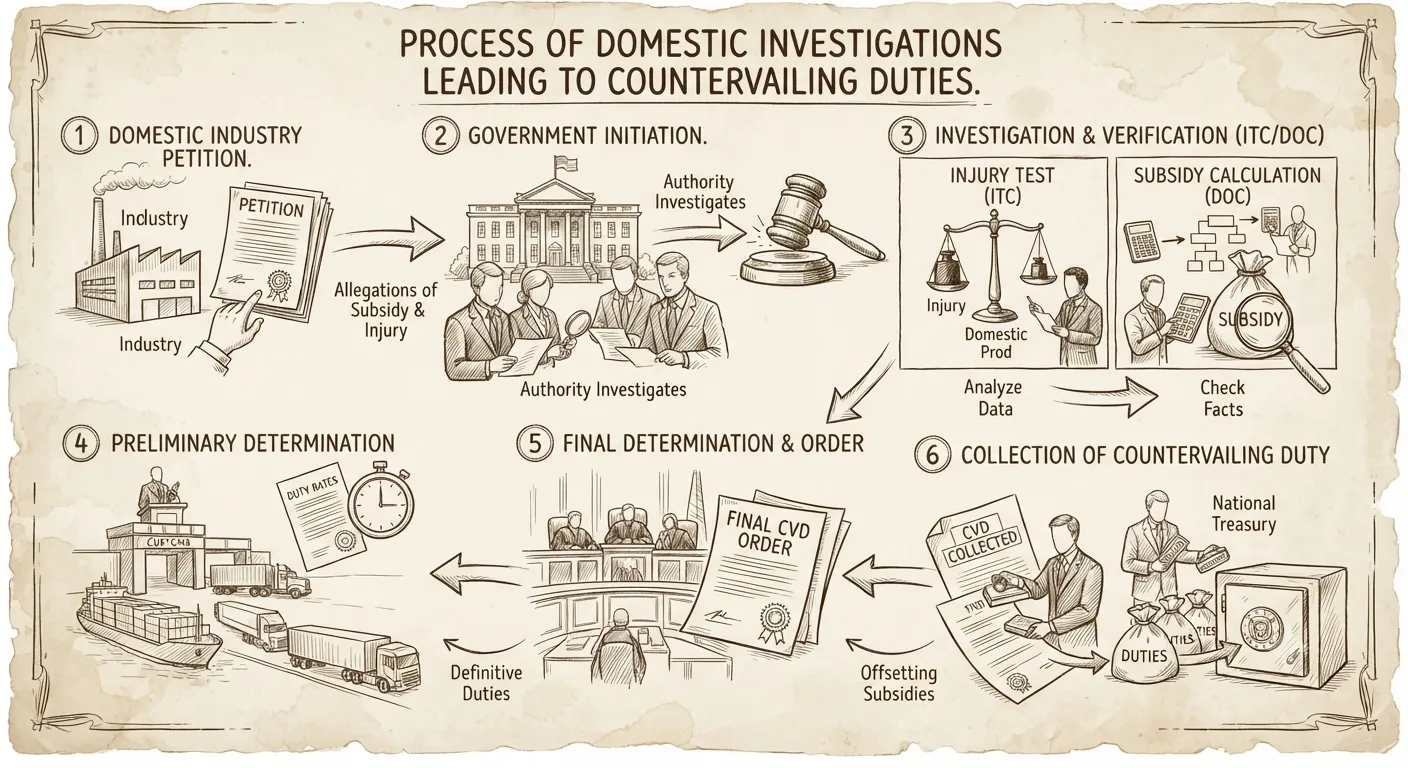
- (i) Countervailing Duty: A targeted border tax applied when domestic businesses suffer clear financial injury, offering an immediate domestic fix while a full investigation plays out.
- (ii) Dispute Settlement: A formal multilateral process used for cases of structural prejudice, relying on an official WTO panel to force the offending nation to withdraw the policy.
- (iii) Investigation Process: Every step must stay strictly transparent and data-driven, clearly proving that an active subsidy exists and showing a direct link between that benefit and local economic harm.
Preference for Countervailing Duty
Even though nations can legally use both defensive tools to fight material injury, most default directly to countervailing duties. They work faster, stay within domestic control, and skip the massive gridlock of international courts.
- (i) Delivers rapid, practical protection against incoming subsidized goods right at the port of entry.
- (ii) Sidesteps the long delays and legal friction of international panel debates.
- (iii) Keeps control within a domestic legal framework where processing rules are clear and highly predictable.
Summary
Mastering subsidy regulations within the WTO framework is a cornerstone for analyzing how nations balance open economic borders with internal growth goals. By isolating illegal trade practices like dumping from general industrial aid, these rules attempt to shield local businesses from artificial price manipulation while keeping global supply lines open and healthy.
Quick Revision Points for Students
Reviewing these foundational trade dynamics keeps key concepts sharp for upcoming exams.
- (i) Free trade relies on fair competition, meaning goods must compete on organic pricing and quality rather than government backing.
- (ii) The WTO SCM Agreement completely bans export-contingent and import-substitution aids, while permitting broad non-specific subsidies.
- (iii) Developing nations with a GNP per capita under US$ 1000 receive explicit exceptions to help kickstart their local industrial baselines.
- (iv) Countries often choose countervailing duties over formal WTO litigation because they offer rapid, locally managed protection against market injuries.
Frequently Asked Questions (FAQ)
Q1: What exactly makes a subsidy "specific" under WTO rules?
A1: A subsidy is specific if it deliberately targets a particular enterprise, sector, or geographic region, rather than being distributed generally across all businesses based on neutral criteria.Q2: How do nations legally protect themselves against subsidized foreign imports?
A2: They can launch transparent domestic investigations to prove market damage, allowing them to levy targeted countervailing duties directly at their borders, or they can take the case to the WTO dispute settlement panel.Q3: Are developing countries forced to follow the exact same subsidy bans as wealthy nations?
A3: Not completely. The WTO provides special provisions allowing Least Developed Countries and developing economies with a GNP per capita under US$ 1000 to keep using export-linked incentives to grow their industries.