
This detailed study looks at how investing in people acts as the main engine for economic growth. It highlights the role of human capital since , when Prof. Theodore W. Schultz highlighted its importance. This guide helps students preparing for competitive exams understand how education, health, and national prosperity work together.
🎯 In this chapter, you will understand:
- The foundation of human capital and why investing in people drives economic growth.
- How brainpower industries and intangible assets shape the modern knowledge economy.
- The strong connection between literacy, health, farm productivity, and poverty reduction.
- Why social innovation and higher education are necessary to support modern physical technology.
💡 Why this topic matters: Real national progress is impossible if a country relies on outdated methods. Investing in human health and education protects an economy from sudden downturns.
🧠 Core Idea: Developing human resources turns population growth into an asset, building a skilled workforce that drives long-term economic prosperity.
The Foundational Concept of Human Capital
Human capital is the baseline for modern development economics. It refers directly to the knowledge and capacity of a population to use information effectively for productive work. This idea gained global attention after Prof. Theodore W. Schultz gave a major talk in to the American Economic Association, changing how economists view wealth by showing that investing in people drives national development.
- The Structural Dynamic of Human Wealth
Building a strong economy requires looking beyond physical infrastructure to focus on the skills of its people. In growing economies like India, Human Resource Development (HRD) acts as a primary catalyst for economic progress and social growth. Today's modern world explicitly demands people who can adapt quickly to changing technology.
- (i) There is a clear two-way link between economic growth and human development. Steady economic growth leads to better health and education, which in turn fuels more economic growth.
- (ii) True national progress cannot happen if the workforce relies on old operational methods.
- (iii) Focusing on healthcare and educational systems directly protects an economy from industrial slowdowns.
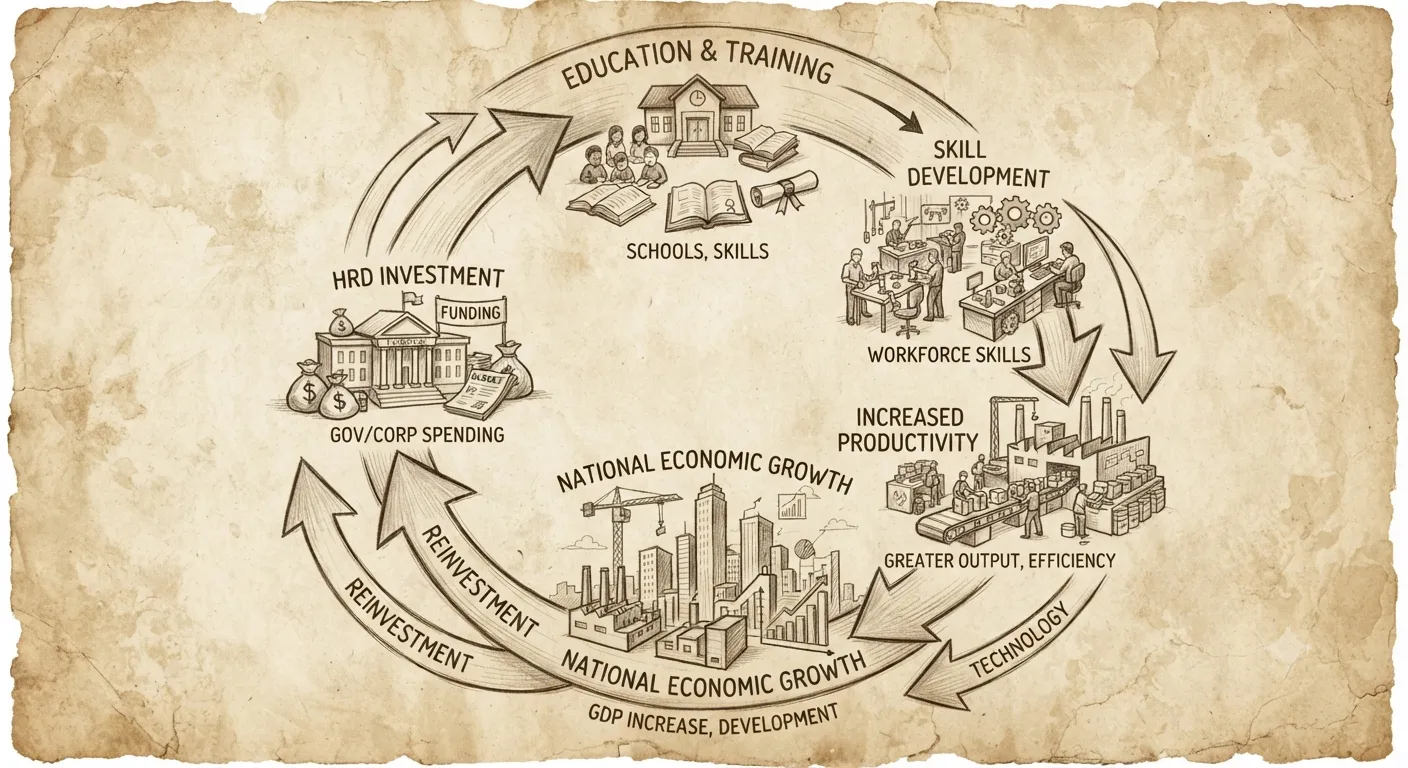
The Evolving Role of HRD in the Global Knowledge Economy
As the global market shifts from basic manual labor to knowledge-based work, the definition of competitive advantage is changing. The value of human competency has now surpassed physical machinery, meaning countries must rethink how they train and keep skilled workers.
The Rise of Brainpower Industries and Innovation
In our current era, brainpower industries have become a dominant economic force. Unlike traditional factories, these knowledge-based fields do not need a fixed physical location. Instead, they grow naturally in countries that prioritize educating their people and encouraging constant innovation.
- (i) Modern economic success no longer depends solely on a country's supply of natural resources, but directly on the intellectual output of its workforce.
- (ii) Planned, long-term investment in education helps developing nations attract global interest and foreign investment.
Valuing Intangible Assets and Human Competencies
In a competitive knowledge economy, intangible assets—like specialized skills, institutional knowledge, and unique expertise—are far more valuable than standard physical assets. The ultimate success of a business or a nation depends heavily on people's competencies and the strength of their organizational culture.
Adapting at the Speed of Thought
The fast pace of modern industry requires rapid adaptation to keep technology from becoming outdated.
- (i) As technology leader Bill Gates famously pointed out in Business @ the Speed of Thought, modern businesses must move quickly just to survive in fast-changing markets.
- (ii) Rapid knowledge creation along with global connectivity has increased competition by instantly spreading new techniques across borders.
Synergy Between Social and Physical Technology
Even the most advanced modern physical technology remains ineffective without the active support of social technology, which refers to the combined skills and social systems of a community.
- (a) Important social innovations and institutional updates often provide the necessary setup for future breakthroughs in physical technology.
- (b) Higher education serves as a key tool for building independence and self-direction, ensuring that fresh knowledge is created and shared across society.
Empirical Links Between Human Development and Economic Productivity
Multiple global studies offer clear real-world evidence about the positive social and economic impact of direct investment in human resources. When a nation addresses basic human needs, its overall economic indicators show positive improvement.
Correlations in Literacy, Poverty, and Productivity
Data consistently shows that HRD is an effective tool for breaking the painful cycle of poverty and low industrial production. Poverty acts as both a cause and a result of low human development levels.
- (i) Poverty and Illiteracy: Studies show a direct positive link between high levels of poverty and widespread illiteracy.
- (ii) Demographic Shifts: A strong negative correlation exists between female literacy and birth rates, making education a key pillar for successful population management.
- (iii) Agricultural Growth: A clear positive correlation is found between years of schooling and the growth of farm productivity in rural areas.
- (iv) Modernizing Attitudes: Targeted HRD programs help update social mindsets, aligning them with the practical needs of economic growth.
⚡ Quick Revision Capsule: Human Resource Development Dynamics
This revision table summarizes key facts connecting human capital investment with broad economic outcomes:
| Development Factor | Economic Link / Correlation | Key Impact on Society |
|---|---|---|
| Human Capital Investment | Direct Positive Link | Increases overall national productivity and drives economic growth. |
| Female Literacy | Negative Correlation | Helps in effective population management by lowering birth rates. |
| Years of Schooling | Positive Correlation | Directly improves rural farm productivity and output. |
| Intangible Skill Assets | High Economic Value | Outperforms physical machinery in the modern knowledge economy. |
| Social Technology | Essential Support Structure | Provides the social foundation needed to adopt new physical technologies. |
📝 Summary
In summary, HRD is essential for increasing a country's overall productivity. By investing in human capital, developing nations can combine skilled, cost-effective labor with global capital to perform well alongside larger economies. This shift allows smaller growing economies to compete effectively in labor-focused sectors, making this a vital topic for students of economics and social sciences.
🚀 Quick Revision Points
Essential facts to review before examinations:
- (i) Human Capital represents the knowledge and working capacity of a population put toward productive work.
- (ii) The global focus on human capital began with Prof. Theodore W. Schultz's address in .
- (iii) Brainpower industries do not rely on fixed locations and value intangible assets over machinery.
- (iv) Female literacy shows a negative correlation with birth rates, serving as a key factor in managing population growth.
- (v) Increased school years show a positive correlation with higher agricultural output.
- 💡 Exam Tip: When answering questions on HRD, always highlight both direct economic metrics (like farm productivity) and social metrics (like female literacy rates) to demonstrate a complete understanding.
❓ Frequently Asked Questions (FAQ)
Q1: What did Prof. Theodore W. Schultz contribute to human resource development theory?
A1: In his address to the American Economic Association, Schultz introduced the concept of human capital, proving that investing in people is a primary driver of economic growth rather than just a social expense.Q2: Why are brainpower industries independent of geographic location?
A2: Unlike factories that need raw materials and transit routes, brainpower industries rely on intellectual work and intangible assets. They thrive wherever a country prioritizes education and supports innovation.Q3: How does HRD break the cycle of poverty?
A3: Poverty is closely linked with illiteracy. Through HRD, communities build useful skills, which leads to better farm productivity and updated social attitudes, helping individuals earn higher incomes.

