
A complex journey toward fiscal prudence has defined India's economic landscape, creating a necessary shift in how the state manages public money. The journey of Expenditure Reforms in India reveals a constant struggle against rigid national budget limits, where mandatory commitments often overshadow reform efforts.
🎯 In this chapter, you will understand:
- The structural constraints and non-discretionary costs limiting government expenditure reforms.
- The historical impact and deficit targets established under the landmark FRBM Act of 2003.
- The role of global economic shocks and fiscal stimulus packages in shifting deficit targets.
- The roadmap and specific debt-to-GDP goals recommended by the Thirteenth Finance Commission.
💡 Why this topic matters: Managing public spending directly affects national debt, inflation, and the funds available for long-term development projects.
🧠 Core Idea: Achieving sustainable economic growth requires balancing essential government costs with disciplined deficit targets enforced by legal and institutional frameworks.
Challenges in Undertaking Expenditure Reforms
The path to streamlining government expenditure is fraught with obstacles, primarily due to the non-discretionary nature of the most significant budget outlays which leave little room for maneuver.
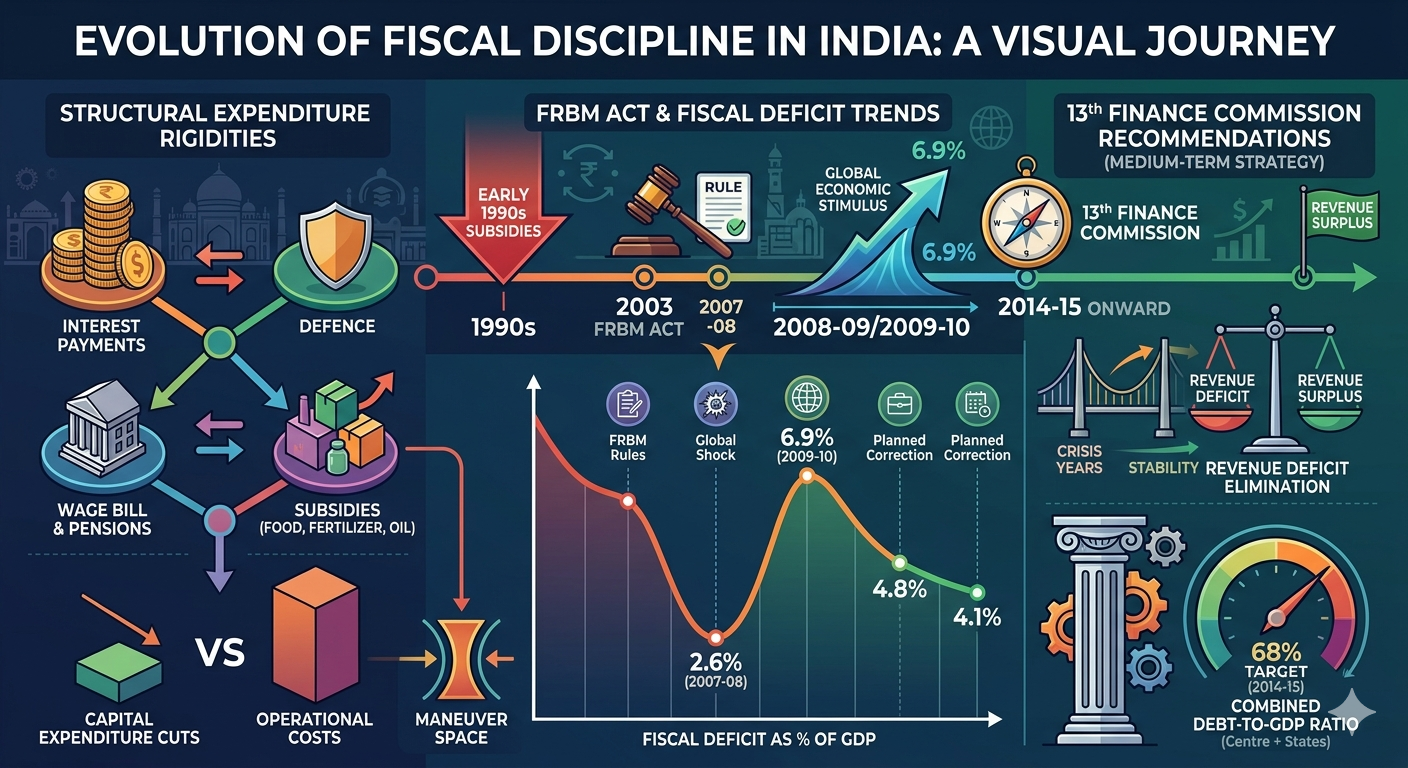
Structural Constraints on Spending
The core of India's fiscal burden is anchored by obligations that cannot be easily set aside or reduced through administrative decisions.
- (i) The heavy burden of Interest payments continues to consume a massive share of the budget, a direct consequence of historically increasing fiscal deficits.
- (ii) Fixed institutional costs such as the government wage bill, rising pension obligations, and the essential requirements of defense expenditure remain incredibly difficult to cut without social or strategic impacts.
Financial and Institutional Frameworks
Detailed analysis reveals key pressures across central government commitments:
- (a) While efforts to target subsidies for food, fertilizer, and oil have been ongoing, they have not led to a significant reduction in overall terms.
- (b) As a proportion of GDP, these subsidies are now lower than in the early 1990s, although recent price increases have renewed upward pressure on them.
- (c) The overall reduction in total central government expenditure has unfortunately come mainly from cuts in capital expenditure, rather than a reduction in recurring operational costs.
FRBM Act and Fiscal Deficit Trends
Legislative intervention became the primary tool for restoring order to the nation's finances, marking a clear shift toward legal accountability.
- Legislative Momentum: Legal frameworks help enforce strict limits on government borrowing during normal economic conditions.
The Landmark Fiscal Legislation
A pivotal moment in India's economic history was the enactment of the Fiscal Responsibility and Budget Management (FRBM) Act in the year .
- (i) Following the implementation of this act, India’s fiscal deficit saw a notable decline from 4.5% of GDP in to 2.6% in .
- (ii) The global economic environment forced a temporary retreat from these targets in , when the fiscal deficit climbed to 6.9% based on revised estimates.
- (iii) This spike was largely the result of a massive fiscal stimulus package introduced by the Government of India to counter external shocks.
- (iv) While necessary for growth, this stimulus contributed to a short-term deterioration in the health of central government finances.
- (v) Corrective measures were subsequently planned with fiscal deficit targets set at 4.8% for and 4.1% for .
Thirteenth Finance Commission Recommendations
To steer the economy back toward stability, the Thirteenth Finance Commission provided a clear blueprint for long-term fiscal discipline.
- Strategic Realignment: Returning to a sustainable path requires coordinated policy targets across all levels of government.
Medium-Term Fiscal Strategy
The Commission focused on a calibrated exit from the expansionary fiscal stance that had been adopted during the crisis years of and .

Fiscal consolidation roadmap and target trajectory - Revenue Deficit Goal: The strategy demanded the total elimination of the Centre’s revenue deficit to ensure that the government does not borrow money for daily consumption.
- Surplus Horizon: The roadmap aimed for the achievement of a revenue surplus starting from onward.
- Debt Cap:The Commission also set a strict combined debt-to-GDP ratio target for both the Centre and States at 68% to be reached by the end of .
⚡ Quick Revision Capsule: Fiscal Reforms
Here is a concise overview of the critical legal benchmarks, deficit movements, and consolidation targets in India's fiscal journey:
| Fiscal Indicator / Event | Timeframe / Target | Key Economic Insight |
|---|---|---|
| Enactment of FRBM Act | Established legal accountability and a structural framework for reducing deficits. | |
| Post-FRBM Deficit Reduction | Fiscal deficit dropped from 4.5% down to 2.6% of GDP due to strict target discipline. | |
| Global Crisis Stimulus Peak | Fiscal deficit rose to 6.9% as government injected funds to protect national economic growth. | |
| Post-Crisis Target Correction | Phased reduction targets set at 4.8% and 4.1% respectively to restore balance. | |
| Combined Debt-to-GDP Target | End of | Thirteenth Finance Commission recommended a combined Centre-State limit capped at 68%. |
📝 Summary
While the path of expenditure reform remains challenged by non-discretionary costs, the structured approach of the FRBM Act and the strategic recommendations of the Thirteenth Finance Commission represent India's commitment to a sustainable fiscal future across critical .
🚀 Quick Revision Points
Essential facts to review before examinations:
- (i) Non-discretionary items like interest payments, salaries, and defense dominate central government spending.
- (ii) The FRBM Act of successfully pulled fiscal deficits down to 2.6% before global shocks hit in .
- (iii) Mandatory spending cuts often hit capital expenditure harder than everyday operational expenses.
- (iv) The Thirteenth Finance Commission advised an exit from stimulus spending to achieve a complete revenue surplus.
- 💡 Exam Tip: Pay close attention to the distinction between revenue deficit and fiscal deficit, as well as how external economic shocks impact statutory FRBM targets in exam questions.
❓ Frequently Asked Questions (FAQ)
Q1: Why is it difficult for the government to cut its everyday expenditure?
A1: A major portion of spending consists of non-discretionary commitments like interest payments, salaries, pensions, and defense, which cannot be easily reduced without administrative or strategic consequences.Q2: What was the primary objective of the FRBM Act of 2003?
A2: The primary goal of the FRBM Act was to introduce statutory discipline to fiscal management, eliminate the revenue deficit, and systematically reduce the overall fiscal deficit.Q3: How did the 2008 global economic crisis affect India's fiscal targets?
A3: The government introduced a large fiscal stimulus package to counter global financial shocks, which temporarily raised the fiscal deficit to 6.9% in before correction plans were resumed.
