The concept of Balance of Payments (BOP) measures under the WTO framework plays a crucial role in managing a country's foreign exchange reserves. Developing countries are allowed to restrict imports temporarily when facing BOP problems, ensuring essential imports are prioritized. This economic safeguard is highly relevant for students preparing for economics and international trade exams due to its practical application in trade regulations and foreign exchange management.
🎯 In this chapter, you will understand:
- The fundamental purpose of Balance of Payments (BOP) measures within global trade.
- Key legal provisions including Article XII and Article XVIIIB of GATT 1994.
- The role of the WTO BOP Committee and the IMF during multilateral reviews.
- Why import restrictions must remain strictly temporary and non-discriminatory.
💡 Why this topic matters: It explains how nations protect their currency reserves during economic stress without causing unfair trade disruptions.
🧠 Core Idea: International trade rules allow temporary import curbs during foreign currency shortages, provided they are monitored and applied equally to all partners.
Balance of Payments (BOP) Measures and WTO Provisions for Developing Countries
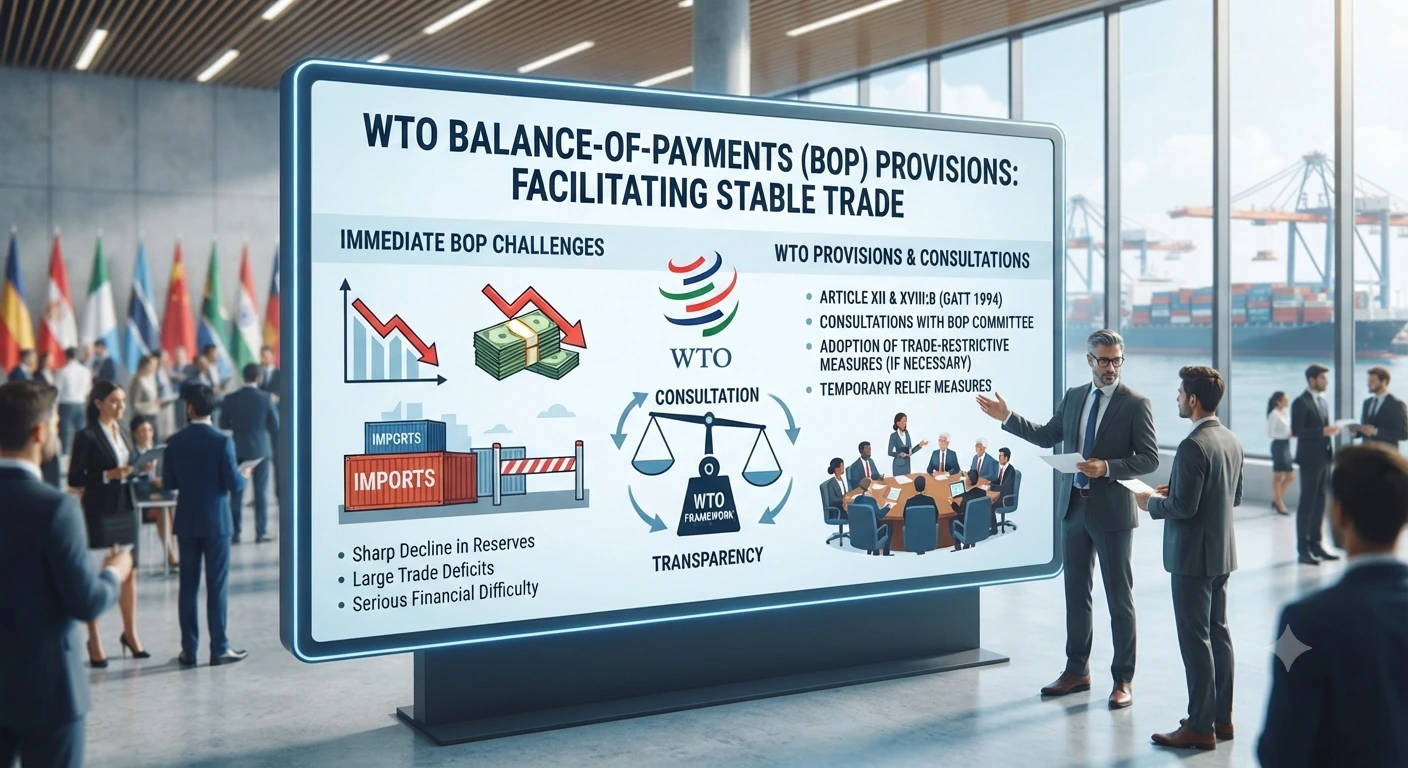
When a country runs low on foreign exchange reserves, it gets a temporary green light under global trade rules to restrict imports and stabilize its domestic economy. The GATT 1994 framework handles this via two distinct pathways: a general rule open to anyone, and a specialized rule reserved entirely for emerging economies.
Understanding the BOP measures under WTO framework and their relevance for developing countries: While the option exists on paper, the rules governing it have tightened significantly over the decades. In the modern trade era, actually invoking these measures has become operationally complex, meaning nations rarely use them today.
- (i) General Provision: Found under Article XII of GATT 1994, this allows any member nation to temporarily curb imports to stop a serious decline in monetary reserves.
- (ii) Special Provision:Article XVIIIB acts as a dedicated window for developing countries, offering them extra flexibility to protect their economy during aggressive growth phases.
- (iii) Practical Application: Due to strict international oversight and shifting global trade patterns, actual reliance on these measures has become rare in recent times.
Economic Rationale for BOP Measures
The primary core purpose of BOP provisions is to provide immediate, short-term relief to developing economies when their foreign currency reserves hit dangerously low levels, making sure they don't run out of money for absolute necessities.
Importance of Temporary Import Curtailment
As developing nations scale up their industries, they frequently experience a classic trade structural strain: their import bills for machinery and raw materials skyrocket while their export revenues take time to catch up. Temporarily tapping the brakes on non-essential imports lets them direct their scarce foreign currency where it matters most.
- (i) Prioritizes vital goods so the domestic market stays stable.
- (ii) Gives the central bank breathing room to replenish foreign exchange reserves.
- (iii) Prevents long-term economic shocks linked to uncontrolled import dependencies.
Consultation and Scrutiny Process
You cannot simply close your borders to imports without international oversight. Any country invoking these rules must submit to an intense review by the WTO BOP Committee. During these sessions, the IMF steps in to present an independent economic health report verifying the country's actual financial distress.
- (a) Generates a detailed evaluation of the country's actual foreign exchange status.
- (b) Validates that the import restrictions directly match the severity of the BOP issues.
- (c) Ensures the trade barriers remain strictly temporary and do not turn into permanent protectionism.
Non-Discriminatory Nature of BOP Measures
Much like standard global safeguard actions, BOP restrictions cannot be used to play favorites or target specific trading rivals. They must be applied across the board to every single exporting nation equally, preserving global international trade equity while the country sorts out its internal financial crunch.
- (i) Applies restrictions uniformly to all trading partners without discrimination.
- (ii) Targets only specific categories of non-essential items to limit currency outflow.
- (iii) Guarantees full compliance with foundational WTO rules of fairness.
⚡ Quick Revision Capsule: BOP Policy Highlights
Reviewing the core regulatory and institutional pillars helps secure top marks in your upcoming exams:
| Key Element | Core Mechanism & Legal Basis | Practical Impact |
|---|---|---|
| Primary Purpose | Protects foreign exchange reserves by letting nations temporarily cut down on non-essential imports. | Maintains domestic market stability during financial distress. |
| Legal Framework | Split into Article XII (general provision) and Article XVIIIB (for developing nations). | Offers flexible legal pathways based on economic maturity. |
| Oversight Bodies | Managed via mandatory consultations with the WTO BOP Committee using analytical data reports from the IMF. | Prevents misuse of emergency provisions for unwarranted protectionism. |
| Core Condition | Must remain strictly temporary and operate on a non-discriminatory basis against trading partners. | Sustains fair international trade equity across all trading partners. |
📝 Summary
At their core, BOP measures function as an emergency safety valve within the WTO framework. They empower developing countries to shield their domestic economies from sudden foreign exchange depletion by temporarily blocking non-essential inflows. Grounded in Article XII and Article XVIIIB of GATT 1994, these rules protect vital economic interests, making them a cornerstone topic for students of international trade and economics looking to grasp real-world regulatory policy.
🚀 Quick Revision Points
Essential facts to review before examinations:
- (i) Balance of Payments (BOP) measures provide temporary emergency relief during severe foreign exchange reserve depletion.
- (ii) Article XVIIIB of GATT 1994 offers tailored flexibilities specifically designed for emerging economies.
- (iii) Mandatory evaluations by the WTO BOP Committee incorporate economic health reports provided by the IMF.
- (iv) Import restrictions must be applied fairly to all trading partners without targeting individual nations.
- 💡 Exam Tip: Always emphasize that BOP measures under GATT 1994 require dual oversight by both the WTO and the IMF, and must never violate non-discrimination principles.
❓ Frequently Asked Questions (FAQ)
Q1: What is the main difference between Article XII and Article XVIIIB of GATT 1994?
A1: Article XII is a general mechanism available to any WTO member facing a reserves crisis, whereas Article XVIIIB is a special, more flexible provision designed exclusively for developing countries to support their economic development.Q2: Can a country use BOP measures to block imports from one specific nation?
A2: No. BOP measures must remain completely non-discriminatory. If a country restricts a particular type of import to save foreign currency, that restriction must apply equally to all exporting nations.Q3: Who verifies whether a country's BOP crisis is real during WTO consultations?
A3: The WTO BOP Committee handles the review process, relying heavily on official statistical assessments and financial reports supplied directly by the IMF.