The concept of Safeguard Measures in International Trade plays a crucial role in protecting domestic industries from unexpected surges in imports. As per Article XIX of GATT 1994 and the Agreement on Safeguards, countries have the right to impose temporary import restrictions when their domestic sectors face serious injury or threats due to increased imports. Understanding these trade policies is essential for students preparing for exams and anyone keen on grasping global trade mechanisms.
🎯 In this chapter, you will understand:
- The legal rules governing emergency import protections under GATT 1994.
- How non-discriminatory investigations and import quotas are applied.
- The maximum allowed duration and compensation requirements for safeguards.
- How burden-sharing keeps the overall global trade system fair and stable.
💡 Why this topic matters: Safeguard measures show how nations protect local workers and businesses from sudden import floods without breaking international trade rules.
🧠 Core Idea: Safeguards are temporary, fair, and evidence-based safety shields used by governments when sudden import spikes threaten local industries.
Safeguard Measures in International Trade: Rules, Implementation, and Impact
When an unexpected flood of imports threatens to cripple a domestic industry, countries need a reliable legal fallback. Safeguard measures serve exactly this purpose, acting as temporary protective shields that help local producers catch their breath and adjust to changing global markets.
- The Core Framework of Trade Defense
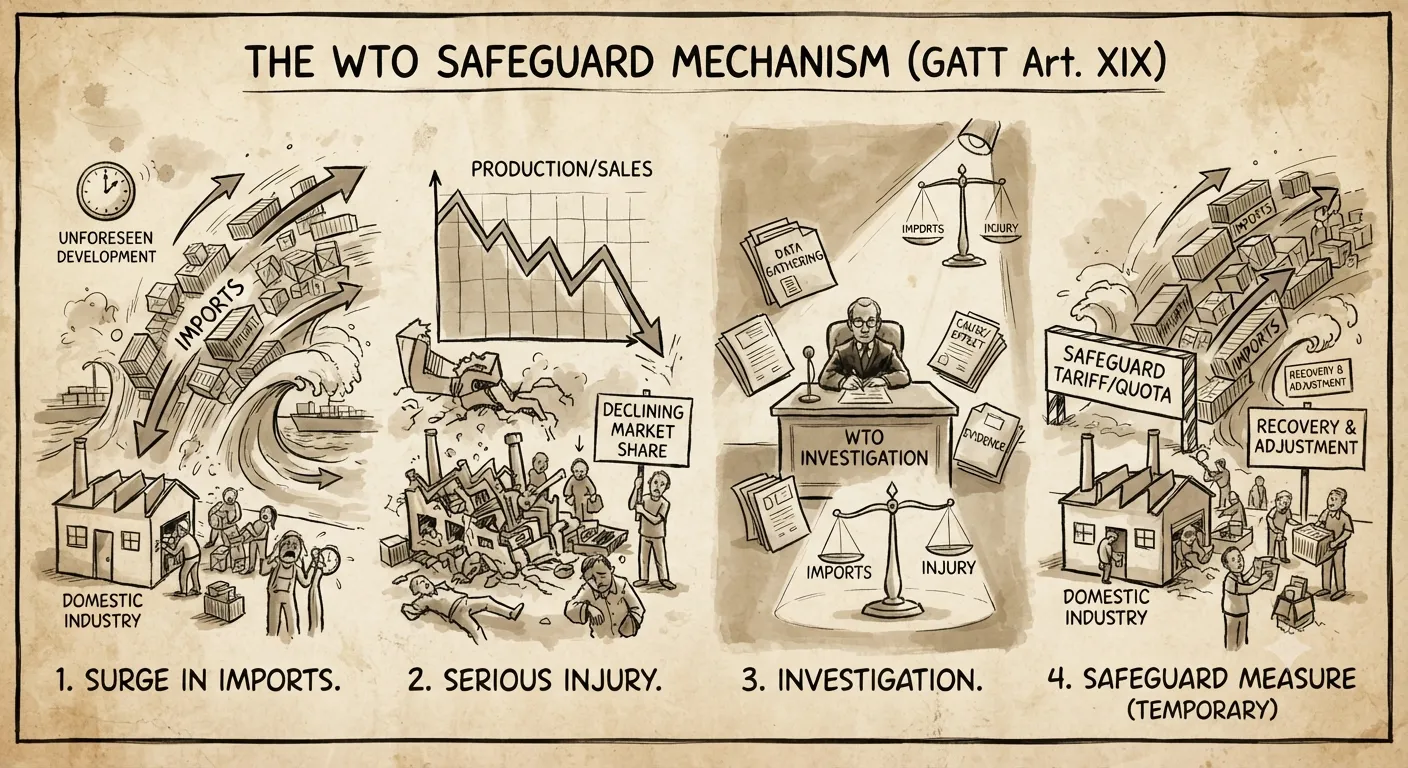
When a domestic sector faces serious injury or direct threats from climbing import volumes, a government can step in by raising import tariffs well beyond their standard bound rates or by setting up strict quantitative restrictions. The entire architecture for these defense tools is legally anchored in Article XIX of GATT 1994 alongside the WTO Agreement on Safeguards (note: the original text refers to it as Agreement on Safeguard).
- Key Conditions for Implementation
A country cannot simply launch protectionist barriers overnight. The WTO enforces strict operational disciplines to prevent these measures from being misused as arbitrary trade hurdles.
- (i) A thorough, transparent, and objective investigation must precede any safeguard action to confirm a surge in imports and the corresponding threat of serious injury to domestic producers.
- (ii) Safeguard actions are applied to the import of a product as a whole, not limited to imports from any specific country, ensuring non-discriminatory treatment.
- (iii) Additional tariffs as safeguards are universally applicable, and if quantitative restrictions are used, an annual global import limit is fixed, typically based on historical data and proportionally allocated among exporting countries.
Role and Procedure of Safeguard Measures
Implementing a safeguard is a delicate balancing act. While it gives local markets a temporary breather, it must follow rigid procedures so that international trade remains stable and fair for exporting partners.
Investigation and Application Process
Before any restrictions hit the ports, the importing country must conduct an open and transparent investigation to evaluate how the rising imports are genuinely affecting domestic production. This step keeps policy decisions entirely evidence-based.
- (i) The investigation confirms whether imports have surged significantly and whether domestic industries are suffering serious injury or face a threat of such injury.
- (ii) Safeguards are applied to the entire product category rather than targeting imports from a specific country, maintaining equity in trade policy.
- (iii) In the case of quantitative restrictions, import quotas are established for all countries, proportionally divided based on past import volumes, with provisions for deviation in exceptional cases.
Duration and Temporary Nature of Safeguard Measures
These defense mechanisms are intentionally short-lived, designed exclusively to help local industries adapt rather than locking down international trade indefinitely.
- (a) The maximum period for safeguard measures is generally , but extensions can be granted, with a total ceiling of .
- (b) Countries imposing safeguards are required to offer compensatory benefits to affected exporting nations, preventing unilateral burden on exporters.
- (c) Retaliatory measures by exporting countries are usually prohibited during the first , ensuring a balanced approach to burden-sharing.
Burden-Sharing in the GATT/WTO System
Safeguard provisions perfectly capture the spirit of shared responsibility in global trade. Instead of letting the importing market buckle under sudden economic pressure, the framework spreads the friction across trading partners under a structured, predictable system.
- Sharing Responsibility: When a domestic industry needs time to adjust, the safeguard provision distributes the burden across all countries, preventing a disproportionate impact.
- Complement to MFN: Just as the Most Favoured Nation (MFN) principle ensures non-discriminatory benefits from lower tariffs, safeguards promote non-discriminatory burden-sharing in times of import surges.
- Global Trade Stability: By providing temporary protection and structured compensation, safeguard measures maintain stability and fairness in international trade relationships.
Importance of Safeguard Measures in Trade Policy
Grasping how safeguard actions function gives you a clear window into the real-world mechanics of economic defense and diplomacy. It shows exactly how nations shield themselves without breaking their global promises.
- Strategic Takeaways for Aspirants
Understanding safeguard measures is vital for students and exam aspirants as it highlights how countries protect their domestic industries, balance global trade obligations, and share economic responsibilities under GATT/WTO. These provisions lines up the practical applications of trade policy principles and underscore the importance of temporary, evidence-based, and equitable measures in international commerce.
⚡ Quick Revision Capsule: Safeguard Measures Key Rules
This capsule summarizes the main rules, timeframes, and application conditions of WTO safeguard measures for quick exam preparation.
| Feature / Metric | Rule / Standard | Key Purpose |
|---|---|---|
| Primary Trigger | Surge in imports causing or threatening serious injury | Protects local industries from sudden market collapse |
| Legal Source | GATT 1994 Article XIX & Agreement on Safeguards | Establishes global rules and procedures |
| Scope of Application | Non-discriminatory (MFN basis) across all origins | Prevents unfair targeting of specific nations |
| Duration Limit | Initial max ; total max extension | Ensures protections remain strictly temporary |
| Trade Freeze Rule | No retaliation allowed for the first | Maintains trade stability while industries adapt |
📝 Summary
Safeguard measures bridge the gap between open global markets and essential domestic industrial safety. By providing a strictly regulated, temporary escape route from import surges under GATT Article XIX, the WTO ensures that emergency industrial protection remains non-discriminatory, time-bound (up to ), and paired with fair compensation.
🚀 Quick Revision Points
Essential facts to review before examinations:
- (i) Safeguards address sudden import surges causing or threatening serious injury to domestic industries.
- (ii) Grounded in Article XIX of GATT 1994 and the WTO Agreement on Safeguards.
- (iii) Must be applied non-discriminately to all imports of the product, regardless of origin.
- (iv) Initial application runs up to , with an absolute maximum extension cap of .
- (v) Importing nations must provide compensation, and retaliatory actions are typically frozen for the first .
- 💡 Exam Tip: Remember that safeguard measures apply to all exporting nations (MFN basis), unlike anti-dumping duties which target specific dumping countries!
❓ Frequently Asked Questions (FAQ)
Q1: What triggers the lawful application of a safeguard measure?
A1: A country can only apply safeguards after a transparent, objective investigation confirms that an import surge has occurred and is causing or threatening serious injury to its domestic producers.Q2: Are safeguard measures targeted at specific exporting countries?
A2: No. Safeguard measures must be applied on an MFN (Most Favoured Nation) basis, meaning they apply to the targeted product imported from all global sources, not just specific countries.Q3: What is the maximum duration allowed for a safeguard intervention?
A3: The standard initial period is up to . However, it can be extended if the need persists and adjustment evidence is shown, up to an absolute total timeline of .