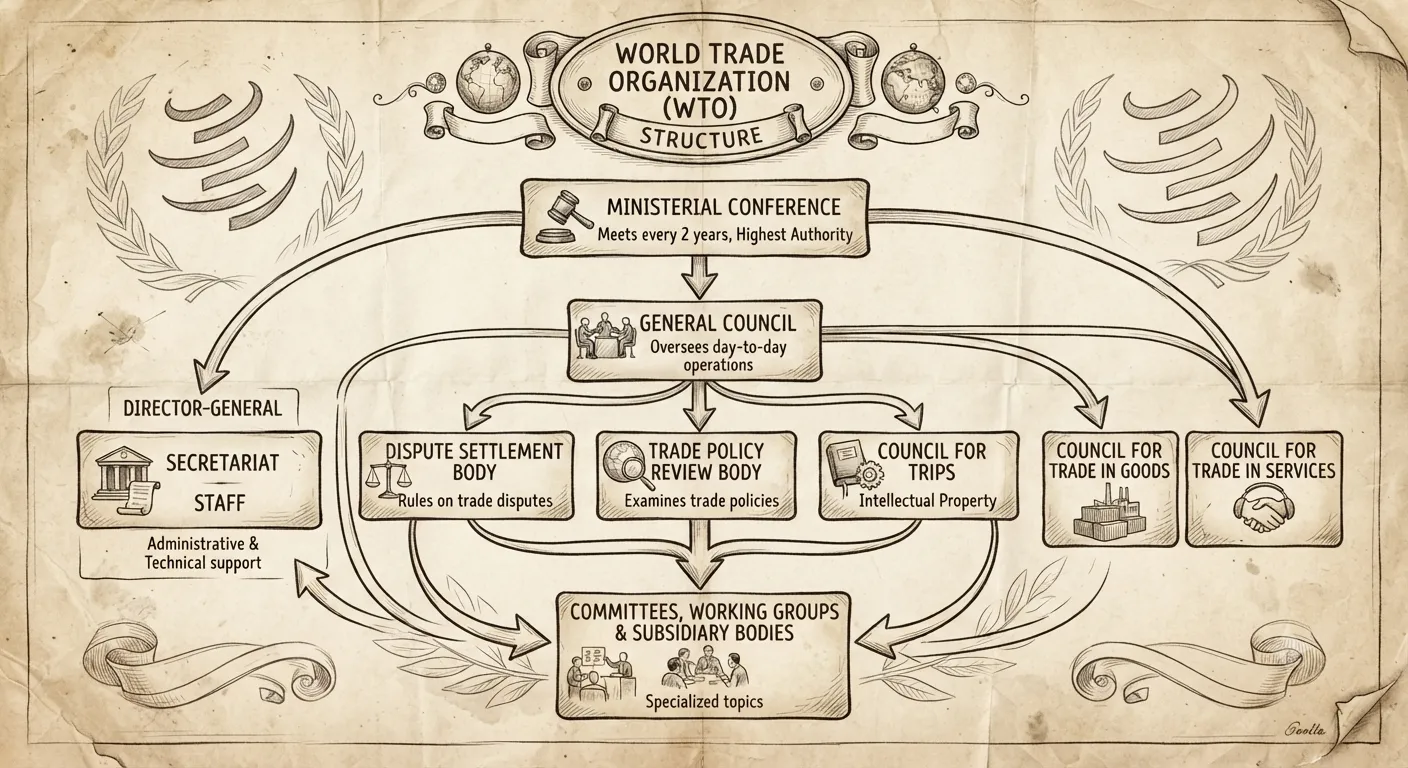
The World Trade Organization decision-making system is anchored in the Ministerial Conference, which meets every and sets the highest policy direction for multilateral trade governance. For students preparing for economics and WTO-based questions, understanding this layered institutional structure — including the General Council, TRIPS Council, Services Council, Goods Council and Dispute Settlement Body — is crucial for exams and analytical writing.
🎯 In this chapter, you will understand:
- The highest governing role of the Ministerial Conference in global trade policy.
- How the General Council and specialized councils handle daily work between major meetings.
- The key responsibilities of the Dispute Settlement Body (DSB) in resolving trade disputes.
- How voting works when members cannot reach a complete consensus.
💡 Why this topic matters: Knowing how the WTO makes decisions helps us see how global trade rules are made, checked, and kept fair for all countries.
🧠 Core Idea: The WTO runs through top-level meetings every two years, day-to-day oversight by councils, and decisions made mainly by consensus.
Decision-Making Structure of the WTO through Ministerial Conference and Councils (1996–2005 Context)
The WTO does not function randomly or informally. Instead, it runs through a well-defined chain of formal institutions, led by the Ministerial Conference and supported by councils and bodies that meet in its absence to convert decisions into workable actions.
- The Apex Trade Architecture
The WTO is governed at the top by the Ministerial Conference, which sits at the apex of the global trade decision architecture. It functions as the ultimate steering body for international trade agreements.
- (i) The Ministerial Conference convenes at least once every and is the final authority for decisions affecting global trade rules.
- (ii) When this conference is not in session, its functions are implemented by the General Council.
- (iii) Specialized councils monitor execution in their defined domains of goods, services and intellectual property.
Ministerial Conference — Locations and Chronology
The Ministerial Conference has been held at different global locations during its formative years, marking key policy cycles of trade diplomacy.
Host Cities of Ministerial Sittings, 1996–2005
The early sequence of conferences illustrates the institutional maturity of WTO deliberations as they toured different continents, shaping the tone of subsequent negotiations without breaking continuity.
Conference Edition Host City Location Year of Sitting 1st Ministerial Conference Singapore 2nd Ministerial Conference Geneva 3rd Ministerial Conference Seattle 4th Ministerial Conference Doha 5th Ministerial Conference Cancun 6th Ministerial Conference Hong Kong Interim Governance by General Council
Whenever the Ministerial Conference is not in session, the General Council carries the mandate forward so that implementation, supervision and procedural continuity never stalls.
- (a) It acts as the operational proxy of the Ministerial Conference.
- (b) It ensures that ongoing decisions are translated into institutional action.
- (c) It links ministerial intent with execution through lower bodies.
Functional Councils for Domain-Specific Implementation
Besides the General Council, three primary councils operate for specialized compliance and technical oversight under WTO legal frameworks.
- Council for Trade in Goods: Handles implementation of agreements governing traded goods.
- Council for Trade in Services: Oversees obligations under the GATS.
- Council for TRIPS: Administers compliance with the TRIPS Agreement.
Dispute Settlement and Decision-Making by Consensus
Along with structured councils, the WTO maintains conflict-resolution and rule-making systems to prevent institutional deadlock and ensure fairness among all trading partners.
- Maintaining Balance in Global Trade
The rules of international commerce require strict enforcement. The WTO ensures that large and small nations alike have a structured forum to handle trade frictions without resorting to unilateral trade wars.
Dispute Settlement Body (DSB)
The Dispute Settlement Body administers the DSU mechanism to resolve conflicts within WTO membership so that disagreements do not paralyze trade rules.
- (i) All WTO members are automatically members of the DSB.
- (ii) The DSB oversees the functioning of the dispute settlement process.
- (iii) It enforces compliance with rulings under WTO obligations.
Consensus and Voting Rules in WTO Decision-Making
WTO decisions are ideally taken by consensus, defined strictly to prevent arbitrary or unilateral outcomes, but voting exists as a fallback to break procedural deadlock.
- (a) A decision is by consensus when no member present at the meeting formally objects.
- (b) If consensus fails, voting is used with a one-country-one-vote system.
- (c) Special decisions such as interpretation of agreements or waivers demand a three-fourths majority, while amendments need two-thirds or unanimous acceptance depending on the subject.
⚡ Quick Revision Capsule: WTO Decision-Making Structure
This table summarizes the core bodies, meeting schedules, and key roles within the WTO governance framework.
| Governance Body | Meeting Schedule / Role | Primary Functions |
|---|---|---|
| Ministerial Conference | Meets at least once every | Apex body that sets overall policy direction for multilateral trade. |
| General Council | Runs ongoing operations | Acts as the operational proxy when the Ministerial Conference is not sitting. |
| Functional Councils | Domain-specific oversight | Manages compliance for Goods, Services (GATS), and TRIPS Agreement. |
| Dispute Settlement Body (DSB) | All WTO members participating | Resolves conflicts through the DSU mechanism to enforce trade rules fairly. |
| Decision Rules | Consensus first, fallback voting | Uses one-country-one-vote or special majorities if consensus fails. |
📝 Summary
The WTO governance model is anchored in the Ministerial Conference and supported by the General Council, domain councils and the Dispute Settlement Body; its consensus-based decision model coupled with voting safeguards forms the core of multilateral trade law. For students of economics and policy, these layers are indispensable for analytical answers on global trade institutions.
🚀 Quick Revision Points
Essential facts to review before examinations:
- (i) The Ministerial Conference is the ultimate authority, gathering at least once every across various global host cities.
- (ii) The General Council serves as the operational proxy, running daily enforcement tasks when the main conference is absent.
- (iii) Specialized compliance is split between three distinct functional bodies: the Goods Council, Services Council (GATS), and TRIPS Council.
- (iv) Every single WTO member has a seat on the Dispute Settlement Body to handle structural trade disagreements fairly.
- (v) The system prioritizes strict consensus, but defaults to a one-country-one-vote mechanism or specific super-majorities (two-thirds or three-fourths) if consensus fails.
- 💡 Exam Tip: Remember that while the Ministerial Conference is the apex body, the General Council handles day-to-day operations and also sits as the Dispute Settlement Body when needed.
❓ Frequently Asked Questions (FAQ)
Q1: Who runs the WTO when the Ministerial Conference is not in session?
A1: The General Council takes over the interim governance, acting as the operational proxy to ensure execution and procedural continuity never stall.Q2: How does the WTO define a decision made by consensus?
A2: A decision is officially made by consensus when no member present at the structural meeting raises a formal objection to the proposed outcome.Q3: What voting majorities are required if a consensus cannot be reached?
A3: The fallback relies on a one-country-one-vote system. Interpretation of agreements or waivers require a three-fourths majority, whereas amendments demand two-thirds or unanimous agreement depending on the topic.