Note on Current Status: While the original text refers to filing appeals before the permanent Appellate Body (AB), please note that the WTO Appellate Body has been non-functional since due to a lack of member appointments. Many countries currently utilize interim arrangements like the MPIA (Multi-Party Interim Appeal Arbitration Arrangement) to resolve appeals.
The World Trade Organization dispute settlement process runs on a highly structured, time-bound system managed by the Dispute Settlement Understanding (DSU). Instead of letting countries take matters into their own hands with unilateral trade penalties, this framework handles conflicts through an organized legal process. It steps in directly whenever a nation's trade benefits are nullified or impaired, making it a critical foundation for students preparing for international trade and economics exams.
🎯 In this chapter, you will understand:
- The role of the Dispute Settlement Understanding (DSU) and Dispute Settlement Body (DSB).
- The step-by-step procedure: mandatory consultation, panel formation, and appellate review.
- The rule of negative consensus and mandatory adoption of panel reports.
- Compliance timelines, arbitration mechanisms, and legal retaliatory tariff rights.
💡 Why this topic matters: Understanding the WTO dispute framework reveals how sovereign nations resolve multibillion-dollar commercial conflicts through law rather than economic force.
🧠 Core Idea: The WTO DSU uses strict timeframes and automatic report adoption rules to keep global trade predictable, fair, and legally enforceable.
WTO Dispute Settlement Process Explained under DSU Mechanism
When a country joins the WTO, it promises to follow global trade rules. If a member state fails to honor these commitments or takes actions that damage another country's trading rights, the DSU steps in to sort things out fairly.
- Key Triggers and Administrative Roles in Global Trade Disputes
The system does not go looking for trouble; it only reacts when an affected country files an official complaint. The entire process is managed by the Dispute Settlement Body (DSB), which consists of representatives from every single WTO member nation. To keep things moving forward and prevent countries from dragging their feet, every phase of the process must stick to tight, unbending schedules.
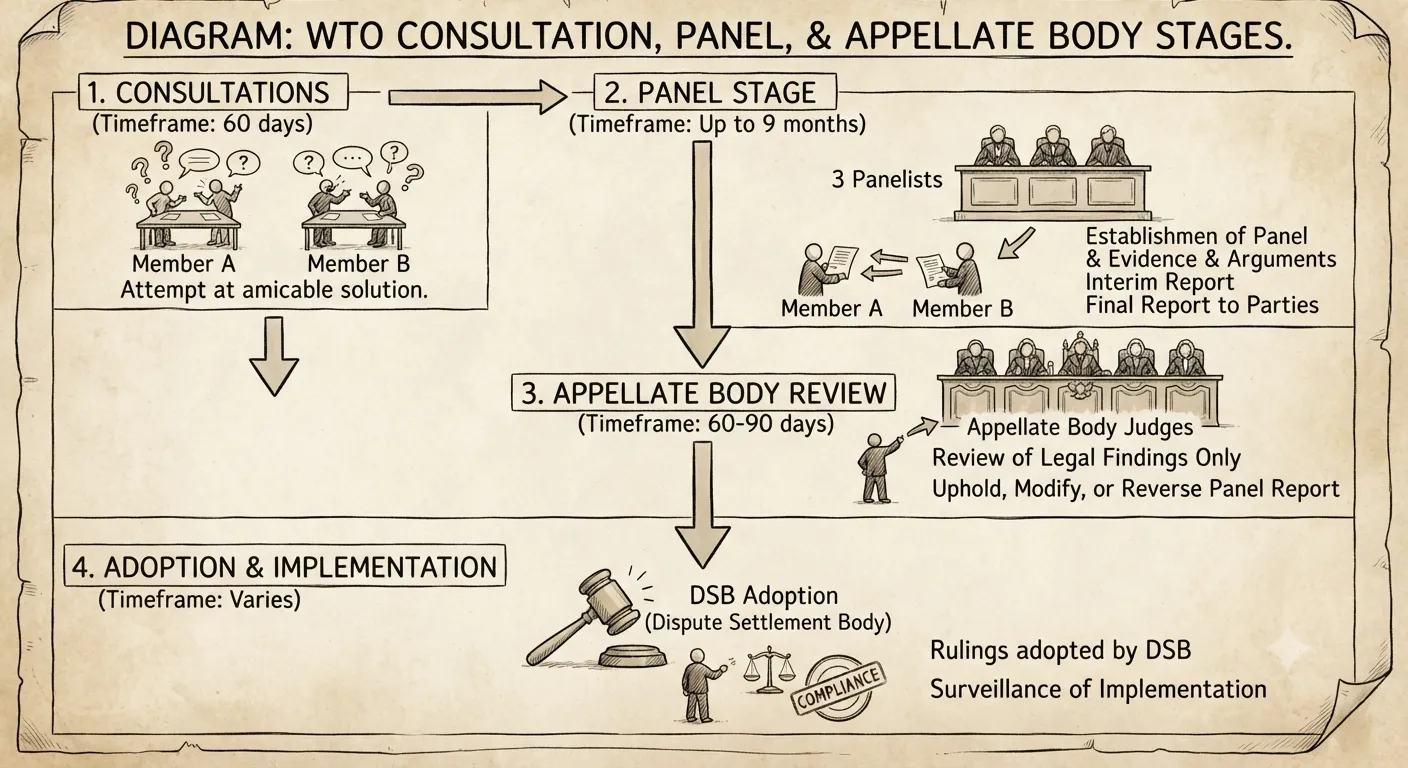
Initial Consultation and Formation of Panel under WTO DSU
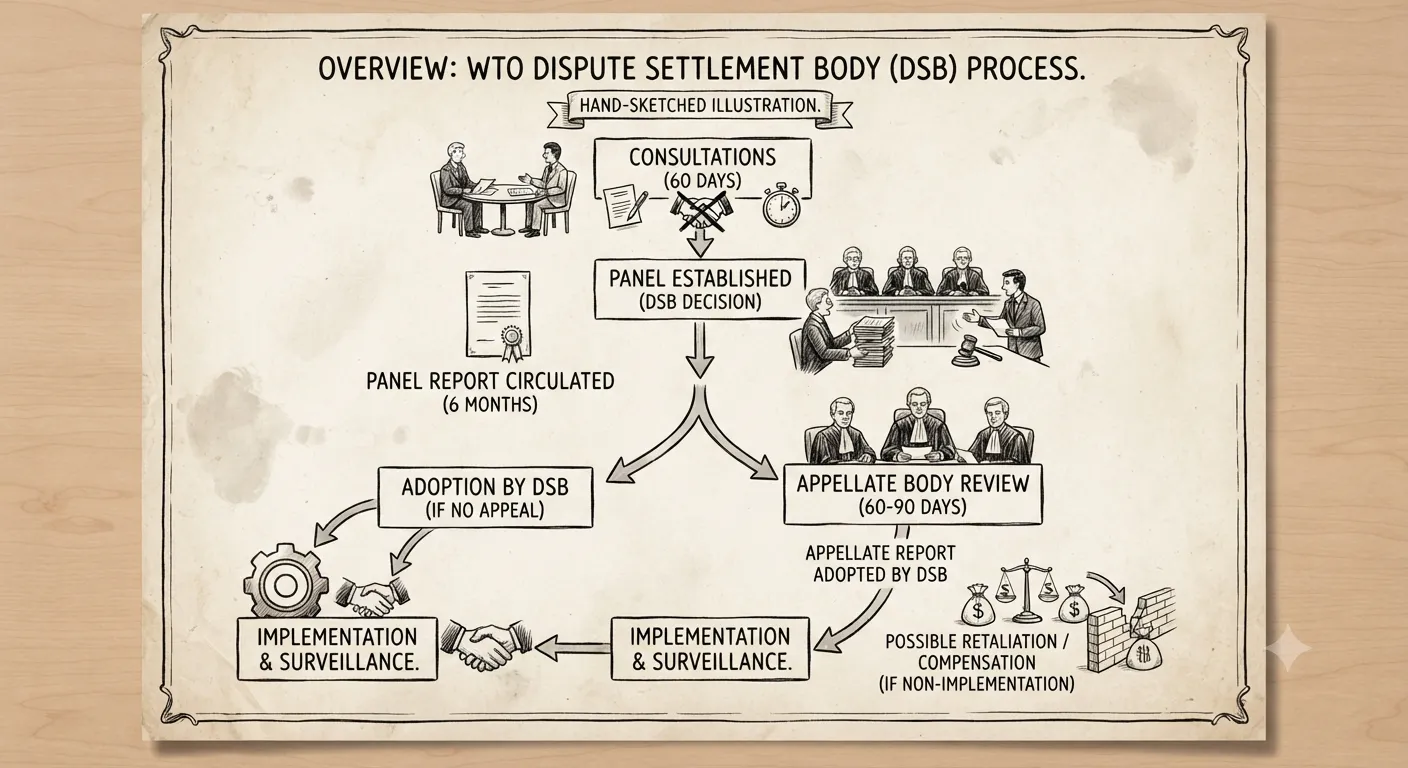
Before rushing into full-scale legal battles, the WTO framework insists that countries sit down at the negotiating table to try and find a diplomatic shortcut.
Mandatory Consultation Phase before Litigation
The injured nation must kick off proceedings by asking for a formal consultation with the defending country. This stage gives both sides a chance to look at the facts and settle things quietly without escalating into a massive legal showdown.
- (i) Both nations have a maximum of to talk things through.
- (ii) The main objective is to agree on a voluntary fix that satisfies both sides.
- (iii) If these talks collapse, the complaining country can finally move forward with formal litigation.
Panel Establishment Stage under the DSB
If diplomacy fails, the complainant can ask the Dispute Settlement Body (DSB) to put together an official panel of experts to review the legal arguments.
- (a) The DSB is required to set up this panel no later than its second official meeting following the request.
- (b) These panels are typically made up of three well-qualified, independent trade professionals.
- (c) The team must examine the arguments and hand in its final report within a window.
Appellate Review and Adoption of the Panel/AB Report
If either nation believes the panel got the law wrong, they have the right to take the case up to the permanent Appellate Body (AB), where independent legal experts review the rulings.
- [Appeal Review]: The Appellate Body is built to look over the legal details and submit its final report within .
- [Adoption Rule]: The DSB automatically adopts the report unless there is a total negative consensus. This means every single member nation would have to vote against it to stop it—a rule that makes rejection almost impossible.
- [Effect]: This unique voting mechanism ensures that panel and appellate reports are accepted and applied as standard practice.
Implementation of Recommendations and Retaliatory Rights
Winning a case at the WTO is only half the battle. Once the DSB adopts a report and rules against a trade policy, the losing country must fix its rules within a clear timeline, or face serious economic consequences.
- Enforcement Windows and Legal Trade Backlash
The defending country must tell the DSB exactly how it plans to fix its policies. If they drag their feet or try to compromise without fixing the core issue, the system shifts from cooperative problem-solving to legal economic retaliation.
Implementation Time Frames under DSU
The losing nation has to lay out its plan and timeline for compliance, and if the timeline looks unreasonable, the case goes to an independent arbitrator.
- (i) If there is an argument over how much time is fair, an arbitrator must be brought in within to settle it.
- (ii) This arbitration step stops countries from manufacturing endless delays.
- (iii) According to standard DSU guidelines, the absolute maximum window for full compliance should not go past .
Retaliation Measures for Non-Compliance
If a nation refuses to alter its illegal policies or simply ignores the deadline, the complaining country can ask the DSB for permission to use retaliatory measures to level the playing field.
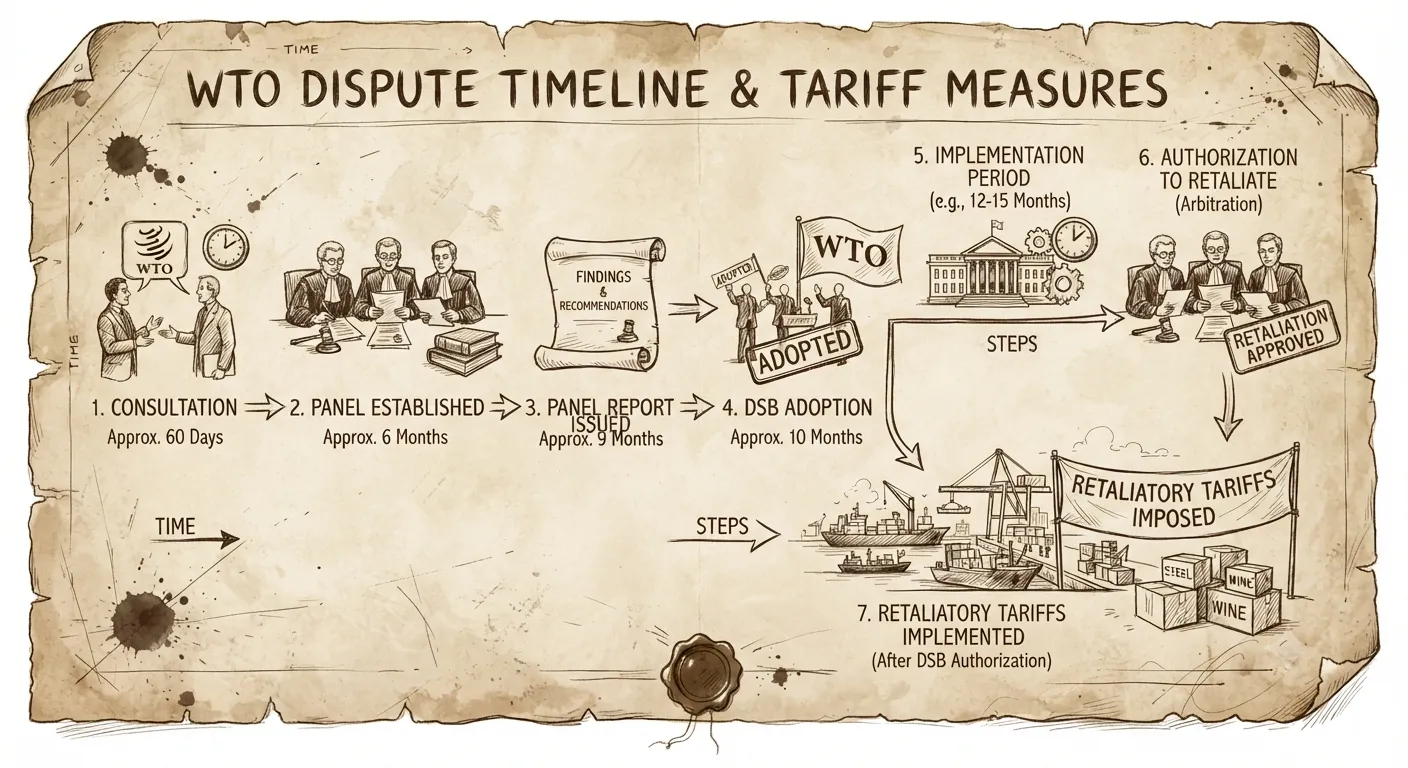
Compliance Monitoring and Retaliation Mechanisms - Retaliatory Tariffs: The most common way to retaliate is by hiking customs tariffs on specific imports coming from the non-compliant country.
- Compensatory Focus: These measures are never meant to be a punishment; they are strictly compensatory to recover lost trade value.
- Duration: The retaliatory tariffs stay in place until the losing country brings its laws into full compliance.
⚡ Quick Revision Capsule: WTO Dispute Settlement Timeline
This capsule summarizes the core stages, time windows, and procedural rules governing disputes under the DSU.
| Dispute Phase | Time Limit / Threshold | Key Operational Rule |
|---|---|---|
| Mandatory Consultations | Up to | Direct negotiations between parties to seek a mutual agreement before litigation. |
| Panel Examination | Standard | Three independent experts review arguments and issue a formal legal report. |
| Appellate Review | Up to | Legal review by the Appellate Body (currently replaced by interim mechanisms like MPIA). |
| DSB Report Adoption | Automatic within | Adopted automatically unless stopped by a universal negative consensus. |
| Compliance Window | Maximum | Losing nation must alter laws; failure opens the path to authorised retaliatory tariffs. |
📝 Summary
The WTO dispute settlement system under the DSU creates a reliable, rule-based environment that keeps global trade predictable and prevents powerful nations from breaking their promises. Its time-bound consultative, panel, appellate and compliance structure serves as a primary pillar of international economic governance. For anyone studying global markets and economic policy, tracking this process shows exactly how member states defuse trade wars and settle heavy disputes without tearing down the global trading system.
🚀 Quick Revision Points
Essential facts to review before examinations:
- (i) The process always starts with a mandatory consultation phase lasting up to to try and settle things out of court.
- (ii) Panels are typically made up of three independent experts who must submit their main report within .
- (iii) The Appellate Body has a window to review legal points, and its findings are adopted automatically unless stopped by a near-impossible negative consensus.
- (iv) Losing nations have a maximum recommended compliance window of before facing compensatory retaliatory tariffs.
- 💡 Exam Tip: Remember that WTO panel and appellate reports are adopted under the principle of negative consensus—meaning a report is automatically accepted unless all WTO members unanimously vote to reject it.
❓ Frequently Asked Questions (FAQ)
Q1: What happens if a country ignores a WTO ruling?
A1: If a country misses its compliance window (which should ideally not exceed ), the winning country can seek DSB approval to impose retaliatory measures, such as raising tariffs on goods imported from the non-compliant nation.Q2: How long does the entire dispute settlement process take from start to finish?
A2: Without an appeal, the process from initial consultation to the panel report adoption takes about . If a party files an appeal, the timeline expands closer to .Q3: What is the rule of "negative consensus" in the DSB?
A3: It is a rule where a report is automatically adopted unless every single member nation votes to reject it. This ensures that a losing country cannot block a ruling against itself on its own.