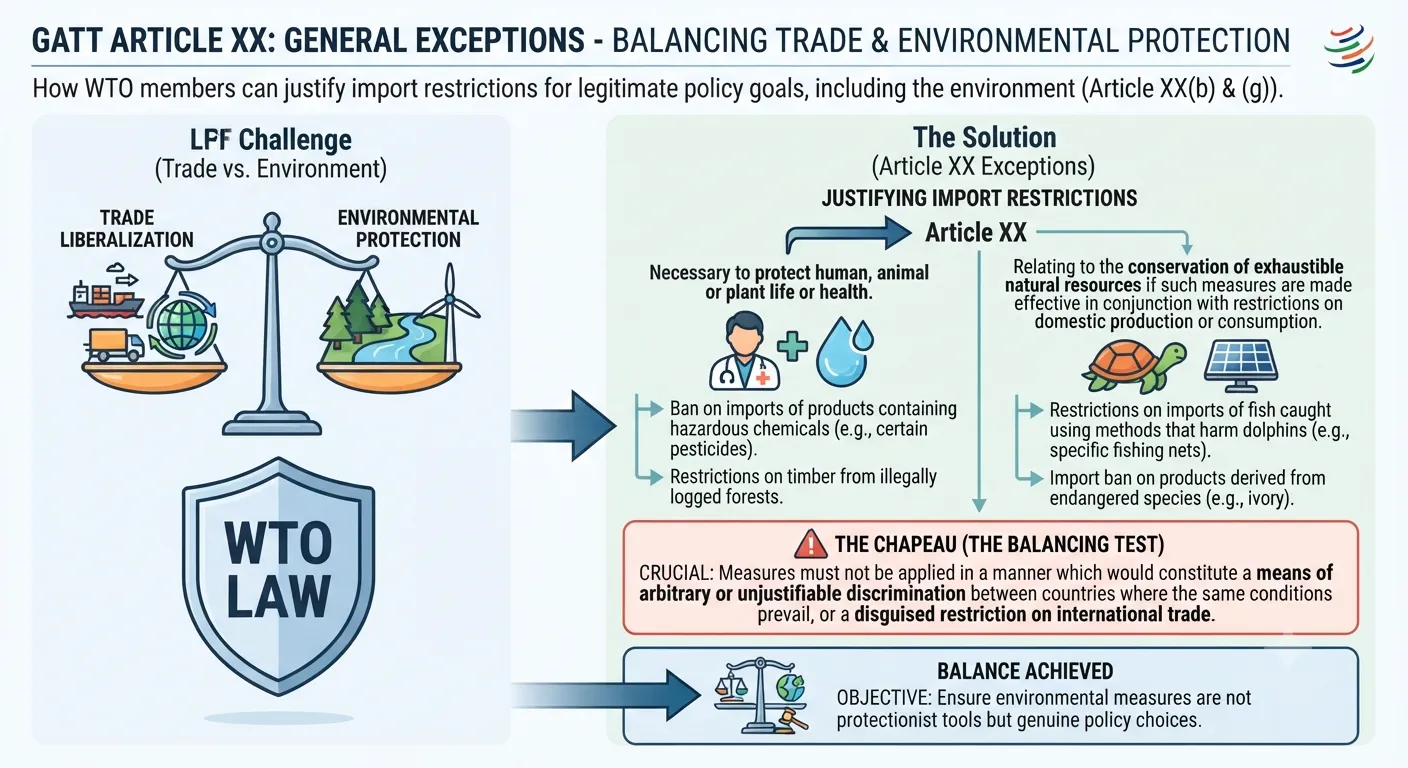
When studying international trade, it is easy to assume that global rules are entirely focused on keeping markets wide open. However, Article XX of GATT 1994 steps in as a vital safety valve, laying down import restrictions under general exceptions. This framework ensures that countries can legally restrict imports when higher values like public morals, human health, animal safety, or environmental protection are at stake. Striking a fair balance between open commerce and domestic safety is a core topic for students preparing for international trade exams.
🎯 In this chapter, you will understand:
- The legal grounds for general exceptions under GATT 1994Article XX.
- How the TBT and SPS agreements prevent trade abuse.
- How environmental regulations can act as non-tariff barriers (NTBs).
- Key revision takeaways for international trade examinations.
💡 Why this topic matters: It explains how countries legally protect health, safety, and nature without violating global trade commitments.
🧠 Core Idea: Global trade agreements allow import bans, but only if they protect real public interests rather than unfair domestic industry.
📌 GATT Article XX: Import Restrictions for Environmental, Health, and Public Protection ()
This critical article serves as a legal shield, giving member states the authority to pause or completely halt certain incoming goods to defend public welfare and safety.
Key Areas of National Interest Covered by General Exceptions
The rules recognize that some domestic priorities matter far more than frictionless trade. Under this clause, governments can step in to halt shipments for very specific reasons:
- (i) They can block trade to protect public morals, giving them the legal ground to ban items like indecent books or magazines.
- (ii) They can stop imports to protect the life and health of humans, animals, and plants, which is common when dealing with unsafe or poorly packaged food articles.
- (iii) They can enforce rules tied directly to environmental protection, targeting items that risk polluting air and water or depleting scarce natural resources.
📌 Agreement on Technical Barriers to Trade (TBT) and Sanitary & Phytosanitary (SPS) Measures
Because these exceptions could easily be abused, the WTO uses side agreements to make sure countries do not disguise simple protectionism as a health or environmental rule.
Formulation and Pre-eminence of International Standards
To keep things fair, the TBT and SPS frameworks lean heavily on the adoption of international standards. If a nation decides to craft its own unique local rules instead, it must stand ready to justify them, proving they do not form unnecessary obstacles to global trade.
- (i) Governments are required to provide prior notification before launching any new technical standards or health measures.
- (ii) Trading partners must be granted a fair opportunity to comment on these upcoming rules.
- (iii) The domestic regulatory body must carefully consider those foreign inputs before finalizing their legal implementation.
📌 Environmental Protection and Non-Tariff Barriers
While the core purpose of these clauses is genuine environmental protection, the reality on the ground can be a bit more complicated. Many developed countries use these measures frequently and loosely, raising concerns that they are tilting the playing field.
Core Takeaways of Article XX Provisions
At its heart, Article XX tries to perform a delicate balancing act. It champions trade liberalization on one side while firmly protecting human, animal, plant life, and ecosystems on the other.
- Protection of public morals: Legally banning goods that collide with local cultural or moral sensitivities.
- Health and life protection: Enforcing strict entry controls on harmful, contaminated, or unsafe imports.
- Environmental preservation: Locking down trade pathways that threaten natural resource pools or degrade vital ecosystems.
- Impact on trade flows: Local regulations often act as hidden non-tariff barriers (NTBs) that shift international trade under environmental covers.
⚡ Quick Revision Capsule: GATT Article XX Provisions
Reviewing the core regulatory provisions highlights the legal mechanisms of trade exceptions.
| Provision Type | Core Objective / Requirement | Key Regulatory Focus |
|---|---|---|
| Public Morals Exception | Allows direct bans on socially sensitive or indecent materials. | Cultural and societal values |
| Life & Health Protection | Covers restrictions on unsafe food articles or poorly packaged biological goods. | Human, animal, and plant safety |
| Environmental Protection | Prevents trade that depletes natural resources or pollutes air and water. | Ecosystem and resource preservation |
| TBT & SPS Agreements | Enforce prior notification, comment periods, and justification of domestic standards. | Preventing non-tariff barriers |
| Legal Scope () | Governed under GATT 1994 general exception clauses. | Balanced trade liberalization |
📝 Summary
Ultimately, Article XX of GATT 1994 ensures that international trade does not come at the cost of domestic safety. By setting clear exceptions for public morals, environmental protection, and health safety, it forces a healthy compromise between trade freedom and responsible regulatory measures—a fundamental dynamic that students must grasp for international trade exams.
🚀 Quick Revision Points
Essential facts to review before examinations:
- (i) Article XX exceptions protect vital national interests without fully derailing trade freedom.
- (ii) Countries can craft custom rules but must prove they do not create unnecessary obstacles.
- (iii) Strict technical rules in developed nations can sometimes function as non-tariff barriers (NTBs).
- (iv) Transparent notifications and shared comment opportunities keep the process fair for all global trading partners.
- 💡 Exam Tip: Focus on how TBT and SPS agreements require non-discriminatory application and scientific proof so that environmental laws do not become disguised protectionism.
❓ Frequently Asked Questions (FAQ)
Q1: How can a country justify import restrictions under GATT Article XX?
A1: A country must show that its restrictions are aimed directly at protecting public morals, human, animal, or plant life, or conserving natural resources, and are not just arbitrary or hidden barriers to trade.Q2: What role do the TBT and SPS agreements play alongside Article XX?
A2: They provide the operational rules. They encourage the adoption of international standards and require countries to notify others and justify any unique domestic standards to prevent unfair trade blocks.Q3: Why are some environmental import restrictions criticized as non-tariff barriers?
A3: Because some developed nations apply these technical and environmental requirements very loosely or strictly, which can end up shutting out foreign products for protectionist reasons rather than genuine safety concerns.