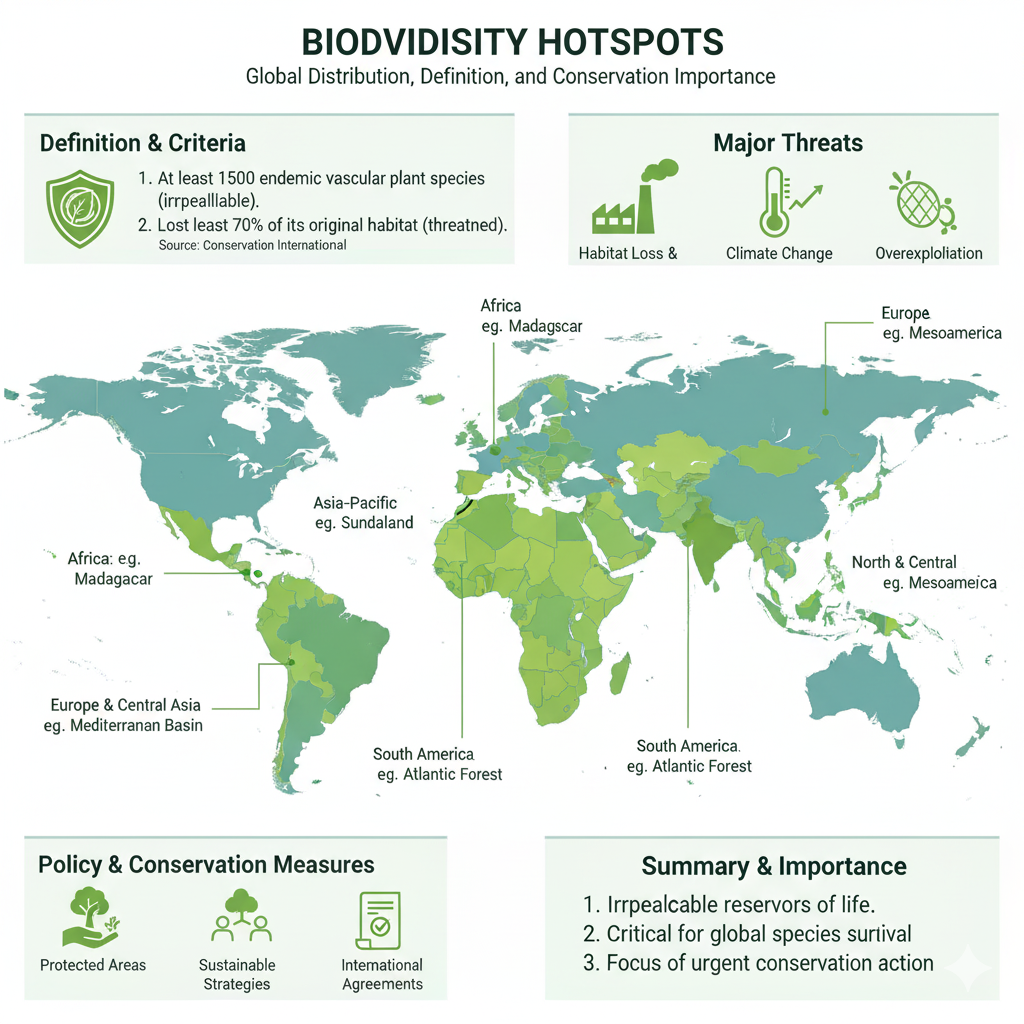
Biodiversity hotspots are regions of the world with exceptionally high species richness and endemism, yet facing severe ecological threats due to human activities. Identified initially by Norman Myers in 1988, these hotspots are crucial for global ecological balance and serve as key areas for environmental studies and geography students. Understanding their distribution, criteria, and conservation importance is essential for both academic preparation and sustainable policy planning.
Biodiversity Hotspots: Global Distribution, Definition, and Conservation Importance
The layout of global environmental priorities shifts significantly when analyzing specific regions that harbor concentrated biological wealth. Biodiversity hotspots represent ecologically rich areas with unique flora and fauna, often holding species that are not found anywhere else on the planet. By mapping out these zones, international bodies can effectively prioritize conservation efforts and enforce strategic ecological management. These regions are biologically irreplaceable and play a critical role in maintaining global biodiversity, enhancing ecological resilience, and securing essential ecosystem services.
- Core Significance of Global Ecological Vaults
The value of safeguarding these particular zones stretches far beyond basic environmental preservation. They serve as primary centers for sustaining life forms that are highly vulnerable to localized extinctions, rendering them indispensable to the global ecosystem structure.
- (i) Ecological Importance: They provide safe habitats for endemic species, sustain general ecological balance, and support crucial ecosystem services like pollination, carbon sequestration, and natural water regulation.
- (ii) Threat Sensitivity: These areas are highly vulnerable to accelerated deforestation, rapid urbanization, changing global temperatures, and other intense anthropogenic pressures.
- (iii) Academic Relevance: They stand out as key focus areas for students preparing for geography, environmental science, and competitive biodiversity conservation examinations.
Origin and Definition of Biodiversity Hotspots
The foundational concept behind establishing biodiversity hotspots emerged from an urgent need to isolate and protect critical areas requiring direct conservation attention due to their unprecedented endemism levels and escalating threats.
Definition and Historical Background
The formal term biodiversity hotspot was first introduced by British ecologist Norman Myers in the year 1988. These specified areas are structurally categorized by their outstanding species richness, particularly regarding endemic species, along with simultaneous, severe ecological vulnerability.
- (i) Endemism Concept: This refers directly to unique species that are completely restricted to specific geographic areas, making them heavily dependent on highly distinct local ecosystem conditions.
- (ii) Habitat Vulnerability: These spaces display an alarming susceptibility to rapid forest loss, advanced habitat fragmentation, and continuous human encroachment.
- (iii) Scientific Relevance: The framework supplies an empirical baseline used by international bodies to establish conservation priorities and coordinate global ecological research.
Criteria for Declaring a Biodiversity Hotspot
Not every region displaying rich biodiversity can be designated as a hotspot. Strict parameters are actively implemented to ensure global conservation funds and efforts remain sharply focused on areas facing the highest risk.
Conservation International Criteria
According to the standards set by Conservation International, a territory must satisfy two stringent conditions to be formally designated as a global biodiversity hotspot. These dual benchmarks ensure both high biological worth and immediate protective urgency.
- (i) Minimum 1,500 endemic vascular plant species: This standard confirms the absolute uniqueness and irreplaceable nature of the region's plant life, ensuring it holds a critical share of global flora.
- (ii) Loss of at least 70% of original habitat: This parameter highlights the extreme level of environmental degradation present, indicating that the zone has been heavily stripped of its primary native vegetation.
Global Distribution of Biodiversity Hotspots
Across the globe, exactly 36 biodiversity hotspots have been formally recognized. These sites span multiple continents and island networks, grouped strictly by their species richness, unique endemism profiles, and high threat factors.
Regional Highlights
These specific regions act as the world's premier ecological treasure chests, sustaining hundreds of endangered life forms. Their distribution across major geographic zones reveals distinct regional patterns:
- (i) Africa: Hosts 8 distinct hotspots, including the highly unique Cape Floristic Region and Madagascar, both containing life forms found nowhere else on earth.
- (ii) Asia-Pacific: Contains 13 hotspots that sweep across the Himalayas down to New Zealand, blending continental terrains with complex island ecosystems like the Western Ghats and Sri Lanka or Sundaland.
- (iii) Europe and Central Asia: Includes 4 hotspots, highlighted by the vast Mediterranean Basin and the Caucasus, showcasing diverse temperate biomes.
- (iv) North and Central America: Houses 6 hotspots ranging from the California Floristic Province to Mesoamerica, merging tropical zones with temperate forests.
- (v) South America: Anchored by 5 major hotspots, featuring the ultra-diverse Tropical Andes and the highly fragmented Atlantic Forest, both celebrated for unmatched biological variety.
Threats and Need for Policy Action in Hotspot Areas
Unregulated human advancement remains the single greatest danger threatening the survival of these ecological reserves. Constructing robust legal frameworks and active policy interventions is vital to secure their long-term preservation.
Major Threats to Biodiversity Hotspots
Accelerated population growth, heavy deforestation, rapid urban expansion, intensive mining, and unsustainable agricultural practices function as the core drivers pushing these vulnerable biomes toward collapse.
- (i) Habitat Destruction: The direct, permanent conversion of pristine forests and ancestral wetlands into commercial farming lands or urban landscapes.
- (ii) Overexploitation: Destructive practices including illegal poaching, commercial logging, and the unsustainable harvesting of sensitive wild plant and animal species.
- (iii) Climate Change: The steady alteration of localized climate patterns, which triggers massive ecosystem imbalances and forces species out of their historical ranges.
Policy and Conservation Measures
Implementing stringent environmental policies and fostering deep community involvement are both mandatory requirements to reverse degradation inside designated hotspots.
- (a) Mandating extensive Environmental Impact Assessments prior to sanctioning any major industrial or developmental projects.
- (b) Erecting clear legal frameworks designed for uncompromising forest conservation and wildlife protection.
- (c) Crafting community-driven conservation initiatives that directly raise public awareness and encourage native participation.
Sustainable Conservation Strategies
Finding a stable balance between economic development and environmental protection is vital. Long-term sustainability preserves essential ecological, economic, and social frameworks for future generations.
- Protected Areas: Setting up well-managed national parks, secure wildlife sanctuaries, and wide-reaching biosphere reserves.
- Ecotourism: Generating sustainable economic rewards for local populations while actively shielding the native wilderness from harm.
- Research and Monitoring: Maintaining continuous scientific observations of local population shifts to deploy flexible, adaptive ecosystem management plans.
Table of Global Biodiversity Hotspots
The complete list of the 36 globally recognized biodiversity hotspots is organized systematically below by their respective continental domains:
Continental Region Designated Biodiversity Hotspots Africa Cape Floristic Region; Coastal Forests of East Africa; Eastern Afro-montane; Guinean Forests of West Africa; Horn of Africa; Madagascar and Indian Ocean Islands; Maputaland-Pondoland-Albany; Succulent Karoo. Asia-Pacific East Melanesian Islands; Himalaya; Indo-Burma; Japan; Mountains of Southwest China; New Caledonia; New Zealand; Philippines; Polynesia-Micronesia; Southwest Australia; Sundaland; Wallacea; Western Ghats and Sri Lanka. Europe & Central Asia Caucasus Region; Irano-Anatolian; Mediterranean Basin; Mountains of Central Asia. North & Central America California Floristic Province; Caribbean Islands; Madrean Pine-Oak Woodlands; Mesoamerica; North American Coastal Plain. South America Atlantic Forest; Cerrado (Brazil); Chilean Winter Rainfall-Valdivian Forests; Tropical Andes; Tumbes-Choco-Magdalena. Summary
Biodiversity hotspots are globally critical for ecological balance, serving as primary reservoirs of endemic species and providing essential ecosystem services. Their long-term protection relies heavily on a firm understanding of their historical definitions, global distribution patterns, and immediate threats. For students of geography and environmental studies, mastering these regions is highly valuable for exam performance and academic research. Enforcing sustainable conservation practices, timely policy interventions, and broad public awareness remain the core pillars for securing their future survival.
Quick Revision Points for Students
Reviewing the core empirical and geographical facts ensures full retention for examinations.
- (i) The global framework currently recognizes exactly 36 hotspots scattered across distinct environmental zones.
- (ii) To qualify, a region must preserve at least 1,500 endemic vascular plant species as a sign of its absolute uniqueness.
- (iii) The territory must have suffered an alarming habitat loss of 70% or more from its historical baseline.
- (iv) The Asia-Pacific region holds the highest count with 13 hotspots, closely followed by Africa with 8 hotspots.
Frequently Asked Questions (FAQ)
Q1: Who originally established the concept of biodiversity hotspots?
A1: The framework was first conceptualized by British ecologist Norman Myers in the year 1988 to prioritize high-risk biological regions.Q2: What organization handles the modern classification and management of these hotspots?
A2: Modern monitoring, assessment, and formal updates are managed primarily by Conservation International based on empirical scientific criteria.Q3: Which hotspot counts as part of the Indian territory?
A3: India features prominent representations across major zones, including the entire Himalaya hotspot, the Western Ghats and Sri Lanka network, parts of Indo-Burma, and the Nicobar Islands within the Sundaland system.