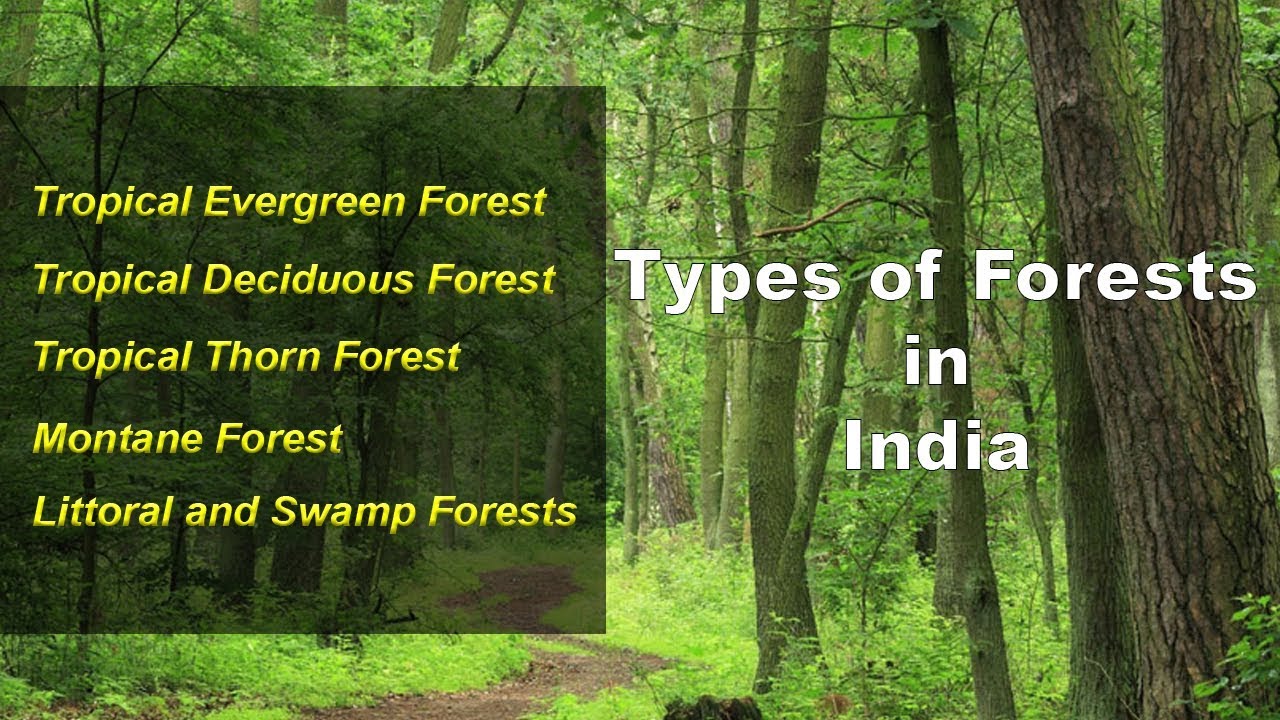
Forests are large areas filled with trees, plants, and wild animals, serving as the green lungs of our planet Earth. In India, rich environmental variety creates many types of plant habitats ranging from warm coastal shores to icy high mountain peaks. Understanding these different green zones helps us protect wild animals, keep local weather balanced, and manage valuable natural resources wisely. Detailed monitoring tools like the India State of Forest Report track overall forest growth and environmental health across every state, ensuring scientists and citizens work together for a healthier, greener future.
🎯 In this chapter, you will understand:
- How different forest types exist across India based on rainfall, soil, and mountain height.
- The special survival features of trees in dry lands, coastal swamps, and icy mountain areas.
- Key protection rules, government projects, and local community efforts that keep Indian forests safe.
- Important facts and figures published in India's State of Forest Report 2021.
💡 Why this topic matters: Forests provide clean air, clean water, natural homes for animals, and protection against floods and global climate change.
🧠 Core Idea: Plant distribution changes dynamically with rainfall and altitude, creating distinct ecosystems that require tailored protection and community management.
Semi-Evergreen Forests: Transition Zones and Diverse Species
Semi-evergreen forests are dynamic green zones that act as a middle transition path between very wet evergreen forests and drier tree lands. These natural areas usually grow in places that get slightly less yearly rainfall than moist evergreen woods, creating a comfortable home for many different kinds of plants and animals.
Inside these forests, you will find a mixed blend of evergreen trees (trees that stay green all year long) and deciduous trees (trees that drop their leaves during dry times of the year). Because some trees shed their leaves while others stay leafy and green, the forest canopy stays partially shaded throughout the entire year. Important regions where these green zones thrive include parts of the Western Ghats mountain range, the coastal Andaman and Nicobar Islands, and the lush Eastern Himalayas.
- Location Regions: Predominantly observed in regions with less rainfall compared to moist evergreen forests, including parts of the Western Ghats, Andaman and Nicobar Islands, and the Eastern Himalayas.
- Forest Characteristics: A natural mix of evergreen and deciduous trees, where some trees shed leaves during the dry season while others remain green.
- Main Tree Species: Prominent plant species include White cedar, hollock, and kail.
Dry Evergreen Forests: Aromatic Plants and Broadleaf Trees
Dry evergreen forests are tough, resilient plant communities that remain green even when rainfall is low. Unlike moist tropical forests, these natural areas experience warm weather and long dry seasons, yet the trees do not shed their leaves. Instead, their shiny, thick leaves help them hold onto precious water drops.
These forests are filled with broadleaf trees and sweet-smelling plants known as aromatic plants. You can spot these unique habitats running along the Shivalik Hills, the lower Himalayan foothills, and along the eastern coastal regions of Andhra Pradesh and Karnataka. The hard leaves and strong scents help protect these plants from intense sunlight and grazing wild animals.

- Location Regions: Occurs along the Shivalik Hills, Himalayan foothills, and coastal areas of Andhra Pradesh and Karnataka.
- Forest Characteristics: Experience warm and dry seasons, dominated by broadleaf evergreen trees along with fragrant aromatic plants.
- Main Plant Species: Characteristic species include Pomegranate, Olive, and Oleander.
Tropical Deciduous Forests (Monsoon Forests): Moist and Dry Variations
Tropical deciduous forests, often called Monsoon Forests, are the most widespread and common type of forest found across India. These trees have a clear yearly rhythm: they drop their green leaves during the dry summer months to save water, and then burst back into bright life as soon as heavy monsoon rains start falling.
Because rainfall amounts differ across the country, scientists divide these monsoon woods into two main groups: Moist Deciduous Forests in areas with higher rainfall, and Dry Deciduous Forests in drier inland zones.
Moist Deciduous Forests
These woodlands grow in areas that receive generous monsoon rainfall, creating tall, impressive tree stands with broad, strong trunks. During dry spells, the trees shed their leaves to conserve moisture. They supply very valuable timber wood used for building homes and crafting sturdy furniture.
- (i) Location Regions: Predominantly found in the North Eastern states, Eastern Himalayas, and the state of Odisha.
- (ii) Forest Characteristics: Trees drop leaves during dry seasons and feature tall, dense growth with wide trunks.
- (iii) Main Tree Species: Highly valuable species include Teak, Sal, Shisham, and fragrant Sandalwood.
Dry Deciduous Forests
Dry deciduous forests grow across large areas with moderate to low rainfall. When the hot dry season arrives, every tree drops its leaves completely. Without green leaves, the forest ground looks wide open and grassy, resembling an open grassland until monsoon rains return.
- (i) Location Regions: Spread across the northern part of the country (except the far northeast), as well as central and southern states like Madhya Pradesh, Gujarat, Andhra Pradesh, Karnataka, and Tamil Nadu.
- (ii) Forest Characteristics: Trees lose leaves completely in dry periods, giving the landscape an open, grassland-like appearance.
- (iii) Main Tree Species: Commonly includes Tendu, Palas, golden-flowered Amaltas, and Khair.
Thorn Forests: Arid Regions and Xerophytic Vegetation
Thorn forests are specialized natural communities built for survival in dry, desert-like places. Plants growing here are known as xerophytic vegetation, meaning they have evolved special survival tools like deep water-seeking roots, thick waxy stems, and sharp thorns instead of big flat leaves to survive with very little water.
These prickly woodlands grow in dry places that receive less than of rain each year. They are spread across rich black soils and dry plains in northern, western, central, and southern India. Trees here stay short and bushy, rarely growing higher than tall.
- Rainfall Threshold: Typically found in dry regions receiving less than of annual rainfall.
- Location Regions: Occur in areas with rich black soil across North, West, Central, and South India, including semi-arid parts of southwest Punjab, Haryana, Rajasthan, Gujarat, Madhya Pradesh, and Uttar Pradesh.
- Vegetation Growth: Composed of hardy wild grasses and bushy shrubs; trees remain low, not growing beyond in height.
- Common Plant Species: Typical thorny species include Babul, Acacia, Kokko, and medicinal Neem.
Montane Forests: Altitudinal Variations and Diverse Flora
Montane forests are high-mountain woods that change dramatically as you climb higher up a mountain slope. As altitude increases, the air temperature drops cooler and cooler, causing the types of trees and wild plants to shift in distinct bands from foothill woods up to cold mountain pastures.
From subtropical pine trees on lower slopes to dense evergreen forests and high cold alpine meadows near snow lines, mountain forests host an amazing collection of plant life across different elevation heights.
Montane Wet Temperate Forests
These dense, cool forests grow in elevated mountain regions in both northern and southern parts of the country. Northern areas feature thicker forest cover filled with colorful flowering trees and lush green ground cover.
- (i) Location Regions: Found in high mountain areas of northern and southern India, with thicker forest stands in the north.
- (ii) Vegetation Types: Highly diverse plant life, featuring bright Rhododendrons, fragrant Champa, and rich green ground shrubs.
Montane Subtropical Forests
Located along lower mountain slopes, these forests are famous for tall pine trees that thrive in cool, mild weather conditions.
- (i) Location Regions: Situated across the north-western Himalayas, Himachal Pradesh, Uttarakhand, Sikkim, and Arunachal Pradesh.
- (ii) Vegetation Types: Mainly composed of evergreen Chir (Pine) trees, alongside Oak, Jamun, and flowering Rhododendron.
Himalayan Moist Forests
Growing at medium mountain heights, these moist hill woods contain a healthy balance of broadleaf trees and tall cone-bearing needle trees.
- (i) Location Regions: Distributed in mountain areas of Jammu & Kashmir, Himachal Pradesh, Uttarakhand, and northern hilly sections of Bengal.
- (ii) Elevation Range: Thrives at mountain altitudes ranging from above sea level.
- (iii) Vegetation Types: Comprises sturdy Oak, Chestnut, Chir, broadleaf Sal, and diverse ground shrubs and grasses.
Himalayan Dry Temperate Forests
Found in inner mountain valleys that receive light rain but heavy winter snow, these cold forests host valuable cone-bearing trees and nut trees.
- (i) Location Regions: Predominantly found in cold dry valleys of Jammu & Kashmir, Chamba, Lahaul & Kinnaur districts in Himachal Pradesh, and high parts of Sikkim.
- (ii) Vegetation Types: Mainly needle-leaf coniferous trees like Deodar, Oak, nut-bearing Chilgoza, and Maple, along with wild Olive, Mulberry, and Willow.
Alpine and Subalpine Forests
These are the highest forest zones on earth, standing just below cold snow-covered mountain peaks. Trees here grow low to the ground to survive chilly winds and heavy snowstorms.
- (i) Elevation Range: Alpine forests grow between high heights of , while subalpine woods stretch from Kashmir to Arunachal Pradesh at elevations between .
- (ii) Vegetation Types: Western Himalayan zones host hardy Juniper, Rhododendron, Willow, and wild Black Currant; eastern zones feature tall Red Fir, Black Juniper, paper-barked Birch, and Larch.
Littoral/Swamp Forests: Coastal Ecosystems and Unique Adaptations
Littoral and swamp forests are wet, watery ecosystems situated along sea coasts, marshlands, and wide river deltas. Plants growing in these wet soils are exposed constantly to tides and brackish water (a mix of fresh river water and salty ocean water).
Because wet mud has very little air, trees here develop unique survival tools, like breathing roots that stick out above wet mud and thick salt-filtering bark. These thick coastal green belts are located around the Andaman and Nicobar Islands and across major river deltas such as the Ganga, Brahmaputra, Mahanadi, Godavari, and Krishna rivers.
- Geographic Location: Situated along the island shores of the Andaman and Nicobar Islands, the massive delta regions of the Ganga and Brahmaputra rivers, and major southern deltas like the Mahanadi, Godavari, and Krishna.
- Vegetation Characteristics: Dense, tightly packed, and nearly impenetrable forests with specialized plant varieties including water-tolerant Mangroves, sturdy Whistling Pines, and tough Bullet wood.
Mangroves: Coastal Protection and Ecological Importance
Mangroves are extra-special coastal evergreen forests that grow directly inside salty ocean tides and muddy sea shores. These tough trees act as natural green shields that stop big sea waves from washing away coastal land and protect seaside villages from harsh ocean storms.
India hosts a massive share of global mangrove cover. The complex, tangled underwater roots of mangrove trees create safe nursery zones for young fish, crabs, and marine animals, while giving homes to wild land animals like tigers and birds.
- Protective Role of Mangroves: Play a vital protective role by locking shoreline soils together and guarding coastal villages against sea erosion.
- National Extent: Covering over , India’s mangrove forests represent approximately of all the world's mangrove forests.
- Ecological Function: Serve as strong natural wall barriers that cushion coastal areas from severe storms, tsunamis, and high ocean tidal waves, while serving as safe breeding homes for marine wildlife.
Conservation Efforts: Protected Areas and Sustainable Practices
Forest conservation means carefully guarding, caring for, and restoring green woodlands so they stay healthy for future generations. India uses special environmental laws, government reserve areas, and community partnerships to protect wildlife and rebuild degraded forest lands.
Protecting big forest areas involves both strict legal enforcement and friendly community teamwork. By giving local villagers an active voice in managing local trees, conservation programs build long-term care for nature.
- Protected Area Networks: Establishing dedicated National Parks and protective Wildlife Sanctuaries where wild animals and plants live safely without human harm.
- Biosphere Reserves: Large ecological hotspots created to balance strict nature preservation with smart, sustainable local development.
- Tree Planting Initiatives: Active nationwide afforestation (planting new forests) and reforestation (replanting cleared forests) via the National Afforestation Programme () and the Green India Mission ().
- Joint Forest Management: Cooperative partnerships uniting government forest officers with nearby village communities to protect and manage local woods.
- Community-Based Care: Traditional community groups like Van Panchayats directly empower local villagers to make smart decisions for forest protection.
- Tribal and Indigenous Rights: Legally recognizing and respecting traditional land and forest usage rights belonging to tribal communities.
- Policy and Legal Frameworks: Strong protective national laws including the Forest Conservation Act (), Environment Protection Act (), Wildlife (Protection) Act (WPA) (), and the overarching National Forest Policy ().
Threats to Forests: Deforestation and Climate Change
Despite their high value, forest lands across the globe face growing danger from human activities and shifting global weather. When large forest areas are damaged or completely cleared away, wildlife homes disappear, soil washes into rivers, and global temperatures rise faster.
Understanding these serious environmental dangers allows scientists and citizens to create smarter protection plans and stop destructive activities before permanent harm occurs.
- Deforestation: Widespread clearing and cutting down of natural forest lands for farming, housing, and industrial use.
- Illegal Logging and Encroachment: Unauthorized tree cutting for timber wood and illegal occupation of protected forest land.
- Mining and Infrastructure: Large-scale surface mining, road building, and dam construction that break up natural animal habitats.
- Forest Degradation: Unhealthy land usage practices that thin out forest trees and reduce natural plant and animal biodiversity.
- Wild Forest Fires: Destructive accidental or natural blazes that burn thousands of trees and disrupt delicate wildlife cycles.
- Climate Change Impacts: Unpredictable rainfall patterns, warmer temperatures, extreme droughts, and the rapid spread of invasive weed plants.
Conclusion: Biodiversity Preservation and Sustainable Management
India features many unique types of forests, each hosting its own special mixture of plant life, wild animals, and natural habitats. Keeping these green areas healthy is essential for preserving wildlife biodiversity, controlling global climate change, guiding natural rain cycles, and supporting human life on Earth.
Overcoming serious threats to our forests requires dedicated teamwork from government leaders, forest officers, scientists, and local citizens. By sticking to strong conservation rules and practicing smart, sustainable forest management, India can keep its precious green treasures safe and thriving for generations to come.
India's State of Forest Report 2021
The India State of Forest Report 2021 (ISFR 2021) is an official evaluation document prepared every two years by the Forest Survey of India (FSI) under the Union Ministry of Environment, Forest and Climate Change (MoEFCC). It offers accurate mapping data regarding green tree cover, forest growth trends, and environmental protection across India.
The survey used advanced satellite mapping technology to measure dense tree covers, tracking positive gains in central states along with tree cover losses in some eastern mountain zones.
- New Survey Additions: For the first time, satellite mapping focused specifically on Gir Forest, national Tiger Reserves, and protected Tiger Corridors to track wildlife habitat safety.
- Overall Growth in Forest Area:
- (i) Total national forest cover achieved a growth of , bringing total green cover to of India's total geographic land area.
- (ii) Standalone tree cover outside main forests expanded by .
- (iii) The top three state performers showing highest forest cover gains were Telangana, Andhra Pradesh, and Odisha.
- State Rank Performance:
- (i) Telangana led all states with a impressive forest growth, followed by Andhra Pradesh () and Odisha ().
- (ii) The top five states holding the largest total forest area are Madhya Pradesh, Arunachal Pradesh, Chhattisgarh, Odisha, and Maharashtra.
- Mangrove and Bamboo Growth:
- (i) Protected coastal mangrove forests grew by a total of .
- (ii) Total bamboo forest area expanded sharply by around between and .
- (iii) High-density Very Dense Forests expanded by roughly .
- Forest Losses in Northeastern States: Several northeastern hill states saw reduced forest cover due to landslides, heavy rain storms, and human land clearance, including Arunachal Pradesh, Manipur, Meghalaya, Mizoram, and Nagaland.
- Natural Forest Shift: Satellite data showed a drop in natural Moderately Dense Forests paired with a rise in Open Forests and scrub land, indicating that some dense natural woodlands are growing thinner.
⚡ Quick Revision Capsule: Indian Forest Comparison
Use this convenient study matrix to quickly review key rainfall requirements, typical locations, and major plant species across India's primary forest zones.
| Forest Category | Key Regions & Rainfall | Dominant Flora & Features |
|---|---|---|
| Semi-Evergreen | Western Ghats, Eastern Himalayas, Andaman Islands | White cedar, hollock, kail; mixture of evergreen and leafy deciduous trees. |
| Dry Evergreen | Shivalik Hills, Andhra Pradesh & Karnataka coasts | Pomegranate, Olive, Oleander; broadleaf trees with aromatic shrubs. |
| Moist Deciduous | North Eastern states, Odisha, Eastern Himalayas | Teak, Sal, Shisham, Sandalwood; broad trunks, sheds leaves in dry season. |
| Dry Deciduous | Madhya Pradesh, Gujarat, Tamil Nadu, Central plains | Tendu, Palas, Amaltas, Khair; complete leaf loss gives grassland look. |
| Thorn Forests | Arid zones (< rain): Rajasthan, Gujarat, Punjab | Babul, Acacia, Neem; short thorny trees under with deep roots. |
| Montane Zones | Himalayas, Nilgiris ( elevation) | Chir Pine, Deodar, Oak, Rhododendron, Juniper; shifts with mountain height. |
| Mangroves & Swamps | Delta shores of Ganga, Mahanadi, Godavari, Andamans | Mangroves, Whistling Pines; salt-tolerant breathing roots protecting coastlines. |
📝 Summary
India presents a rich tapestry of forest types conditioned by climate, rainfall, and elevation. From coastal Mangroves protecting river deltas to cold Alpine mountain scrub in the high Himalayas, every ecosystem supports vital natural balances. Key policies like the Forest Conservation Act () and local programs such as Van Panchayats work alongside regular satellite tracking in the India State of Forest Report () to protect total forest cover, which currently stands at of the nation's total land area.
🚀 Quick Revision Points
Essential facts to review before examinations:
- (i) Tropical Deciduous Forests are India's most widespread forest type, dropping leaves during dry months.
- (ii) Thorn Forests thrive in dry areas receiving less than of annual rainfall using spiked leaves and deep roots.
- (iii) India holds around of world mangrove cover (over ), offering crucial storm buffers.
- (iv) According to the ISFR 2021, Telangana registered the highest forest growth rate ().
- 💡 Exam Tip: Remember that Montane forests change by elevation height, while Deciduous forests are categorized by yearly rainfall amounts!
❓ Frequently Asked Questions (FAQ)
Q1: What is the main difference between moist and dry deciduous forests?
A1: Moist deciduous forests grow in areas with higher rainfall and feature tall trees like Teak and Sal, whereas dry deciduous forests grow in drier zones where full leaf loss makes the forest look like an open grassland in summer.Q2: Why are mangrove forests ecologically important for coastal areas?
A2: Mangroves anchor shoreline mud, protect coastal villages against severe ocean waves and storms, and serve as safe breeding grounds for marine life.Q3: What were the key findings of India's State of Forest Report 2021?
A3: The ISFR 2021 reported that India's total forest cover rose to , with Telangana leading forest growth and Madhya Pradesh holding the largest overall forest land area.