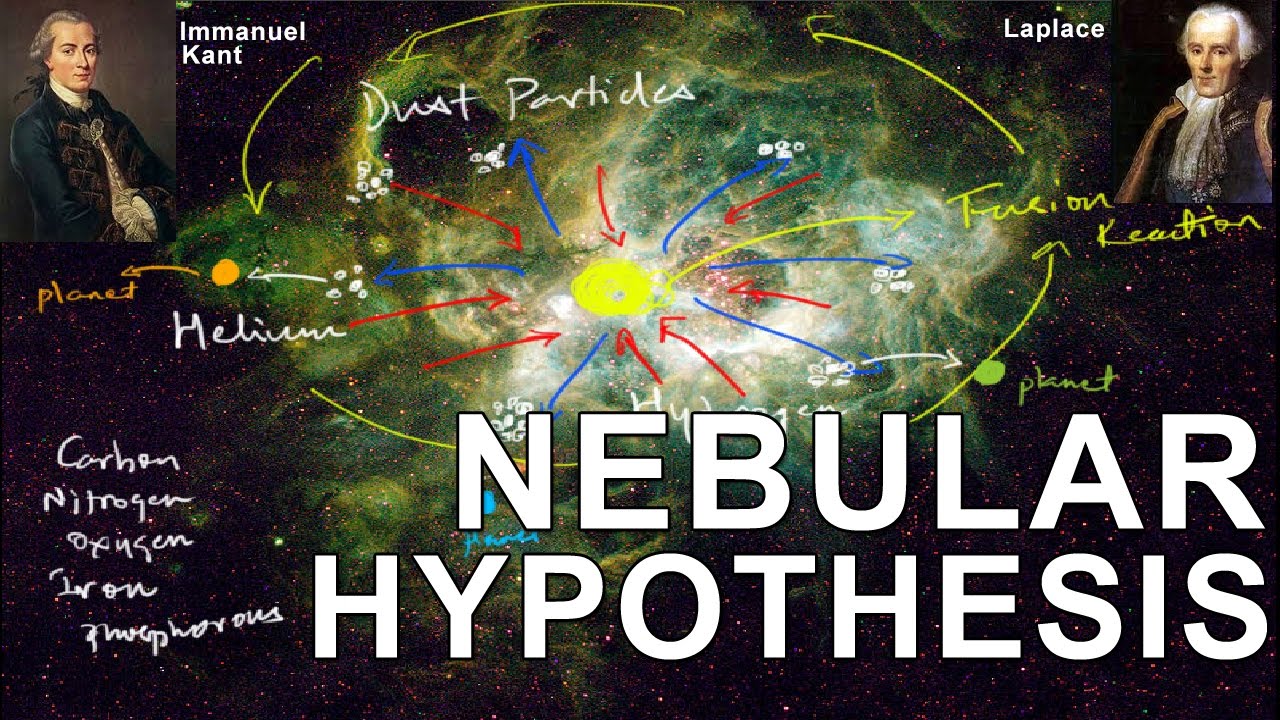
The Gaseous Hypothesis of Kant, presented in , represents a groundbreaking, though flawed, early scientific endeavor to unravel the mysteries of planetary formation and the origin of the Earth. Rooted in the then-contemporary understanding of Newton’s laws, this theory centered on a primordial, amorphous cloud of gas and dust known as the nebula. Understanding Kant’s theory and its subsequent evaluation is essential for students of Geography, Cosmology, and Physical Geology as it laid the foundational conceptual groundwork for later, more refined hypotheses like that of Laplace.
🎯 In this chapter, you will understand:
- How Immanuel Kant used physical laws to explain how our Solar System was created from space dust.
- The step-by-step physical transformation from a cold, motionless particle cloud into a spinning hot gaseous nebula.
- How outward forces, specifically centrifugal force, caused material rings to separate and form individual planets.
- The major scientific shortcomings of Kant's theory, including the breach of the law of conservation of angular momentum.
💡 Why this topic matters: It marks humanity's very first transition away from purely religious myths toward a mechanical, physics-based explanation of how space bodies take shape.
🧠 Core Idea: Gravity pulls scattered space dust together, generating friction and heat. This friction turns the dust cloud into a hot spinning gas cloud that sheds outer rings, which eventually bundle together to form planets.
Immanuel Kant's Gaseous Hypothesis: A 1755 Attempt at Explaining Planetary Origin from a Primordial Nebula
The Gaseous Hypothesis, proposed by Immanuel Kant, sought to explain the birth of the Solar System from a slowly rotating cloud of gas and dust, applying the principles of Newton’s law of gravitation.
This early cosmological model, published in , was a pivotal moment in the history of science, attempting to move the discourse on planetary origins away from purely theological explanations and towards a mechanical, scientific framework based on known physical laws of motion and gravitation. The central component of this theory was the nebula, conceived as the primitive, shapeless, or amorphous mass from which all celestial bodies formed.
- (i) The core concept revolved around the nebula, a primordial, amorphous cloud composed of gas and dust.
- (ii) The entire Gaseous Hypothesis of Kant was systematically developed based on the application of Newton’s law of gravitation and the dynamics of rotatory motion.
The Initial Assumptions: A Cold, Motionless Universe of Primordial Matter
To begin his theoretical construction, Kant had to make several key starting assumptions regarding the nature and initial state of matter scattered across the early universe.

Starting Point: Supernaturally Created Hard Matter
The hypothesis began with the assumption of supernaturally created primordial hard matter that was initially dispersed and scattered throughout the cosmos. This initial state was the only element not entirely explained by a scientific mechanism, which would later be a point of criticism.
- (i) The matter was believed to be scattered unevenly throughout space.
The Initial State: Cold, Solid, and Motionless Particles
The primordial matter, including the early form of the nebula, was assumed to consist of particles that were initially in a state of absolute rest, being very cold and solid.
- (a) The particles were characterized as being very cold, solid, and motionless.
- (b) The process of formation began when these static particles started to collide against each other under their inherent mutual gravitational attractions, initiating the entire cosmological chain of events.
The Kantian Evolutionary Chain: From Collision to a Rapidly Rotating Nebula
Kant’s theory beautifully attempts to connect the dots from a cold, static universe to a hot, dynamic, rotating system through a series of logical physical steps.
Phase One: Motion, Friction, and the Rise of Heat
The initial gravitational attraction and resulting collisions were proposed by Kant as the mechanical driver that transitioned the static primordial matter into a dynamic, energy-generating system.
- (i) Generation of Random Motion:Mutual gravitational attraction and subsequent collisions between particles generated random motion within the primordial matter.
- (ii) Friction and Heat: These collisions, in turn, generated friction, and this friction was the source that initiated the generation of heat, causing the temperature of the primordial matter to begin rising.
Phase Two: Increased Temperature, Rotation, and the Gaseous State
As heat built up, the particles' activity accelerated, dramatically changing the physical state of the matter and initiating the crucial rotatory motion that would eventually lead to the separation of planets.
Transformation into a hot, spinning gaseous nebula as heat and collision rates increased. - (a) Accelerated Activity: Increased temperature led to a rise in random motion and the rate of collision among particles.
- (b) Increased Rotation: The higher collision rate resulted in an increased rate of rotatory motion of the entire mass.
- (c) State Change: The primordial matter changed its state from solid to gaseous due to the rising temperature, transforming the cloud into a vast hot nebula that actively started rotating around its axis.
Phase Three: Centrifugal Force Exceeds Centripetal Force, Leading to Ring Separation
The continuous rise in temperature caused the nebula to expand, and the relentless increase in rotatory speed reached a critical point where the outward force overcame the inward pull, initiating the segregation of material.
- (i) Expansion and Speed: With continuous temperature rise, the nebula expanded in size, and its rotatory speed further increased.
- (ii) Critical Threshold: The centrifugal force (outward force) eventually exceeded the centripetal force (inward force), a dynamic threshold required for material to detach.
Phase Four: Planet Formation from Concentric Rings
The rapid spinning caused material to be ejected in rings, which then aggregated to form the first planets, with the central remaining mass becoming the Sun.
- (i) Ring Ejection: The rapid spinning of the nebula caused an irregular ring to separate from its middle, equatorial part.
- (ii) System of Rings: This process repeated over time, forming a system of approximately nine concentric rings, corresponding to the then-known planets.
- (iii) Sun and Planets: The great central mass of the nebula remained to form the Sun, and each ejected ring subsequently aggregated into a core or knot, which eventually condensed to form a planet.
Evaluation: Major Criticisms and Enduring Significance of Kant’s Hypothesis
While conceptually ambitious, Kant’s Hypothesis faced several scientific criticisms regarding its adherence to fundamental laws of physics, yet its historical importance remains undeniable.
Scientific Flaws and Violation of Physical Laws
The hypothesis suffered from critical logical and physical flaws, especially concerning the conservation of energy and momentum.
- (i) Origin of Primordial Matter:Kant suggested the existence of primordial matter but did not explain its origin, admitting an initial supernatural creation.
- (ii) Source of Initial Motion: He failed to explain the actual source of the energy that initiated the random motion and subsequent collisions of the initially cold, motionless particles.
- (iii) Motion Generation Flaw: The core assumption that simple collisions between particles could spontaneously generate a systematic, large-scale rotatory motion for the entire mass was scientifically incorrect.
- (iv) Angular Momentum Violation: The hypothesis violated the fundamental law of conservation of angular momentum by suggesting that the rotatory speed would increase as the nebula expanded in size, whereas rotation speed should decrease upon expansion.
Historical Importance and the Foundation for Laplace’s Nebular Hypothesis
Despite its flaws, the Gaseous Hypothesis of Kant holds a key place in the history of science and cosmology.
- (i) First Scientific Attempt: The enduring significance of Kant’s Hypothesis lies in its role as the first scientific attempt to provide a comprehensive, mechanical explanation for the origin of the Earth and the Solar System.
- (ii) Groundwork for Successor: Crucially, Kant’s Hypothesis laid the intellectual groundwork and provided the foundational concept of the nebula for the later, more refined and influential Nebular Hypothesis proposed by Laplace in .
⚡ Quick Revision Capsule: Kantian Gaseous Hypothesis (1755)
A structured breakdown summarizing the key assumptions, evolutionary steps, and scientific drawbacks of Kant's model.
| Stage / Aspect | Core Concept & Mechanism | Scientific Criticism / Status |
|---|---|---|
| Initial Condition | Cold, motionless, solid primordial hard matter floating in space. | Unexplained origin; assumes supernatural creation. |
| Energy Source | Mutual gravitational attraction causes collisions and friction. | Cannot generate net rotation from stationary collisions alone. |
| State Change | Heat converts solid matter into a hot, spinning gaseous nebula. | Violates thermodynamic principles without external energy. |
| Ring Detachment | Centrifugal force exceeds inward gravity, casting off 9 rings. | Violates the law of conservation of angular momentum. |
| Final System | Rings condense into planets; remaining central core becomes the Sun. | Serves as the foundation for Laplace's Nebular Hypothesis (). |
📝 Summary
The Gaseous Hypothesis of Kant is a historically significant model, proposing that the Solar System evolved from a rotating nebula driven by gravity and collision-generated heat, as set out in . While it contained flaws, particularly the violation of the law of conservation of angular momentum, its value lies in being the first scientific, mechanical explanation for the origin of the Earth. For students, understanding Kant’s theory is crucial as a precedent for the later and more influential Nebular Hypothesis by Laplace, marking the dawn of modern cosmological thought.
🚀 Quick Revision Points
Essential facts to review before examinations:
- (i) Proposed by philosopher Immanuel Kant in using Newton's laws of gravitation.
- (ii) Assumed space started with static, cold, hard particles created supernaturally.
- (iii) Stated that gravitational pull caused collisions, generating friction, heat, and rotational spin.
- (iv) Claims centrifugal force threw off 9 concentric material rings that condensed into planets.
- 💡 Exam Tip: Always highlight that Kant's greatest error was asserting that expanding clouds spin faster. According to the law of conservation of angular momentum, an expanding object actually spins slower!
❓ Frequently Asked Questions (FAQ)
Q1: What is the primordial material in Kant's Gaseous Hypothesis?
A1: It refers to the original, supernaturally created hard matter floating cold and motionless in early space before gravitational attraction began.Q2: Why did Kant's theory violate physical laws?
A2: It incorrectly claimed that random collisions could create a single direction of spin, and that expanding the cloud increased its speed, breaking the law of conservation of angular momentum.Q3: What was Kant's major legacy in cosmology?
A3: Though scientifically inaccurate, it was the first mechanical model of planetary formation and paved the way for Laplace’s Nebular Hypothesis in .