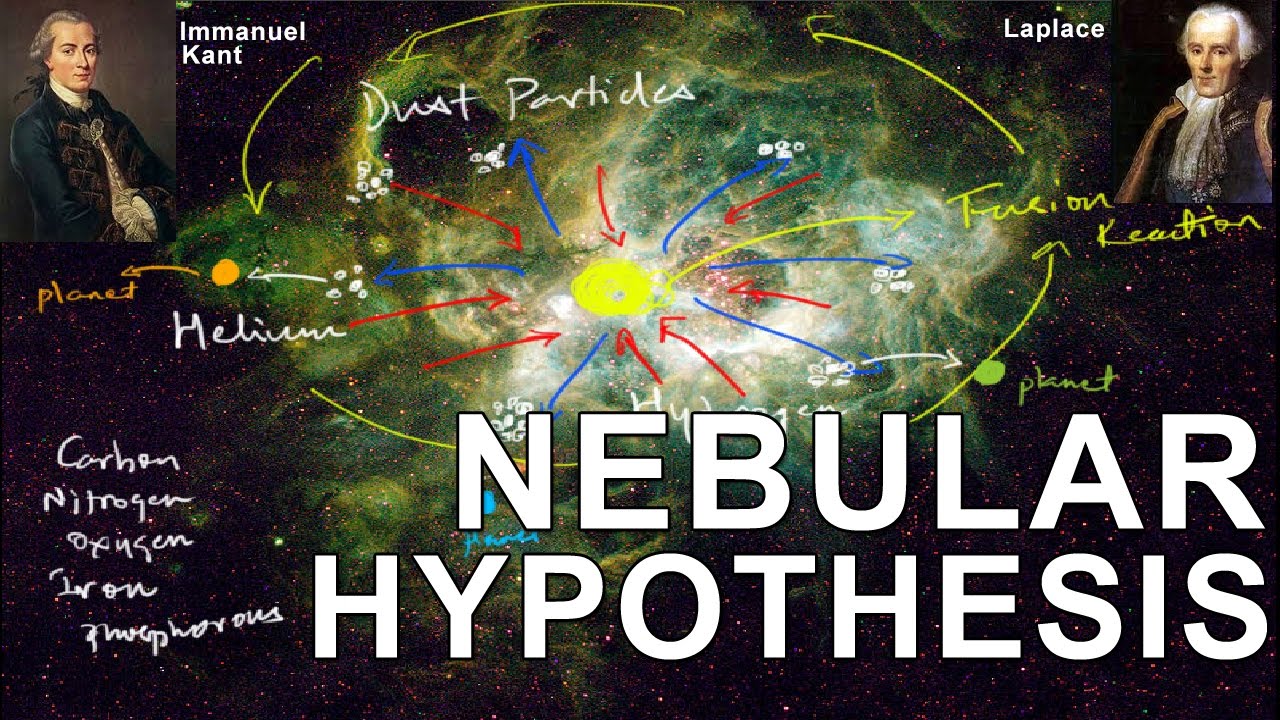
Explore the starting concepts of modern space science with an easy look into the Nebular Hypothesis of Laplace, a key idea explaining the origin of the Solar System. This breakdown is very helpful for competitive exam aspirants preparing for tests like the UPSC. It explains the simple step-by-step model created by the French mathematician Pierre-Simon Laplace in , which improved upon the earlier Gaseous Hypothesis of Kant. Learn how planets formed step by step from a cooling, shrinking gas cloud, and see where this idea succeeded and where it fell short.
🎯 In this chapter, you will understand:
- The main ideas behind Laplace's gaseous nebula model.
- How cooling and spinning caused rings of gas to detach.
- How the nine major planets and the central Sun were formed.
- The scientific limitations, like backward moon orbits and spinning energy distribution.
💡 Why this topic matters: It marks the historical transition from simple assumptions to physical, science-based models of how our home in space was born.
🧠 Core Idea: A giant, hot, spinning cloud of gas cooled down, shrank, spun faster, and threw off rings of material that clumped together into planets.
The Nebular Hypothesis of Laplace: Explaining the Origin of the Solar System in 1796
As a foundation in the study of space origins, the Nebular Hypothesis of Laplace offered a detailed step-by-step process showing how our Sun and planets grew out of a single spinning gas cloud.
The idea was shared by famous French mathematician Pierre-Simon Laplace in . It worked as a fixed version of the earlier Gaseous Hypothesis suggested by philosopher Immanuel Kant. Laplace aimed to clear up the scientific journey from a giant starting cloud to the organized family of planets we see today.
- (i) Laplace published this theory in his famous book Exposition du Système du Monde (The System of the World), presenting a simple view of how planets were born.
- (ii) It quickly became one of the most widely accepted science explanations for the Solar System's formation during the entire 19th century.
- (iii) Its value for learners comes from its historical spot as the key step right before modern nebular theories.
Core Assumptions of Laplace's Gaseous Nebula Theory
Laplace based his model on a few basic rules about how the early gas cloud looked and acted right at the start.

The Initial State of the Primordial Nebula
Laplace pointed out that in the beginning, there was a giant and hot body of gas called a nebula filling up massive areas of empty space. This big cloud was already moving right from the start.
- (i) Inherent Rotation: A primary starting rule was that the nebula was already spinning around its central axis on its own.
- (ii) Continuous Cooling: The cloud was constantly losing its heat into cold space from its outer parts through natural heat loss.
The Mechanism: Contraction, Cooling, and Increasing Velocity
This steady loss of heat brought out a chain reaction of physical changes inside the gas cloud that made material separate.
- (a) Size Reduction: As the gas cloud cooled down, its overall size grew smaller because cold gas naturally shrinks together.
- (b) Accelerating Spin: Because of the physics law known as the Law of Conservation of Angular Momentum, shrinking in size forced the cloud to spin much faster around its center.
- (c) Dominant Centrifugal Force: As the spin grew faster, the outward pushing force (centrifugal force) became stronger than the inward pulling gravity (centripetal force) at the outer edge. This force difference caused the gas to split off.
The Step-by-Step Formation of Planets and the Sun
Once the outward pushing force took over, the gas cloud began to break apart into distinct layers, making space for planets and the central star.
Separation of the Ring and Condensation
The extra high spinning speed made the outer equator line of the gas cloud unstable, leading to a ring of gas detaching from the main body.
- (i) Detachment: The outer layer cooled down the fastest, making it hard for it to match the super fast spin of the hotter, shrinking inner core.
- (ii) The First Ring: Because of this speed difference, one big ring of gas broke free from the main cloud body and started orbiting around the center on its own.
From One Ring to Nine Planets and the Sun
Laplace explained how this detached piece of gas ended up forming the familiar family of planets in our home system.
- (i) Ring Fragmentation: Laplace stated that the single large ring broke apart into nine smaller separate rings.
- (ii) Planetary Birth: Each of these nine smaller rings cooled down, gathered its own gas together, and formed a major planet traveling in a circle around the center.
- (iii) The Sun's Origin: The huge leftover center of the original gas cloud kept cooling down and shrinking until it turned into the solid, hot Sun.
⚡ Quick Revision Capsule: Laplace's Nebular Hypothesis
Here is a quick overview table summarizing the stages, physical laws, and main issues of the 1796 theory.
| Stage / Component | Physical Process / Feature | Key Outcome or Flaw |
|---|---|---|
| Starting Nebula | Giant, intensely hot gas cloud spinning on its axis | Origin of heat and gas was left unexplained by Laplace |
| Cooling & Shrinking | Heat radiated to space; volume decreased | Shrinking triggered the Law of Conservation of Angular Momentum |
| Force Imbalance | Faster spin increased outward centrifugal force | Outward push beat inward gravity at the outer equator |
| Ring Detachment | Equatorial outer gas separated from the main core | Broke into nine rings that condensed into planets |
| Central Core | Main leftover mass continued contracting | Formed the Sun, but lacks an expected equatorial bulge |
📝 Summary
Proposed in , the Nebular Hypothesis of Laplace explained that our Sun and planets grew out of a single, hot, spinning gas cloud. As the cloud cooled over long , it shrank and spun faster, throwing off rings of gas that condensed into nine planets, leaving the center core as the Sun. Even though later scientific discoveries found flaws in its physics, it remains a historical landmark in astronomy and geology textbooks.
🚀 Quick Revision Points
Essential facts to review before examinations:
- (i) Formulated by Pierre-Simon Laplace in as a fix for Kant's earlier Gaseous Hypothesis.
- (ii) Uses the law of physics where shrinking objects spin faster to explain ring detachment.
- (iii) Claims one original ring broke into nine distinct rings that formed our major planets.
- (iv) Highlighted in geology texts like Exposition du Système du Monde for introducing Earth's internal layered structure.
- 💡 Exam Tip: When answering exam questions on Laplace's theory, make sure to highlight both the mechanism (cooling → shrinking → faster spin → ring separation) and its key flaws (angular momentum distribution and retrograde satellite motion).
Critical Evaluation and Shortcomings of the Nebular Model
Even with its grand place in history, Laplace's model faced major scientific challenges because it could not explain several real features of our space neighborhood.
Unexplained Sources and Physical Mechanics
Scientists pointed out missing starting details and math inconsistencies in how the planets separated.
- (i) Origin of the Nebula: Laplace did not explain where the original hot gas cloud came from in the first place.
- (ii) Number of Rings: The idea gives no clear reason why one big ring would break into exactly nine planet rings instead of any other number.
- (iii) The Sun's Shape: If the Sun is the leftover middle part of a fast-spinning cloud, it should bulge out slightly at its middle line, but real telescopes show no such extra bulge.
The Angular Momentum Problem and Retrograde Motion
The toughest problems came from how spinning energy is shared and how some moons move in reverse directions.
- (i) Angular Momentum Distribution: The theory cannot explain why planets hold almost all the spinning energy (angular momentum) in our Solar System today, while the massive central Sun holds very little.
- (ii) Reverse Satellite Orbits (Retrograde Motion): A major issue is that some moons, like those around Jupiter and Saturn, travel backward compared to their planet's rotation direction, which goes directly against Laplace's rule that everything must spin the exact same way.
Legacy of the Nebular Hypothesis and its Importance for Students
Even though modern science has replaced it with better models, Laplace's idea stays very important for students of geology and space science. Its biggest success was introducing the idea that Earth and planets grew step by step, helping us understand Earth's internal layered structure.
❓ Frequently Asked Questions (FAQ)
Q1: What is the main difference between Kant's and Laplace's hypotheses?
A1: Kant assumed cold, motionless gas particles collided to build heat and rotation, whereas Laplace assumed the starting cloud was already intensely hot and spinning from the very beginning.Q2: What is retrograde motion in the context of this theory's flaws?
A2: Retrograde motion refers to moons revolving in the opposite direction of their planet's spin, which breaks Laplace's rule that all bodies must move in the same uniform direction.Q3: Why is Laplace's theory still taught in geology today?
A3: It is studied in texts like Exposition du Système du Monde because it was the first scientific model to explain how Earth developed a hot, concentrated interior and a layered structure.