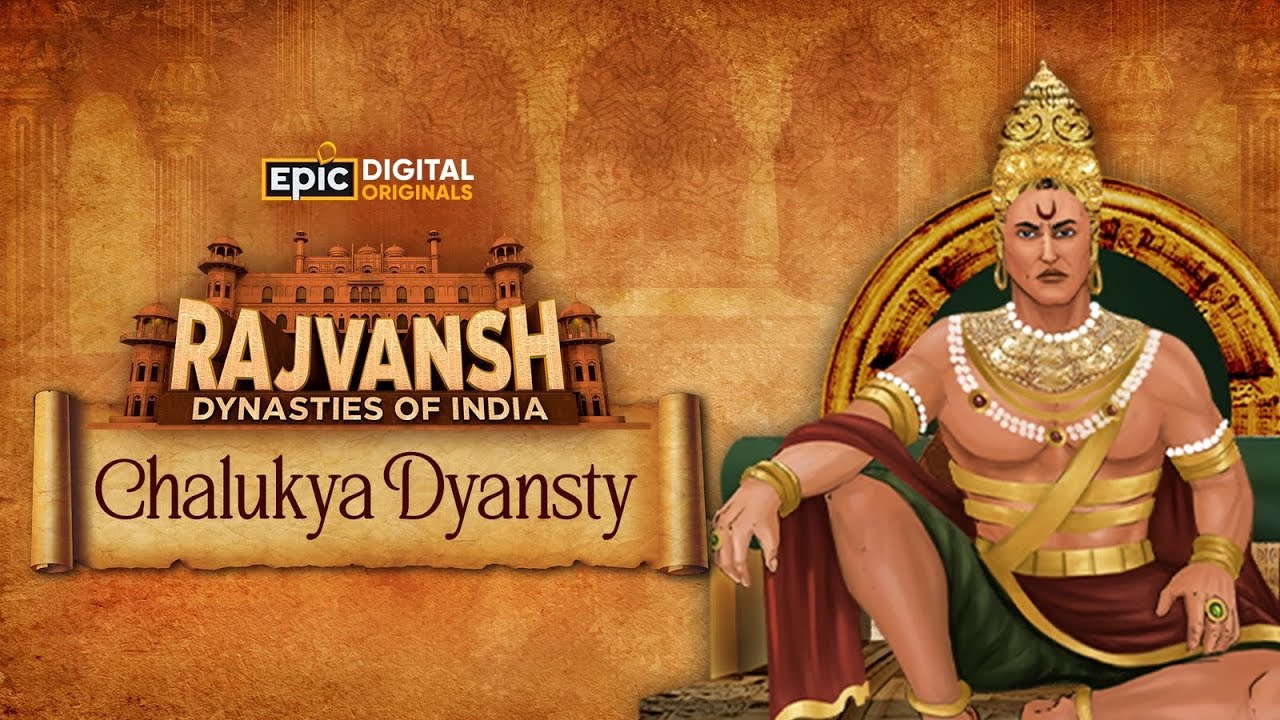
The Chalukya dynasties stand out as a highly influential Indian royal lineage that governed large sections of southern and central India between the 6th and 12th centuries. They built up a huge empire famous for its strategic political influence, unique artistic contributions, and deep literary patronage. If you are a student diving into Indian history, ancient Deccan empires, or the nuances of Vesara temple architecture for upcoming competitive exams, mastering this timeline is essential. Their steady governance allowed the Vesara architecture style to bloom across the landscape and created a stable foundation for classical Kannada and Telugu literature to grow into maturity.
In this chapter, you will understand:
- The geographical growth and chronological differences among the Badami, Eastern, and Western Chalukya branches.
- The definitive characteristics of hybrid Vesara architecture found in ancient rock-cut cave temples.
- Crucial epigraphic records like the Badami inscriptions and court biographies that document major military achievements.
- The structural setup of their military forces, multi-layered land revenue systems, and general socio-religious tolerance.
Why this topic matters: This era forms the backbone of medieval South Indian historical studies, offering frequent questions on temple art, regional language development, and iconic battles like the defense against northern expansion.
Core Idea: The Chalukya rule represents a major transition point where northern and southern Indian traditions merged seamlessly. By looking at their three main administrative branches, we see a continuous line of royal patronage that protected borders while cultivating brilliant advancements in stone carving, classical poetry, and law books.
Comprehensive Overview of the Three Chalukya Dynasties in South India (6th to 12th Century)
The Chalukya dynasty serves as a vital anchor point for historical studies of the Deccan Plateau, stepping into power right after the Vakataka and Kadamba kingdoms faded away. They maintained a long, active presence that reshaped the entire region's politics for over six centuries.
- (i) They maintained a strong grip across the wide landscapes of India, focusing primarily on the Deccan territories from the early 6th century right up to the late 12th century CE.
- (ii) This royal line was split into three connected branches that arrived one after the other: the early Badami Chalukyas, the localized Eastern Chalukyas who settled in Vengi, and the later Western Chalukyas who are often called the Kalyani Chalukyas.
- (iii) The initial group, the Badami Chalukyas, built their kingdom up as the old Kadamba kingdom lost its hold, reaching their absolute highest point of strength under the famous emperor Pulakesi II.
- (iv) The Eastern Chalukyas moved outward to form their own separate, independent zone, managing affairs in the eastern parts of the Deccan from their main base at Vengi until they eventually merged with other powers in the 11th century.
- (v) The Western Chalukyas managed to bring back the family's old glory during the late 10th century after defeating the dominant Rashtrakuta forces, ruling safely from Basavakalyan until the dynamic shifted near the end of the 12th century.
Significance: Enduring Impact and Foundational Contributions of the Chalukya Rule
The era of Chalukya rule is widely celebrated as a true golden timeline for the cultural and structural development of South India, setting long-lasting standards for the area that forms modern Karnataka today.
Political, Territorial, and Administrative Achievements
The rulers were skilled at tracking battle tactics while keeping a firm hand on local law, creating an administrative template that later southern empires copied.
- (i) They completed a massive political task by bringing together a scattered territory that ran all the way from the Kaveri River in the south to the Narmada River in the north.
- (ii) They used an efficient, well-thought-out style of governance that utilized clear provincial divisions to keep the peace across huge distances.
- (iii) The royal courts directly looked after domestic trade routes and encouraged overseas shipping docks, bringing a steady stream of wealth and fresh ideas into their urban centers.
Cultural, Artistic, and Literary Contributions
The emperors used their personal wealth to support artists, poets, and architects, sparking a massive cultural shift across the central plains.
- (a) They were the first to build using the unique Vesara architecture style, which mixed design aspects from the northern Nagara models with features from southern Dravida temple buildings.
- (b) Their continuous financial support helped early Kannada writing flourish from the 9th century onward, which brought out important Jaina Puranas, emotional Veerashaiva Vachanas, and classic Brahmanical books.
- (c) Over in the eastern districts, the Vengi branch gave heavy backing to early Telugu writing, setting the stage for it to blossom into a major literary language by the 11th century.
Sources of Chalukyan History: Epigraphic Inscriptions and Detailed Literary Works
Historians have managed to put together an accurate timeline of Chalukya history by reading through a vast array of old stone inscriptions and matching them up with surviving literary accounts from court poets.

Important Epigraphic Inscriptions of the Chalukya Dynasty
Stone walls and engraved copper sets give us unchangeable dates, royal names, and records of old military conflicts.
- (i) The popular Badami cave inscriptions, written down around 578 CE, come from the time of ruler Mangalesa and explain the very beginning steps of the royal family.
- (ii) The important Kappe Arabhatta stone carving, made around 700 CE, stands out because it contains the earliest surviving example of Kannada poetry written down in the local three-line tripadi metre.
- (iii) The clear lines of the Peddavaduguru inscription tell us exactly how far Pulakesi II managed to push his borders during his active years.
- (iv) Records kept safely inside the Kanchi Kailasanatha Temple and the beautiful Pattadakal Virupaksha Temple highlight the military moves of Vikramaditya II against his rivals, the Pallavas.
External and Internal Literary Sources
Travel logs from visitors and long poems written by court-funded scholars add fine detail to what we know about the empire's wealth.
- (i) The observant Chinese monk and traveler Hiuen-Tsiang (also known as Xuanzang) wrote a vivid description of Pulakesi II’s domain, writing that it held three massive provinces called Maharashtrakas, with each province containing roughly 99,000 individual villages.
- (ii) The talented writer Vidyapati Bilhana, who lived under the protection of the Western Chalukya king Vikramaditya VI, put together a detailed historical biography titled Vikramankadeva Charita, which scholars use to understand the politics of the later kingdom.
History of the Chalukyas: Evolution of the Badami, Kalyani, and Eastern Branches
The general storyline of the early medieval era centers on the growth of the Chalukya family, which split into three separate centers of power across the map.
Chalukyas of Badami: The Pioneering Dynasty
This original branch started the entire imperial legacy, operating out of their heavily protected capital city of Vatapi (which people now call Badami).
- (i) The kingdom was officially setup around the year 550 CE by its primary founder, Pulakesi I, who chose the rocky site of Vatapi for his central fort.
- (ii) Their power spread out smoothly across the geographic boundaries of Karnataka and into modern Andhra Pradesh, making them the most prominent force in the region.
- (iii) Their biggest battlefield win happened when Pulakesi II stood his ground and defeated the powerful northern ruler Harsha right along the edge of the Narmada River, stopping northern armies from taking over the lower plains.
- (iv) The empire went through a brief drop in power after their great leader fell in battle, but they bounced back strongly under Vikramaditya I and reached another high point with Vikramaditya II.
- (v) This initial branch finally lost its hold on the region in the year 753 CE, when they were pushed out of power by the rising military force of the Rashtrakuta Dantidurga.
Chalukyas of Kalyani / Western Chalukyas: The Great Revival
After enduring a long stretch under Rashtrakuta rule, this branch broke through to re-establish the family name and kickstart an era of high-end art production.
- (i) The big comeback started up around 973 CE because of the smart actions of Tailapa II, who broke the Rashtrakuta control over the local trade hubs.
- (ii) Their era is treated as a spectacular Golden Age for the expansion of Kannada literature, keeping a long list of legendary writers working steadily in the royal courts.
- (iii) The long, fifty-year rule of Vikramaditya VI carried so much historical weight that he started an entirely new system for tracking time on monuments, known to us as the Chalukya Vikrama Era.
- (iv) The dynasty finally broke apart completely around 1180 CE, leaving room for three new rising local kingdoms: the Hoysalas, the Kakatiyas, and the Seuna (Yadava) rulers.
Eastern Chalukyas: The Vengi Branch
This eastern wing held long-term control over the valuable coastal lowlands, making an indelible stamp on the regional identity of the area.
The strategic coastal placement of the Eastern Chalukyas allowed them to govern trade hubs separate from the western branches. - (i) They first got their start way back in 616 CE, right when Pulakeshin II marched his armies across the eastern edge of the peninsula to plant a permanent flag.
- (ii) They developed their own independent way of doing things around Vengi, holding onto the coastal strip that sits directly between modern Nellore and Visakhapatnam.
- (iii) Though they used early Kannada scripts in their initial years, they eventually adjusted their focus to put their power and money into cultivating Telugu poetry.
Quick Revision Capsule: The Three Chalukya Branches Compared
Use this foundational comparison chart to review the central details of the distinct dynastic periods for your exam preparation:
| Dynastic Branch | Capital Center & Era | Core Historical Highlights |
|---|---|---|
| Badami Chalukyas | Vatapi (Badami) c. 550–753 CE | Pioneered early Vesara rock temples; Pulakesi II halted northern armies at the Narmada. |
| Western Chalukyas | Basavakalyan (Kalyani) c. 973–1180 CE | Sparked a major Kannada literary revival; Vikramaditya VI created the Chalukya Vikrama Era. |
| Eastern Chalukyas | Vengi Center c. 616–11th Century CE | Governed the vital eastern coastal belt; acted as primary patrons for foundational Telugu writing. |
Art & Architecture: The Vesara Style and Temple Constructions
The entire Chalukya timeline is defined by a massive explosion of masterfully built stone monuments, introducing the artistic world to the hybrid Vesara architecture style.
Badami Chalukyas: Architectural Achievements
The early kings left a massive line of heavy stone structures centered directly around their historic homelands.
- (i) Master builders put together over 150 durable monuments right inside the Malaprabha river basin during an active building phase between 450 and 700 CE.
- (ii) Their most famous creations are the rock-hewn shrines at the complex of Pattadakal (a protected UNESCO World Heritage Site), the caves of Badami, and the old structures at Aihole.
- (iii) This early experimentation brought together the basic foundations of the South Indian architectural style, passing down clear structural patterns that later generations built upon.
Key Temple Architecture Sites: Aihole and Pattadakal
The ancient towns functioned like an architectural laboratory where stonecutters tested out fresh styles on pillars and structural towers.
- (i) The unique Durga Temple (built around the 6th century) in Aihole is famous for using an apsidal, rounded layout that demonstrates their early mastery of stone design.
- (ii) Buildings like the basic Ladh Khan Temple (dated to c. 450 CE) and the inscribed Meguti Temple (built around 634 CE) show us the exact steps of how the hybrid Vesara style grew over time.
- (iii) Additional clear structures like the Hucchimalli and Huccappayya Temples (c. 5th century), along with the deep Badami Cave Temples (c. 600 CE), contain brilliant collections of detailed sculptures that show off their creative flair.
Literature during the Chalukya Period: Flourishing of Kannada, Telugu, and Sanskrit
The royal courts regularly kept a multi-lingual mix of scholars on the payroll, resulting in heavy advancements for Kannada, Telugu, and classical Sanskrit books.
- (i) The ninth and tenth centuries brought forward the legendary writing trio of Adikavi Pampa, Sri Ponna, and Ranna, who are affectionately called the three brilliant gems of Kannada literature (the Ratnatraya).
- (ii) The long-standing Kappe Arabhatta record (c. 700 CE) remains the oldest surviving proof of rhythmic Kannada poetics written down using the standard three-line structural style.
- (iii) The early historical narrative document known as the Karnateshwara Katha is traditionally linked to the court of Pulakesi II.
- (iv) Financial backing from the eastern Vengi branch made the regular formalization of the Telugu language possible, leading directly to the 11th-century translation works of Nannaya Bhatta, who holds the title of Adikavi in Telugu.
- (v) The brilliant legal expert Vijnaneshwara put together the classic treatise titled Mitakshara, which served as a foundational source for traditional Hindu law across many territories for centuries.
- (vi) King Somesvara III proved his own writing skills by compiling an absolute masterpiece of an encyclopedia called the Manasollasa, filling it with chapters on governance, medicine, arts, and royal hobbies.
Badami Chalukya Government, Administration, Army, and Socio-Religious Life
The daily operation of the empire combined solid military readiness with highly layered local administration, all while keeping a peaceful, open attitude toward different religious paths.
- (i) The regular standing army used four traditional divisions: foot soldiers, fast cavalry units, trained elephant squads, and a functional navy designed to watch over coastal trading routes.
- (ii) Inscriptions from their bitter rivals, the Rashtrakutas, use the specific phrase Karnatabala to describe the fearsome, highly disciplined military forces of the Chalukyas.
- (iii) The state treasury kept wealth flowing in by gathering regular taxes like the Herjunka (a major custom duty), Kirukula (small retail tax), Bilkode (a standard sales tax), and the Pannaya (a specialty tax on betel leaves).
- (iv) The map was broken down into manageable geographic sections: the massive Maharashtrakas (provinces), which were split into Rashtrakas (mandalas), then smaller Vishayas (districts), down to individual Bhogas (small village clusters).
- (v) They let trusted local feudatory families like the Alupas, Gangas, Banas, and Sendrakas manage day-to-day work in exchange for battlefield support when wars broke out.
- (vi) They gave out special tax-free land units called Agraharas to groups of scholars who managed local learning centers through village councils known as Mahajanas.
- (vii) Their minted gold coins were stamped with words in both Nagari and Kannada scripts, carrying images of the royal boar (Varaha), lions, and lotus flowers, with the base unit weighing 4 grams called a honnu.
- (viii) While the early courts paid close attention to Vedic rituals, later eras saw a huge boom in Shaivism along with strong royal funding for Jainism, all while women frequently held administrative offices and classical temple arts like Bharatanatyam flourished.
Summary
The Chalukya period stands out as an absolutely essential chapter in the timeline of the medieval Deccan, performing the historical duty of bridging northern and southern cultural habits. Their structural choices left behind permanent markers in the world of art via the Vesara architecture style, gave shape to the classical growth steps of both Kannada and Telugu literature, and showed how a huge empire could thrive through religious tolerance. For any student attempting to score well in examinations covering ancient Indian statecraft, remembering their administrative setup, their major inscriptions, and their defensive campaigns along the rivers is foundational to understanding how regional identities formed across the peninsula.
Quick Revision Points for Students
Keep these central facts completely clear in your notes before walking into the exam hall:
- (i) Pulakesi I was the true operational founder who setup the central capital fort at Vatapi (Badami) around 550 CE.
- (ii) Pulakesi II fought off Emperor Harsha of Kanauj at the Narmada River, earning a massive name across the subcontinent.
- (iii) The Kappe Arabhatta inscription stands as the definitive earliest record of the Kannada tripadi verse form.
- (iv) The legal text Mitakshara by Vijnaneshwara and the encyclopedia Manasollasa by King Somesvara III were both written in this era.
- Exam Tip: Pay close attention to matching questions that connect specific inscriptions with their respective kings. For instance, always link the Aihole prasasti or Peddavaduguru records directly with Pulakesi II, and the Kanchi or Pattadakal victories with Vikramaditya II.
Frequently Asked Questions (FAQ)
Q1: What exactly makes Vesara architecture different from Nagara and Dravida styles?
A1: Vesara architecture acts as a hybrid building style. It merges the curved tower shapes typical of northern Indian Nagara templates with the tiered, step-like stories and detailed pillared halls seen in southern Dravida design models.Q2: Who were the 'three gems' of Kannada literature supported during this general era?
A2: The three gems, or Ratnatraya, consist of the celebrated classical poets Adikavi Pampa, Sri Ponna, and Ranna. They were famous for writing down influential Jaina religious histories and epic poems under royal court protection.Q3: What does the historical term 'Karnatabala' refer to in old records?
A3: The term Karnatabala shows up in rival Rashtrakuta stone carvings to describe the disciplined, highly effective military power and physical strength of the Chalukyan standing army units.