The rise of the Chalukya Dynasty represents a groundbreaking turning point in the geopolitical landscape of the early medieval Deccan region. Acting as a link between North and South India, their political ascent reshaped traditional power balances across the peninsula. Historians piece together this transformative era using vital Epigraphic records, royal land grants, and temple inscriptions, most notably the Undikavatika Grant and the Daulatabad Grant. These primary materials trace how a localized military household managed to break free from their sovereign overlords, establish a strong capital, and systematically construct a vast empire. Understanding these 6th-century structural developments provides modern history students with a clearer framework for analyzing regional shifts in feudal systems, administrative structures, and imperial architectural patronage.
In this chapter, you will understand:
- How the early Chalukyas evolved from subordinate military commanders into a sovereign dynastic power.
- The strategic maneuvers used by Jayasimha to dismantle the influence of regional powers like the Nalas, Mauryas, and Kadambas.
- The military and ritual steps taken by Pulakesin I to permanently anchor dynastic supremacy at the fortified stronghold of Vatapi.
- The expansionist policies of Kirtivarman I and the subsequent internal conflicts that cleared the way for the imperial golden age under Pulakesin II.
Why this topic matters: Mastering the early phases of the Chalukya Dynasty is absolutely vital for competitive civil service and history academic exams. Questions frequently focus on specific inscriptions, administrative titles, territorial limits, and the transition of feudatories into absolute rulers during the early medieval period.
Core Idea: The history of the Chalukya Dynasty details a classic transition from subordinate vassalage to absolute imperial authority. Through timely rebellions, strategic geographical choices, and historic Vedic rituals, the early rulers successfully established a domain that would dictate south-central Indian politics for generations.
The Origins and Early Rulers: Establishing the Chalukya Dynasty in the 6th Century
Uncovering the earliest roots of the Chalukya Dynasty requires carefully tracking their path from regional military subordinates to fully autonomous monarchs. Standard historical research confirms that the Chalukyas did not start out as independent royals, but instead spent their earliest days functioning as an essential military vassal or feudatory branch serving under the authority of the early Rashtrakutas.
Jayasimha: The Founder of Chalukya Independence and Rise to Power
The foundational story of this historic dynasty is defined by Jayasimha, the very first ruler of the lineage, who successfully took advantage of major regional geopolitical struggles to establish a permanent sovereign territory.
The Strategic Declaration of Sovereignty in Bijapur
When the early Rashtrakutas became locked in a difficult, draining military conflict against an alliance of the Nalas and Mauryas, Jayasimha recognized a perfect political opportunity. Moving quickly, he seized the administrative region of Bijapur and officially declared his total independence from his former masters.
- (i) The primary source known as the Undikavatika Grant, which dates firmly to the 6th century, explicitly lists Jayasimha as an active military leader serving under the Rashtrakuta king Abhimanyu before his rebellion.
- (ii) Historical records show that the Rashtrakutas were too distracted by external wars to launch a counter-attack, allowing Jayasimha to take control of Bijapur smoothly without immediate defensive interference.
- (iii) The loss of this powerful military vassal severely crippled the Rashtrakutas, directly leading to their ultimate defeat by the combined forces of the Nala-Maurya alliance.
Dispelling the Chalukya-Kadamba Feudatory Theory and Conquests
Old theories suggesting the Chalukyas were originally subordinate to the Kadambas are cleanly disproven by the dynasty's own historical declarations, which celebrate major military victories won against them.
- (a) The definitive Daulatabad Grant of Jagadekamalla openly honors Jayasimha with the highly specific title, "destroyer of the pomp of the Kadambas."
- (b) Epigraphic analysis indicates that Jayasimha either defended his borders against Kadamba incursions during his early rise or shattered their armies in a decisive battle right after gaining independence.
- (c) After neutralizing the Kadambas, Jayasimha expanded his influence by systematically defeating the neighboring Nalas and Mauryas, ensuring his new kingdom could grow without border threats.
Ranaraga: The Second Ruler in the Dynastic Line
Following the successful reign of the founder, authority over the young kingdom passed down to his son Ranaraga, who is recognized across official genealogies as the second historical monarch of the dynasty.
- (i) Though direct records for this specific era are limited, official inscriptions reliably confirm Ranaraga's place in the proper timeline of succession.
- (ii) The primary achievement of Ranaraga was maintaining complete internal stability across the realm, which preserved the state assets his own son would soon use to build a true superpower.
Pulakesin I and the Consolidation of Chalukya Supremacy at Vatapi
The transition of the Chalukya state from a basic regional kingdom into a massive imperial force truly began under the leadership of Pulakesin I. His actions completely reformed the military capabilities and spiritual authority of the throne.

- The choice of a naturally secure capital allowed the family to withstand regional counter-attacks.
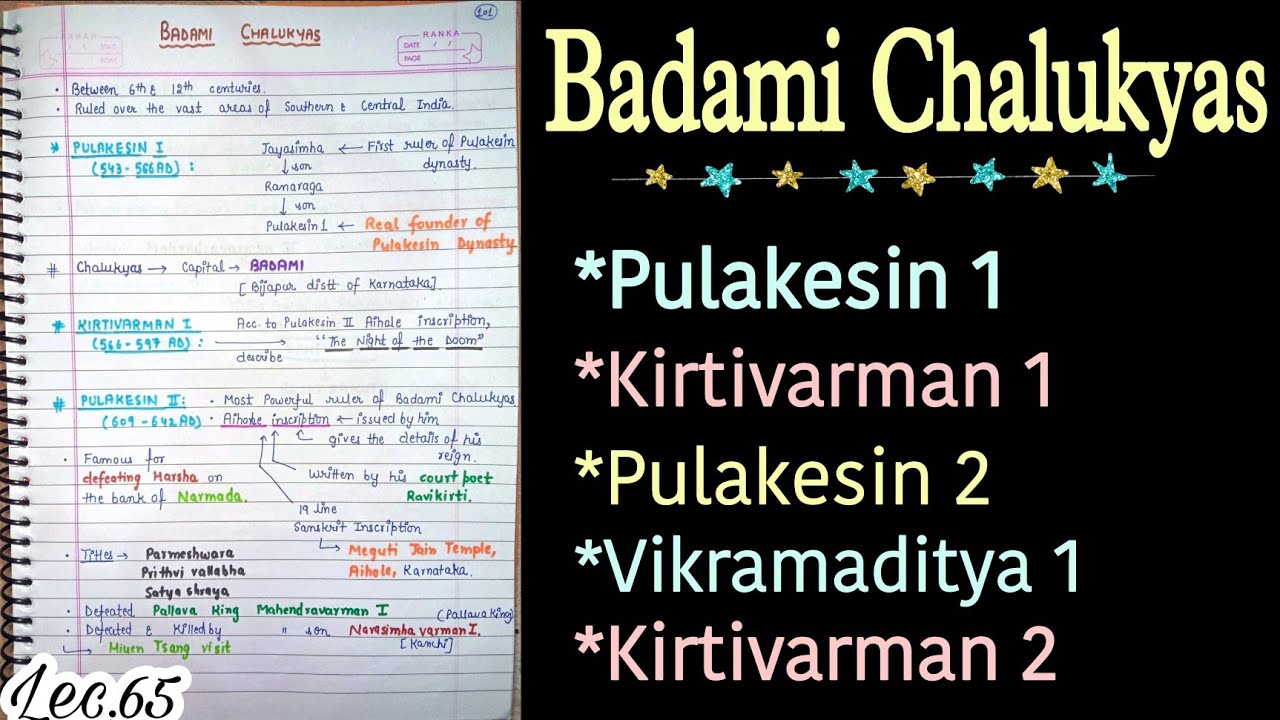
Pulakesin I: The Rise and Adoption of Imperial Titles (c. 540 CE)
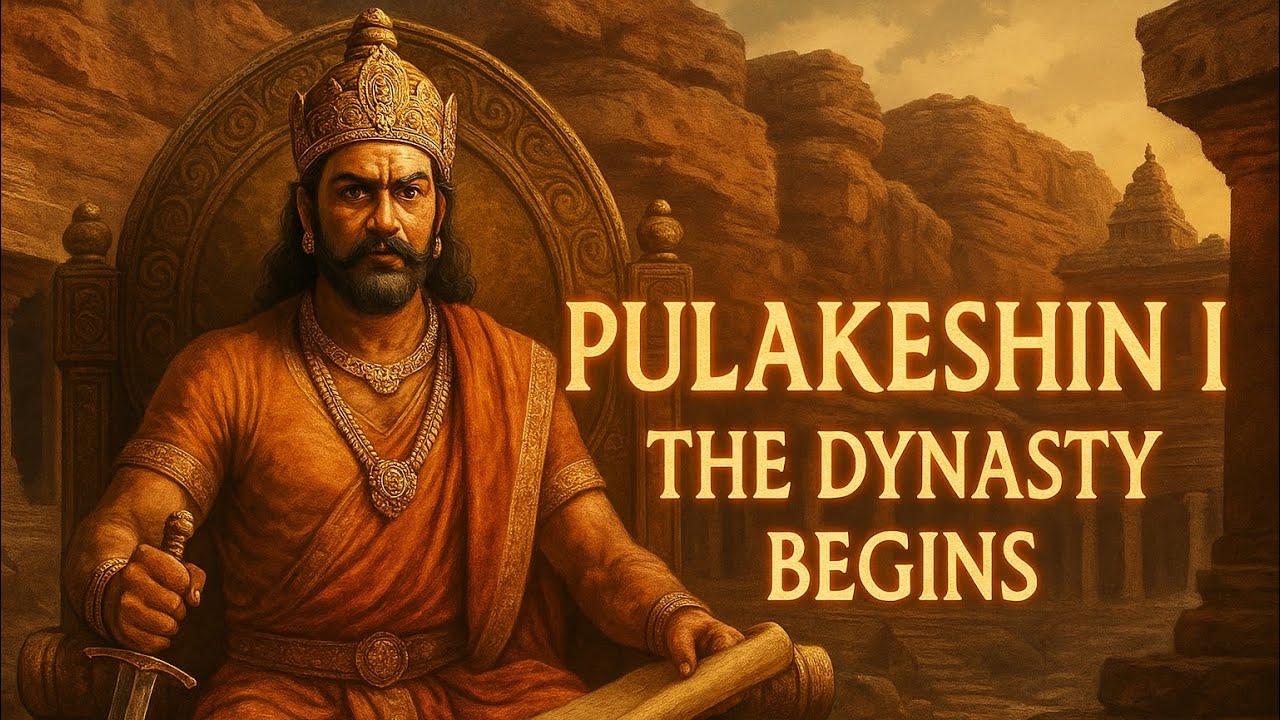
Ascending the royal throne around the year 540 CE, Pulakesin I (whose name translates out of Sanskrit as "the Great Lion") launched a series of deliberate steps to broadcast his supreme status to rival kingdoms.
- (i) He immediately dropped modest titles and adopted the grand names of Sriprithvivallabha (meaning Lord of the Earth) and Maharaja to link his authority directly with Lord Vishnu.
- (ii) He moved the royal seat of power to Vatapi (modern Badami), a highly strategic location near the Malaprabha River protected by massive natural rock cliffs.
- (iii) To seal his ultimate power over the landscape, Pulakesin I performed the legendary Aswamedha Sacrifice (Horse Sacrifice), an ancient Vedic ritual meant exclusively for independent emperors.
Kirtivarman I: Expansion and Military Consolidation (c. 566-567 CE)
Following the passing of the emperor, his eldest son Kirtivarman I (historically called Kirtiraja or the Kannada name Katti-arasa) assumed control around 566-567 CE, bringing an aggressive, military-first approach to the crown.
- (a) The famous Mahakuta Pillar inscriptions state that he served as his father's top commander before securing victories over regional powers like the Cheras along the Malabar coast.
- (b) Under his command, the borders expanded dramatically, stretching cleanly from the western coastal sands of the Konkan all the way to eastern points in Andhra.
- (c) By the end of his rule, he left a secure, interconnected, and massively expanded landscape ready for future generations.
Mangalesa, Pulakesin II, and the Zenith of Imperial Power
The death of the expanding monarch led directly to a period of internal family instability, which tested the resilience of the empire before it reached its historic peak.
- Dynastic successions in early medieval India regularly caused intense civil wars between uncles and nephews.
Mangalesa: Regency, Conquests, and Fratricidal Conflict (c. 591 CE)
Taking power around 591 CE, Mangalesa initially ruled simply as a temporary regent for his young nephew, Pulakesin II. However, his own greed for power eventually pushed the family into open war.
- (i) He won brilliant early milestones, including an absolute victory over the rival Kalachuris and a naval invasion that captured the island of Revatidvipa (known today as Goa).
- (ii) Blinded by these successes, Mangalesa attempted to alter the succession line to pass the throne to his own son, completely ignoring the lawful claims of his nephew.
- (iii) This betrayal triggered a bloody fratricidal war across the country, which ended in the total defeat and death of Mangalesa on the battlefield.
Pulakesin II: The Imperial Peak and Religious Tolerance
Emerging victorious from the civil war, Pulakesin II claimed absolute control, ushering in the true golden age of the Chalukya Empire across the entire Deccan.
- (i) Utilizing the defensive stability and infrastructure built by Pulakesin I and Kirtivarman I, he maintained a massive, unshakeable sphere of political influence.
- (ii) Though the state platform was dedicated to Brahminical Hinduism, the royal court practiced high tolerance, allowing local faiths to operate without fear.
- (iii) Despite this tolerance, historical records show that Buddhism began to decline across the region during this time, mostly due to a lack of direct financial donations from the royal palace.
Quick Revision Capsule
Review this comprehensive breakdown of early Chalukya rulers, their recorded epigraphic sources, and their historical milestones:
| Ruler & Timeline | Primary Source Documents | Core Target Objective & Achievement |
|---|---|---|
| Jayasimha (Early 6th Century) | Undikavatika Grant & Daulatabad Grant | Broke away from the early Rashtrakutas, seized the Bijapur territory, and defeated the Kadambas. |
| Ranaraga | Official Dynastic Successions | Preserved early territorial borders and maintained internal stability for the kingdom. |
| Pulakesin I (c. 540 CE) | Vatapi Royal Records | Moved the capital to the fortified base of Vatapi, took the title of Maharaja, and held the Aswamedha Sacrifice. |
| Kirtivarman I (c. 566-567 CE) | Mahakuta Pillar Inscriptions | Expanded borders from Konkan to Andhra and defeated the coastal Cheras. |
| Mangalesa (c. 591 CE) | Revatidvipa Naval Inscriptions | Conquered the Kalachuris and annexed Goa, but died in a self-inflicted succession war. |
Summary
The historical trajectory of the early Chalukyas provides a clear look into how political power shifted during India's early medieval era. By transforming their status from simple military vassals under the early Rashtrakutas into absolute imperial lords at Vatapi, these rulers completely altered the politics of the Deccan. Key actions—like the timely rebellion of Jayasimha, the strategic fortress planning of Pulakesin I around 540 CE, and the wide conquest campaigns of Kirtivarman I—created the essential wealth and power base needed for the empire. Despite facing severe internal challenges like the succession war against Mangalesa, the kingdom survived to reach its ultimate peak under Pulakesin II, leaving behind a lasting legacy in Indian history.
Key Historical Takeaways for Students
Focus closely on these specific points for direct exam questions:
- (i) The Undikavatika Grant proves the early family worked as vassals under the authority of the Rashtrakutas.
- (ii) Jayasimha earned the specific title of "destroyer of the pomp of the Kadambas" in the Daulatabad Grant.
- (iii) The year 540 CE marks the official consolidation of power at Vatapi by Pulakesin I.
- (iv) The Mahakuta Pillar inscriptions remain the main source for tracking the wide campaigns of Kirtivarman I.
- Exam Tip: Always remember the exact connections between specific rulers and their inscriptions for matching questions. For example, connect the Mahakuta Pillar to Kirtivarman I, and the Undikavatika Grant to Jayasimha's early career. Missing these connections is a common mistake on exams.
Frequently Asked Questions (FAQ)
Q1: What primary source proof links the early Chalukyas to the Rashtrakutas?
A1: The Undikavatika Grant from the 6th century explicitly records the founder Jayasimha serving as an active military commander under the Rashtrakuta king Abhimanyu before launching his independence movement.Q2: Why did Pulakesin I choose Vatapi as the new capital city of the empire?
A2: Around 540 CE, Pulakesin I shifted the capital to Vatapi (modern Badami) near the Malaprabha River because the surrounding rock cliffs provided a natural defensive fort that was easy to protect against rival kings.Q3: What caused the political downfall of the ruler Mangalesa?
A3: Though he was a skilled general who conquered the Kalachuris, Mangalesa tried to steal the throne from the rightful heir, Pulakesin II. This triggered a bitter fratricidal war that ended with his defeat and death.