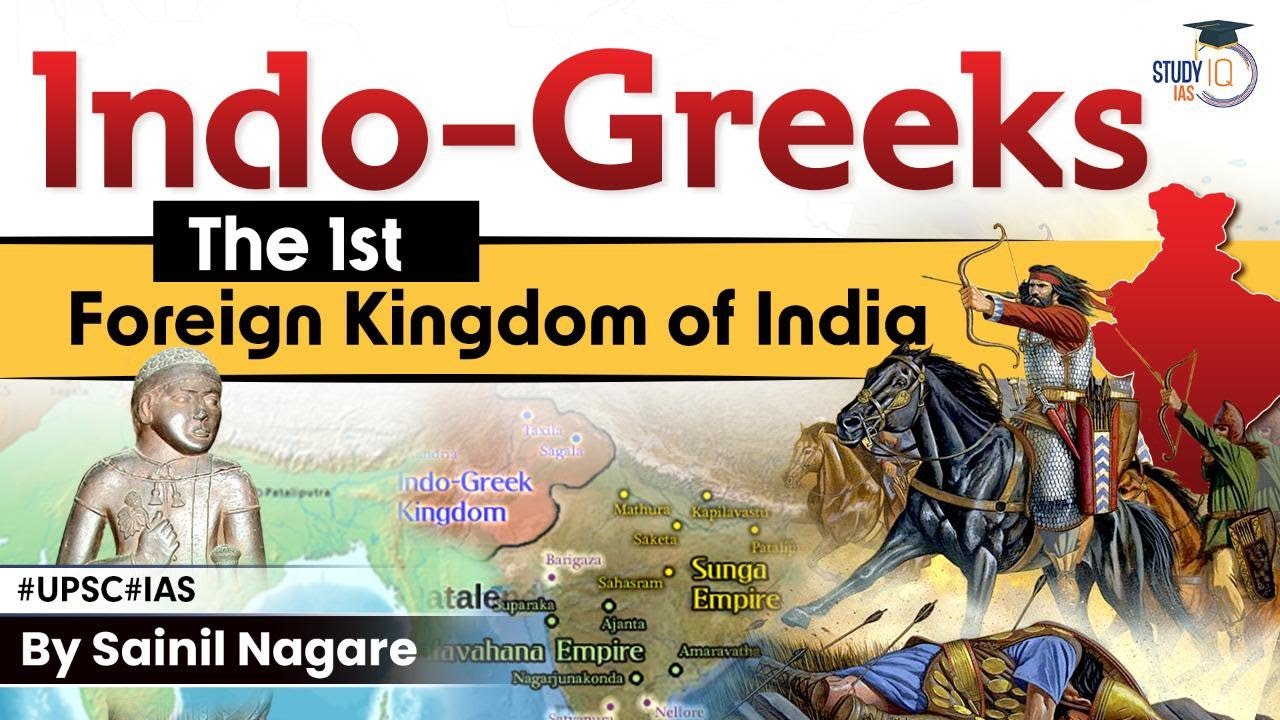
The Indo-Greeks, frequently referred to in ancient Indian texts as Yavanas, represent a transformative period in ancient Asian history. Their presence established a direct bridge between the Hellenistic world and the northwestern Indian subcontinent, spanning from the to the early . Ruling across parts of Central Asia, modern-day Afghanistan, and the Indus Valley, these kings left behind a rich record of political intrigue and cultural exchange. Most of what we know today comes from thousands of finely minted, die-struck coins alongside references in classical Greco-Roman accounts and Sanskrit or Pali literature. Studying this era—from the early invasions led by Demetrius to the famed Buddhist patronage of Menander I Soter—helps us understand how cross-continental trade, artistic mixing, and religious integration gave birth to the renowned Gandhara School of Art.
In this chapter, you will understand:
- The migration and political rise of Graeco-Bactrian rulers into Northwest India.
- The military expansion under Demetrius I and the dynastic split caused by Eucratides I.
- The reign of Menander I Soter, his philosophical exchanges, and his support for Buddhism.
- The process of cultural assimilation, including Vaishnavite devotions, bilingual coinage, and Gandharan art.
Why this topic matters: This period illustrates how foreign rulers adapted to local traditions, showing early examples of artistic synthesis, monetary standardization, and religious tolerance in South Asia.
Core Idea: After the collapse of the Mauryan Empire around , Bactrian Greek commanders moved south across the Hindu Kush. Over two centuries, these rulers blended Hellenistic craftsmanship, language, and governance with Indian religions, languages, and artistic styles, leaving an enduring mark on ancient Indian coinage and sculpture.
Indo-Greeks (Yavanas): Analyzing Cultural Exchanges and Rise of Regional Powers Post-Mauryan Empire (c. 200 BCE)
The arrival of Indo-Greek rulers heralded a unique era of contact between Mediterranean traditions and Indian society, gradually transforming foreign Greek kings into local Indianized monarchs.
The Post-Mauryan Transition
The fragmenting of Mauryan authority after left a political vacuum in northern and northwestern India. Regional powers quickly rose to claim influence, with the Indo-Greeks shaping trade networks, monetary systems, and administrative practices across the region.
- (i) Historians piece together their royal lineages, shifts in power, and territorial borders primarily using rich stashes of coins along with passing references in Greco-Roman writings.
- (ii)
Western Historical Views
Western scholars frequently highlight how Hellenistic philosophy, artistic techniques, minting skills, and architectural designs travelled eastward during this period.
- Actionable insights reveal how Greek die-struck coins set a standard for precision across South Asian mints.
- Classical sculptors brought realistic physical proportions and drapery styles to local stone carving.
- Astronomy and mathematical ideas crossed regional borders through ongoing diplomatic contact.
- Philosophical exchanges opened dialogues between Mediterranean thinkers and Indian ascetics.
- (iii) Indian historians, on the other hand, emphasize how thoroughly these Greek leaders absorbed local customs, adopting Prakrit languages, local scripts like Kharosthi, and patronizing faiths like Buddhism and Vaishnavism.
Tracing Origins: The Bactrian Greeks from Alexander's Legacy to the Seleucid Satrapy
Contact between Greek-speaking peoples and the Indian subcontinent did not start overnight; it built upon centuries of trade routes and military deployments dating back to the Achaemenid Empire.

- Early contacts deepened when Alexander the Great launched his Indian campaign between and , leaving behind permanent garrisons, administrative outposts, and veteran settlements across the northwest.
Historical Precursors: Greek Contact with India during the Mauryan Era
During the Mauryan period, peaceful diplomatic ties replaced military conflict, allowing trade and ambassadorial exchanges to flourish.
- (i) The Mauryan imperial court hosted famous Greek ambassadors, including Megasthenes, whose observations recorded details of Indian social life and court administration.
- (ii) Inscriptions found on the Rock Edicts of Ashoka show that the Mauryan Emperor sent diplomatic envoys to Hellenistic kings across North Africa and the Mediterranean, promoting peaceful ethical ideas.
- (iii)
Founding of the Graeco-Bactrian Kingdom and the City of Ai-Khanum
Strategic settlements, often named Alexandria, were founded across present-day Turkmenistan, Tajikistan, Afghanistan, and Pakistan to secure trade routes.
- The excavated site of Ai-Khanum, situated at the junction of the Kokcha and Oxus rivers, reveals a massive Greek city spanning roughly .
- Archaeological digs at Ai-Khanum uncovered traditional Greek features including a palace, gymnasium, theater, and administrative buildings alongside local Central Asian influences.
- Originally governed as a province of the Seleucid Empire, Bactria declared independence around under Diodotus I, establishing the sovereign Graeco-Bactrian Kingdom.
- This new kingdom acted as a vital economic and political link connecting West, Central, and South Asia.
The First Indo-Greek Expansion: Demetrius I's Bold Invasion of India
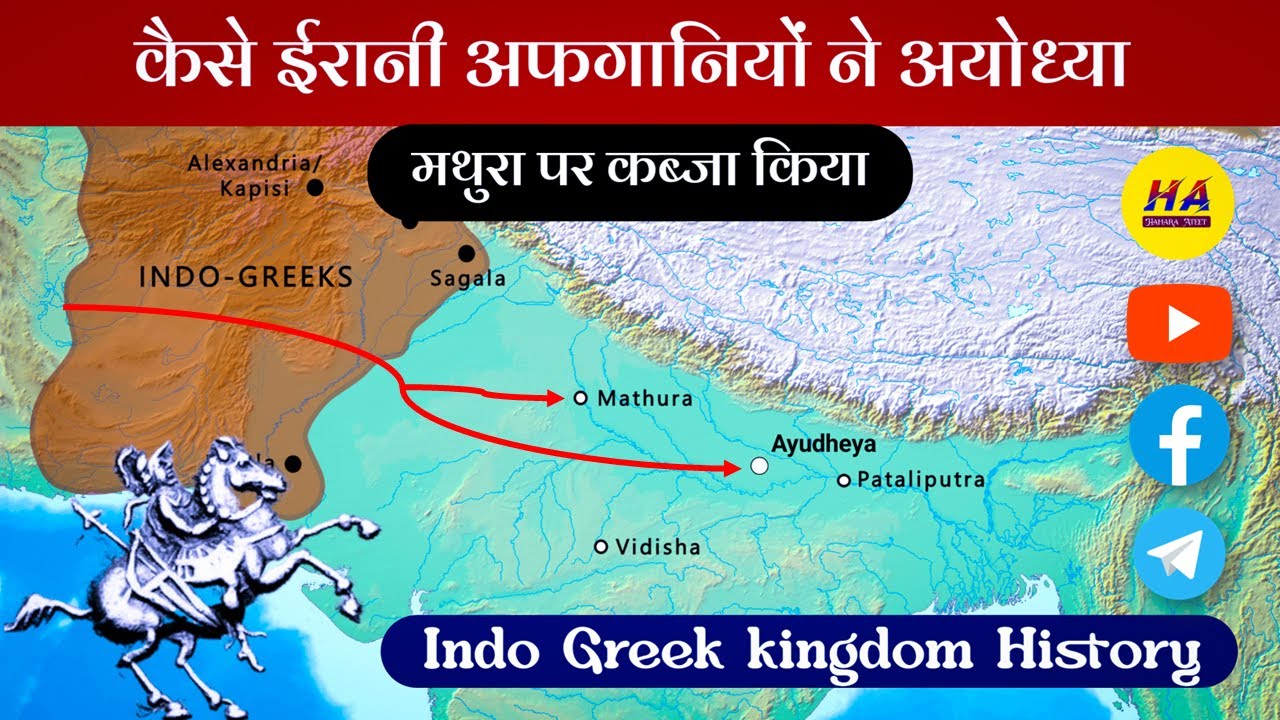
Around , the Graeco-Bactrian state turned its forces southward across the Hindu Kush mountains to launch major military campaigns into the Indian heartland.
- This initial push was led by Demetrius I, the ambitious son of King Euthydemus, whose armies marched deep into the Gangetic plains, according to literary references reaching as far as Pataliputra.
Demetrius' Campaigns, Literary References, and the Elephant Scalp Coin
Military advances under Demetrius I targeted key strategic towns, placing sieges on places such as Saketa and Madhyamika.

Numismatic portrait of Demetrius I featuring the signature elephant scalp crest, minted to celebrate military campaigns in northern India. - (i) The Hathigumpha Inscription, commissioned by King Kharavela of Kalinga, explicitly mentions a retreating Yavana king named Dimitra.
- (ii) Internal political strife back in Bactria cut this ambitious campaign short, forcing Demetrius to pull his main forces back toward Mathura.
- (iii) To commemorate his victories in India, Demetrius issued distinct silver coins showing him wearing an elephant scalp helmet, a visual symbol of his subduing parts of the subcontinent.
- (iv) These coins adopted bilingual inscriptions, marking an early step in adapting Greek currency for local Indian populations.
Eucratides I and the Rise of the Parallel Dynastic Line
Political rivalry broke out within the Greek territories around when a powerful general named Eucratides I overthrew the ruling Euthydemid house.
- Claiming the title King Great Eucratides, he established a competing royal dynasty that split the Indo-Greek realm into rival factions.
Eucratides' Coinage, Extent of Territorial Control, and Final Conflict
The coins minted under Eucratides I stand out for their artistic detail, scale, and clear expression of royal power across northwestern India.
Fine silver tetradrachm of Eucratides I showing the king wearing a bull-horned helmet, flanked by the Castor and Pollux cavalry motif. - (i) Eucratides issued some of the largest gold coins produced in the ancient world, featuring portraits of his parents on the reverse to validate his royal lineage.
- (ii) His silver coins often show him wearing a broad-brimmed helmet decorated with bull horns and ears, holding a spear.
- (iii) His expansion was cut short by clashes with the Parthian king Mithridates I, demonstrating how unstable the northwestern frontiers remained.
- (iv) This dynastic divide permanently split the Indo-Greek territories into Eastern and Western ruling houses.
Quick Revision Capsule: Major Indo-Greek Rulers & Characteristics
A quick summary of key rulers, their strategic centers, and notable cultural contributions during the Indo-Greek period:
| Ruler / Dynasty | Primary Region / Capital | Core Historical Contribution |
|---|---|---|
| Diodotus I | Bactria (Balkh) | Secured independence from the Seleucid Empire in ; founded the Graeco-Bactrian Kingdom. |
| Demetrius I | Taxila / Mathura | Led the first major invasion into northern India (); issued iconic elephant scalp coins. |
| Eucratides I | Bactria / Pushkalavati | Usurped Euthydemid power; minted massive gold coins; split the kingdom into rival dynastic branches. |
| Menander I Soter | Sakala (Sialkot) | Most famous Indo-Greek ruler; extended territory; engaged in Buddhist debates recorded in the Milindapanho. |
| Antialcidas | Taxila | Sent envoy Heliodorus to Besnagar; supported Vaishnavite devotion as recorded on the Garuda Pillar. |
Menander I Soter: The Most Celebrated Indo-Greek King and His Patronage of Buddhism
Of all the Indo-Greek monarchs, Menander I Soter (ruling around from his capital at Sakala, modern Sialkot) became the most famous and culturally influential figure.
Menander, the Milindapanho, and Evidence of Buddhist Patronage
Menander is celebrated not just for his wide territorial rule and abundant coinage, but also because he is the only Indo-Greek king prominently featured in classical Indian literature under the name King Milinda.
- (i) The famous Pali Buddhist text Milindapanho (Questions of Milinda) documents a series of deep philosophical debates between King Milinda and the learned Buddhist monk Nagasena.
- (ii) A Kharosthi inscription found at Bajaur records the enshrinement of a Buddhist relic during his reign, offering clear proof of his royal patronage of Buddhism.
- (iii) Copper and silver coins bearing the names of Menander and his successor Apollodotus circulated widely, even reaching major trade ports like Barygaza (Bharuch) as noted in the Periplus of the Erythraean Sea.
Indianization of Indo-Greeks: Religious Syncretism in Hinduism and Buddhism
Cultural integration went both ways: while Greek culture influenced local arts, Indo-Greek rulers actively embraced Indian faiths, adopting titles and symbols from Buddhism and Hinduism.
Antialcidas' Devotion to Vaishnavism and the Heliodorus Pillar Inscription
While Menander favored Buddhism, King Antialcidas of Taxila established diplomatic and religious ties with Hindu traditions, particularly Vaishnavism.
- (i) Antialcidas sent a Greek ambassador named Heliodorus to the court of Vidisha. In Besnagar, Heliodorus erected a famous stone column known as the Heliodorus Garuda Pillar in honor of Vasudeva (Vishnu).
- (ii) The Brahmi inscription on the pillar records Heliodorus calling himself a Bhagavata (devotee of Vishnu) and outlines three ethical steps to immortality: self-control (dama), self-denial (tyaga), and watchfulness (apramada).
- (iii) This pillar serves as clear archaeological proof that foreign Greek officials living in India fully embraced local socio-religious customs and philosophical values.
Geo-Political Legacy and Cultural Contributions of Indo-Greek Rule
The political and economic stability maintained by Indo-Greek kingdoms fostered long-distance trade, urban growth, and major advances in arts and minting standards.
Indo-Greek Coinage and Artistic Influence on the Gandharan School
Die-struck coinage represents the most lasting contribution of the Indo-Greeks, replacing rough punch-marked coins with round, weight-standardized currency bearing portraits of rulers and names of deities.
- (i) Early Bactrian coins followed pure Greek standards, featuring Greek legends and images of Olympian gods like Zeus, Athena, and Apollo.
- (ii) As rulers settled in India, coins became bilingual and bi-scriptural, featuring Greek on the obverse and Kharosthi or Brahmi scripts on the reverse.
- (iii) Greek sculptural realism directly influenced the Gandhara School of Art, leading artists to create the earliest humanlike representations of the Buddha with realistic drapery and facial features.
Decline: Political Instability and Conflicts Leading to Their Diminishment by Sakas and Parthians
Following the death of Menander, constant dynastic splits and rivalries weakened the Indo-Greek kingdoms, leaving them vulnerable to new waves of central Asian invaders.
Post-Menander Succession and Intensifying External Conflicts
After Menander's death, rule fell to Queen Agathocleia and her young son Strato I in Gandhara, while rival princes ruled small, fragmented pockets across the northwest.
- (i) Migrating Nomadic tribes, particularly the Sakas (Scythians) and the Parthians, pushed through mountain passes and gradually captured Indo-Greek strongholds.
- (ii) By the late , Indo-Greek authority was confined to small areas of Eastern Punjab before disappearing entirely around .
Summary
The Indo-Greeks played an important role in ancient Indian history by linking South Asia to wider Mediterranean trade networks, artistic styles, and administrative ideas. Their introduce of uniform, die-struck bilingual coins transformed regional economics, while their support for local faiths—exemplified by Menander's engagement with Buddhism and Heliodorus's devotion to Vishnu—shows a high level of cultural mixing. For students reviewing ancient history, understanding this era explains how Greco-Roman artistic techniques mixed with Indian traditions to create the Gandhara School of Art during the post-Mauryan period.
Quick Revision Points
Key facts to remember for rapid review:
- (i) Demetrius I launched the first major Greek campaigns into post-Mauryan northern India around .
- (ii) Menander I Soter (Milinda) is the most famous Indo-Greek ruler, remembered in the Pali text Milindapanho.
- (iii) The Heliodorus Pillar at Besnagar provides direct archaeological proof of a Greek official adopting Vaishnavism.
- (iv) Indo-Greek coins introduced standardized die-striking, royal portraiture, and bilingual legends (Greek and Kharosthi) to South Asia.
- Exam Tip: Focus on the numismatic features (bilingual/biscriptal coins), the cultural impact of the Heliodorus Garuda Pillar at Besnagar, and the philosophical significance of the Milindapanho when answering exam questions about post-Mauryan foreign invasions.
Frequently Asked Questions (FAQ)
Q1: Who were the Yavanas mentioned in ancient Indian literature?
A1: Yavanas was the term used in ancient Indian texts (derived from Ionian) to refer to Greek-speaking populations, particularly the Graeco-Bactrians and Indo-Greeks who established kingdoms in northwestern India.Q2: What is the historical importance of the Milindapanho?
A2: The Milindapanho is a major Pali Buddhist text that records philosophical dialogues on Buddhist doctrine between the Indo-Greek King Menander I (Milinda) and the Buddhist sage Nagasena.Q3: How did Indo-Greek coinage differ from earlier Indian punch-marked coins?
A3: Unlike earlier punch-marked silver pieces, Indo-Greek coins were die-struck, rounded, bore realistic portraits of ruling monarchs, featured names of deities, and frequently used bilingual inscriptions in Greek and Kharosthi scripts.