The Iranian and Macedonian Invasions of India during the were critical turning points in ancient history. These foreign incursions altered the political landscape across the north-western frontier, exposing the vulnerabilities of smaller local kingdoms and showing the need for a unified defensive strategy. Beyond military conflicts, these contacts opened long-distance trade routes across land and sea. They introduced administrative models like provincial governorships and sparked cultural exchanges that enriched art, script writing, architecture, and coinage throughout the region. Understanding these Western contacts helps trace how fragmented regional territories transitioned into a unified realm under the Mauryan Empire.
In this chapter, you will understand:
- The geopolitical changes brought by Persian rule under King Darius I.
- The mechanics of the Satrap system and its impact on Indian administration.
- The military and political effects of Alexander the Great's campaign.
- The treaty with Seleucus I Nicator and the emergence of the Mauryan Empire.
Why this topic matters: It explains how foreign campaigns broke the isolation of north-western India, accelerated trade, inspired new artistic traditions like Gandhara art, and created the conditions for political unification under the Mauryans.
Core Idea: Between the , Persian and Macedonian invasions entered India's north-west. These campaigns exposed local political divisions, introduced new governance methods, boosted cross-border trade, and encouraged cultural blending. The resulting political shifts paved the way for the rise of a centralized Indian empire.
Iranian and Macedonian Invasions of India: Cultural and Political Catalyst (6th–3rd Century B.C.)
Spanning nearly three centuries, these invasions reshaped India’s path toward political unity, catalyzed cultural synthesis, and permanently opened vital external trade links.
Iranian (Achaemenid) Invasion and Its Historical Impact on India
The sequence of powerful incursions began with the Iranian campaign under Darius I around , bringing a substantial portion of north-west India under Persian control. This campaign transformed the north-western frontier, influenced local governance, stimulated cross-border economies, and forged deep intercultural ties.
- (i) The campaigns exposed significant defensive weaknesses and political disunity among the small kingdoms of the north-western Indian subcontinent.
Darius I’s Campaign and Annexation of Indian Provinces
The Persian King Darius I extended the Achaemenid Empire by annexing fertile lands in Punjab and Sind. These territories remained under Persian influence for nearly two centuries until the arrival of Macedonian forces.
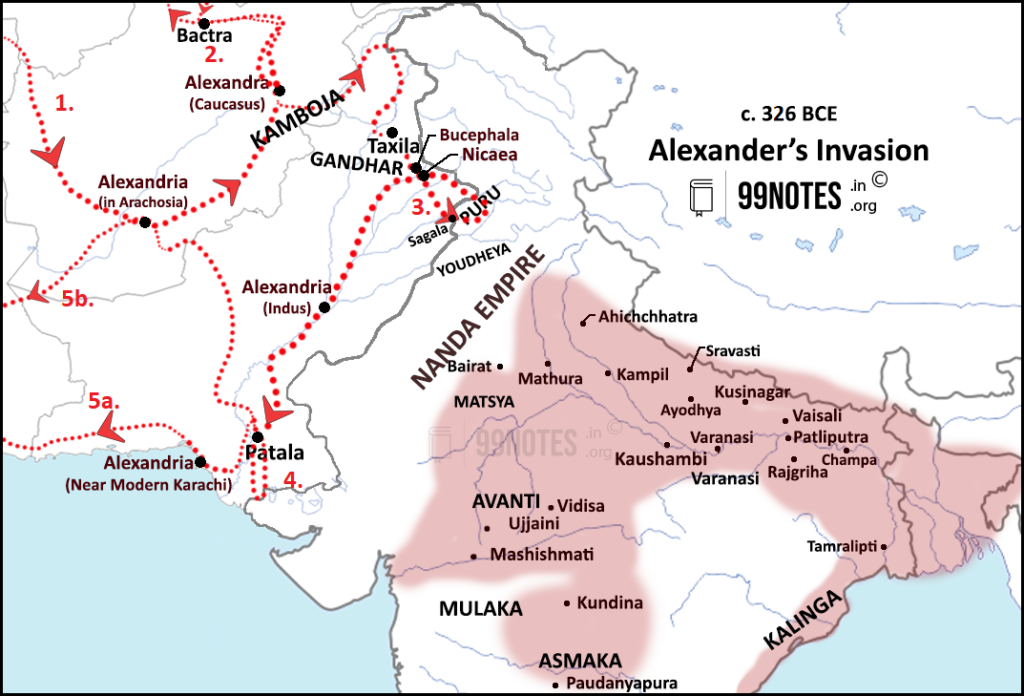
Map showing the geographical extent of the Iranian and Macedonian invasions in North-West India - (i) Established Persian rule over regions of Punjab and Sind, integrating them as the 20th Satrapy of the Achaemenid Empire.
- (ii) Linked Indian resources directly into the organized Persian imperial trade network, expanding commercial routes.
- (iii) Set an early precedent for subsequent Western incursions into the Indian subcontinent.
Introduction of the Satrap System: A Lasting Administrative Legacy
The Persians introduced the Satrap System, a provincial governance framework that influenced later rulers in India.
- (i) The Achaemenid Empire was divided into administrative provinces called satrapies for centralized management.
- (ii) Governors called Satraps were appointed to collect taxes, resolve disputes, and maintain regional law and order.
- (iii) Later foreign rulers in India, including the Sakas and Kushanas, adopted similar administrative principles.
Indo-Iranian Cultural and Economic Syncretism
Persian rule in the north-west introduced lasting cultural, economic, and administrative influences that shaped the region.
- Trade Expansion: Communication lines established under the Achaemenids created a steady boost in Indo-Iranian commerce.
Macedonian Invasion under Alexander and Its Transformative Effects
The Persian connection helped spread the Kharoshthi script, written from right to left, and introduced Persian architectural influences seen in later Ashokan inscriptions and pillars.
- (i) Persian minting techniques helped refine early Indian coinage and introduced formal diplomatic customs.
- (ii) Communities of Greeks, Persians, and other groups established settlements across north-western India.
Alexander’s Expedition: Exposing Political Disunity
The campaign led by Alexander the Great of Macedon between and marked a significant military and cultural milestone. After defeating the Persian Empire, Alexander crossed the Indus River and marched into Punjab, engaging in notable battles such as the one against King Porus.
- The invasion exposed local political divisions and stimulated direct contact between Greek and Indian cultures.
Seleucid Invasion and The Landmark Mauryan Alliance
Alexander established Greek garrisons and appointed Satraps in key areas such as Taxila and Punjab before turning back. Following his death, his general Seleucus I Nicator attempted to reclaim these territories around , leading to a landmark treaty with Chandragupta Maurya.

Map showing key cities founded by Alexander (such as Bucephala and Nicaea) which served as trade and cultural centers - (i) The treaty established marriage alliances and diplomatic ties, recognizing the strength of the Mauryan state.
- (ii) The Seleucid ambassador Megasthenes was posted to the Mauryan court, writing the Indica, an essential primary source on ancient Indian society.
- (iii) The political vacuum created by the Greek withdrawal helped clear the path for Chandragupta Maurya to unite northern India.
Indo-Greek Cultural and Intellectual Cross-Pollination
Continued contact between Greek and Indian populations led to mutual exchanges in art, philosophy, and science.
- Art & Sculpture: Combining Greek realistic sculpting techniques with Indian spiritual themes created the famous Gandhara School of Art.
- Historical Records: Accounts by Greek historians provided Western scholars with detailed descriptions of Indian society and geography.
- Knowledge Exchange: Concepts in astronomy, medicine, and philosophy were exchanged between Greek and Indian thinkers.
Quick Revision Capsule
Key highlights comparing the Iranian and Macedonian invasions of ancient India:
| Feature / Aspect | Iranian (Achaemenid) Invasion | Macedonian (Hellenistic) Invasion |
|---|---|---|
| Primary Leaders | Darius I | Alexander the Great, Seleucus I Nicator |
| Time Period | onwards | |
| Key Regions Affected | Punjab and Sind (20th Satrapy) | North-West Frontier, Taxila, Punjab |
| Administrative Impact | Introduced the Satrap system of governance | Exposed political fragmentation, speeding Mauryan unification |
| Cultural Legacy | Spread Kharoshthi script and Persian architectural styles | Gave rise to Gandhara Art and detailed historical texts like Indica |
Summary
The Iranian and Macedonian invasions between the brought external contact to ancient India. Starting with Darius I and continuing through Alexander the Great and Seleucus I, these incursions introduced new administrative frameworks, opened major trade routes, and fostered distinct artistic traditions. Ultimately, the disruption caused by these invasions highlighted the weakness of divided local kingdoms, setting the stage for the rise of a unified empire under the Mauryans.
Quick Revision Notes
Essential takeaways for quick study and review:
- (i) Darius I annexed Punjab and Sind around , turning them into the 20th Satrapy of the Persian Empire.
- (ii) The Persian administration introduced the Satrap System and helped popularize the right-to-left Kharoshthi script.
- (iii) Alexander invaded in , defeating King Porus at the Hydaspes River, exposing regional disunity.
- (iv) Seleucus I Nicator signed a treaty with Chandragupta Maurya, sending ambassador Megasthenes who wrote the Indica.
- Exam Tip: Pay special attention to the administrative features of the Satrap system, the origin and direction of the Kharoshthi script, and how the alliance between Chandragupta Maurya and Seleucus I influenced early Mauryan diplomacy and primary historical sources like Megasthenes' Indica.
Frequently Asked Questions (FAQ)
Q1: What was the main administrative impact of the Iranian invasion on ancient India?
A1: The Iranian invasion introduced the Satrap system, a provincial governance framework where appointed governors (Satraps) collected taxes and maintained law and order. This administrative model influenced later foreign rulers in India, including the Sakas and Kushanas.Q2: How did Alexander's campaign influence the political landscape of northern India?
A2: Alexander's campaign revealed the military vulnerabilities and political disunity of small north-western kingdoms. The removal and weakening of these local rulers created a power vacuum that Chandragupta Maurya utilized to consolidate power and establish the Mauryan Empire.Q3: What was the Gandhara School of Art and how did it originate?
A3: The Gandhara School of Art was a Greco-Buddhist artistic style that developed in north-western India. It combined Greek sculpting techniques—such as detailed drapery and anatomical realism—with Indian Buddhist themes and iconography.