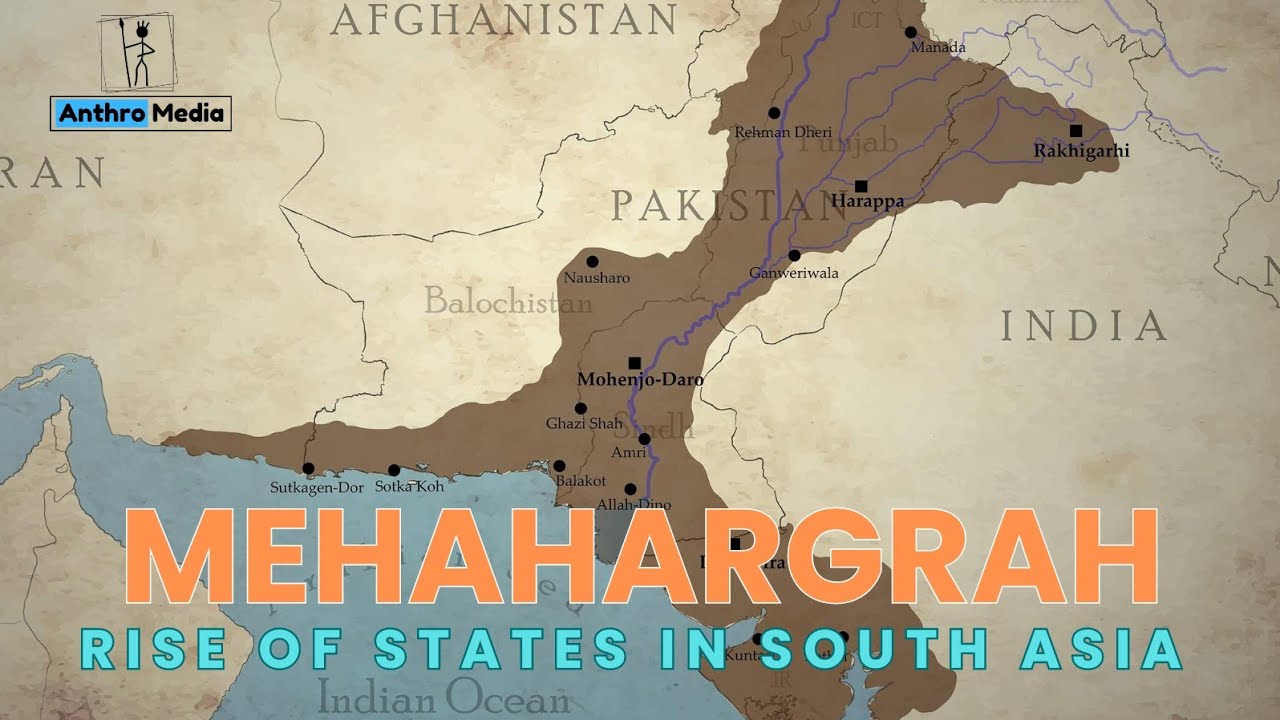
The discovery of the Mehrgarh settlement completely reshaped our understanding of early human history in the South Asian subcontinent. Located near the strategic Bolan Pass and west of the Indus River, this archaeological site reveals how early human communities moved away from a nomadic lifestyle focused purely on hunting and gathering. Over several millennia, the inhabitants of Mehrgarh mastered animal husbandry, built durable mud-brick structures, established complex trade networks, and developed sophisticated ceramic traditions. Understanding this transitional phase provides essential context for analyzing the foundation of the later Indus Valley Civilization.
In this chapter, you will understand:
- The transition of nomadic groups into early agrarian communities in South Asia.
- Architectural developments from temporary mud huts to multi-room mud-brick homes.
- Technological milestones including early metallurgy, lithic tools, and Togau Ware pottery.
- The cultural and economic links connecting Mehrgarh to the Harappan urban era.
Why this topic matters:Mehrgarh provides the earliest direct evidence of agriculture, animal domestication, and settled life in South Asia, making it a foundational subject for competitive exams and ancient history studies.
Core Idea: Occupational layers at Mehrgarh span from to , documenting the gradual shift from Neolithic foraging to a Chalcolithic farming society. The site demonstrates step-by-step technological progress in housing, grain storage, tool production, and long-distance trade. These cultural and economic advancements set the stage for the urban rise of the Indus Valley Civilization.
Mehrgarh's Critical Role as a Precursor to the Indus Valley Civilization
The cultural and technological groundwork laid at Mehrgarh directly influenced the eventual emergence of urban centers across the Indus plain. Its long occupation sequence reveals how basic survival strategies evolved into organized social structures.
Early Religious Beliefs and Figurine Art in Mehrgarh
Artifacts recovered from the site offer insights into the spiritual and symbolic lives of these early farmers. Terracotta figurines highlight an early interest in fertility and natural forces.
- Female figurines dominate the older archaeological layers, featuring detailed hairstyles and defined physical traits.
Spiritual Symbolism and Gender Representation
These early figures are widely interpreted as representations of a fertility deity, essential for a society relying on crop yields and livestock breeding.
- Figurines from Period I and II reflect a focus on maternal symbols linked to agricultural survival.
- Male figurines appear much later in the archaeological sequence, showing a shift in artistic focus over time.
- Crafting techniques for these clay figures improved alongside advancements in pottery firing.
- Similar symbolic objects appear across contemporary regional sites, indicating shared cultural practices.
The Transition from Nomadism to Settled Agriculture
Moving from mountain valleys to the plains allowed early groups to establish permanent camps, gradually shifting their main economic focus toward farming and herd management.
- Migrating groups brought wild animals under control, building steady herds of cattle, sheep, and goats.
- Cultivation focused heavily on einkorn wheat, emmer wheat, and two-row barley.
- Early food-processing tools, such as grinding stones and hearths, became standard fixtures in domestic areas.
- Archaeologists categorize this crucial era () as the Early Food-Processing Stage of the South Asian Stone Age.
Technological and Architectural Evolution in Mehrgarh
The shift to permanent living required continuous adaptation in building materials and daily tools, leading to stronger shelters and refined craft techniques.

- Early shelters made from mud and reeds were frequently damaged by seasonal river flooding.
Architectural Adaptation: From Mud Shelters to Mud-Brick Homes
To resist floodwaters, residents began shaping uniform sun-dried mud bricks, establishing a building method that lasted for centuries.
- Bricks were molded in regular proportions, allowing for sturdier rectangular structures.
- Multi-room layouts emerged, separating living quarters from working and storage zones.
- Thick walls provided insulation against seasonal temperature extremes in the valley.
- Communal spaces between houses suggest planned village layouts and cooperative living.
Agrarian Success, Grain Storage, and Pottery Craftsmanship
Reliable grain storage helped protect communities against drought, while the introduction of the potter's wheel revolutionized utility vessel production.
- Compartmentalized mud-brick granaries were constructed specifically to keep harvested grain dry and safe.
- By , multi-story structures and complex compound walls were in active use.
- Wheel-turned pottery enabled mass production of smooth, durable cookware and storage jars.
Advanced Craftsmanship, Long-Distance Trade, and Ceramic Traditions
Resourcefulness in toolmaking and trade helped Mehrgarh transform from an isolated farming village into an active trade hub linked to central and western Asia.
- Specialized stone tools, including fine bladelets and geometric microliths, improved daily woodworking and hide processing.
Pioneering Metalworking and Trade Networks
Early metallurgy began with the cold-hammering of native copper, paving the way for cast copper items in later periods.
Selected artifacts from Mehrgarh displaying geometric Togau Ware designs and early copper implements. Long-Distance Trade Evidence
- Lapis lazuli imported from Badakhshan shows active contact with northern regions.
- Turquoise beads from northeastern Iran highlight trade routes across the Iranian plateau.
- Seashell ornaments brought from the Arabian Sea coast demonstrate trade spanning hundreds of kilometers.
The Togau Ware Ceramic Sequence
The ceramic sequence known as Togau Ware serves as an important stylistic marker for dating layers across prehistoric Baluchistan.
- Togau A Phase: Features detailed painted animal figures, such as caprids and birds, along vessel interior rims.
- Togau B & C Phases: Animal figures gradually simplified into stylized hooks and geometric motifs.
- Togau D Phase: Designs converted into simple black lines and abstract geometric bands.
Quick Revision Capsule: Key Phases of Mehrgarh Culture
The historical evolution of Mehrgarh is divided into distinct cultural phases that reflect continuous technological advancement:
| Chronological Phase | Key Economic Activity | Major Technological Milestone |
|---|---|---|
| Period I () | Aceramic Agriculture & Pastoralism | Polished stone tools, mud shelters, and bone implements. |
| Period II () | Cereals Cultivation & Stock Breeding | Introduction of coarse handmade pottery and sun-dried mud bricks. |
| Period III () | Intensive Agriculture & Early Metallurgy | Potter’s wheel adoption, Togau Ware production, and copper smelting. |
| Period IV–VI () | Specialized Crafting & Regional Trade | Multi-room housing, extensive bead making, and intricate female figurines. |
| Period VII () | Pre-Urban Integration | Mass-produced ceramics and architectural styles leading into the IVC era. |
Summary
Mehrgarh remains one of the most significant archaeological sites in South Asia, documenting over four thousand years of continuous human development. Its deep occupational layers trace the transformation of nomadic foraging groups into organized farming communities. Through step-by-step advancements in mud-brick architecture, grain storage, wheel-made ceramics like Togau Ware, early copper metallurgy, and long-distance trade, Mehrgarh established the cultural, technological, and economic foundation for the subsequent rise of the Indus Valley Civilization.
Quick Revision Points for Students
Focus on these core facts when reviewing the material for examinations:
- (i) Located near the Bolan Pass in Baluchistan, Pakistan, serving as an ancient trade corridor.
- (ii) Provides the earliest evidence in South Asia for wheat and barley cultivation alongside cattle herding.
- (iii) Marks the transition from the Aceramic Neolithic phase to the Chalcolithic copper-using era by .
- (iv) Features distinctive ceramic traditions, particularly the evolution of wheel-turned Togau Ware.
- Exam Tip: Remember that Mehrgarh represents an aceramic (pottery-free) culture in its earliest period (Period I). Questions often test the chronological progression from early stock-breeding without pottery to the wheel-made ceramic phases of the later Chalcolithic periods.
Frequently Asked Questions (FAQ)
Q1: Why is Mehrgarh considered a precursor to the Indus Valley Civilization?
A1: Mehrgarh shows continuous development in farming, mud-brick architecture, craft specialization, and trade networks from onward, laying the direct economic and technological foundation for the urban Harappan period.Q2: What is the historical significance of Togau Ware ceramics?
A2: Togau Ware is a specialized ceramic style featuring red slip and black painted designs. Its design evolution from detailed animal figures (Togau A) to simplified geometric lines (Togau D) serves as a key marker for dating regional layers.Q3: What materials at Mehrgarh prove the existence of long-distance trade?
A3: The presence of lapis lazuli from northern Afghanistan, turquoise from northeastern Iran, and marine shells from the Arabian coast proves that Mehrgarh participated in extensive trade networks across Asia.