Explore the captivating world of Mughal miniature painting, a rich synthesis of Persian, Indian, and European artistic traditions that flourished from the . This detailed study of royal patronage under emperors like Akbar, Jahangir, and Shah Jahan offers deep insights into the evolution of Indo-Islamic visual culture for history and art scholars.
🎯 In this chapter, you will understand:
- The historical evolution and synthesis of Mughal painting from the to the .
- The royal patronage of key Mughal emperors including Babur, Humayun, Akbar, Jahangir, and Shah Jahan.
- Key differences between indigenous Indian traditions and Mughal optical realism.
- Major illustrated manuscripts like the Hamza Nama, Razm Nama, Akbar Nama, and Padshahnama.
💡 Why this topic matters: Understanding Mughal miniature painting highlights how diverse cultural traditions merged to form a uniquely refined Indo-Islamic art form that influenced both regional Indian schools and European masters.
🧠 Core Idea: Mughal court art evolved from Persian foundations into a distinct, realistic style through imperial patronage, cross-cultural synthesis, and meticulous workshop production.
🎨 Evolution and Patronage of Mughal Miniature Painting (16th–19th Century)
The Mughal painting style emerged as a sophisticated form of miniature art in the northern Indian subcontinent, spanning from the to the middle of the . Recognized for its refinement and varied themes, this style secured a distinct position, later inspiring numerous subsequent schools and styles of Indian painting.
- (i) The core identity of Mughal painting lies in its use of highly developed techniques and its exploration of a wide diversity of themes, setting a new benchmark for artistic expression.
- (ii) Its legacy is rooted in its ability to inspire and influence later painting traditions across India, marking it as a pivotal force in the history of subcontinental art.
👑 The Mughal Emperors as Patrons of Art and Illustration
The Mughal dynasty was renowned for its profound dedication to the arts, with each emperor making significant contributions to fields like calligraphy, painting, architecture, and bookmaking, which shaped the evolution of Mughal painting.
Imperial Interest and the Development of the Mughal Style
The story of Mughal painting is inextricably linked to the political and genealogical history of the ruling dynasty. Each Mughal ruler contributed uniquely, tailoring the art forms based on their personal tastes and aesthetic preferences, thereby creating a rich and evolving artistic tradition.
- (i) The Mughal rulers actively fostered various art forms, showing an especial fondness for illustration and miniature painting, elevating them to an imperial standard.
- (ii) The personal preferences of emperors dictated the subjects, styles, and scale of production within the royal ateliers.
- (iii) The evolution of Mughal painting is a visual chronicle of the dynasty's history, reflecting courtly life, military campaigns, and intellectual pursuits.
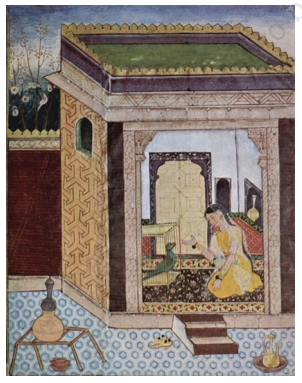
Tutinama Painting - A captivating piece depicting the fables of animals, offering insights into the morals and lessons in Mughal art. Artistic Synthesis: Persian, Indian, and European Influences
Mughal painting represents a remarkable cultural fusion, successfully integrating indigenous Indian themes and stylistic elements with the sophistication of Persian traditions and later incorporating influences from European visual culture. This synthesis resulted in an artistic diversity unparalleled in contemporary Indian and Iranian painting.
- (a) The style is defined by a bold synthesis, merging Islamic and Hindu visual narratives with the techniques and motifs introduced via European contact.
- (b) Mughal ateliers were comprehensive workshops, employing specialists like calligraphers, painters, gilders, and binders, highlighting the sophisticated production process.
- (c) The primary function of these paintings was to meticulously document important events, prominent personalities, and the various interests of the royal household, often serving as illustrations within manuscripts and albums.
Stylistic Difference: Indigenous Versus Mughal Realism
The Mughal style fundamentally transformed the existing indigenous Indian painting traditions by introducing a new level of subtlety and optical realism, moving away from the flatter, more abstract compositions of the earlier schools.
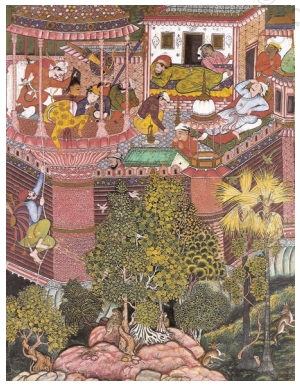
Spies of Hamza Attack - A dynamic depiction from the Hamzanama series, illustrating the thrilling moments of spies attacking the forces in a historical battle. - Indigenous Indian Style: Primarily utilized a flat perspective, characterized by strong, defining lines, and employed highly vivid colors without deep tonal variations.
- Mughal Style: Introduced nuances like three-dimensional figures, optical realism, and a refined handling of subtlety in color and shading, creating a sense of depth and life.
- Popular Themes: The dominant subjects included lavish royal court scenes, detailed individual portraits, and highly naturalistic depictions of flora and fauna.
🌱 The Formative Years: Early Mughal Painting Under Babur and Humayun
The foundation of Mughal painting was laid by the first two emperors, Babur and Humayun, who introduced the crucial Persian and Central Asian influences that defined the nascent style.
Babur's Influence and the Persian Aesthetic ()
Babur, the founder of the Mughal empire, was instrumental in introducing strong cultural and aesthetic influences primarily drawn from Persia and Central Asia. His literary works reflect a keen interest in the arts and natural observation.
- (i) His famous autobiography, the Baburnama, serves as a testament to his artistic sensibilities, filled with detailed observations of the Indian landscape and his passion for the arts.
- (ii) Babur’s memoirs mention key artists such as Bihzad, celebrated for his compositions, and Shah Muzaffar, known for his skill in portraiture and hairstyling techniques.
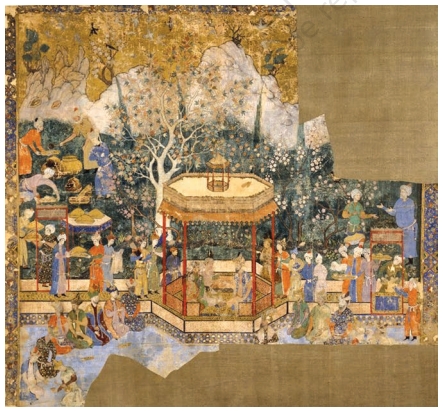
Princes of House of Taimur - A powerful portrayal of the royal Taimur lineage, highlighting the nobility and the legacy of the Mughal rulers. 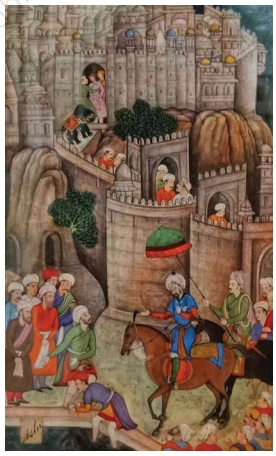
Babar Inspecting the Fort of Gwalior - A historical painting depicting the first Mughal emperor Babar inspecting the Gwalior Fort, symbolizing military strategy and conquest. Humayun's Foundational Contribution and the Nigaar Khana ()
Humayun's period of exile at the court of Shah Tahmasp of Persia proved transformative. Inspired by refined Persian miniature painting, he strategically brought masters like Mir Sayyid Ali and Abd us Samad back to India to establish the royal studio.
- (a) Humayun formally established the Nigaar Khana (painting workshop), initiating large-scale projects, most notably the illustration of the heroic narratives contained in the Hamza Nama.
- (b) The magnificent painting, Princes of the House of Timur (c. ) by Abd us Samad, exemplifies this early phase, using opaque watercolor on cotton and featuring the historical portraits of the dynasty members, often updated over time.
- (c) Humayun introduced the Persian-inspired style characterized by open-air settings, depicting lush trees, delicate blossoms, and formal royal gatherings.
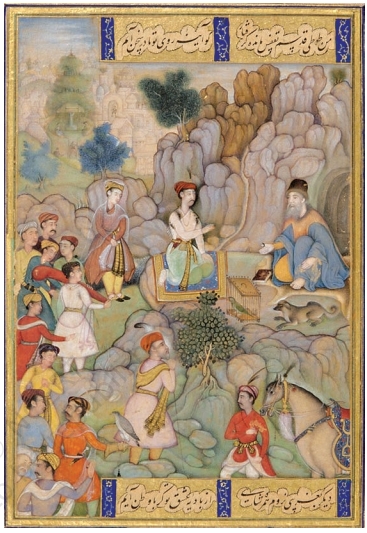
Painting of Prince and Hermit - A symbolic artwork capturing the meeting between a prince and a hermit, emphasizing the spiritual journey and introspection in Indian art.
🔥 Akbar the Great's Artistic Renaissance and Indigenous Integration ()
Emperor Akbar profoundly expanded the artistic legacy, forging a robust Indo-Persian style by establishing a massive, diverse royal atelier that marked the golden age of Mughal manuscript illustration.
The Grand Akbari Atelier and Major Manuscript Projects
Akbar employed over a hundred artists, integrating both master Persian and highly skilled Indian masters in his royal painting workshop. This blending of talent accelerated the synthesis of styles, resulting in monumental illustrated manuscripts.
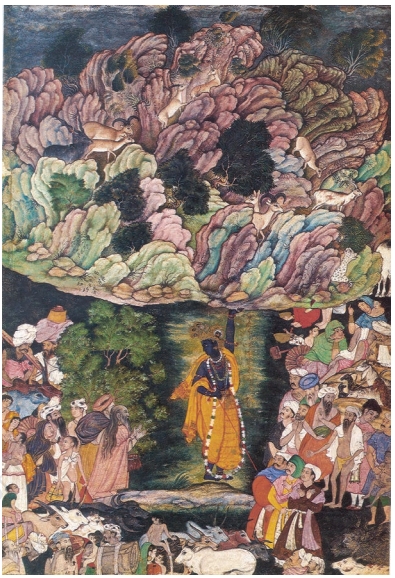
Miskin Harivamsa Krishna Lifting Mount Govardhana - A detailed painting from the Harivamsa, illustrating Lord Krishna's miraculous feat of lifting the Govardhana Hill. - (i) The Hamza Nama: An epic illustrated narrative detailing the heroic deeds of Hamza. This massive undertaking spanned 14 volumes with 1,400 illustrations, completed between and , utilizing a large format on a cloth base with opaque gouache technique, overseen by Mir Sayyid Ali and Abd us Samad.
- (ii) The Razm Nama: The Persian translation and comprehensive illustration of the Mahabharata, finished in under the supervision of the master artist Daswant.
- (iii) The Akbar Nama: A historical manuscript containing 169 paintings that meticulously documented Akbar’s extensive political and personal life and reign.
Characteristics of the Akbari Painting Style
The style under Akbar was expansive, covering a range of subjects from political conquests and court rituals to the narratives of Hindu mythologies and Persian-Islamic themes. It began to absorb naturalistic influences due to increasing interaction with European visitors at the Mughal court.
- (a) The artistic output reflected the emperor's cosmopolitan and inclusive approach, resulting in diverse themes and visual elements.
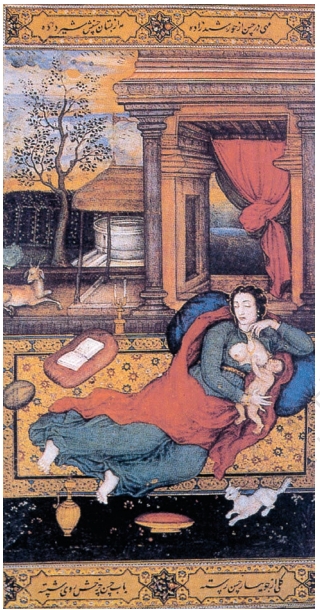
- (b) Paintings like the Madonna and Child (c. ) clearly demonstrate the early adaptation of European Renaissance themes and artistic sensibilities into the Mughal context.
🌿 Jahangir's Era: Naturalism and the Quest for Scientific Accuracy ()
Emperor Jahangir, an accomplished connoisseur, shifted the focus from mass production to individual artistic brilliance, cultivating a style marked by intense naturalism and a pursuit of near-scientific accuracy in depiction.
The Refined Jahangiri Atelier and the Muraqqas
Jahangir passionately sought high artistic refinement, employing masters like Aqa Riza and his son Abul Hasan. His atelier focused on producing a fewer number of works, but of significantly higher quality and finish.
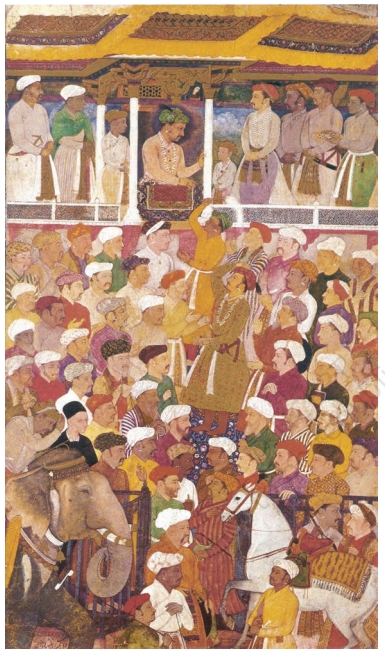
Jahangir's Darbar Painting by Abul Hasan and Manohar - A majestic portrayal of Jahangir's royal court, showcasing the splendor of the Mughal emperor's reign. - (i) A major innovation was the popularization of the Muraqqas (albums), which featured paintings with highly illuminated margins adorned with intricate depictions of flora, fauna, and poised human figures.
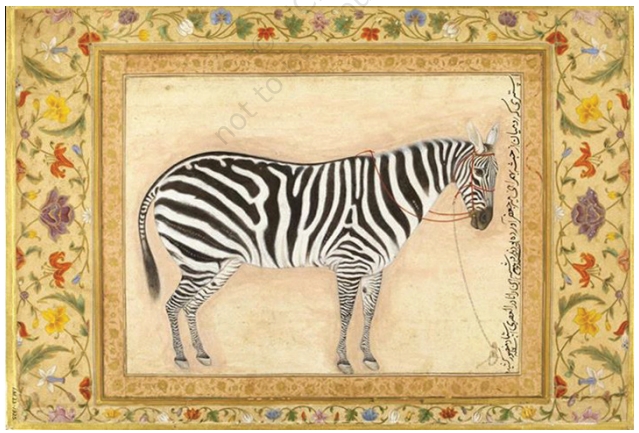
- (ii) Artistic subjects focused on opulent court scenes, realistic royal portraits, and minute, detailed studies of the natural world, reflecting the emperor's documented fascination in his memoirs, the Tuzuk-i-Jahangiri.
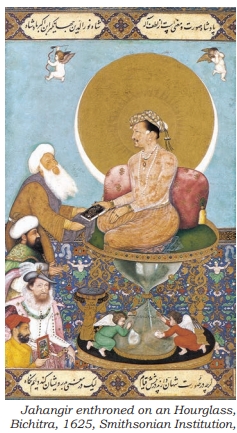
Painting of Jahangir by Bichitra - An exquisite Mughal portrait of Emperor Jahangir, embodying the grandeur and magnificence of the Mughal court. Blending European Sensibilities in the Jahangir School
Jahangir’s interaction with visiting Europeans, from whom he received numerous paintings and decorative objects, spurred the integration of European art motifs and even Christian religious themes into his court art. This fusion gave rise to the distinct and impressive Jahangir School of Art.
- (a) Key Features: The style incorporated an enhanced sense of spatial depth in composition, prioritized naturalistic representation of life, and achieved a seamless blending of indigenous, Persian, and European styles.
- (b) Detailed Artworks: The painting Jahangir in Darbar (c. ), attributed to Abul Hasan and Manohar, features the centrally seated emperor, detailed portraits of courtiers positioned by rank, and the inclusion of figures like Father Corsi, a Jesuit priest.
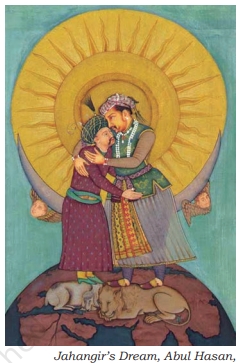
- (c) The Symbolic Dream:Jahangir's Dream (c. ) by Abul Hasan, depicting the emperor embracing the Safavid emperor Shah Abbas, uses powerful symbolism—Jahangir on a lion and Shah Abbas on a sheep—to convey Mughal dominance, further enriched by European motifs like golden halos and angels.
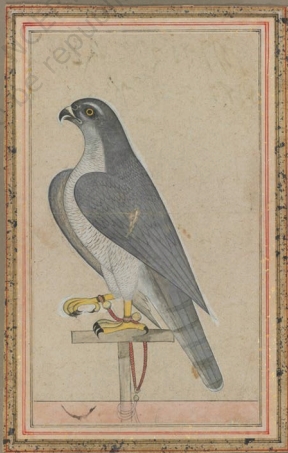
Falcon on Rest by Ustad Mansur Jahangir - A serene and detailed depiction of a falcon resting, illustrating the Mughal fascination with wildlife and nature.
🏛️ Shah Jahan's Era: Stylization, Idealization, and the Padshahnama
Emperor Shah Jahan inherited a politically stable empire and a flourishing atelier. His reign favored idealization and stylization in art, moving away from Jahangir's intense naturalism toward a grander, more formal aesthetic.
Hallmarks of Shah Jahani Painting
The art under Shah Jahan is characterized by opulence, technical precision, and a focus on high, often mystical, concepts, culminating in magnificent illustrated chronicles.
- (i) Aesthetic Choice: A preference for jewel-like colors and extremely intricate fine lines, lending the works a luxurious, regal finish.
- (ii) Thematic Focus: Emphasis on high concepts, promoting the emperor's idealized image and the political importance of his reign.
- (iii) Key Documentation: The era's magnificent artistic and historical records were compiled and documented in the famous manuscript, the Padshahnama.
Art Under Prince Dara Shikoh: Philosophy and Syncretism
Prince Dara Shikoh, son of Shah Jahan, was a notable patron in his own right, known for his deep intellectual interest in Sufi mysticism and Vedantic philosophy, which permeated the commissions under his guidance.
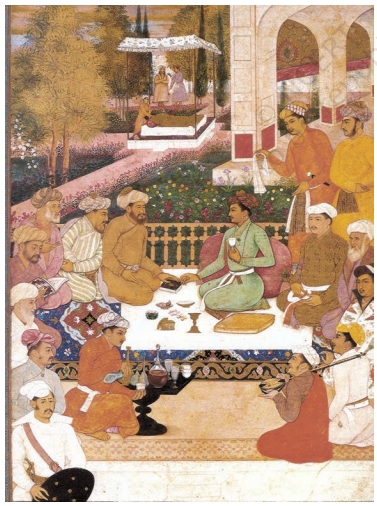
Dara Shikoh with Sages in Garden - A reflective scene portraying Dara Shikoh, the Mughal prince, with sages in a tranquil garden, emphasizing spirituality and wisdom. - (a) Key Commission: The painting Dara Shikoh with Sages in a Garden (c. ) by Bichitra exemplifies his eclectic and inclusive approach.
- (b) Personality Reflected: The artwork often portrayed his philosophical, eclectic, and inclusive nature, highlighting his spiritual journeys and intellectual companionship.
🌍 Aurangzeb's Reign and the Lasting Impact of Mughal Art
While Aurangzeb’s focus shifted towards political expansion, the royal atelier continued to produce paintings, marking the final stage of the imperial style before its decline and subsequent influence on other schools.
The Continuation of the Atelier Under Aurangzeb
Despite the emperor’s personal priorities being focused on governance and military expansion, and contrary to certain popular beliefs, the tradition of painting continued within the Mughal court during Aurangzeb's lengthy reign.
- (i) The focus on political affairs meant a reduction in the personal patronage seen in previous reigns, but the artistic skills and workshops persisted.
Global Influence of the Mughal School
The Mughal School was not merely a recipient of artistic influence; it became an exporter of style, blending the leading art traditions of its time and significantly influencing even European artists.
- (a) The famous Dutch master Rembrandt is known to have meticulously studied Mughal miniatures, drawing inspiration from their delicate lines, intricate compositions, and refined portraiture.
⚡ Quick Revision Capsule: Mughal Painting Timeline & Characteristics
A quick-reference comparison detailing the evolution of Mughal miniature painting across major imperial reigns:
| Ruler / Era | Key Contributions & Style | Major Works / Masters |
|---|---|---|
| Babur () | Introduced Persian and Central Asian aesthetics; keen interest in nature. | Mentions in Baburnama: Bihzad, Shah Muzaffar |
| Humayun () | Established the Nigaar Khana; introduced open-air Persian settings. | Princes of the House of Timur; Mir Sayyid Ali, Abd us Samad |
| Akbar () | Large ateliers; merged Indian, Persian, and European elements into dramatic narratives. | Hamza Nama, Razm Nama, Akbar Nama; Daswant, Basawan |
| Jahangir () | Scientific naturalism; flora & fauna focus; compilation of Muraqqas (albums). | Tuzuk-i-Jahangiri illustrations, Falcon on Rest; Ustad Mansur, Abul Hasan |
| Shah Jahan () | Formal stylization, rich jewel colors, fine lining, idealization of imperial authority. | Padshahnama; Dara Shikoh with Sages by Bichitra |
📝 Summary
The study of Mughal painting provides students with a vital understanding of Indo-Islamic art history, showcasing the unparalleled blending of Persian, Indian, and European styles across a dynamic period from Babur to Aurangzeb (). The emphasis on detailed naturalism under Jahangir and the opulent stylization under Shah Jahan are core insights. This tradition of royal patronage and its resulting masterpieces, such as the Hamza Nama and Padshahnama, serve as essential benchmarks for comprehensive exam preparation.
🚀 Quick Revision Points
Essential facts to review before examinations:
- (i) The Mughal style merged Persian miniature art with indigenous Indian techniques and European perspective.
- (ii) Humayun set up the royal workshop (Nigaar Khana) after returning from Persian exile.
- (iii) Akbar oversaw large-scale manuscript projects like the Hamza Nama (1,400 illustrations on cloth) and Razm Nama.
- (iv) Jahangir introduced scientific realism, bird/animal studies, and elaborate album margins (Muraqqas).
- 💡 Exam Tip: When answering questions on Mughal art, highlight the transition from Akbar's dramatic narrative action to Jahangir's scientific naturalism and Shah Jahan's formal idealization.
❓ Frequently Asked Questions (FAQ)
Q1: What is the Nigaar Khana?
A1: The Nigaar Khana was the imperial painting workshop established by Emperor Humayun, which served as the primary production hub for Mughal illustrated manuscripts.Q2: How did Mughal painting differ from traditional indigenous Indian painting?
A2: Indigenous Indian painting relied on flat perspectives, bold outlines, and vivid flat colors, whereas Mughal painting introduced three-dimensional figures, optical realism, fine line shading, and spatial depth.Q3: What role did European art play in the Jahangir school?
A3: Under Jahangir, contact with European artworks introduced elements like golden halos, cherubs, and linear perspective into portraits recorded in texts like the Tuzuk-i-Jahangiri.