The Mughal Miniature Painting tradition represents a brilliant artistic fusion of Persian Safavid techniques and native Indian artistic styles. Flourishing between the , this movement holds a prominent place in South Asian history. It spans from the royal court of Emperor Humayun to the final years of imperial rule, showcasing renowned painters like Abdus Samad and Ustad Mansur. Famous projects like the Akbarnama highlight how these intricate techniques developed over time. Grasping these artistic methods and their cross-cultural ties is essential for students preparing for historical and cultural studies.
🎯 In this chapter, you will understand:
- How Persian and Indian artistic styles merged under early Mughal rulers.
- The major contributions of master painters during the reigns of Akbar and Jahangir.
- The technical stages and natural materials used to produce miniature paintings.
- The political shift that caused imperial art to spread into regional traditions.
💡 Why this topic matters: Mughal miniatures offer a visual record of court life, imperial politics, and cultural exchange across South Asia.
🧠 Core Idea: The tradition brought together Persian structure, Indian color choices, and European realism to create a distinct imperial style.
Mughal Miniature Painting: Origin, Evolution, Master Artists, and Techniques (16th–19th Centuries)
The Mughal painting style began when Emperor Humayun invited two leading Persian artists to establish a royal studio. This decision set the stage for a new visual tradition in India.
- (i) The foundations of the Mughal school of painting were established during Humayun’s period of exile, when he met and recruited talented Persian masters.
- (ii) These artists brought the refined Safavid style to the court, known for its detail, rich colors, and formal layouts, which slowly adapted to regional Indian tastes.
- (iii) The partnership between Persian masters and Indian craftsmen in the royal workshop gave rise to a blend of styles that flourished under Akbar.
Master Artists Patronized by Emperor Humayun: Laying the Foundation
Emperor Humayun brought Persian miniature traditions to India by securing two influential painters who shaped the foundation of Mughal art.
Abdus Samad: The Master of Vibrant Miniatures and Persian Finesse
Khwaja Abdus Samad was celebrated for his control over bright colors and fine detail work. He later played a leading role in directing Akbar’s busy art studio.
- (i) He was recognized for his skill in painting portraits, capturing soft clothing textures, and rendering natural landscapes in the traditional Persian manner.
- (ii) His work in the manuscript Khamsa of Nizami displays his technical skill through detailed figures, floral patterns, and vivid color schemes.
- (iii) His presence ensured that early Mughal art maintained the technical quality and polish of the Safavid school.
Mir Sayyid Ali: The Courtly Storyteller and Master Draftsman
Mir Sayyid Ali was a pioneering artist known for depicting court events and historical stories with clarity and expression.
- (a) His illustrations for the Shahnameh of Ferdowsi feature balanced layouts, expressive faces, and clear details in clothing and surroundings.
- (b) Along with Abdus Samad, he helped shift manuscript design from a purely Persian layout toward a style open to local Indian touches under Akbar.
- (c) Both artists guided the next generation of painters, creating a strong routine of collaborative manuscript work.
Akbar's Favorite Art Project: The Monumental "Akbarnama"
Under Emperor Akbar, royal patronage expanded significantly. His primary commission was his official biography, the Akbarnama, which reflected his vision of a diverse empire.
The Akbarnama: Fusion of Persian and Indian Artistry
The Akbarnama serves as a central milestone in Mughal art. Directed by artists like Abdus Samad, this group project illustrated Akbar’s life, military campaigns, and court events.
- (i) The main feature of the Akbarnama is its combination of Persian layout rules and energetic Indian details, especially visible in active battle scenes.
- (ii) The artwork records key events, such as the Second Battle of Panipat, using clear visual storytelling.
- (iii) The manuscript stands out for its detailed buildings, varied figures, and smooth combination of different regional styles into one imperial look.
Notable Mughal Artists and Their Unique Contributions to Imperial Painting
Although the imperial studio relied on teamwork, individual painters developed distinct personal styles during the rules of Akbar and Jahangir.
Master Mughal Artists and Their Iconic Works
Key artists focused on specific subjects ranging from emotional human drama to detailed studies of nature:
- Basawan: Skilled at showing personal emotion and narrative depth. His contributions to the Tutinama (Tales of a Parrot) use expressive figures and strong color choices.
- Daswanth: Focused on traditional Indian themes with detailed borders and rich colors. His work on the manuscript of the Ramayana demonstrates his versatility.
- Ustad Mansur: Gained recognition under Jahangir for his focus on nature. His famous study, Dodo and Crane, established him as a master of natural history paintings.
- Abdus Samad: Contributed action scenes and detailed Persian border work to the large Hamzanama project.
- Mir Sayyid Ali: Maintained refined Safavid techniques and narrative pacing in his work for the Shahnameh.
Visual Elements: Cross-Cultural Influences in Mughal Painting
Mughal art succeeded by combining elements from local Indian traditions, Persian Safavid styles, and European Renaissance artwork.
Indigenous Indian Elements: The Integration of Mythology and Brightness
Indian traditions brought saturated colors and new perspectives to the art form, drawing from native styles like Rajput painting.
- (i) The painting Krishna Lifting Mount Govardhan shows this balance, pairing Mughal composition with bold Indian subject matter.
- (ii) These local touches introduced vivid pigments, flatter background views, and a focus on traditional regional stories.
Persian Elements: Symmetrical Composition and Idealization
Persian traditions provided structured layouts, soft color palettes, and neat border patterns.
- (a) The early work Hamzanama demonstrates Persian styling through symmetrical designs and floral borders.
- (b) This tradition introduced pastel tones and smooth, idealized human forms focused on court elegance over direct realism.
European Elements: Realism, Shading, and Depth
Under Jahangir, painters adopted European artistic tools brought by European visitors, adding realistic depth to their work.
- (i) Works like Jahangir Holding a Globe show the use of light shading, realistic distance, and natural physical proportions.
- (ii) The inclusion of a light halo (nimbus) around the emperor’s head combined Christian and Islamic symbolic art to show royal authority.
The Sophisticated Process and Colors of Mughal Painting
Creating a miniature painting was a multi-step team effort requiring specialized preparation of papers, sketches, and natural pigments.
The Process of Mughal Miniature Creation
Miniatures were designed to fit into bound manuscripts and royal albums, requiring clean coordination between painters and calligraphers.
- (i) Workers first prepared smooth, handmade paper. They marked out blank spaces for pictures before calligraphers wrote out the main text.
- (ii) Artists then completed the image through three distinct stages:
Stages of Mughal Painting
- (a) Tarh: The initial stage of drawing the outline and setting up the composition.
- (b) Chiharanama: The delicate work of painting faces and facial expressions.
- (c) Rangamizi: The final stage of layering opaque colors across the sketch.
- (iii) Studio painters specialized in these different stages, and their pay matched their level of technical skill.
Colors and Techniques: Natural Pigments and Burnishing for Radiance
The bright appearance of these paintings came from natural mineral pigments, finished with stone polishing for long-lasting color.
- (i) Painters used Vermilion (made from cinnabar), Ultramarine (ground from lapis lazuli stone), Bright Yellow (from orpiment), White (from crushed shells), and Black (from lamp charcoal).
- (ii) Ground gold and silver powders were mixed into paint or dusted over surfaces to highlight royal clothing and objects.
- (iii) After painting, artists polished the back of the page with a smooth agate stone. This burnishing process smoothed the pigments and gave the surface a durable, glossy shine.
The Decline and Merging of Later Mughal Painting
As financial and political support from the central court decreased in the , painters moved away from Delhi to seek work in regional courts.
Provincial Patronage and Artistic Dissemination
Skilled artists left the primary imperial workshop and took jobs with regional leaders who wanted to capture the style of the capital.
- (i) Regional courts commissioned artwork showing their own rulers, regional battles, and local court events using Mughal techniques.
- (ii) Later emperors like Muhammad Shah Rangila, Shah Alam II, and Bahadur Shah Zafar continued to hire painters, though on a smaller scale.
- (iii) Bahadur Shah Zafar, a skilled poet, commissioned expressive portraits before the events of the revolt led to his exile.
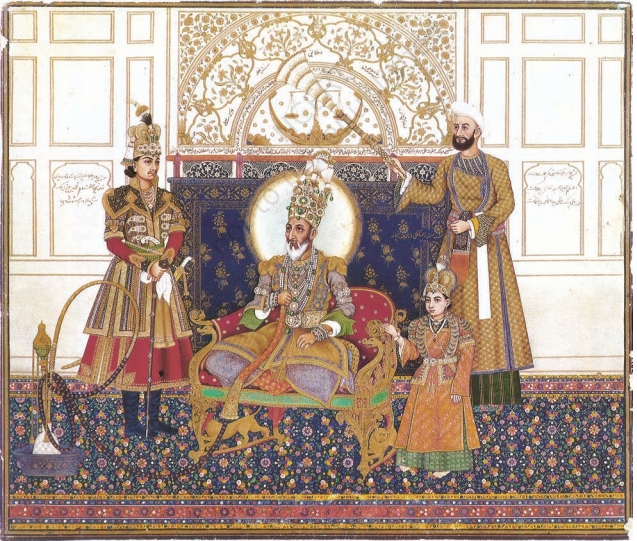
Painting of Bahadur Shah Zafar - A portrait capturing the final years of the last Mughal ruler. - (iv) Over time, the main imperial style merged with local traditions, forming regional styles and later influencing the Company School of art.
Famous Mughal Paintings and Their Historical Significance
Key surviving paintings highlight the technical range, subjects, and historical changes seen across the Mughal period.
Iconic Works of Mughal Miniature Art
These individual pieces provide detailed visual evidence of court preferences, diplomatic exchanges, and religious interactions:
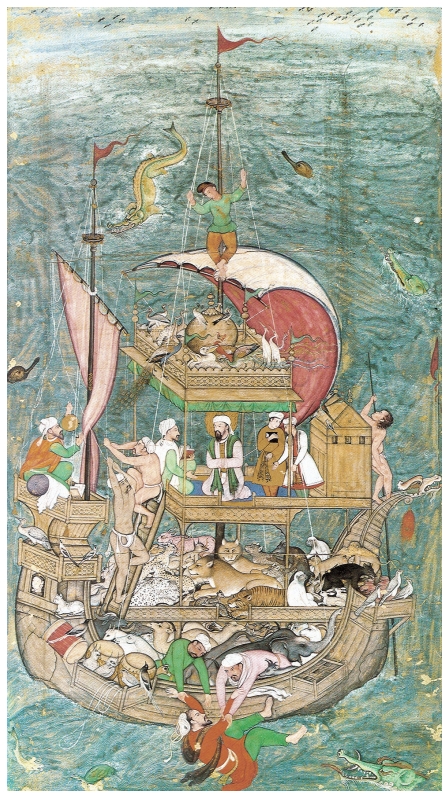
- (i) Noah’s Ark: Painted by Miskin around and held in the Freer Gallery of Art, this image illustrates Prophet Noah and animal pairs during the flood using vertical composition.
- (ii) Krishna Lifts Mount Govardhan: Painted by Miskin around for the Harivamsa Purana, showing Lord Krishna protecting villagers, reflecting Akbar’s interest in Hindu texts.
- (iii) Falcon on a Bird Rest: Painted by Ustad Mansur in for Jahangir. It shows a falcon sent by Shah Abbas of Persia, complete with Devanagari lettering along the border.
- (iv) Zebra: Created by Ustad Mansur in for Jahangir’s natural history collection, capturing an African zebra brought through trade networks.
- (v) The Marriage Procession of Dara Shikoh: Painted by Haji Madni, this piece shows the festive crowds, gifts, and lights during Dara Shikoh’s wedding celebration.
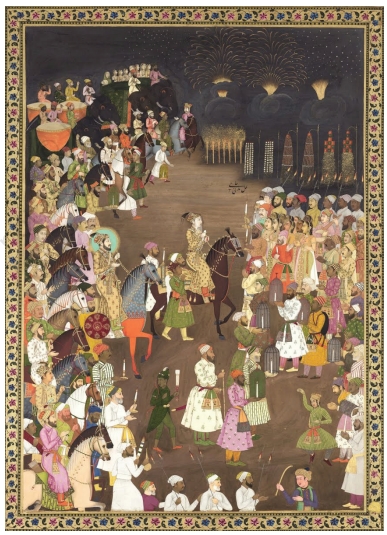
Marriage Procession of Dara Shikoh - An illustration of royal wedding celebrations and court luxury. Details of the Royal Procession
- (a) Shah Jahan appears in the scene with a golden nimbus halo around his head to signify royal status.
- (b) The painting documents historical wedding customs, showing musicians, attendants, and celebratory fireworks displays.
⚡ Quick Revision Capsule: Mughal Miniature Painting Overview
Use this summary table to review primary figures, techniques, and famous artworks across the Mughal era.
| Category | Key Elements & Artists | Historical Significance |
|---|---|---|
| Foundational Era | Emperor Humayun, Abdus Samad, Mir Sayyid Ali | Introduced Safavid Persian layout standards and established the royal studio in India. |
| Peak Expansion | Akbar, Basawan, Daswanth | Created large group manuscripts like the Akbarnama, combining local and Persian methods. |
| Natural History | Jahangir, Ustad Mansur | Focused on realistic animal portraits (Falcon on a Bird Rest) and European lighting styles. |
| Technical Stages | Tarh (Outline), Chiharanama (Faces), Rangamizi (Coloring) | Systematic studio process utilizing natural minerals and agate stone burnishing. |
| Later Transition | Bahadur Shah Zafar, Regional Courts | Spread imperial techniques to regional studios, giving rise to regional and Company School art. |
📝 Summary
The Mughal miniature tradition remains an essential topic for understanding South Asian art history. Starting under Humayun and developing through the rules of Akbar and Jahangir, it combined Persian composition, Indian color schemes, and European realistic shading. Masterpieces like the Akbarnama and natural studies by Ustad Mansur highlight this blend. Understanding technical steps like Tarh, Chiharanama, and Rangamizi, alongside the use of mineral pigments, provides valuable context for history and art examinations.
🚀 Quick Revision Points
Essential facts to review before examinations:
- (i) Mughal Miniature Painting began when Humayun brought Persian artists Abdus Samad and Mir Sayyid Ali to India.
- (ii) Akbar encouraged the merger of Persian layouts with vibrant Indian details, as seen throughout the Akbarnama.
- (iii) Ustad Mansur specialized in realistic natural history studies during Jahangir's reign.
- (iv) Miniature creation followed three clear steps: Tarh (sketching), Chiharanama (portrait faces), and Rangamizi (color painting).
- 💡 Exam Tip: Focus on identifying how Persian symmetry, Indian color choices, and European depth combined in specific paintings like Krishna Lifting Mount Govardhan and Jahangir Holding a Globe.
❓ Frequently Asked Questions (FAQ)
Q1: Who established the Mughal school of miniature painting in India?
A1: Emperor Humayun established the foundation by inviting Persian masters Abdus Samad and Mir Sayyid Ali to direct his royal studio.Q2: What are the three main technical stages of making a Mughal miniature?
A2: The three main stages are Tarh (sketching the initial layout), Chiharanama (painting the details of faces), and Rangamizi (applying opaque color layers).Q3: How did European art influence Mughal painting under Jahangir?
A3: Contact with European visitors introduced light shading, spatial depth, realistic body proportions, and symbolic elements like the royal halo (nimbus) seen in paintings like Jahangir Holding a Globe.