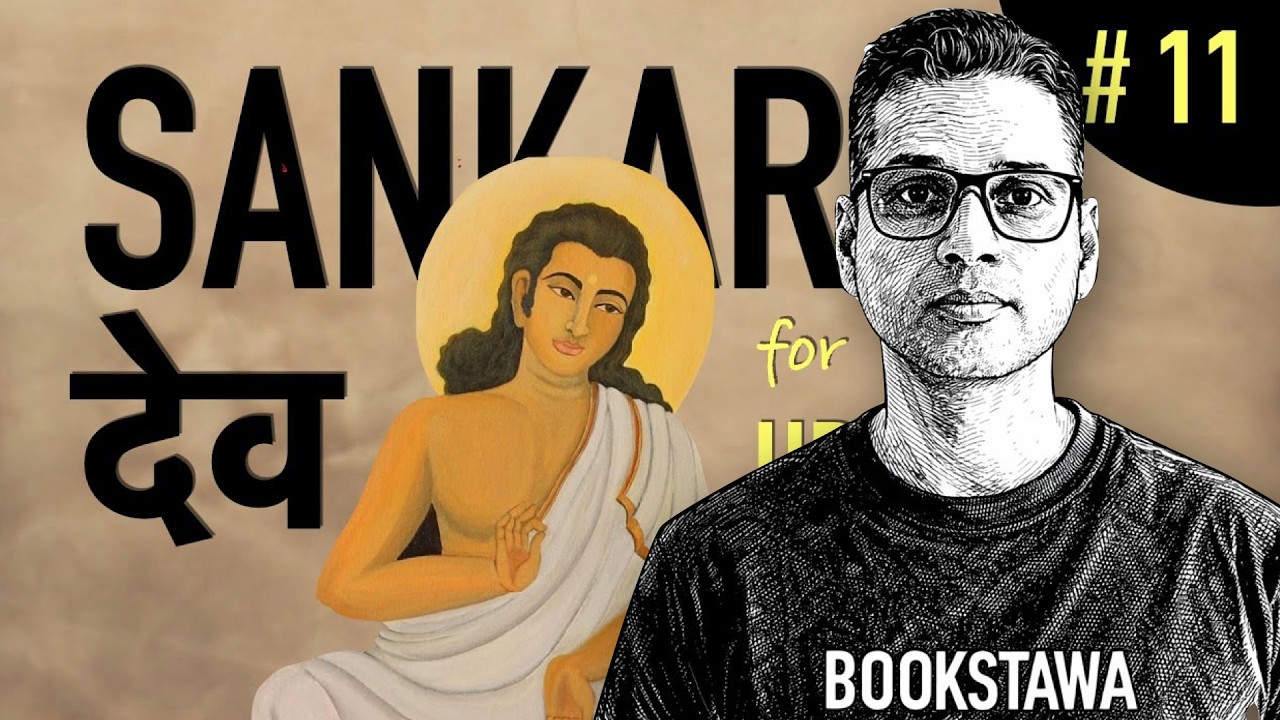
Srimanta Sankardeva () was a polymath of Assam whose contributions in literature, art, music, and spirituality left a deep mark on Indian history. Known as a saint-scholar and social-religious reformer, he founded Ekasarana Dharma and started the Bhakti movement in Assam. His works are very important for students preparing for Indian history and cultural studies, showing how devotion, art, and literature shaped Assamese society.
🎯 In this chapter, you will understand:
- The early life, upbringing, and spiritual transformation of Srimanta Sankardeva.
- His core literary, theatrical, and musical creations like Kirtana Ghosha, Ankia Naat, and Sattriya dance.
- The foundation and main principles of Ekasarana Dharma and the Sattra institutional system.
- His broader impact on the Bhakti movement, regional unity, and Assamese social equality.
💡 Why this topic matters: Srimanta Sankardeva transformed the cultural and spiritual identity of Assam by making devotion inclusive and creating art forms that are still vibrant today.
🧠 Core Idea: Unifying society through pure devotion to Lord Krishna, replacing costly rituals with song, dance, drama, and community prayer.
Srimanta Sankardeva: Contributions to Assamese Culture and the Bhakti Movement ()
Overview: Srimanta Sankardeva’s life combined deep devotion, artistic skill, and social reform, giving shape to Assam's religious and cultural identity.
Born in Alipukhuri, near Bordowa in modern Nagaon, Assam, Sankardeva belonged to the Baro-Bhuyans family. Despite facing early personal hardships, he showed great talent in writing, arts, and spiritual studies, laying the groundwork for his life's work.
- (i) Showed writing talent from childhood; wrote the poem Karatala Kamala Kamala Dala Nayana at twelve years of age.
- (ii) Mastered sacred texts, yogic practices, and physical skills like swimming, showing a well-rounded education.
- (iii) Experienced a spiritual shift after the death of his first wife Suryawati, turning his focus to single-minded devotion to Lord Krishna.
Early Life and Upbringing of Srimanta Sankardeva
His early environment and family background shaped his later achievements, bringing together knowledge, faith, and leadership.
Childhood Talents and Education
Sankardeva showed exceptional learning and artistic skills at an early age. Reading religious texts and observing local cultural practices prepared him for his future role as a reformer.
- (i) Composed poetry using only vowels and consonants without using any vowel marks, proving his early mastery over language.
- (ii) Gained deep knowledge of sacred scriptures, traditional music, and dance.
- (iii) Built spiritual discipline and practiced yoga under his early teachers.
Personal Tragedy and Spiritual Awakening
The loss of his wife Suryawati brought a deep inner change, guiding him toward total devotion to Lord Krishna and leading to his religious teachings.
- (a) Focused on personal devotion rather than complicated ritualistic traditions.
- (b) Created early devotional writings that expressed deep spiritual feelings.
- (c) Took inspiration from Vaishnavite traditions and active Bhakti thinkers across India.
Contributions to Art and Literature
Sankardeva’s writings and artistic works built the foundation of Assamese devotional culture, combining multiple art forms for spiritual expression.

Literary Genius: Kirtana Ghosha and Related Works
His writings, which include devotional songs and plays, were made to teach and inspire large gatherings with spiritual and moral values.
- (i) Kirtana Ghosha: The main devotional text of Assamese religious life, focusing on group prayers and singing.
- (ii) Gunamala: A brief, clear version of the Bhagavata Purana written in simple Assamese language.
- (iii) Borgeet: A collection of devotional songs that blend poetic beauty with deep spiritual meaning.
Dramatic and Musical Innovation
He transformed stage performance in Assam by uniting music, dance, and drama to build powerful spiritual experiences.
- (a) Ankia Naat: One-act plays like Kaliya Daman and Patni Prasad, illustrating stories of Krishna and Rama.
- (b) Sattriya Dance: A classical dance style that brings together devotion and performance arts.
- (c) Created community-based performances that brought people together and provided spiritual education.
Establishment of Ekasarana Dharma
The neo-Vaishnavite movement started by Sankardeva put faith and devotion above rituals. It was open to people of all social backgrounds and was spread through literature, music, and group prayers.
Principles of Ekasarana Dharma
It focused on a direct connection with Lord Krishna, moving past caste barriers and rituals to make faith welcoming to all.
- (i) Prioritized bhakti (devotion) over complex outer rituals.
- (ii) Used group singing (kirtan) and listening to sacred stories (sravan) as main forms of worship.
- (iii) Taught moral living, kindness, and inner discipline.
Scriptures and Monastic Institutions
Translating sacred books and building monasteries helped spread his teachings and protect local culture.
- (a) Translating the Bhagavata into Assamese made complex teachings easy for common people to understand.
- (b) Sattras: Monasteries that served as center points for social, religious, and cultural activities.
- (c) Provided centers for teaching music, drama, dance, and community work.
Influence on the Bhakti Movement
Sankardeva’s work extended far beyond Assam, reaching neighboring kingdoms and adding greatly to the broader Indian Bhakti movement.
Regional Unity and Cultural Integration
He brought harmony among communities, linking different groups through devotion, theater, and poetry.
- (i) Built stronger cultural connections across the Koch and Ahom kingdoms.
- (ii) Encouraged shared cultural practices across different tribes and social levels.
- (iii) Inspired local communities to take an active part in art and music.
Comparison with Other Bhakti Leaders
His ways of teaching matched famous reformers like Ramananda, Kabir, and Chaitanya Mahaprabhu, reflecting a nationwide movement of devotional reform.
- (a) Focused on personal devotion instead of caste-based rules.
- (b) Used song, drama, and local language literature to teach everyone.
- (c) Helped spread Vaishnavism across northern and northeastern parts of India.
Summary: Srimanta Sankardeva’s Cultural and Spiritual Legacy
Srimanta Sankardeva changed Assamese art, literature, and spirituality through his varied works between . By founding Ekasarana Dharma and leading the Bhakti movement in Assam, he built lasting institutions. His work remains vital for students learning about Indian history, social reform, and cultural traditions.
Srimanta Sankardeva: Creative Innovations and Cultural Impact in Assam
Overview:Srimanta Sankardeva was a pioneer of the Bhakti movement in Assam. His creative and spiritual efforts transformed the region's religious and cultural life, leaving a lasting mark on cultural practices and history studies.
- (i) Introduced open-air theater practices that were ahead of their time.
- (ii) Created an easy-to-understand literary dialect by blending regional languages.
- (iii) Wrote devotional texts that shaped regional traditions.
Creative Innovations of Srimanta Sankardeva
Sankardeva's new ideas gave Assam its unique artistic style and religious identity.
Cihna Jatra: Pioneering Open-Air Theater
Cihna Jatra was one of the earliest open-air play performances in the world, created to share religious stories with entire villages through drama and art.
- (i) Gave a platform for showing Bhakti-themed plays to people of all backgrounds.
- (ii) Brought communities together by mixing music, dance, and storytelling.
- (iii) Served as an educational tool, teaching moral values and culture.
Brajavali: Literary Dialect Innovation
Brajavali was a special literary language crafted by Sankardeva by mixing Assamese, Brajbhasha, and Maithili so that people from different areas could understand it easily.
- (a) Made devotional stories clear and easy to understand for all audiences.
- (b) Helped connect different language communities through shared plays and songs.
- (c) Helped poets and performers express deep spiritual thoughts clearly.
Devotional Literature and Enduring Cultural Legacy
Sankardeva’s writings are remembered for their depth and beauty, continuing to guide Assam’s culture today.
- Bhakti texts: Encouraged moral life and faith among his followers.
- Narrative works: Preserved ancient stories for teaching future generations.
- Cultural impact: Inspired art forms, festivals, and stage traditions across Assam.
Challenges and Resilience
Sankardeva faced strong opposition during his lifetime, but he stayed firm in sharing his vision.
Opposition from Orthodox Brahmins and Regional Rulers
His reforms questioned old social hierarchies, leading to pushback from traditional priests and some local rulers.
- (i) Faced criticism for speaking out against costly, exclusive rituals.
- (ii) Handled political pressure by explaining his peaceful philosophy clearly in royal courts.
- (iii) Earned deep respect through his gentle character, eventually winning protection from kings.
Devotion and Humility Amid Recognition
Even when offered high power and positions near the throne, Sankardeva chose a modest life dedicated to teaching people.
- (a) Turned down royal favors to keep his spiritual work independent.
- (b) Focused his energy on setting up sattras and community halls.
- (c) Kept spiritual knowledge open and available to every person in society.
Legacy of Srimanta Sankardeva
Sankardeva’s teachings brought unity, equality, and pride to Assam, leaving a lasting legacy.
Uniting Society Through Bhakti
His focus on love, faith, and good values helped overcome social divisions, uniting people through Bhakti.
- (i) Promoted social equality through his devotional lessons.
- (ii) Encouraged everyone to gather at sattras and festivals.
- (iii) Built a strong cultural identity shared across the region.
Cultural and Educational Influence
By creating institutions and promoting performance arts, Sankardeva opened new ways for learning and creativity.
- (a) Sattras: Active centers for learning, social gatherings, and art.
- (b) Inspired generation of musicians, actors, and writers across Assam.
- (c) Serves as a vital study topic for students of Indian history and culture.
Spiritual and Temporal Legacy
Passing away in at the age of 120, Sankardeva left a lasting gift to Assam’s culture and spirit.
- (i) His writings continue to guide moral living and devotion today.
- (ii) Made Assam a vibrant center for Bhakti and artistic creations.
- (iii) Remains a main figure in Indian cultural studies for students.
Conclusion: Sankardeva’s Enduring Impact on Indian Culture
Srimanta Sankardeva shaped Indian art, culture, and spirituality. His focus on unity, devotion, and artistic expression remains at the heart of Assamese culture and serves as a key topic for students preparing for history and culture exams.
Srimanta Sankardeva, a saint and reformer of Assam, transformed Indian art, culture, and spirituality through his artistic work, devotional writings, and social reforms. His achievements in Assam are important for students preparing for history exams, showing his creative skill and lasting impact on society.
⚡ Quick Revision Capsule: Srimanta Sankardeva
A structured quick review of Srimanta Sankardeva's life, major works, and social impact.
| Category | Key Contributions & Concepts | Historical & Cultural Impact |
|---|---|---|
| Basic Life Details | Lived ; born in Alipukhuri, Nagaon to the Baro-Bhuyans family. | Lived to age 120, transforming Assamese social and cultural life. |
| Religious Reform | Founded Ekasarana Dharma focused on single-minded devotion to Lord Krishna. | Removed expensive rituals and caste divisions in spiritual practices. |
| Major Literature | Wrote Kirtana Ghosha, Gunamala, and Borgeet devotional songs. | Created accessible spiritual books in local language and Brajavali dialect. |
| Performing Arts | Created Ankia Naat plays, Cihna Jatra open-air theater, and Sattriya Dance. | Established classical performing art traditions that continue today. |
| Key Institutions | Built Sattras (monasteries) and Namghars (prayer halls). | Created community centers for worship, learning, and local governance. |
📝 Summary
During his long life from , Srimanta Sankardeva re-shaped Assam's social and cultural landscape through the Bhakti movement. By writing classics like Kirtana Ghosha and pioneering open-air drama like Cihna Jatra, he brought art and spiritual learning to all levels of society. His institution of Sattras continues to protect Assamese culture and promote social harmony today.
🚀 Quick Revision Points
Essential facts to review before examinations:
- (i) Formulated Ekasarana Dharma, which centers on pure devotion to Lord Krishna without caste barriers.
- (ii) Pioneered Ankia Naat (one-act plays) and created the artificial literary language called Brajavali.
- (iii) Established Sattras (monastic centers) and Namghars (community prayer halls) across Assam.
- (iv) Composed foundational texts like Kirtana Ghosha and sacred devotional songs known as Borgeet.
- 💡 Exam Tip: Focus on the four pillars of Sankardeva's legacy for exam questions: Ekasarana Dharma (religion), Brajavali (language/literature), Sattriya (dance/drama), and Sattras (institutional network).
❓ Frequently Asked Questions (FAQ)
Q1: What is Ekasarana Dharma?
A1: It is a neo-Vaishnavite devotional movement founded by Srimanta Sankardeva that emphasizes single-minded devotion (bhakti) to Lord Krishna, setting aside ritualistic sacrifices and caste distinctions.Q2: What is Brajavali and why was it created?
A2: Brajavali is a literary dialect blending Assamese, Brajbhasha, and Maithili created by Sankardeva to make devotional plays and songs understandable across different linguistic regions.Q3: What role do Sattras play in Assamese society?
A3: Sattras are monastic institutions that serve as centers for religious teaching, preservation of classical arts like Sattriya dance, and community gathering.