The Rashtrakuta Dynasty held a major position in medieval Indian politics, culture, and governance across the Deccan and South India, ruling from to . Their reign is known for military wins, rock-cut temple architecture, rich books and poetry, and clear administrative systems, making this topic important for students preparing for history exams. Learning about famous Rashtrakuta rulers helps us see the political power and culture of southern and western India in the medieval era.
🎯 In this chapter, you will understand:
- How the Rashtrakutas rose to power from local roots to rule the Deccan.
- The military achievements of major kings like Dantidurga, Dhruva, and Amoghavarsha I.
- Masterpieces of rock-cut temple art, such as the Kailasanatha Temple at Ellora.
- The growth of early Kannada literature and the administrative setup of the empire.
💡 Why this topic matters: The Rashtrakutas connected northern and southern Indian politics, creating architectural wonders that still stand today.
🧠 Core Idea: Strong military leadership combined with royal support for art, Jainism, and Kannada literature created a stable and wealthy empire in medieval India.
Rashtrakuta Dynasty: Deccan Rulers, Administration, Art, and Literature (753–982 CE)
The Rashtrakutas quickly grew into the strongest power in southern and western India, creating a large empire famous for stability, art, and respect for different religions.
Their empire covered main parts of modern Karnataka, Maharashtra, and sections of Andhra Pradesh. Their capital was Manyakheta (modern Malkhed), which served as the center for trade, politics, and culture.
- (i) The rulers traced their roots to the old Rastikas or Rathikas, a Kannada-speaking group first named in the Edicts of Ashoka.
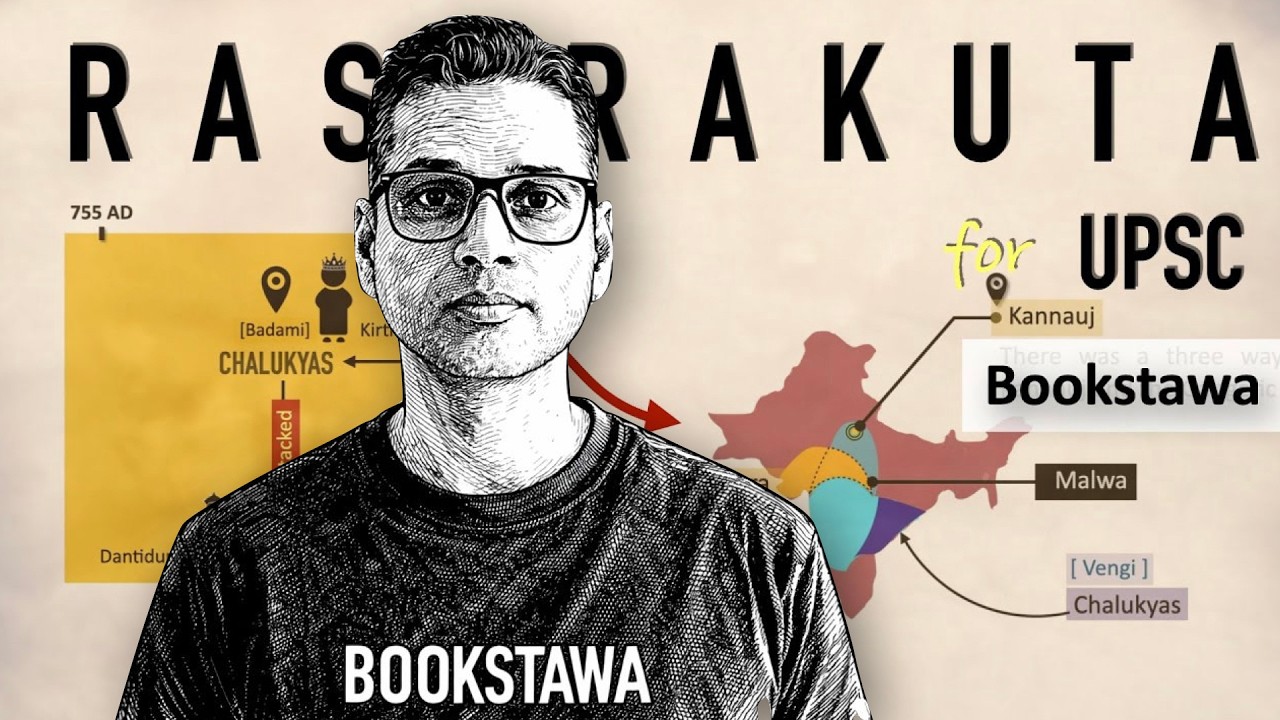
- (ii) Using strong armies, the Rashtrakutas captured the key northern city of Kannauj several times, defeating the Pratiharas and spreading their power into northern India.
- (iii) Their long rule combined battlefield strength with steady support for art, books, and peaceful religious coexistence.
Political History and Administrative Structure of the Rashtrakutas
The Rashtrakuta dynasty kept a strong, centralized system of rule from to , using Manyakheta (Malkhed) as its central capital.

Notable Kings: Imperial Expansion and Cultural Patronage
A line of skilled rulers led the Rashtrakuta empire to its highest political and cultural power.
- (i) Dantidurga (–): The founder of the main imperial line, who defeated the Chalukyas of Badami to start the dynasty.
- (ii) Krishna I (–): A ruler who expanded the empire, defeated the southern Pallavas, and built the famous single-rock Kailasanatha Temple at Ellora.
- (iii) Dhruva (–): Marched north and defeated both Vatsaraja (Pratihara) and Dharmapala (Pala), adding the northern Ganga and Yamuna river symbols to his royal seal.
- (iv) Govinda III (–): Known for military skill, he defeated Dharmapala of the Pala dynasty and broke up southern alliances to secure Rashtrakuta rule.
- (v) Amoghavarsha I (–): Ruled for , favored peace, supported Jainism, wrote the classic Kannada poetic work Kavirajamarga, and expanded Manyakheta.
- (vi) Indra III (–): Defeated Mahipala I of the Pratiharas; the Arab traveler Al-Masudi called him the greatest king in India during that period.
- (vii) Krishna III (–): The last major king, who fought the Paramaras in the north and Cholas in the south while supporting Pampa, Ponna, and Ranna (the 'three gems' of Kannada literature).
Contributions to Art and Architecture: Rock-Cut Wonders
The Rashtrakuta period is famous for impressive rock-cut temples that show great skill in stone carving and design.
- (i) The Kailasanatha Temple at Ellora: A huge temple carved out of a single mountain rock to look like Mount Kailash.
- (ii) The Dashavatara Temple at Ellora: Known for detailed stone carvings showing the ten avatars of Vishnu, including the Narasimha (man-lion) form.
- (iii) The Elephanta Caves on Elephanta Island near Mumbai: Features large stone carvings of Shiva, including the 25-foot high multi-faced Sadashiva statue.
Literary Contributions and the Golden Age of Kannada
Royal support helped Kannada writers create foundational literary works, alongside writings in Sanskrit and Prakrit.
Inscriptions documenting Kannada literary work under Rashtrakuta patronage. - Pampa: A court poet and Jain writer who wrote Adipurana (Jain history) and Vikramarjuna Vijaya (an adaptation of the Mahabharata).
- Sri Ponna: A court poet who wrote Shanti Purana, which details the life of the 16th Jain Tirthankara, Shantinatha.
Administrative Organisation and Governance Structure
The Rashtrakuta empire used a clear, step-by-step administrative system to run its lands smoothly.
- (i) Central Administration: The throne passed down through families, but kings were chosen based on capability. The Mahasandhivigrahi handled foreign affairs and diplomatic relationships.
- (ii) Provincial Administration: The empire was divided into provinces called Mandalas or Rashtras, governed by a Rashtrapathi. Under Amoghavarsha I, the empire had 16 main Rashtras.
- (iii) Military Administration: The army contained trained infantry, horse cavalry, and war elephants, supported by regional feudatories during large military campaigns.
Socio-Religious Conditions: Caste, Women’s Status, and Pluralism
Society under the Rashtrakutas allowed different religious beliefs to live together while following clear social norms.
- (i) Society: People were grouped into traditional social divisions. The scholar Al-Biruni later recorded 16 different occupational groups in society.
- (ii) Women’s Status: Women held respected roles, owned land and personal property, took part in land sales, and attended court events.
- (iii) Religion: Kings supported multiple faiths. Jainism grew strong under Amoghavarsha I, while Hinduism flourished with wide worship of Shiva and Vishnu.
Decline and Fall of the Rashtrakuta Dynasty
Outside invasions and regional leaders breaking away slowly weakened the empire, leading to its conquest by the Western Chalukyas.
- (i) In , the Paramara king Siyaka Harsha attacked and looted the capital city of Manyakheta, damaging imperial power.
- (ii) After this defeat, local governors and vassal chiefs declared independence, breaking up the empire.
- (iii) The Western Chalukyas conquered the remaining lands, taking over Manyakheta as their own capital until .
⚡ Quick Revision Capsule: Rashtrakuta Dynasty Highlights
A quick summary of key rulers, dates, and contributions of the Rashtrakuta Dynasty for revision:
| Ruler / Topic | Time Period / Key Term | Major Contribution / Fact |
|---|---|---|
| Dantidurga | – | Founded the imperial dynasty by defeating the Chalukyas of Badami. |
| Krishna I | – | Built the famous monolithic rock-cut Kailasanatha Temple at Ellora. |
| Dhruva | – | Expanded north, defeating both Pratihara and Pala kings. |
| Amoghavarsha I | – | Patron of Jainism; authored Kavirajamarga in Kannada. |
| Rock Architecture | Ellora & Elephanta | Homes to the Dashavatara Temple and the 25-foot Sadashiva statue. |
📝 Summary
The Rashtrakuta Dynasty shaped medieval Indian politics, administration, art, and literature in the Deccan between and . Their achievements in monolithic temple architecture, patronage of Kannada poetry like Adipurana, and structured governance make them essential for history study and exam preparation.
🚀 Quick Revision Points
Essential facts to review before examinations:
- (i) Capital was based at Manyakheta (modern Malkhed).
- (ii) Kavirajamarga by king Amoghavarsha I is an early milestone in Kannada poetics.
- (iii) The diplomatic officer in charge of foreign affairs was called the Mahasandhivigrahi.
- (iv) The dynasty ended after the sack of Manyakheta in and takeover by the Western Chalukyas.
- 💡 Exam Tip: Remember the connection between Krishna I and the Kailasanatha Temple at Ellora, as well as Amoghavarsha I's literary work Kavirajamarga—these frequently appear in history exams!
❓ Frequently Asked Questions (FAQ)
Q1: Who was the founder of the imperial Rashtrakuta Dynasty?
A1: Dantidurga (–) founded the main line by defeating the Chalukyas of Badami.Q2: What was the capital city of the Rashtrakuta Dynasty?
A2: Their capital was Manyakheta (now known as Malkhed in Karnataka).Q3: Who built the Kailasanatha Temple at Ellora?
A3: King Krishna I commissioned the monolithic Kailasanatha Temple carved out of a single rock at Ellora.