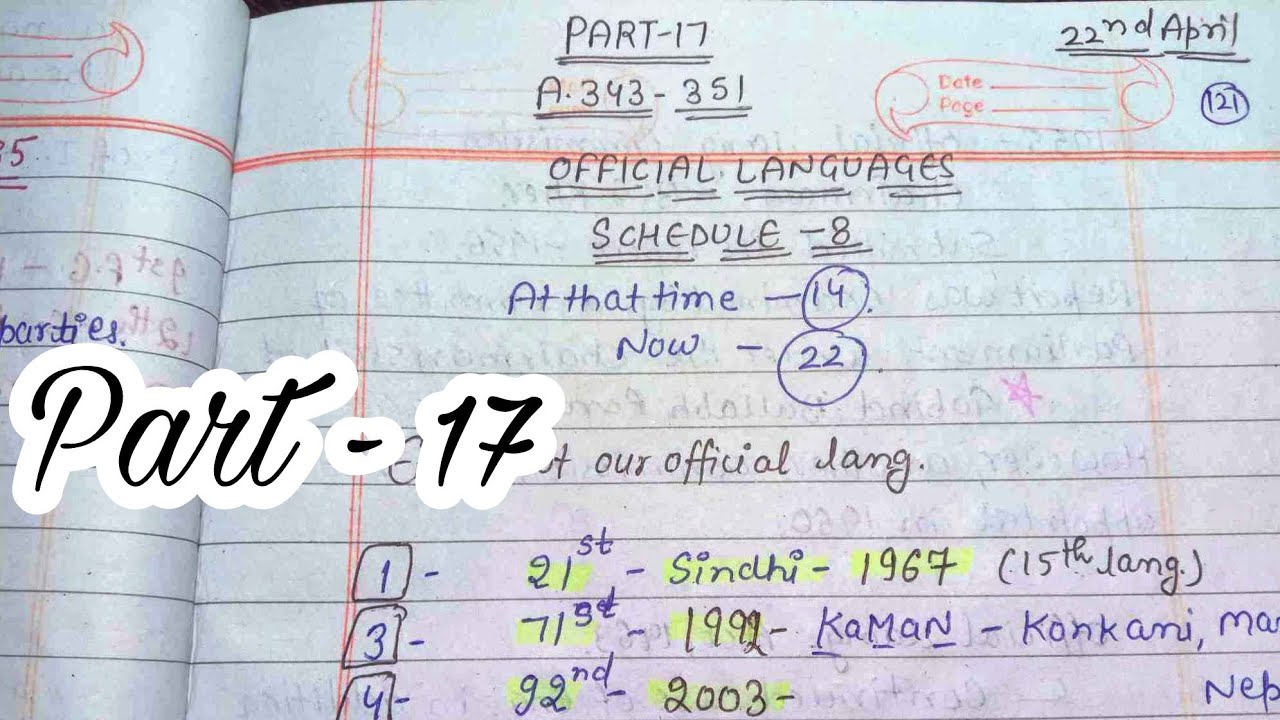
The comprehensive framework of Part XVII of the Indian Constitution meticulously outlines the official language provisions spanning from , serving as a vital blueprint for India's linguistic identity. This constitutional segment, essential for UPSC aspirants and law students, categorizes the nation's verbal landscape into the Language of the Union, Regional Languages, the Judiciary and Legal Texts, and Special Directives. Understanding these constitutional mandates is paramount for mastering the complexities of federalism and administrative governance in a multilingual society. Think of these rules as a shared rulebook created so that people speaking different languages across India can communicate smoothly, run government work fairly, and protect every community's unique mother tongue.
🎯 In this chapter, you will understand:
- How the central government uses Hindi and English for its daily working and official letters.
- How individual Indian states choose their own official regional languages for local governance.
- The rules guiding clear communication between different state governments and the central government.
- How the Constitution protects minority language speakers and smaller linguistic communities.
💡 Why this topic matters: India is home to hundreds of spoken languages. Having clear constitutional rules prevents language misunderstandings, protects cultural identity, and makes sure government decisions are understood by citizens across all states.
🧠 Core Idea: The Constitution balances the promotion of Hindi as an official central language, the practical daily use of English, and the complete freedom of states to use their own regional mother tongues.
Official Language in the Constitution of India (Articles 343–351) Context and Evolution
The constitutional journey of India's linguistic policy is a narrative of balancing long-standing regional tradition with practical administrative efficiency. When India gained independence in , leaders faced the giant challenge of picking an official administrative medium that respected all local cultures while keeping the country united and functioning without disruption.
- (i) Article 343 established the primary foundation by designating Hindi written in the Devanagari script as the main official language for central government work.
- (ii) The transition from colonial-era rules was planned to be very gradual, recognizing that government offices had relied heavily on English for many decades.
- (iii) The constitutional framework provided a clear procedural roadmap and timeline for evolving language policies in Parliament, central offices, and courts.
The Evolving Language of the Union Provisions
This section explores how the Union (central) government navigates the practical use of both Hindi and English in its legislative work, official forms, and daily administrative duties across the nation.

Foundational Directives for Union Communication
The story of the Union's language begins with the adoption of Hindi in the Devanagari script as the primary official language. However, to maintain smooth connections with international trade, science, and mathematics, the international form of Indian numerals (1, 2, 3) was mandated for all official records instead of traditional Devanagari numbers.
- (i) Initial Transition Period: To avoid government stoppage right after independence, English was allowed to continue for as an official working language just as it was used before .
- (ii) Parliamentary Authority: The Constitution gave Parliament the authority to extend the official use of English beyond the initial 15-year period if needed.
- (iii) Constitutional Commissions: A mechanism for periodic official reviews was set up to check the progress of Hindi and decide the future role of English.
The Timeline of Language Commissions
To inspect how language adoption was progressing, special presidential committees were appointed in the first decade after the Constitution took effect.
- (i) In , the first Official Language Commission was appointed under B. G. Kher, submitting its detailed report in .
- (ii) In , a Parliamentary Committee led by Gobind Ballabh Pant examined the Kher Commission recommendations.
- (iii) Although another language commission was planned for , it was ultimately never convened by the government.
Legislative Milestones: The Official Language Act (1963 & 1967)
As the original deadline approached, Parliament passed key laws to address the genuine concerns of non-Hindi speaking southern and eastern states, ensuring long-term political harmony and administrative stability.
- (i) The 1963 Act: This landmark law allowed English to continue indefinitely alongside Hindi for official Union tasks and parliamentary work.
- (ii) The 1967 Amendment: This update strengthened the bilingual system by making English mandatory for specific administrative documents, ensuring non-Hindi states were never disadvantaged.
The Tapestry of Regional Languages in Indian States
India’s federal system gives every state legislature the full freedom to choose one or more official local languages for its internal state government work.
State Autonomy in Linguistic Selection
The Constitution allows States to adopt any regional language spoken within their borders, or Hindi, as their official medium. Until a state passes its own language law, English remains the default language for official state operations.
- (a) Majority Regional Choices: Many states selected their most widely spoken local tongue, such as Telugu in Andhra Pradesh, Malayalam in Kerala, and Odia in Odisha.
- (b) Hindi Heartland Adoption: Northern states like Uttar Pradesh, Madhya Pradesh, Bihar, and Rajasthan chose Hindi as their official language.
- (c) Bilingual Approaches: Some states officially use two languages, such as Gujarat (Gujarati and Hindi) and Goa (Konkani and Marathi).
- (d) Unique Exceptions:Jammu & Kashmir selected Urdu, while North-Eastern states like Meghalaya, Arunachal Pradesh, and Nagaland chose English.
- (e) Scope of Choice: A state's official choice is not limited to the 22 languages listed in the Eighth Schedule; states can pick any local dialect spoken in their region.
Bridging the Gap: Union–State and Inter-State Communication
To ensure smooth collaboration across state borders, simple rules regulate official communication between different regional governments.
- (i) The Link Language:English acts as the official link language between the central government and states, or between two different states, unless states mutually agree to use Hindi.
- (ii) Inter-State Agreements: States like Rajasthan, Uttar Pradesh, Madhya Pradesh, and Bihar have formal agreements to communicate with each other in Hindi.
- (iii) Translation Safeguards: Under the Official Languages Act 1963, any official Hindi communication sent to a non-Hindi state must include an English translation to maintain complete transparency.
Safeguarding the Voice of Linguistic Minorities
The Constitution provides protective safeguards for minority language speakers living inside larger states, protecting them against linguistic marginalization.
- (i) Presidential Intervention: If a distinct section of a state's population requests official recognition for their mother tongue, the President can direct the state government to recognize it.
- (ii) Human Rights Shield: This protection guarantees that smaller cultural communities can preserve their language and heritage within the broader Indian Union.
⚡ Quick Revision Capsule: Official Language Provisions
Here is a simplified summary table reviewing the primary constitutional provisions, articles, and key rules related to official languages in India:
| Category | Constitutional Articles | Key Provision / Rule |
|---|---|---|
| Language of the Union | Hindi in Devanagari script is the official language; international numerals are used; English is continued alongside Hindi per the Official Languages Act 1963. | |
| Regional Languages | States can adopt any regional tongue or Hindi; English serves as the link language between Union and non-Hindi states. | |
| Inter-State Link Language | Official communication between states uses English unless two or more states agree to use Hindi together. | |
| Linguistic Minority Protection | The President can direct a state to grant official recognition to a minority language upon demand. | |
| Special Directives for Hindi | The central government is tasked with spreading and developing Hindi so it represents India's composite culture. |
📝 Summary
The intricate design of in Part XVII of the Indian Constitution ensures that official language rules remain flexible, practical, and protective of national unity. By balancing the gradual promotion of Hindi with the practical daily necessity of English and the full freedom of Regional Languages, the Constitution creates an equitable environment for students, government officers, and citizens alike. These constitutional mandates cited in Part XVII of the Indian Constitution safeguard democratic participation, administrative ease, and individual cultural rights across every state in India.
🚀 Quick Revision Points
Essential facts to review before examinations:
- (i) Part XVII of the Indian Constitution covers official language provisions from .
- (ii) Hindi in Devanagari script is designated as the primary official language of the Union, paired with international Indian numerals.
- (iii) The Official Languages Act of 1963 allowed English to continue indefinitely for parliamentary and official central duties.
- (iv) State governments can officially adopt any regional language, regardless of whether it is listed in the Eighth Schedule.
- 💡 Exam Tip: Remember that the Constitution distinguishes between "Official Language" and "National Language." The Indian Constitution designates Hindi as the Official Language of the Union, but does not declare any single language as the sole National Language.
❓ Frequently Asked Questions (FAQ)
Q1: Which part of the Indian Constitution deals with the official language?
A1: Part XVII of the Constitution deals with official language provisions across .Q2: Is English still an official language of the central government of India?
A2: Yes. Under the Official Languages Act 1963, English continues as an associate official language alongside Hindi for central government work and parliamentary proceedings.Q3: Are state governments required to choose an official language from the Eighth Schedule?
A3: No. A state legislature can select any regional language spoken within its borders as its official state language, even if it is not listed in the Eighth Schedule.