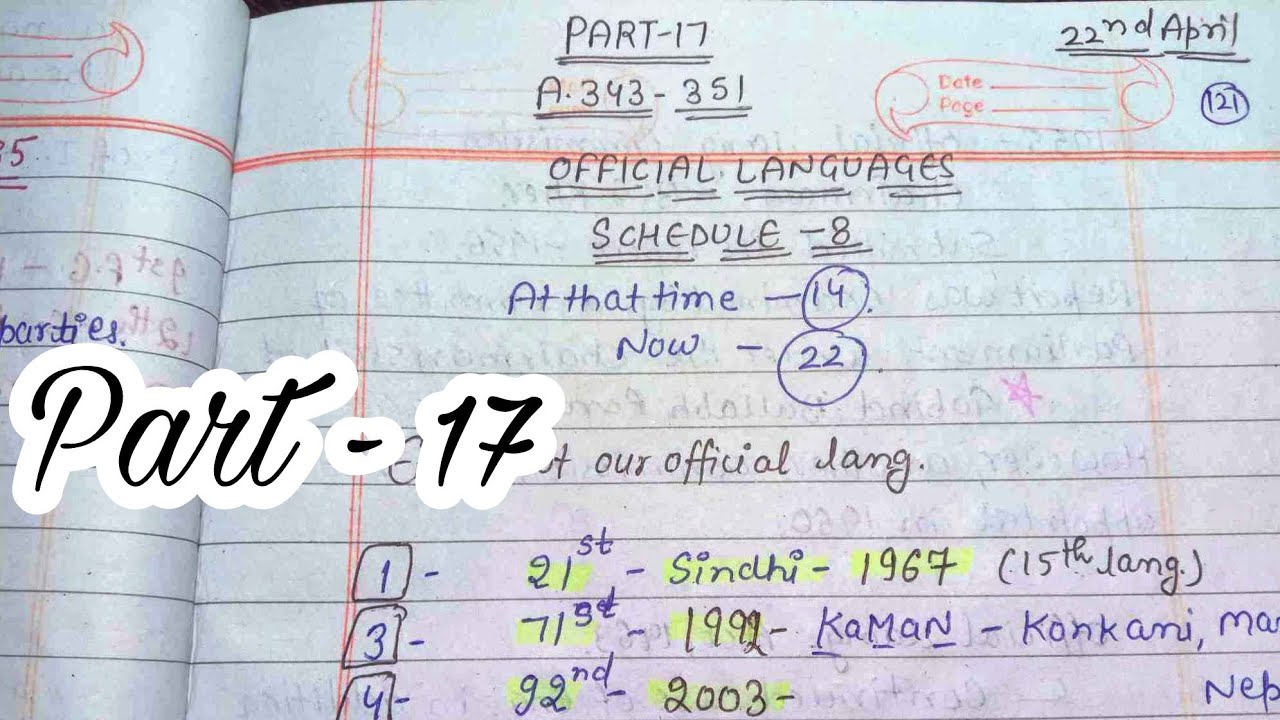
The Official Language Act, 1963 serves as the bedrock for the legal rules governing how Hindi is used within the administrative work of the Indian Government. Passages under this law guarantee a smooth changeover and steady growth for official communication across government offices. To monitor this ongoing process, Parliament established the dedicated Parliamentary Committee on Official Language. This supervisory body ensures that all legal provisions are followed systematically. For students and candidates preparing for government examinations like the UPSC, mastering these administrative rules is essential. Alongside administrative policies, the Central Government also celebrates India's deep ancient roots by recognizing specific regional tongues with Classical Language status.
🎯 In this chapter, you will understand:
- The historic background and purpose behind the Official Language Act, 1963.
- How the Parliamentary Committee on Official Language is formed and how it inspects government offices.
- The strict rules and financial benefits linked with Classical Language recognition.
- The core constitutional articles () that guide language policy across India.
💡 Why this topic matters: Language policies balance administrative needs with cultural preservation. Knowing these laws helps clear civil service exams and explains how India respects its diverse linguistic heritage while running an unified national administration.
🧠 Core Idea: India uses a dual strategy for languages: structured parliamentary rules guide day-to-day government administration, while special classical status preserves and funds ancient literary traditions.
Official Language Act, 1963 and the Evolution of Classical Language Status
India’s journey in framing an official language policy focuses on balancing regional diversity with practical governance. The Official Language Act, 1963 was created to build an organized system for reviewing how Hindi is adopted across central administrative offices. Rather than forcing immediate changes, the law laid out a gradual, structured path for national integration.
- A legislative journey towards linguistic integration and administrative clarity.
The law set up clear timelines to evaluate how government departments were progressing in using Hindi alongside English for official paperwork.
- (i) The Act required that ten years after the main constitutional provisions took effect on , a specialized review committee had to be created.
- (ii) Meeting this legal requirement, the official Committee on Official Language was formally created in to monitor these administrative goals.
- (iii) This legal design makes sure that the national language framework remains flexible, inclusive, and responsive to modern administrative needs.
Committee on Official Language: Provisions and Organizational Structure
The Committee functions as an influential parliamentary body entrusted with reviewing how the Central Government communicates across its many branches and ministries. It conducts field inspections, meets officials, and provides feedback to the highest levels of governance.

Comprehensive Composition of the Committee
To uphold strong democratic values, the Committee includes members from both houses of the Parliament of India. This ensures balanced representation across various political parties and geographic regions.
- (i) The entire body consists of 30 Members of Parliament who provide legislative oversight on language implementation.
- (ii) Exactly 20 members are elected from the Lok Sabha (Lower House), giving the directly elected house a strong voice in policy reviews.
- (iii) Exactly 10 members are elected from the Rajya Sabha (Upper House), making sure state interests are well represented.
- (iv) The selection follows a fair voting method called proportional representation using the single transferable vote system.
Primary Functions and the Role of the President
The main job of the Committee is to act as an advisory unit for the President of India by evaluating how effectively Hindi is used in official work.
- (i) Its primary responsibility is checking the continuous progress of Hindi across central ministries and departments.
- (ii) After finishing its evaluations, the Committee submits an extensive report containing specific recommendations directly to the President of India.
- (iii) The President ensures this report is presented before both Houses of Parliament and sent to all State Governments for full public clarity.
- (iv) Importantly, the President holds the legal power to issue binding directions based on these findings to ensure the Official Language Act is properly followed.
Operational Methods and the Secretariat's Support
The Committee relies on practical, real-world monitoring techniques rather than relying only on written reports. Its members active inspect government work environments firsthand.
Leadership and On-site Inspections
The leadership structure and field visits ensure direct government compliance with language policies.
- (i) Members choose their own Chairman; by long-standing tradition, the Union Home Minister is elected to lead this body.
- (ii) The Committee carries out direct inspections of Central Government offices to check how much Hindi is actually used in daily operations.
- (iii) To cover all administrative branches thoroughly, the body is split into three sub-committees, each monitoring specific ministries.
Expert Evidence and Departmental Coordination
Administrative support and expert testimony help keep language policies effective and grounded.
- (i) The Committee gathers direct oral testimony from leading experts in judiciary, education, and public governance.
- (ii) The administrative Secretariat, headed by a senior Secretary, works under the Department of Official Language inside the Ministry of Home Affairs.
- (iii) Dedicated support officers, including Under Secretaries, offer continuous research and data assistance for periodic reviews.
The Prestigious Status of Classical Languages in India
Beyond daily administrative communication, the Central Government protects India's deep history by granting official Classical Language status to ancient tongues with outstanding literary traditions.
Origins and Declared Languages
In , the Government of India created the official Classical Language category to honor languages with an independent and rich ancient heritage.
- (i) Tamil became the first language granted this honor in , followed by Sanskrit in .
- (ii) Both Telugu and Kannada received classical status in due to their ancient Dravidian roots.
- (iii) The list grew when Malayalam was added in and Odia in , bringing the total to six recognized languages under this scheme.
Rigorous Criteria for Classical Recognition
A language must meet strict historical and literary requirements established in before receiving this title.
Key guidelines including 1500 to 2000 years of recorded history - (i) It must showcase high antiquity, supported by recorded texts spanning between .
- (ii) It must possess a body of ancient literature valued as a priceless heritage by generations of speakers.
- (iii) The literary tradition must be original and self-developed, not copied or borrowed from another language community.
- (iv) While modern forms may change over time, the classical version must remain distinct enough to show its original character.
Benefits Awarded to Classical Languages
Earning classical status unlocks major financial grants and university backing to help preserve and study the language.
- (i) The Central Government allocates funds to set up dedicated centres of excellence for ongoing language research.
- (ii) Accomplished researchers and scholars can win prestigious national awards for outstanding contributions to classic literature.
- (iii) The University Grants Commission (UGC) creates specialized professional chairs in Central Universities to encourage academic research.
Constitutional Overview: Articles Related to Official Language
The Constitution of India contains detailed instructions on how languages are used across central administration, state governments, and courts of law under (Part XVII).
Union and Regional Legal Framework
outline how the Central Government communicates internally and handles correspondence with states.
- (a) Article 343: Identifies Hindi written in Devanagari script as the official administrative language of the Union.
- (b) Article 344: Controls how the Official Language Commission and Parliamentary Committee are created.
- (c) Article 345: Grants state legislatures the authority to choose one or more regional languages for official state work.
- (d) Article 346: Regulates official written communications between individual states, and between states and the Union.
- (e) Article 347: Gives special authority to protect linguistic minorities when a significant population demands recognition.
Judiciary, Legislation, and Special Directives
Specific constitutional provisions make sure legal processes and minority protections remain clear across all courts.
- (i) Article 348: Mandates English as the language used inside the Supreme Court, High Courts, and for legislative Bills and Acts.
- (ii) Article 349: Sets special legal steps required before Parliament can pass new laws changing language rules.
- (iii) Article 350: Guarantees every citizen the right to submit grievances to authorities in any language they use.
- (iv) Article 350A & 350B: Directs primary education in one's mother tongue and establishes a Special Officer for Linguistic Minorities.
- (v) Article 351: Sets a Special Directive ordering the Central Government to spread and develop Hindi across India.
⚡ Quick Revision Capsule: Official Language Rules & Classical Status
Here is a quick summary table covering the core facts, legal articles, and classical language milestones for fast exam revision.
| Topic / Area | Key Provisions / Details | Constitutional Article or Year |
|---|---|---|
| Official Language of Union | Hindi in Devanagari script along with international numerals | |
| Parliamentary Committee | 30 MPs (20 Lok Sabha + 10 Rajya Sabha) monitoring Hindi usage | Constituted in under Act of 1963 |
| First Classical Language | Tamil recognized for its ancient independent literary tradition | Declared in |
| Classical Language Criteria | Textual history spanning with original literature | Notification set in |
| Special Directive for Hindi | Union directive to promote and develop Hindi nationwide |
📝 Summary
Understanding the Official Language Act, 1963 and the rules governing Classical Languages offers essential insights into how India preserves its unity while respecting diverse regional identities. Through , the Constitution of India balances central governance needs with regional rights, keeping state administration organized and culturally inclusive.
🚀 Quick Revision Points
Essential facts to review before examinations:
- (i) The Official Language Act passed in and led to the formation of the official review committee in .
- (ii) The Committee consists of 30 Members of Parliament elected through proportional representation.
- (iii) Exactly six languages carry Classical status: Tamil, Sanskrit, Telugu, Kannada, Malayalam, and Odia.
- (iv) mandates English for legal proceedings inside the Supreme Court and High Courts.
- 💡 Exam Tip: Remember the breakdown of the Parliamentary Committee: 20 from Lok Sabha and 10 from Rajya Sabha. Also note that the Union Home Minister traditionally serves as the Chairman of this body!
❓ Frequently Asked Questions (FAQ)
Q1: When was the Parliamentary Committee on Official Language established?
A1: The Committee was formally constituted in under the guidelines of Section 4 of the Official Language Act, 1963.Q2: Which language was first recognized as a Classical Language in India?
A2: Tamil was the first language granted Classical Language status in .Q3: What constitutional article directs the Union to spread the Hindi language?
A3: of the Constitution of India provides a special directive instructing the Union to promote and develop Hindi.