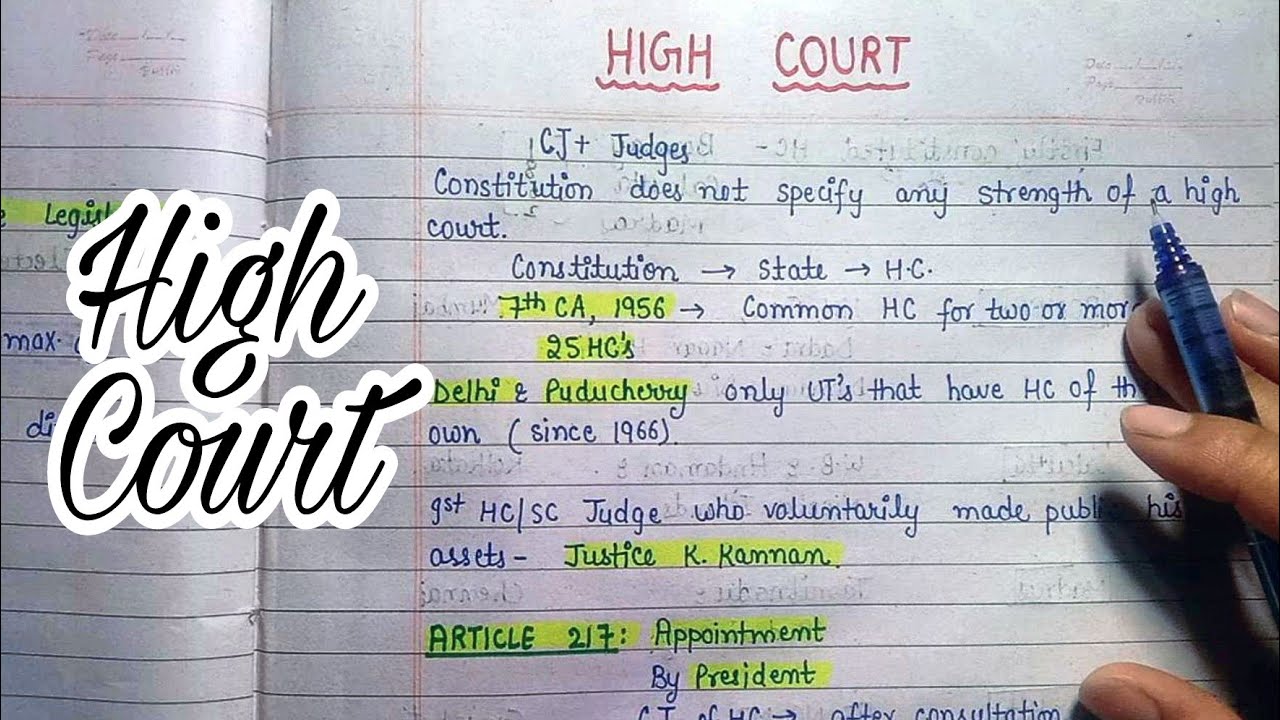
Explore the comprehensive evolution and structural framework of the High Courts in India, a vital component of the unified judicial system established under Part VI of the Constitution. This detailed analysis covers the appointment of judges, their tenure, and the qualifications required for judiciary examinations and academic excellence for students. The High Court is not merely another court in the country; it is the highest judicial institution within a state and plays a major role in protecting rights, interpreting laws, and supervising the lower courts.
🎯 In this chapter, you will understand:
- The historical evolution of High Courts in India from to the present day.
- The organisation, composition, and territorial jurisdiction of High Courts.
- The appointment, qualifications, oath, tenure, and removal of High Court judges.
- The constitutional provisions contained in Articles 214 to 231 of Part VI.
💡 Why this topic matters: High Courts form the backbone of the state-level justice system. They decide important legal questions, protect fundamental rights, and supervise subordinate courts. For students preparing for judiciary, law, and competitive examinations, this topic explains how judicial independence is maintained through appointment, tenure, and removal rules.
🧠 Core Idea: India follows a unified judicial framework in which the Supreme Court stands at the top, High Courts act as the principal courts in the states, and subordinate courts work below them. The Constitution gives High Courts a special position by laying down their organisation, powers, judges, and jurisdiction in Articles 214 to 231.
High Courts in the Indian Judicial System: Evolution, Context, and Legal Framework
India operates under a unified judicial framework, a seamless hierarchy where the High Court serves as the primary pillar below the Supreme Court. The story of the Indian judiciary is one of integration and hierarchy, ensuring that justice flows from the highest levels down to the common citizen through a well-organised structure. In simple words, if a person faces a legal problem in a state, the case usually begins in a lower court, may move to the High Court, and can ultimately reach the Supreme Court. This chain helps maintain uniformity in the interpretation of laws across the country.
The judicial landscape of every state is anchored by a High Court, which acts as the supreme legal authority within that state’s boundaries, supported by a network of subordinate courts. The High Court hears appeals from these lower courts and also exercises original jurisdiction in certain matters. Its decisions carry great legal weight and guide the working of courts within its territorial area.
- (i) The historical roots of this institution trace back to the year , a landmark era when the first three High Courts were inaugurated at Calcutta, Bombay, and Madras to serve the British presidency towns. These early courts laid the foundation for the modern judicial structure that India follows today.
- (ii) The expansion continued in with the establishment of the Allahabad High Court, eventually leading to a system where every province in British India possessed its own dedicated court of record. A court of record is a court whose proceedings and decisions are preserved permanently and can be used as legal evidence or precedent.
- (iii) Following the dawn of independence and the adoption of the Constitution in , these provincial entities were seamlessly transitioned into the High Courts of their respective states. This change gave the courts a firm constitutional foundation and made them an essential part of India’s democratic system.
- (iv) Flexibility was introduced via the Seventh Constitutional Amendment Act, 1956, which granted the Parliament the legal power to create a common High Court serving multiple states or union territories. This provision became useful where two or more smaller states or union territories could share one High Court instead of maintaining separate institutions.
- (v) Geographically, the territorial jurisdiction of these courts is typically aligned with state borders, though common High Courts extend their reach across all constituent territories. Territorial jurisdiction means the geographical area within which a court can hear cases and exercise its legal authority.
- (vi) In the current landscape, India maintains 24 High Courts, with four functioning as shared jurisdictions; notably, Delhi stands as the only union territory with its own independent court since . This arrangement shows how the judicial system can adapt to administrative and geographical needs.
- (vii) The Parliament retains the exclusive constitutional mandate to modify, extend, or retract a High Court’s jurisdiction over any specific union territory. Therefore, changes relating to a union territory’s judicial coverage are made through parliamentary action rather than by the state government alone.
- (viii) The governing principles for these institutions are enshrined in Articles 214 to 231 of Part VI, detailing everything from organisation and independence to procedures and powers. These articles together form the constitutional backbone of the High Court system in India.
Organisation of the High Court and Judicial Composition
The internal setup of a High Court is designed to be flexible, allowing it to scale based on the legal demands and population size of the state it serves. A state with a large population, many districts, and a heavy number of pending cases may require more judges than a smaller state. This flexible method helps the judicial system respond to changing needs without requiring a permanent constitutional change every time the workload increases.
Composition and Strength of the Bench
Every High Court, regardless of whether it serves one state or many, is headed by a Chief Justice who works alongside a variable number of other judges. The Chief Justice is the administrative head of the High Court and plays an important role in managing its functioning, assigning cases, and maintaining judicial discipline within the institution.
- (i) Unlike some other constitutional bodies, the Constitution does not mandate a specific, fixed number of judges for every court. This means the number of judges is not permanently written into the Constitution.
- (ii) Instead, the President determines the strength of each High Court periodically, adjusting the numbers to effectively manage the prevailing workload and case backlog. This flexibility allows the government to increase judicial strength when courts face a growing number of cases.
The Appointment, Qualifications, and Service of High Court Judges
The process of selecting and maintaining the judiciary is a rigorous journey intended to safeguard judicial independence and legal expertise. Judicial independence means that judges should be able to decide cases fairly without pressure from the government, political parties, or powerful individuals. For this reason, the Constitution lays down careful rules regarding who can become a judge, how a judge is appointed, and how a judge can be removed.
The Appointment Process and Judicial Precedents
The President of India is the appointing authority for all High Court judges, navigating a complex web of consultations and legal mandates to ensure the highest quality of the judiciary. Although the President formally appoints judges, the appointment is not made casually or independently. It involves consultation with constitutional authorities so that only suitable and experienced persons are selected.
The Consultation Mechanism
The consultation process ensures that both the central government and the state government have a role in the appointment of judges. It also ensures that senior judicial authorities can assess the legal ability, integrity, and experience of the proposed candidate.
- (i) For the Chief Justice of a state, the President consults the Chief Justice of India and the Governor of that state. This ensures that the appointment receives input from both the highest judicial office in the country and the constitutional head of the state.
- (ii) For other judges, the Chief Justice of the respective High Court is also involved in the deliberation. The Chief Justice of the High Court is best placed to understand the needs of that court and the qualities required in a new judge.
- (iii) In scenarios involving a common High Court, the Governors of all states within that jurisdiction must be consulted. Since the court serves more than one state, each concerned Governor is consulted to protect the interests of all territories covered by that High Court.
Evolution Through Case Law
The method of appointing judges has developed over time through important decisions of the Supreme Court. These cases explain how the balance between the judiciary and the executive should work in judicial appointments.
- The Second Judges Case (1993): This established that no appointment can be finalised without the explicit concurrence of the Chief Justice of India. In simple terms, the opinion of the CJI became central to the appointment process.
- The Third Judges Case (1998): Expanded the process into a collegium system, involving the CJI and two senior-most Supreme Court judges. The collegium system was created to make judicial appointments more independent from executive control.
- The 99th Constitutional Amendment Act, 2014: This sought to replace the collegium with the National Judicial Appointments Commission (NJAC). The NJAC was intended to create a new body for appointing judges with representation from both the judiciary and the executive.
- The Fourth Judges Case (2015): The Supreme Court declared the NJAC unconstitutional, effectively reviving the collegium system to prevent executive interference. The Court held that judicial independence required the collegium method to continue.
Constitutional Qualifications and Eligibility
To ensure that only seasoned legal minds preside over state matters, the Constitution sets forth clear eligibility criteria for any prospective judge. These conditions are meant to ensure that a person appointed as a High Court judge already has deep experience in law, either as a judicial officer or as an advocate.
- (i) The candidate must be a citizen of India as a fundamental requirement. This condition ensures loyalty to the country and connects the judge’s office with Indian constitutional citizenship.
- (ii) They must have held a judicial office within the territory of India for at least ten years. A judicial office generally means serving as a judge or in another judicial capacity in courts within India.
- (iii) Alternatively, they must have served as an advocate in one or more High Courts for a continuous period of at least ten years. This route allows experienced lawyers to become judges based on their long practice and legal knowledge.
- (iv) Distinctly, there is no minimum age requirement, nor is there a provision for a “distinguished jurist” to be appointed, which differs from the Supreme Court rules. Therefore, a person may become a High Court judge at any age if the required legal experience is fulfilled.
Oath, Affirmation, and Judicial Integrity
Before a judge can legally exercise their powers, they must undergo a formal oath or affirmation ceremony, typically presided over by the Governor. The oath is not just a formality; it reminds the judge of their duty to the Constitution, the nation, and the people who approach the court for justice.
- (i) The judge must pledge to bear true faith and allegiance to the Constitution of India. This means the judge promises to respect the Constitution as the supreme law of the country.
- (ii) They commit to upholding the sovereignty and integrity of the nation at all times. Sovereignty means India’s independent authority, while integrity means the unity and wholeness of the country.
- (iii) They must perform their duties without fear, favour, affection, or ill-will towards any party. This ensures that every person before the court receives equal and impartial treatment.
- (iv) A solemn promise is made to protect the Constitution and the laws of the land. The judge therefore becomes a guardian of constitutional values and legal order.
Tenure, Resignation, and the Removal Process
While the Constitution does not define a fixed number of years for service, it provides a stable framework for the tenure of judges to ensure security of office. Security of tenure means that a judge cannot be removed easily or unfairly. This protection helps judges decide cases boldly and independently.
- (i) A judge is entitled to hold office until they reach the age of 62 years, with any age-related disputes being settled by the President after consulting the Chief Justice of India. Thus, retirement age is fixed, but questions about a judge’s exact age can be resolved through this constitutional procedure.
- (ii) A judge retains the right to resign their position by submitting a written notice to the President. Resignation is voluntary and allows a judge to leave office before reaching the retirement age.
- (iii) Removal is possible only through a rigorous process where the President acts upon a recommendation from the Parliament. This difficult process protects judges from arbitrary removal and preserves judicial independence.
- (iv) The office is automatically vacated if the judge is elevated to the Supreme Court or transferred to another High Court. In such situations, the judge leaves the present High Court position because they move to a new judicial role.
⚡ Quick Revision Capsule: High Courts in India
This quick revision capsule brings together the most important facts about the High Courts in India. It is especially useful before examinations, as it helps students revise the historical background, constitutional provisions, judge appointments, and service conditions in one place.
| Aspect | Key Provision / Fact | Simple Meaning |
|---|---|---|
| Constitutional Basis | Articles 214 to 231 of Part VI | These articles govern the organisation, independence, judges, and jurisdiction of High Courts. |
| First High Courts | Calcutta, Bombay, and Madras in | These were the first three High Courts established during British rule. |
| Present Number | 24 High Courts, with four shared jurisdictions | Some High Courts serve more than one state or union territory. |
| Head of High Court | Chief Justice and other judges | The Chief Justice leads the High Court, while the President decides its sanctioned strength. |
| Appointment | President appoints judges after consultation; collegium system operates after judicial precedents | The process involves the CJI, Governors, and High Court Chief Justice; the Third Judges Case (1998) developed the collegium system. |
| Qualifications | Indian citizenship plus 10 years as a judicial officer or 10 years as a High Court advocate | A candidate must have substantial legal or judicial experience. |
| Retirement | 62 years | A High Court judge normally holds office until the age of 62. |
📝 Summary
The High Court remains the cornerstone of state-level justice, balancing the independence of the judiciary with the constitutional mandates of Part VI. Understanding these Articles 214 to 231 is essential for students preparing for legal examinations, as it highlights how the President and Parliament collaborate to maintain a robust unified judicial framework. The historical journey from to the present day reflects India’s commitment to a fair and structured legal system.
🚀 Quick Revision Points
Essential facts to review before examinations:
- (i) India has a unified judicial system, with the Supreme Court at the top and High Courts functioning as the principal courts in the states.
- (ii) The first three High Courts were established in at Calcutta, Bombay, and Madras.
- (iii) The Seventh Constitutional Amendment Act, 1956 allowed Parliament to create a common High Court for two or more states or union territories.
- (iv) The appointment process evolved through the Second Judges Case (1993), Third Judges Case (1998), and Fourth Judges Case (2015).
- 💡 Exam Tip: Remember the sequence: Articles 214 to 231 govern High Courts; the first High Courts came in ; judges retire at 62; and the collegium system was restored after the Fourth Judges Case (2015).
❓ Frequently Asked Questions (FAQ)
Q1: How many High Courts are there in India?
A1: India has 24 High Courts. Four of them are common High Courts, meaning they serve more than one state or union territory.Q2: What are the qualifications for becoming a High Court judge?
A2: A candidate must be a citizen of India and must have either held a judicial office in India for at least 10 years or worked as an advocate in one or more High Courts for at least 10 continuous years.Q3: What is the collegium system?
A3: The collegium system is the method of recommending judicial appointments through the Chief Justice of India and senior Supreme Court judges. It developed through the Third Judges Case (1998) and was revived after the Fourth Judges Case (2015).