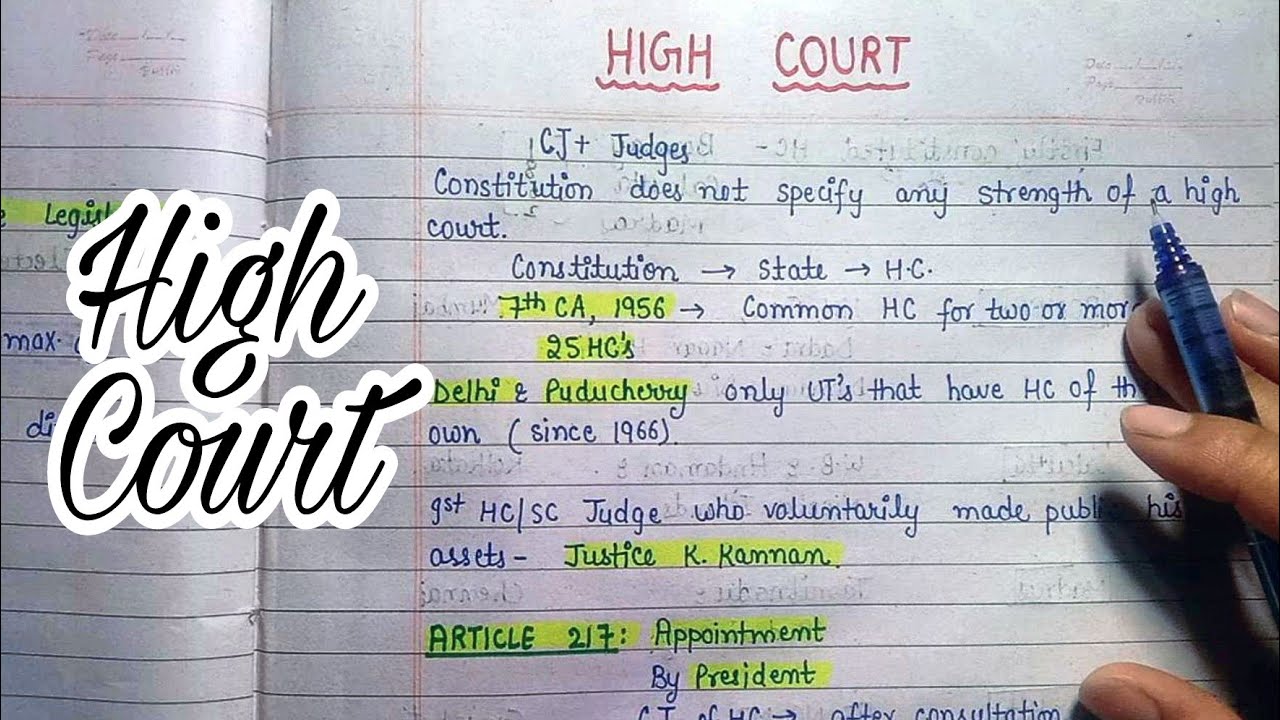
High Court judges hold an important position in India’s justice system. They decide serious cases, protect the rights of citizens, and make sure that laws are applied fairly. Because their work affects everyone, the Constitution gives them strong protection. A judge cannot be removed simply because the government dislikes a decision. Instead, removal follows a careful and difficult process. This chapter explains the removal process, salaries and allowances, transfers, and temporary judicial appointments. It also explains how the Judges Enquiry Act, 1968 works and why these rules help maintain judicial independence.
🎯 In this chapter, you will understand:
- How a High Court judge can be removed only for proved misbehaviour or incapacity.
- How the Judges Enquiry Act, 1968 controls the removal procedure.
- Why judges’ salaries, allowances, and pensions are protected from easy changes.
- How transfers, acting judges, additional judges, and retired judges help courts function smoothly.
💡 Why this topic matters: The independence of the High Court depends on strong safeguards for its judges. If judges could be removed, transferred, or paid unfairly at the wish of the government, they might feel pressured while giving judgments. These rules protect judges so that they can decide cases without fear or favour.
🧠 Core Idea: A High Court judge is not an ordinary government employee. The judge’s removal, salary, pension, and transfer are governed by special constitutional and legal rules. These rules create a system of checks and balances between the judiciary, Parliament, and the executive.
Removal of High Court Judges
A High Court judge does not serve at the pleasure of the President. This means that the President cannot remove a judge whenever the government wants. A judge can be removed only through a rigid, impeachment-like procedure. This procedure is purposely made difficult because judges must be able to give fair decisions, even when those decisions go against powerful people or the government. The removal process for a High Court judge follows the same broad path as the removal process for a Supreme Court judge.
Constitutional Grounds and Presidential Orders
The Constitution allows the removal of a High Court judge only on two limited grounds: proved misbehaviour or incapacity. Misbehaviour means serious improper conduct by the judge. Incapacity means that the judge is unable to perform judicial duties properly, often because of physical or mental inability. These grounds prevent removal for political reasons, personal dislike, or disagreement with a judge’s legal decisions.
The final step in removal is an order issued by the President. However, the President cannot issue this order alone. The order can be issued only after both Houses of Parliament present an address to the President in the same session. This address must first be passed by a special majority in each House. A special majority means that the motion must be supported by a majority of the total membership of each House and also by two-thirds of the members present and voting in that House.
- (i) An order of the President is the final step in the removal process.
- (ii) This order is issued only after an address by Parliament has been presented in the same session.
- (iii) The motion requires a special majority: a majority of the total membership and two-thirds of those present and voting in each House.
The Procedure Under the Judges Enquiry Act, 1968
The Judges Enquiry Act, 1968 is the main law that explains how the investigation and proof of a judge’s misbehaviour or incapacity should take place. It also explains how Parliament should present an address to the President for removal. In simple words, it works like a guidebook for the removal process. It ensures that accusations against a judge are examined carefully, rather than being accepted without proof.
Step 1: Initiation and Committee Investigation
The process begins when Members of Parliament give a signed removal motion to the correct presiding officer. If the motion is started in the Lok Sabha, it must be signed by at least 100 members and given to the Speaker. If it is started in the Rajya Sabha, it must be signed by at least 50 members and given to the Chairman. These signature requirements stop casual or politically motivated complaints from easily reaching the investigation stage.
If the Speaker or Chairman admits the motion, a three-member committee is formed to investigate the matter. The committee must include a Supreme Court judge, a Chief Justice of a High Court, and a distinguished jurist. This mixture of senior judges and a legal expert helps make the investigation fair, experienced, and independent.
- (i) A removal motion must be signed by 100 members in the Lok Sabha or 50 members in the Rajya Sabha and given to the Speaker or Chairman.
- (ii) If admitted, a three-member committee investigates the matter.
- (iii) The committee consists of a Supreme Court judge, a High Court Chief Justice, and a distinguished jurist.
Step 2: Parliamentary Vote and Final Order
After the investigation, the committee submits its findings. If the committee finds the judge guilty of misbehaviour or incapable of performing duties, the concerned House considers the removal motion. The motion must then be passed by a special majority. After both Houses pass the address, it is sent to the President, who issues the final removal order.
This long process shows that removal is not easy. It requires strong evidence, approval by both Houses of Parliament, and a special majority. Importantly, no High Court judge has ever been impeached in the history of independent India. This shows how difficult and exceptional the process is.
- (i) If the committee finds the judge guilty, the House considers the motion for a special majority vote.
- (ii) Once both Houses pass the address, it is sent to the President for the final removal order.
- (iii) No High Court judge has ever been impeached in the history of independent India.
Salaries, Allowances, and Financial Security
Financial security is essential for judicial independence. If a government could reduce a judge’s salary whenever it was unhappy with the judge, the judge might feel pressured. To prevent this, the Constitution protects the salaries and privileges of High Court judges. Parliament decides these financial matters, not the day-to-day executive government. Once a judge is appointed, the judge’s salary and allowances cannot be changed to the judge’s disadvantage.
Determination of Salaries and Perks
Parliament has the authority to decide the salaries, allowances, and privileges of High Court judges. This arrangement keeps judicial pay separate from sudden executive control. Judges also receive several facilities that help them perform their duties with dignity. These benefits are not merely personal comforts; they also support the independent functioning of the court.
- (i) Historical context: In , the Chief Justice’s salary rose to ₹90,000 per month, while other judges received ₹80,000 per month.
- (ii) Allowances: Judges receive a sumptuary allowance, free residence, and medical or transport facilities.
- (iii) Pension: After retirement, a judge is entitled to a pension equal to 50% of the last drawn salary.
- (iv) Exceptions: These benefits can be reduced only during a Financial Emergency.
The pension provision is important because it gives judges financial confidence after retirement. A judge who knows that retirement benefits are secure may be less likely to worry about losing favour with the government. Similarly, the Financial Emergency exception is narrow, so ordinary budget decisions cannot easily reduce judicial benefits.
The Dynamics of Transfer of High Court Judges
Transfers help judicial administration in a large country like India. Sometimes a judge may be transferred to another High Court to balance workload, improve court administration, or serve public interest. However, transfer should never become a punishment. If judges could be transferred arbitrarily for giving uncomfortable judgments, judicial independence would suffer. Therefore, the transfer process is regulated through constitutional provisions and important judicial rulings.
The Role of the President and the Collegium
Although the President formally issues the order transferring a High Court judge, the decision is not made by the President alone. In practice, the Chief Justice of India (CJI) and judicial precedents play a major role. The collegium system was developed through court rulings to ensure that transfers are considered carefully by senior judges rather than being controlled entirely by the executive.
- (i) Public interest: The ruling established that transfers must serve the public interest.
- (ii) Judicial review: A ruling allowed judicial review to prevent arbitrary transfers, though only the affected judge can initiate it.
- (iii) The ruling: In the Third Judges Case, the CJI was required to consult a collegium of four senior-most Supreme Court judges and the Chief Justices of both the sending and receiving High Courts.
The involvement of the collegium makes the transfer process more balanced. The CJI must consider the views of senior Supreme Court judges and the Chief Justices of the High Courts concerned. This reduces the chance that a transfer will be used as a tool to punish a judge or interfere with judicial work.
Appointments of Acting, Additional, and Retired Judges
Courts must continue working even when a judge is absent, a post is vacant, or the number of cases suddenly increases. To handle such situations, the Constitution allows certain temporary appointments. These appointments keep the administration of justice running and help reduce delays in deciding cases.
Acting and Additional Roles
Acting and additional appointments are temporary arrangements. They do not replace the need for permanent judges, but they ensure that judicial work does not stop. For example, if the Chief Justice of a High Court is absent, an acting Chief Justice can look after the court’s administration until the regular Chief Justice returns.
- (a) Acting Chief Justice: Appointed by the President when the office of Chief Justice is vacant or the incumbent is unable to perform duties.
- (b) Additional Judges: Appointed for a maximum of two years to handle a temporary rise in workload.
- (c) Acting Judges: Appointed when a sitting judge is absent; they serve until the permanent judge returns.
- (d) Age limit: Neither acting nor additional judges can serve beyond the age of 62 years.
Requesting the Services of Retired Judges
A High Court Chief Justice can request the services of a retired judge to help clear pending cases. This can be useful when a court has a heavy backlog of cases and needs experienced judicial help. However, the retired judge must agree personally to serve again. The President’s prior consent is also required.
A retired judge who is appointed temporarily enjoys the same jurisdiction and powers as a sitting judge. However, the retired judge is not treated as a permanent judge. The allowances for such service are determined by the President.
- (i) The retired judge must give personal consent to serve temporarily.
- (ii) The retired judge enjoys the same jurisdiction and powers as a sitting judge.
- (iii) The retired judge is not considered a permanent judge but receives allowances determined by the President.
⚡ Quick Revision Capsule: High Court Judges
This table brings together the most important points about the removal, salary, transfer, and temporary appointment of High Court judges. Use it for quick revision before examinations.
| Topic | Key Provision | Important Point |
|---|---|---|
| Grounds for removal | Proved misbehaviour or incapacity | A judge cannot be removed for political reasons or disagreement with judgments. |
| Removal motion | 100 members in Lok Sabha or 50 members in Rajya Sabha | The motion is given to the Speaker or Chairman. |
| Inquiry committee | Three members | Includes a Supreme Court judge, a High Court Chief Justice, and a distinguished jurist. |
| Parliamentary approval | Special majority | Majority of total membership and two-thirds of members present and voting in each House. |
| Salary protection | Decided by Parliament | Cannot be changed to a judge’s disadvantage after appointment, except during a Financial Emergency. |
| Transfer | President issues the order | The CJI and collegium play an important role; transfers must serve public interest. |
| Additional judges | Maximum two years | Appointed to manage a temporary increase in judicial work. |
| Retired judges | Temporary service | Require personal consent and the President’s prior consent; they receive President-determined allowances. |
📝 Summary
The rules for the removal, salaries, and transfer of High Court judges are designed to protect the independence of the judiciary. A judge can be removed only for proved misbehaviour or incapacity, and only after a strict process under the Judges Enquiry Act, 1968. Parliament controls salaries and privileges, while transfers require careful consultation through the CJI and the collegium. Temporary appointments, including acting judges, additional judges, and retired judges, help courts continue their work during vacancies or heavy caseloads. Together, these provisions maintain judicial integrity and protect judges from political pressure.
🚀 Quick Revision Points
Essential facts to review before examinations:
- (i) A High Court judge can be removed only for proved misbehaviour or incapacity.
- (ii) A removal motion needs 100 signatures in the Lok Sabha or 50 signatures in the Rajya Sabha.
- (iii) The inquiry committee has three members: a Supreme Court judge, a High Court Chief Justice, and a distinguished jurist.
- (iv) The removal address must be passed by a special majority in both Houses and then sent to the President.
- (v) Judges’ salaries and allowances cannot be reduced to their disadvantage after appointment, except during a Financial Emergency.
- (vi) In the Third Judges Case, the CJI was required to consult a collegium of four senior-most Supreme Court judges for transfers.
- (vii) Additional judges can serve for a maximum of two years, and acting or additional judges cannot continue beyond 62 years of age.
- 💡 Exam Tip: Remember the sequence for removal: signed motion → Speaker/Chairman → three-member committee → special majority in both Houses → address to President → President’s removal order. Also remember that no High Court judge has ever been impeached in independent India.
❓ Frequently Asked Questions (FAQ)
Q1: Can the President remove a High Court judge directly?
A1: No. The President issues the final removal order only after both Houses of Parliament pass an address by special majority.Q2: What is the role of the Judges Enquiry Act, 1968?
A2: It provides the procedure for investigating and proving the misbehaviour or incapacity of a Supreme Court or High Court judge and for presenting a parliamentary address to the President.Q3: Why are judges’ salaries protected?
A3: Salary protection supports judicial independence. It prevents the executive from using financial pressure to influence judges, while Parliament retains authority over salaries and privileges.Q4: Can a retired High Court judge be appointed again?
A4: Yes. With the retired judge’s personal consent and the President’s prior consent, the Chief Justice of a High Court may request the judge’s temporary service. The retired judge receives the same jurisdiction and powers as a sitting judge but is not a permanent judge.