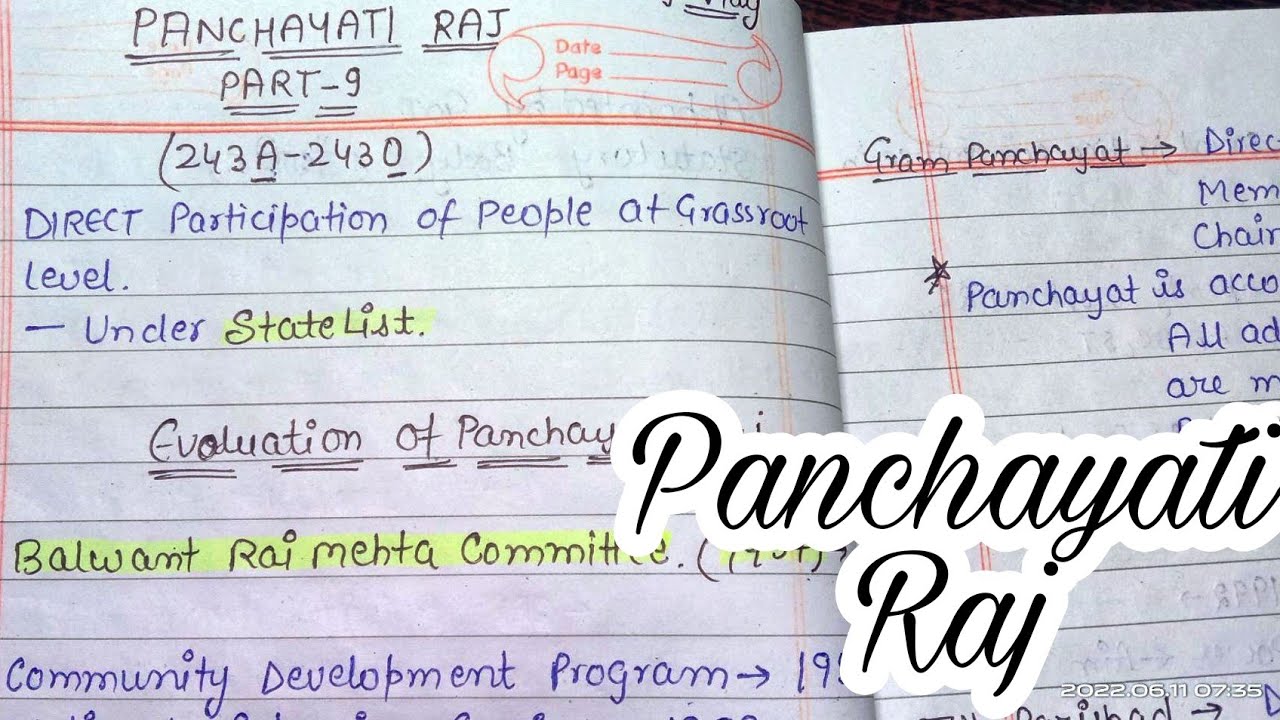
The Panchayati Raj System is India’s framework for rural local self-government. It was created to bring decision-making closer to people living in villages, so that local needs could be understood and solved by local representatives. Its modern form received constitutional status through the 73rd Constitutional Amendment Act, 1992, which made Panchayati Raj a permanent and legally recognised part of India’s democratic system. This topic is especially important for students and competitive-exam aspirants because it explains how grassroot democracy developed in India after independence.
🎯 In this chapter, you will understand:
- The meaning and importance of the Panchayati Raj System in rural local self-government.
- How the Balwant Rai G. Mehta Committee recommended democratic decentralisation in .
- How Rajasthan became the first state to implement Panchayati Raj in .
- How different states adopted different models, tiers, and local governance structures.
💡 Why this topic matters: The Panchayati Raj System shows how India moved power from distant government offices to villages. It helps ordinary citizens take part in planning, development, and local decision-making, making democracy stronger at the grassroots level.
🧠 Core Idea: Panchayati Raj is based on democratic decentralisation, meaning that powers, responsibilities, and resources are given to locally elected bodies. This allows villages, blocks, and districts to participate in their own development.
Panchayati Raj System in India: The Architecture of Rural Local Self-Government (1957-1992)
The story of India’s democratic journey cannot be complete without understanding the rise of the Panchayati Raj. It is the main framework for rural local self-government in India. In simple words, it is a system through which people in villages choose their own representatives to manage local matters such as development work, public facilities, and community welfare. Before such a system became strong, many important decisions were taken far away from the villages, even though the people living there understood their local problems best.
This system emerged as a visionary response by various State Legislatures seeking to empower the common man by strengthening grassroot democracy and fueling sustainable rural development. The idea was not only to create local bodies but also to give them real powers and responsibilities. The evolution reached its zenith when the system was formally granted constitutional status through the 73rd Constitutional Amendment Act, 1992, ensuring its permanence in the Indian political landscape.
- (i) The system serves as the foundational pillar for political participation at the village level, allowing villagers to elect representatives and take part in local governance.
- (ii) It bridges the gap between the central authority and the rural populace by creating local institutions that can understand and respond to village-level needs.
- (iii) It fulfills the Gandhian vision of Gram Swaraj, or village self-rule, through legislative empowerment and democratic local institutions.
The Historical Evolution of Panchayati Raj and Democratic Decentralisation
The path to modern local governance began with a critical evaluation of post-independence development programs. After independence, India wanted to improve village life through development schemes, but the government realised that development would be more successful if local people were directly involved in planning and implementation. This realisation led to the birth of the three-tier structure of Panchayati Raj, which connected villages, blocks, and districts in one organised system.
The Balwant Rai Mehta Committee: The Blueprint of Decentralization
In , the Government of India took a decisive step by forming a high-level committee under the esteemed chairmanship of Balwant Rai G. Mehta. Their mission was to scrutinize the efficacy of the Community Development Programme (1952) and the National Extension Service (1953), which were struggling to achieve their full potential. The committee examined why these programmes were not producing the expected results and suggested a better way to organise rural development through local participation.
Specific Recommendations for Institutional Reform
The committee submitted its report in . Its most important contribution was the idea of democratic decentralisation. This means that instead of keeping all power with the state or central government, some powers should be handed over to elected local bodies. The committee believed that local people and their representatives would be better able to identify local problems and plan suitable solutions.
- (i) Submission of the report occurred in , introducing the revolutionary concept of democratic decentralisation.
- (ii) The establishment of a three-tier system: the Gram Panchayat at the village level, the Panchayat Samiti at the block level, and the Zila Parishad at the district level.
- (iii) Implementation of indirect elections to link these tiers organically, so that each level could work in coordination with the others.
- (iv) Ensuring Gram Panchayat members are directly elected, while Panchayat Samiti and Zila Parishad members are indirectly elected to maintain administrative continuity.
- (v) Entrusting all planning and development functions directly to these newly formed bodies, so that local institutions could actively guide rural development.
Administrative Roles and Financial Autonomy
The Balwant Rai Mehta Committee did not only suggest the creation of new institutions. It also explained what work each institution should do and how they should receive money and authority. Without proper powers and funds, local bodies could become weak and unable to serve people effectively. Therefore, the committee stressed both administrative responsibility and financial independence.
- (i) The Panchayat Samiti was designated as the executive authority, driving ground-level implementation of development plans and welfare activities.
- (ii) The Zila Parishad was assigned an advisory, coordinating, and supervisory role to oversee district progress and guide lower-level bodies.
- (iii) The District Collector was positioned as the chairman of the Zila Parishad to ensure administrative synergy between government officers and elected local representatives.
- (iv) A genuine transfer of powers and responsibilities was mandated to make these institutions truly democratic rather than merely symbolic.
- (v) Provision of adequate financial resources was emphasized to prevent these bodies from becoming mere figureheads without the means to carry out development work.
- (vi) Creation of a dynamic mechanism for the further devolution of authority as the system matured, allowing more powers to be given to local bodies over time.
Implementation Across Indian States and Regional Variations
Following the National Development Council’s acceptance of the proposals in , the landscape of Indian administration began to change state by state. States started examining the recommendations and preparing laws to establish Panchayati Raj institutions. However, each state adapted the system according to its own administrative needs, geographical conditions, and political priorities. This is why the basic idea remained similar, but the structure and working of Panchayati Raj differed from one state to another.

Pioneering States: Rajasthan and Andhra Pradesh
The honour of being the first state to adopt this system went to Rajasthan. In a historic ceremony on , the Prime Minister inaugurated the Panchayati Raj in the Nagaur district. This event was a major milestone because it converted the recommendations of the Mehta Committee into a working system on the ground. It also encouraged other states to follow the same path and introduce rural local self-government in their own regions.
- (i) Andhra Pradesh became the second state to implement the framework later in , showing that the idea was quickly gaining acceptance beyond Rajasthan.
- (ii) By the mid-1960s, the system had reached almost every corner of the nation, though styles of governance varied significantly from state to state.
Structural Diversity and Regional Governance Models
While the principles remained the same, the execution differed based on state priorities, leading to variations in composition, tenure, functions, and finances. Some states preferred a simple structure with fewer levels, while others created more levels to cover larger populations and wider administrative areas. These differences show that Panchayati Raj was flexible and could be shaped according to local requirements.
- (a) The Tiered Differences:Rajasthan maintained the three-tier structure; Tamil Nadu opted for a two-tier system; while West Bengal innovated with a four-tier framework.
- (b) Power Centers: In the Rajasthan–Andhra Pradesh model, the Panchayat Samiti was the powerhouse of planning. Conversely, the Maharashtra–Gujarat model favored the Zila Parishad as the primary unit of district authority.
- (c) Judicial Evolution: Several states introduced Nyaya Panchayats, which served as judicial bodies dedicated to settling petty civil and criminal disputes at the local level.
⚡ Quick Revision Capsule: Panchayati Raj System
This quick revision capsule brings together the most examination-relevant facts about the Panchayati Raj System. It helps students revise the committee, dates, tiers, and state-level variations in one place.
| Aspect | Key Detail | Importance |
|---|---|---|
| Panchayati Raj | A system of rural local self-government in India. | Strengthens grassroots democracy and local participation. |
| Balwant Rai G. Mehta Committee | Formed in ; report submitted in . | Recommended democratic decentralisation and the three-tier structure. |
| Three-Tier Structure | Gram Panchayat, Panchayat Samiti, and Zila Parishad. | Connects village, block, and district levels of governance. |
| First Implementation | Rajasthan inaugurated Panchayati Raj in Nagaur district on . | Rajasthan became the first state to implement the system. |
| Constitutional Status | Provided by the 73rd Constitutional Amendment Act, 1992. | Gave Panchayati Raj a permanent constitutional foundation. |
📝 Summary
The Panchayati Raj remains a vital subject for students because it encapsulates the essence of rural local self-government in India. From the early recommendations of the Balwant Rai G. Mehta committee in to the formal constitutional status achieved in , this system has redefined how grassroot democracy functions. Understanding these historical shifts and regional variations is crucial for mastering Indian polity and the mechanics of democratic decentralisation.
🚀 Quick Revision Points
Essential facts to review before examinations:
- (i) The Panchayati Raj System is the framework for rural local self-government in India.
- (ii) The Balwant Rai G. Mehta Committee was formed in and submitted its report in .
- (iii) The committee recommended democratic decentralisation and a three-tier structure of Gram Panchayat, Panchayat Samiti, and Zila Parishad.
- (iv) Rajasthan became the first state to implement Panchayati Raj, inaugurated at Nagaur district on , while the 73rd Constitutional Amendment Act, 1992 later gave it constitutional status.
- 💡 Exam Tip: Remember the sequence clearly: Mehta Committee formed in , report in , National Development Council acceptance in , Rajasthan’s Nagaur inauguration on , and constitutional status through the 73rd Constitutional Amendment Act, 1992.
❓ Frequently Asked Questions (FAQ)
Q1: What is the Panchayati Raj System?
A1: The Panchayati Raj System is India’s system of rural local self-government. It allows people in villages to elect local representatives who participate in planning and implementing development work at the local level.Q2: What did the Balwant Rai Mehta Committee recommend?
A2: The committee recommended democratic decentralisation and a three-tier structure consisting of the Gram Panchayat at the village level, Panchayat Samiti at the block level, and Zila Parishad at the district level.Q3: Which state first implemented Panchayati Raj, and when did it receive constitutional status?
A3: Rajasthan was the first state to implement Panchayati Raj; it was inaugurated in Nagaur district on . The system later received constitutional status through the 73rd Constitutional Amendment Act, 1992.