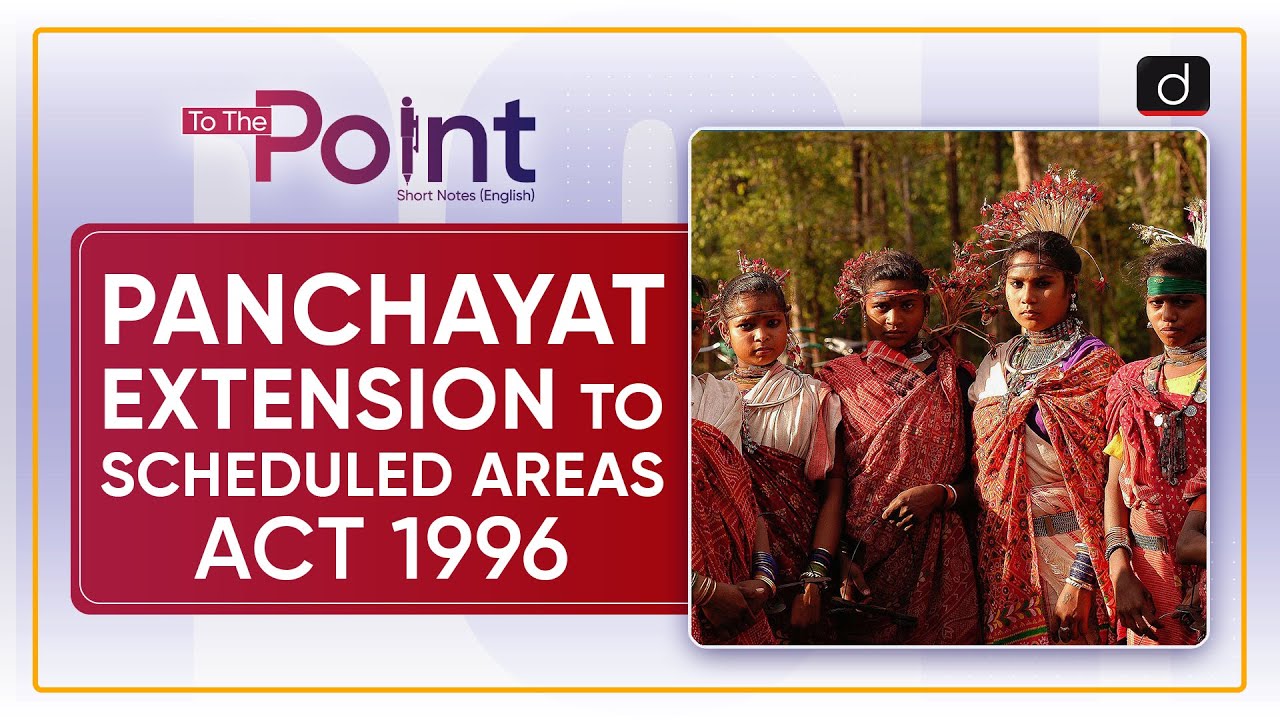
The Panchayats (Extension to the Scheduled Areas) Act, 1996, commonly called the PESA Act, is an important Indian law made to give more power to tribal communities living in Fifth Schedule Areas. It was enacted by Parliament in and came into force on . The Act connects the Panchayati Raj system under Part IX of the Constitution of India with the traditional self-governance practices of tribal people. In simple words, it allows modern village democracy to work in tribal areas without ignoring their customs, culture, and local ways of managing community affairs.
🎯 In this chapter, you will understand:
- Why the PESA Act was needed in Fifth Schedule Areas.
- Which states implement the PESA framework.
- How the Gram Sabha protects tribal customs, land, forests, and resources.
- The special powers given to Panchayats and tribal communities under PESA.
💡 Why this topic matters: PESA is important because it shows how India balances constitutional democracy with the rights of tribal communities. It helps students understand how local self-government can protect culture, land, forests, and community resources.
🧠 Core Idea: PESA extends the Panchayati Raj system to Scheduled Areas, but with special changes so that the Gram Sabha remains the main centre of power and tribal self-rule is protected.
Panchayats Extension to the Scheduled Areas Act 1996: PESA and Tribal Self-Rule
A historic legal bridge was built when the Indian Parliament recognised that the standard provisions of Part IX of the Constitution, which deal with Panchayats, could not simply be applied to the sensitive Fifth Schedule Areas without change. These areas are home to many tribal communities whose social systems, customs, and traditional institutions are different from those in other parts of the country. If the usual Panchayat rules were applied without care, they could weaken traditional tribal self-governance instead of strengthening it. Therefore, Parliament used its power to extend Panchayati Raj to these areas with suitable exceptions and modifications.
To correct this gap, the legislature created a special law known as the Provisions of the Panchayats (Extension to the Scheduled Areas) Act, 1996. This law is popularly called PESA. Its main purpose is to make sure that formal democracy reaches remote tribal regions while also respecting their traditional heritage. It does not treat tribal communities as passive receivers of government schemes; instead, it gives them an active role in deciding matters that affect their daily lives.
- (i) The idea began with the understanding that tribal populations needed a governance model that respected their unique social and cultural fabric.
- (ii) Parliament enacted the Provisions of the Panchayats (Extension to the Scheduled Areas) Act, 1996 to ensure that formal democracy meets traditional heritage.
- (iii) PESA serves as the foundation for participatory democracy in tribal and remote regions.
Geographical Reach and Implementation Across Ten States
By , PESA had been implemented across ten Indian states that contain Fifth Schedule Areas. These states amended their own Panchayati Raj laws so that their local systems could follow the central PESA framework. This does not mean every rule is exactly the same everywhere; states can make suitable state-level rules. However, the central aim remains the same: to protect tribal self-governance while allowing Panchayats to function effectively.
States Compliant with the PESA Framework
Each of the following states has amended its local Panchayati Raj laws to align with the central PESA mandate. This helps create a system that is broadly uniform but still sensitive to local tribal traditions and administrative needs.
- (a) The southern states of Andhra Pradesh and Telangana.
- (b) The mineral-rich and tribal-dominated states of Chhattisgarh and Jharkhand.
- (c) The western states of Gujarat, Maharashtra, and Rajasthan.
- (d) The central state of Madhya Pradesh and the eastern coastal state of Odisha.
- (e) The northern mountainous state of Himachal Pradesh.
Strategic Objectives Behind the PESA Act
The central philosophy of PESA is to shift power from higher levels of government to the village level. Instead of allowing decisions to be made only by officials or distant authorities, PESA encourages local people to take part in planning, approving, and monitoring development work. This makes governance more transparent, more responsive, and more connected to the real needs of tribal villages.
Legal Extensions and Tribal Self-Rule
The first major objective was to extend the provisions of Part IX of the Constitution to Scheduled Areas, while making sure that the self-rule of tribal populations was not weakened. PESA recognises that tribal communities have their own traditions, community institutions, and ways of solving problems. Therefore, the Act allows Panchayati Raj institutions to work alongside these traditional systems rather than replacing them. [469][474]
- (i) To promote village governance where the Gram Sabha acts as the core institution of power.
- (ii) To protect and preserve the customs, traditions, cultural identity, and community resources of tribal people.
- (iii) To create an administrative structure that does not conflict with traditional tribal practices.
Safeguarding Local Authority
Another important objective is to stop higher-level Panchayats from taking away the powers of smaller local bodies. PESA wants decisions to remain close to the people who are directly affected by them. For example, a district-level body should not interfere in a matter that a village Gram Sabha is competent to decide. This protects the independence of village-level institutions and prevents concentration of power at higher levels.
- (i) To empower lower-level Panchayats with tribal-specific powers.
- (ii) To ensure that district or intermediate Panchayats cannot usurp the authority of the Gram Sabha.
Distinguishing Features of the PESA Governance Model
PESA changes the Gram Sabha from a simple village meeting into a powerful institution for local resource management, social justice, and community decision-making. It gives people in Scheduled Areas the legal ability to protect their land, forests, water, markets, and cultural practices. This makes the Gram Sabha the heart of tribal self-governance under PESA.
The Supremacy of the Gram Sabha
Under PESA, every village has its own Gram Sabha. A village may consist of one habitation or a group of hamlets whose residents manage their affairs according to their traditions and customs. The Gram Sabha includes all persons whose names appear in the electoral rolls of the village-level Panchayat. This means it is not controlled by a few leaders; it represents the collective voice of the village community.
- (i) The Gram Sabha consists of all persons whose names are included in the electoral rolls for the village-level Panchayat.
- (ii) It is legally responsible for protecting natural resources, community resources, customs, cultural identity, and customary methods of dispute resolution.
Financial and Social Oversight
The Gram Sabha also keeps a check on how public money and development plans are used in the village. Before a village Panchayat can implement certain plans, programmes, or projects, the Gram Sabha must approve them. It also identifies beneficiaries for poverty-alleviation and other welfare programmes and certifies the utilisation of funds. This reduces the chances of misuse of money and helps ensure that benefits reach the right people. [473][476]
- (a) Mandatory certification of fund utilisation by the Gram Sabha before Panchayats can spend funds on approved plans, programmes, and projects.
- (b) Approval of all socio-economic development plans before they are implemented at the village level.
- (c) Identification of beneficiaries for poverty-alleviation schemes and other welfare programmes.
Reservation and Political Representation
PESA also focuses on political representation so that tribal people can lead their own institutions. It requires reservation of seats in proportion to the population of Scheduled Tribes in the area, but the reservation cannot be less than half of the total seats. This ensures that tribal communities have a strong voice in Panchayati Raj institutions. The law also reserves all Chairperson positions at all levels of Panchayats for Scheduled Tribes.
- (i) Seats must be reserved for Scheduled Tribes in proportion to their population, and this reservation must not be less than 50%.
- (ii) All Chairperson posts at every level of the Panchayat are reserved for Scheduled Tribes.
- (iii) The State may nominate unrepresented Scheduled Tribes at higher Panchayat levels, but such nominations cannot exceed 10% of the total elected members.
Consultation Rights and Resource Control
The Gram Sabha acts as an important gatekeeper for the village’s land and natural resources. PESA requires consultation with the Gram Sabha or the appropriate Panchayat before land is acquired for development projects or before affected people are resettled and rehabilitated. This provision is important because land is closely connected to tribal identity, livelihood, and culture.
- Land Acquisition: The Gram Sabha or appropriate Panchayat must be consulted before land is acquired in Scheduled Areas for development projects and before resettlement or rehabilitation of affected persons takes place.
- Mineral Rights: The recommendation of the Gram Sabha or appropriate Panchayat is mandatory before granting a prospecting licence or mining lease for minor minerals.
- Minor Water Bodies: The planning and management of minor water bodies are entrusted to Panchayats at the appropriate level.
Specific Powers Vested in Local Bodies
State Legislatures are required to endow Panchayats and Gram Sabhas with specific powers so that they can protect the tribal way of life. These powers cover everyday matters that directly affect tribal communities, such as local markets, money-lending, forest produce, land, and intoxicants. By giving local institutions control over these matters, PESA strengthens community-based decision-making. [473][478]
- Prohibition: Power to regulate or prohibit the sale and consumption of intoxicants.
- Forest Produce: Ownership of minor forest produce.
- Land Protection: Power to prevent alienation of tribal land and to take action to restore unlawfully alienated land.
- Market and Credit: Power to manage village markets and regulate money-lending to Scheduled Tribes.
- Social Sector: Power to exercise control over institutions and functionaries in local social sectors and over local plans and resources.
Summary of the PESA Act 1996 and its Modern Significance
The PESA Act, 1996 remains a revolutionary law because it changed tribal communities from passive subjects of administration into active participants in self-governance. By combining the protections of the Fifth Schedule with the Panchayati Raj system, it helps preserve cultural identity, community resources, and traditional decision-making. For students, the most important points are the supreme role of the Gram Sabha, mandatory consultation for land acquisition and minor-mineral leases, ownership of minor forest produce, and the special reservation provisions for Scheduled Tribes.

⚡ Quick Revision Capsule: PESA Act 1996
The following table gives a quick overview of the most important features of the PESA Act. It is useful for last-minute revision before examinations.
| Aspect | Key Provision | Importance |
|---|---|---|
| Full Form | Panchayats (Extension to the Scheduled Areas) Act, 1996 | Extends Panchayati Raj to Scheduled Areas with modifications. |
| Constitutional Link | Extends Part IX of the Constitution with exceptions and modifications. | Protects tribal self-governance while enabling local democracy. |
| Core Institution | The Gram Sabha, consisting of persons on the village electoral rolls. | Approves plans, identifies beneficiaries, and certifies fund use. |
| States Covered | Ten states with Fifth Schedule Areas. | Includes Andhra Pradesh, Telangana, Chhattisgarh, Jharkhand, Gujarat, Maharashtra, Rajasthan, Madhya Pradesh, Odisha, and Himachal Pradesh. |
| Resource Powers | Consultation for land acquisition; mandatory recommendation for minor-mineral leases; ownership of minor forest produce. | Protects tribal land, livelihood, and community resources. |
📝 Summary
The PESA Act, 1996 was enacted to extend the Panchayati Raj system to Fifth Schedule Areas while respecting the customs and traditional governance systems of tribal communities. It came into force in and applies in ten states with Fifth Schedule Areas. Its greatest strength is that it makes the Gram Sabha a powerful village institution: it approves development plans, identifies welfare beneficiaries, certifies fund utilisation, protects community resources, and participates in decisions related to land and minor minerals. In this way, PESA supports both constitutional democracy and tribal self-rule. [471][473][476]
🚀 Quick Revision Points
Essential facts to review before examinations:
- (i) PESA stands for the Panchayats (Extension to the Scheduled Areas) Act, 1996.
- (ii) It extends Part IX provisions to Fifth Schedule Areas with exceptions and modifications.
- (iii) The Gram Sabha is the central institution for approving plans, identifying beneficiaries, and certifying fund utilisation.
- (iv) PESA provides for ownership of minor forest produce, consultation before land acquisition, and mandatory recommendations for minor-mineral prospecting licences and mining leases under PESA, 1996.
- (v) At least 50% of Panchayat seats are reserved for Scheduled Tribes, and all Chairperson posts at every Panchayat level are reserved for Scheduled Tribes.
- 💡 Exam Tip: Remember the phrase “Gram Sabha first.” Under PESA, the Gram Sabha approves village development plans, identifies beneficiaries, certifies fund use, and must be consulted on land acquisition and minor-mineral matters.
❓ Frequently Asked Questions (FAQ)
Q1: What is the main purpose of the PESA Act, 1996?
A1: Its main purpose is to extend the Panchayati Raj system to Fifth Schedule Areas while protecting the self-governance, customs, culture, land, and resources of tribal communities.Q2: Why is the Gram Sabha so important under PESA?
A2: The Gram Sabha is the main village-level decision-making body. It approves development plans, identifies beneficiaries, certifies fund utilisation, protects community resources, and helps resolve local disputes through customary methods.Q3: How does PESA protect tribal land and natural resources?
A3: Under PESA, 1996, the Gram Sabha or appropriate Panchayat must be consulted before land acquisition, resettlement, or rehabilitation. Its recommendation is mandatory for minor-mineral prospecting licences and mining leases. It also has powers over minor forest produce, village markets, money-lending, and prevention of tribal land alienation.