
This detailed analysis explores the critical Agricultural Policy Reforms and pricing strategies implemented during post-liberalisation India, focusing on how Economic Acts and Policy Shifts after impacted rural stability. For students preparing for competitive exams, understanding these structural adjustments is vital for grasping the evolution of the Indian Economy and Sustainable Development goals.
🎯 In this chapter, you will understand:
- How post-1991 economic policies reshaped the farm sector and rural growth.
- The risks of creating a divided society between rich and poor farming regions.
- The role of government price support, public investment, and rural credit.
- Key solutions including seed quality improvement, technology adoption, and food stock reforms.
💡 Why this topic matters: Agriculture remains the backbone of income and livelihoods for most rural families in India. Learning how post-1991 reforms shaped farming helps us understand current economic challenges and government safety nets.
🧠 Core Idea: Economic liberalisation opened new markets for farming, but a fall in public investment and rising costs created severe gaps between wealthy and small-holder farmers.
Agricultural Policy Reforms and Pricing in Post-Liberalisation India (Post-1991 Period)
The transition into a global market created a complex situation for Indian farming, as the nation tried to balance economic growth with fair treatment for all social groups. Following the liberalisation era, the agricultural sector experienced major changes alongside tough challenges. While India worked to connect with global trade, the internal social and economic conditions in villages changed heavily under new government policies.
- Agricultural growth remains the main engine for improving the lives of most Indian farmers and is the most effective path to alleviate poverty.
- A clear steep deceleration in agricultural growth happened because the government neglected public investment in rural infrastructure.
- There is a serious risk of building a dual society where elite-centered growth policies help wealthy groups while leaving disadvantaged farmers behind.
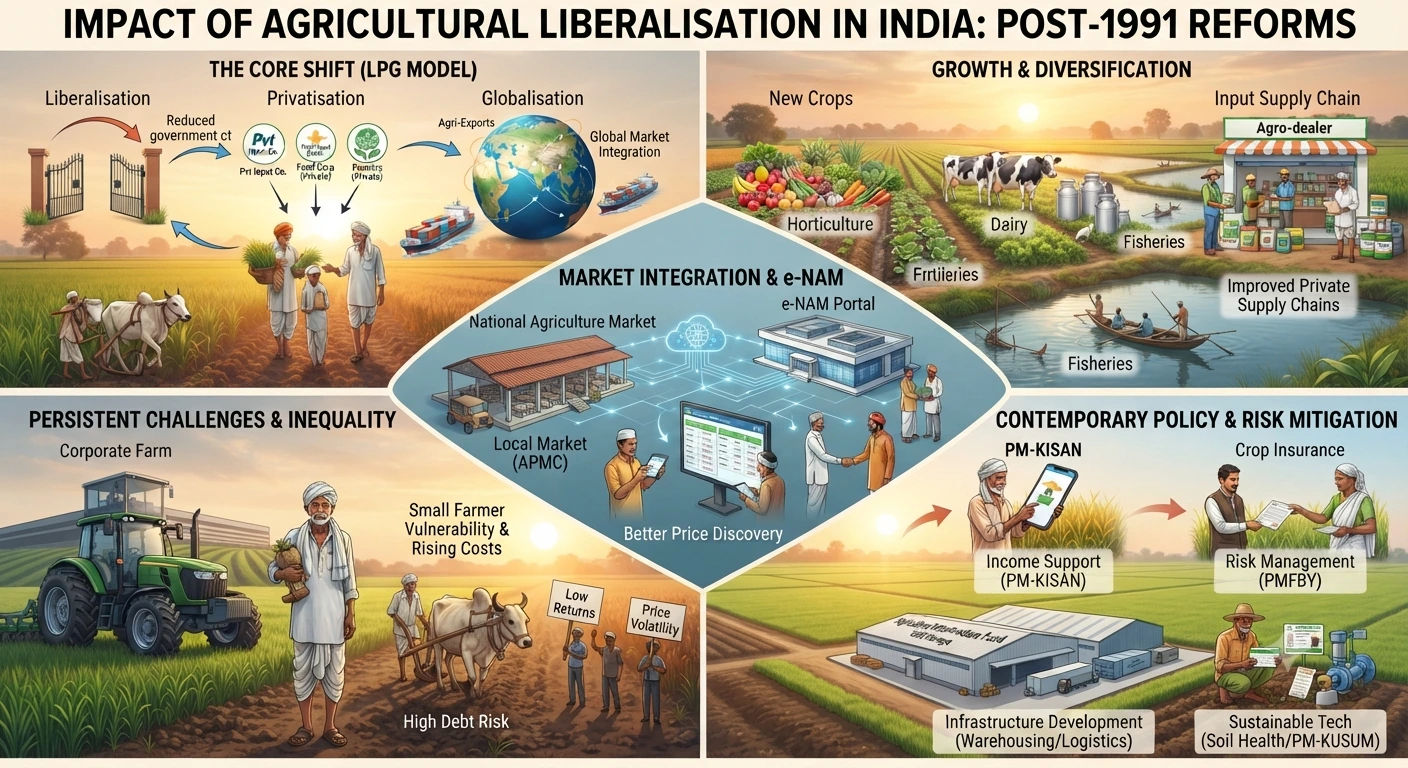
The economic changes started in shifted India from a state-managed agricultural system to one guided by open market forces. Although this shift encouraged farmers to grow high-value items like fruits, vegetables, and dairy, it brought ongoing difficulties for small farmers who faced rising prices for farm supplies and unpredictable weather. In response, recent policy focuses on lowering risks for farmers through direct cash support (PM-KISAN), broader crop insurance (PMFBY), better transport infrastructure, and solar-powered irrigation.
Post-Liberalisation Challenges and the Risk of a Dual Society
Moving toward market-led policies created a growing divide between developed farming areas and regions lagging behind due to weak infrastructure. This gap threatens rural stability by concentrating financial gains in places that already have good roads, water supply, and markets.
Impacts of Market-Driven Liberalisation
A market-driven approach often leads to an unequal distribution of wealth, where prosperous regions and wealthy farmers gain the most from open trade policies.
- (i) Peasant movements and local activists must intervene to protect small and marginal farmers during this economic transition.
- (ii) Globalisation brings both opportunities and challenges; while international trade is open, most Indian peasants have not yet received real benefits.
- (iii) India has natural strengths to become an agricultural superpower thanks to its diverse agro-climatic zones, abundant sunshine, and rich biodiversity.
Policy Uncertainty and Biotechnology Adoption
Over the past decade, a diffuse policy focus led to reduced investment and confusion regarding scientific advancement in farming.
- (a) Current uncertainty around biotechnology slows down the use of modern tools that boost crop yields.
- (b) A science-based stance by the Central government is essential to stop a return to outdated, low-yield farming practices.
Pricing Policy and Macro-Economic Influences on Rural Markets
Broad economic decisions often shape farm profits even more than direct agricultural programs. Changes in government spending, tax rules, and currency values quickly pass through local village markets, altering crop prices and farmer security.
Structural Adjustment and Pricing Strategies
Changes in fiscal, monetary, and exchange rate policies produce deep effects on social relations and farm output within the countryside.
Factors Influencing Terms of Trade
- (i) The rising political influence of farm lobbies has turned agricultural pricing into a key topic in reform discussions.
- (ii) A plausible pricing strategy means removing negative protection and permitting staggered price increases to match global trends smoothly.
Social Safety Nets for Vulnerable Farmers (PDS and Employment)
- (i) Supporting vulnerable populations with safety nets is essential during major economic reforms.
- (ii) Strengthening the Public Distribution System (PDS) and employment generation programs provides essential support for rural family stability.
Fiscal Policies and Institutional Support for Sustainable Growth
Keeping government finances healthy requires balancing necessary farm subsidies with recovering service costs. Diverting state money away from temporary consumption aid and toward long-term physical projects is key to lasting success.
Equity in Public Investment and Irrigation Efficiency
Government funding for irrigation infrastructure has suffered a steady decline, which private investment could not replace in low-growth districts.
- (i) A phased reduction of input subsidies on fertilizers and electricity is necessary to maintain a sustainable fiscal policy.
- (ii) Failing to achieve cost-recovery for water and power supply will eventually deteriorate service delivery and hurt national food security.
- (iii) Increasing irrigation investment is proven to be a more effective method of raising output than simply offering fertilizer discounts.
Seed Quality and the Technology Dissemination Gap
A major obstacle to farm growth is the large gap between actual and potential yields caused by poor adoption of best practices and low-quality inputs.

Seed Quality and Farm Technology Dissemination - Seed Confusion: Many farmers fail to separate "seed and grain", leading to weak crop harvests.
- Research Limits:Research institutes currently face limited seed multiplication capacity to meet national demand.
- Market Reforms: Diverting subsidies toward seed production and building a competitive seed market with private sector participation is a high priority.
⚡ Quick Revision Capsule: Agricultural Policy Comparison
The following table summarizes the main pillars of agricultural policy reforms in India after 1991, highlighting key goals and challenges.
| Policy Focus Area | Key Post-1991 Objective | Main Challenge / Structural Risk |
|---|---|---|
| Market Integration | Connect domestic crop sales with international trade markets. | Creates a risk of a dual society favoring wealthy farmers. |
| Subsidies & Investment | Shift funds from power/fertilizer subsidies to long-term assets. | Declining public spending in irrigation infrastructure. |
| Seed & Biotechnology | Boost farm yields through high-quality seeds and research. | Gap between lab potential and field adoption by farmers. |
| Rural Credit Access | Replace informal moneylenders with official bank loans. | Financial stress in Regional Rural Banks (RRBs). |
| Food Grain Management | Streamline grain stocks held by the FCI. | High management costs straining the national budget. |
Agricultural Credit Reforms and Marketing Inefficiencies
Improving the flow of money and creating efficient supply chains are essential steps for supporting small farmers. Without reliable bank loans and transparent crop markets, smallholders stay trapped under heavy debt burdens.
Overhauling the Rural Credit System
The heavy reliance on local moneylenders underscores the urgent need for a systematic institutional credit reform aimed at small farmers.
- (i) Thorough reform is required across both cooperative and commercial banks to guarantee timely credit delivery.
- (ii) Fixing financial losses at non-viable Regional Rural Banks (RRBs) remains a critical institutional hurdle.
Marketing Infrastructure and the Risks of Over-Commercialisation
Current marketing structures remain inefficient and outdated, particularly in backward districts.
- (i) Official price support operations concentrate heavily on wheat and rice, often missing deficit States that need help.
- (ii) Over-commercialisation can end up benefiting only resource-rich regions, leaving non-commercial marketing structures behind.
Food Stock Operations, Technology, and Institutional Sustainability
Updating how the Food Corporation of India operates and expanding dryland farming methods are vital for protecting India's agricultural future. Targeted state support ensures vulnerable families receive help without burdening public finances.
FCI Operations and Food Security Subsidies
The economic costs of food grains managed by the Food Corporation of India (FCI) have increased sharply, placing pressure on the national exchequer.
- (i) Restricting PDS coverage to truly needy groups is essential for fiscal sustainability.
- (ii) An integrated framework is required to re-evaluate optimal food stock levels and procurement policies.
Dry Land Technology and Agro-climatic Planning
Promoting dry land technology is a top priority for areas facing underdeveloped infrastructure and weak extension services.
- (a) Agro-climatic Regional Planning (ACRP) provides a practical framework for area-specific technological adoption.
- (b) Ensuring the sustainability of irrigation in drought-prone areas must remain a priority as growth paths expand.
Institutional Land Reforms and Labourer Welfare
Despite political challenges, land reforms must stay at the center of structural adjustment to fix past state intervention biases.
Supporting the Backbone: Agricultural Labourers and Crop Insurance
- (i) Enforcing minimum wage laws and tracking the distribution of surplus land are vital for landless labourers.
- (ii) Crop insurance schemes must expand to cover cash crops, helping lower financial risk across different farming sectors.
📝 Summary
In summary, Agricultural Policy Reforms in post-liberalisation India emphasize the delicate balance between market efficiency and social equity. For students, mastering these concepts of fiscal discipline, institutional credit, and technology dissemination is key to understanding modern Indian economic history and the future of rural development. Sustaining growth after requires a science-based approach and renewed public investment to prevent the rise of a dual society.
🚀 Quick Revision Points
Essential facts to review before examinations:
- (i) Post-1991 reforms integrated domestic farming with global trade, making agricultural growth critical to poverty alleviation.
- (ii) Public spending on infrastructure dropped, creating an urgent need for a phased input subsidy reduction to fund long-term assets.
- (iii) Crop yield gaps stay wide due to poor seed choices; closing the technology dissemination gap is essential.
- (iv) Overhauling credit through RRBs and cooperative networks insulates small farmers from high-interest moneylenders.
- (v) High grain management costs at the FCI call for a targeted PDS approach to safeguard national finances.
- 💡 Exam Tip: When writing answers on post-1991 Indian agriculture, highlight the contrast between public investment cuts and input subsidy growth, and explain how this shift created regional growth disparities.
❓ Frequently Asked Questions (FAQ)
Q1: Why is there a risk of a "dual society" in post-liberalisation Indian agriculture?
A1: Market-driven policies naturally reward resource-rich regions and wealthy farmers who possess the scale to access global markets. Without deliberate public investment in backward districts, poorer communities fall behind, creating an unequal economic layout.Q2: What is the primary roadblock highlighted regarding agricultural infrastructure funding?
A2: Public investment has experienced a steady decline because state resources are heavily tied up in unrecovered input subsidies for electricity and fertilizer. Shifting these subsidies toward real asset creation like irrigation is proven to yield better output.Q3: How do macro-economic adjustments affect local terms of trade for peasants?
A3: Changes in broader fiscal, monetary, and exchange rate policies alter relative prices, production costs, and export values. If safety nets like the Public Distribution System (PDS) are not maintained, these structural variations pass heavy financial shocks down to small and marginal farmers.

Value for money. Good article