The subject of Intellectual Property Rights (IPR) within the World Trade Organization (WTO) framework is a crucial aspect for students preparing for international trade and law exams. Introduced at the insistence of major developed countries, the Agreement on TRIPS provides a comprehensive framework for protecting IPR in seven key areas. Understanding the patent and copyright provisions, alongside their implications for innovation and consumer balance, is essential for grasping global trade dynamics and legal enforcement mechanisms.
The TRIPS Agreement and Protection of Intellectual Property Rights (IPR) under the WTO Framework
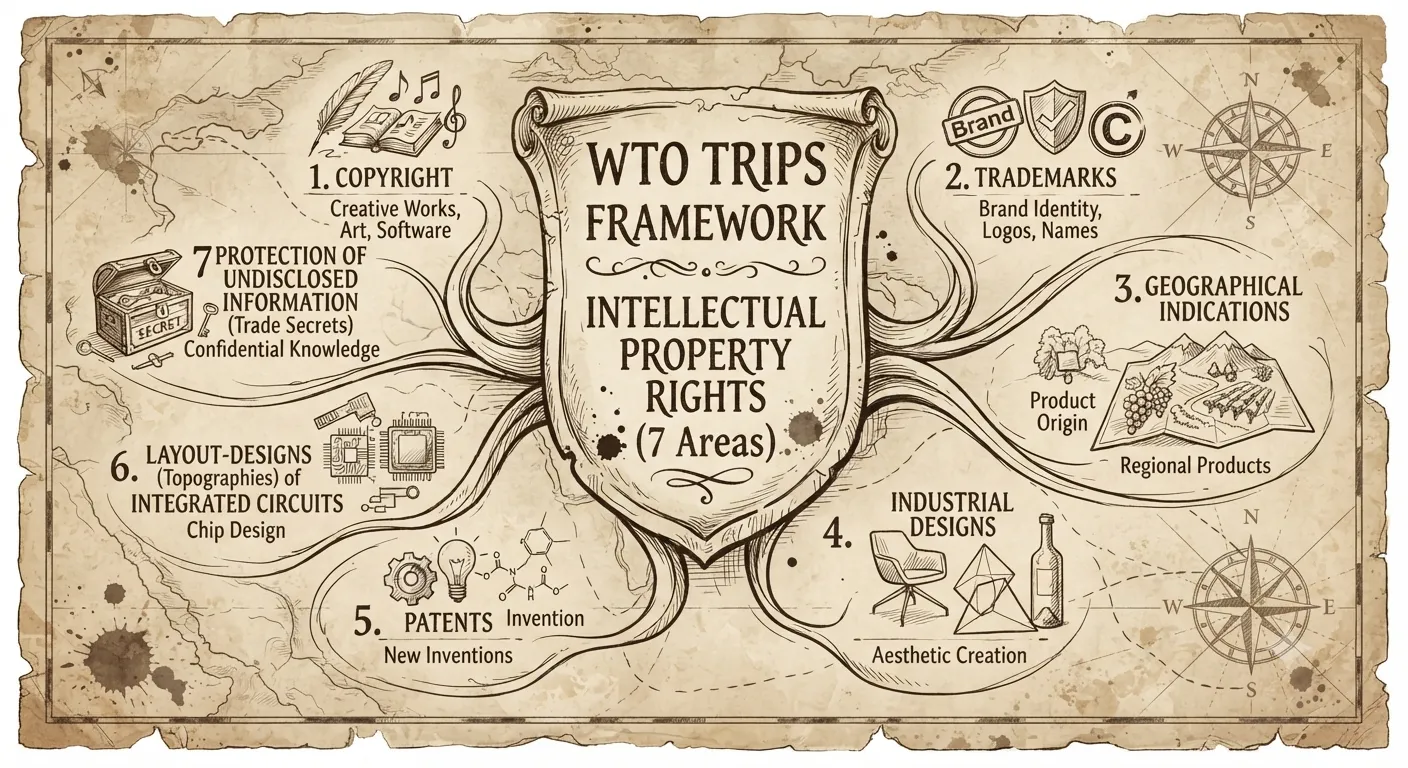
The inclusion of IPR in the WTO was primarily driven by major developed nations, despite its limited alignment with free trade principles. The protection of intellectual property, being a creation of the human mind, differs fundamentally from conventional trade. While IPR safeguards the monopoly of the creator and ensures returns for innovation, the WTO primarily focuses on facilitating free trade. The TRIPS Agreement bridges this gap by standardizing seven areas of IPR enforcement and linking them with the WTO’s dispute settlement mechanisms.
- The Seven Pillars and Global Standard Enforcement
The TRIPS Agreement sets minimum standards of protection, ensuring countries cannot provide lower protection than required, though they may opt for higher safeguards. Earlier treaties like the Paris Convention, Berne Convention, Rome Convention, and Washington Treaty existed, but they completely lacked enforceability through a global trade body. TRIPS completely changes this by creating a uniform, legally binding web across member nations.
- (i) The seven areas covered include patents, copyrights, trademarks, geographical indications, industrial designs, integrated circuits, and undisclosed information.
- (ii) National laws must align directly with these global rules, closing old legal loopholes.
Need for Protection of Intellectual Property Rights
Protecting these rights is a delicate balancing act. We need to actively incentivize innovation and reward inventors, but we also have to keep consumer interests and public welfare in mind.
Incentive for Innovation
IPR protection ensures that inventors and creators receive exclusive rights to produce, market, and benefit financially from their innovations. This exclusivity encourages further innovation and research. The inventor gets returns on investment, motivating continuous creativity. However, products protected under patents often have higher prices, which are borne by consumers. TRIPS mandates minimum protection standards to keep this balance functional.
Patent Provisions under TRIPS
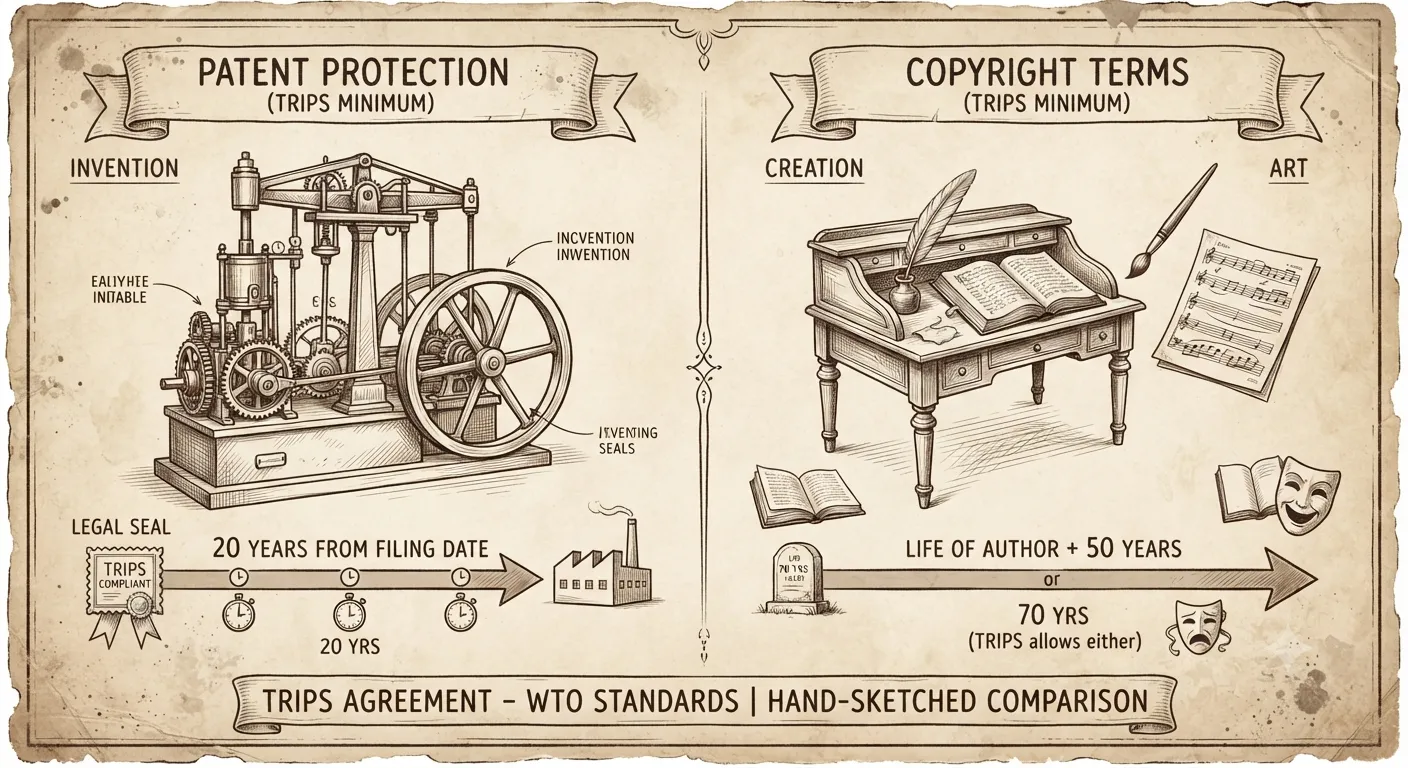
Patents are granted for inventions that are new, non-obvious, and industrially applicable. Both products and processes can be patented, with exceptions for certain methods and biological creations. Patents typically last at least twenty years from filing, providing the owner exclusive production and marketing rights.
- (a) Countries may refuse patents on grounds of public morality, human/animal/plant health, or environmental concerns.
- (b) Compulsory licenses allow governments to authorize use without the owner’s consent, subject to remuneration and procedural conditions.
Copyright Provisions under TRIPS
Copyright protects literary, artistic, architectural, cinematographic, and computer works along with performers’ rights and phonograms. Unlike patents, copyright applies automatically across countries without registration. Computer programs receive protection similar to literary works, ensuring creators' rights globally to support artistic and technological development.
Work Type Minimum Term of Protection under TRIPS Literary and Artistic Works Life of the author plus 50 years Cinematography and Phonograms 50 years post-creation or performance Implementation and Enforcement under TRIPS
The TRIPS framework incorporates legal processes and domestic measures to effectively implement IPR protection, integrating it directly with the WTO dispute settlement mechanism. It provides enforceable standards across member countries, aligns national laws with global obligations, and ensures creators and inventors receive adequate protection and remuneration for their intellectual contributions.
Summary
The TRIPS Agreement represents a significant milestone in the integration of Intellectual Property Rights within global trade. It ensures a structured framework for patents, copyrights, and other forms of IPR, balancing the needs of inventors and consumers. For students, understanding these provisions is essential to grasp global trade policy, innovation incentives, and the enforceability of intellectual property across nations.
Quick Revision Points for Students
Reviewing the core empirical and legal facts ensures full retention for examinations.
- (i) TRIPS covers seven key areas of IPR, establishing uniform minimum protection standards worldwide.
- (ii) Patents apply to both products and processes, granting exclusive rights for at least 20 years.
- (iii) Copyright applies automatically without registration, protecting standard literary works for the author's life plus 50 years.
- (iv) Governments retain the right to issue compulsory licenses to protect public health or address emergencies under strict rules.
Frequently Asked Questions (FAQ)
Q1: Why was IPR integrated into the WTO through TRIPS if it limits free trade?
A1: Major developed nations heavily pushed for its inclusion to standardize enforcement globally and link IPR protection to the WTO's powerful dispute settlement mechanisms.Q2: What is a compulsory license under the TRIPS framework?
A2: It is an authorization that allows a government to permit someone else to produce a patented product or process without the patent owner's consent, subject to paying remuneration and meeting specific procedural conditions.Q3: Do computer programs get patented or copyrighted under TRIPS?
A3: Under the TRIPS agreement, computer programs are explicitly given protection under copyright law, being treated similarly to traditional literary works.