Explore the complex world of Currency Derivatives in India, a vital sector for managing exchange rate risk in an increasingly globalized economy. This detailed guide covers the evolution of Currency Futures and Options, providing essential insights for students preparing for financial and competitive examinations by highlighting the roles of RBI and SEBI.
🎯 In this chapter, you will understand:
- The core structure and basic rules of currency derivatives in India.
- How the Over-the-Counter (OTC) market operates through forwards and swaps.
- The growth and daily trading numbers of exchange-traded currency contracts.
- The regulatory oversight provided jointly by the RBI and SEBI.
💡 Why this topic matters: Indian companies working globally face constant price shifts in foreign currencies. Knowing how currency derivatives protect businesses helps you grasp modern risk management.
🧠 Core Idea: Currency derivatives allow buyers and sellers to lock in future exchange rates today, helping protect against unpredictable changes in foreign exchange values.
Currency Derivatives in India: Evolution and Market Dynamics
The journey of currency derivatives in India represents a major shift from traditional, private banking hedges to highly sophisticated, transparent exchange-traded mechanisms. As Indian firms expanded their global footprint, managing volatile swings in the forex market became absolutely essential for survival.
Understanding the Core Framework and Definitions
Before diving into market complexities, let's break down the foundational building blocks that govern these financial contracts. A currency derivative acts as a binding financial agreement whose value is anchored directly to an underlying asset, which is simply the specific currency amount involved. These tools allow a buyer and a seller to lock in a deal today to exchange currencies at a fixed future date and pre-determined rate. By utilizing these futures contracts, businesses can effectively shield themselves from unexpected shocks in the forex market.
The Landscape of Foreign Exchange Derivatives in India
While the foreign exchange derivative segment has been active in India for a long time, it has historically experienced different levels of institutional engagement and structural design compared to standard interest rate derivatives.
The Dominance of Over-the-Counter (OTC) Instruments
In the broader Indian financial system, the OTC market remains the absolute cornerstone for large-scale institutional hedging through customized contracts tailored to specific corporate needs.
- (i) Primary Instruments: The most widely utilized tools in this segment are currency forwards and currency swaps, which allow parties to bypass rigid exchange rules and set bespoke terms.
- (ii) Market Participants: Importers, exporters, and commercial banks are the dominant forces driving the rupee forward market to safeguard their massive foreign currency exposure.
- (iii) Maturity Profiles: Although overall liquidity and turnover are on an upward trajectory, the vast majority of these contracts remain strictly short-term, typically maturing in less than .
Dynamics of Currency Swaps and Options
The operational utility of swaps provides a crucial financial bridge for large corporations, allowing them to transform and manage long-term debt liabilities across different international borders.
- (i) Mechanism of Swaps: Banks and corporate entities frequently use currency swaps to convert their rupee-denominated debt into foreign denominations like the US dollar or Japanese yen. This process is fully reversible, meaning they can convert foreign debt back into Indian Rupees whenever their hedging strategy requires it.
- (ii) Status of OTC Options: In stark contrast to the booming forward market, OTC currency options trading has historically remained relatively inactive and underutilized in the Indian landscape.
Growth and Regulation of Exchange-Traded Currency Derivatives
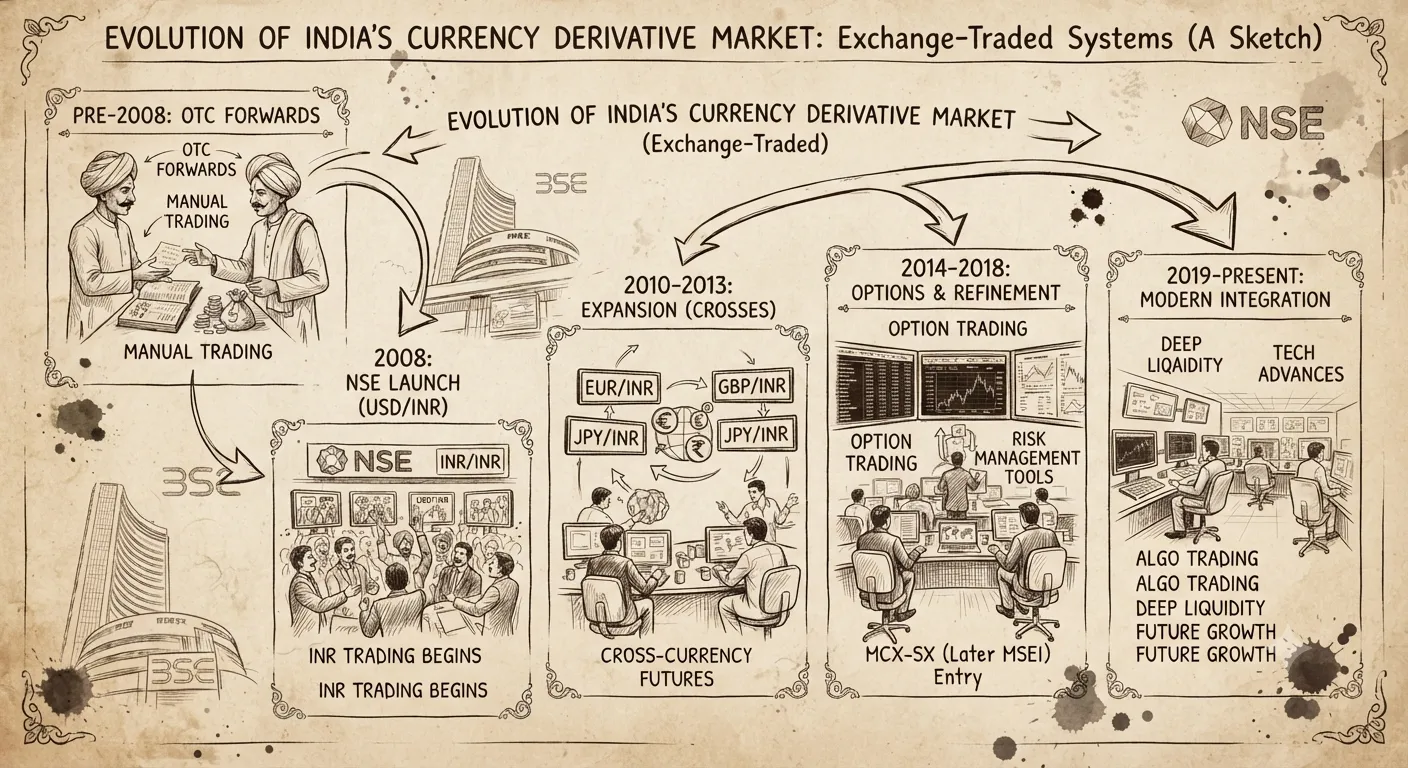
A major milestone in Indian financial history was the formal introduction of exchange-traded products. This pivotal shift moved currency trading away from private bank counters and onto fully transparent, heavily regulated stock exchange platforms.
Historical Market Performance and Global Integration
The currency futures market witnessed a massive period of robust activity during the fiscal period, highlighting how fast India was integrating with the global economy.
- (i) Turnover Statistics: By , the combined average daily turnover across major exchanges like the NSE, MCX-SX, and USE surged to an impressive US$ 8.0 billion.
- (ii) Comparative Growth: This marked a substantial jump from the US$ 7.1 billion recorded in , proving that the corporate appetite for protective risk management tools was accelerating rapidly.
- (iii) Risk Amplification: As Indian firms aggressively expanded their international business, their direct exchange rate risk grew, prompting the Reserve Bank of India (RBI) to formalize standardized hedging instruments.
The Regulatory Framework by RBI and SEBI
The ultimate safety and transparency of these high-volume markets are strictly maintained through the joint, coordinated oversight of the RBI and the Securities and Exchange Board of India (SEBI).
- (i) Permitted Trading Activities: Indian residents are legally permitted to trade in futures contracts for four specific currency pairs on recognized stock exchanges. Furthermore, authorities introduced standardized plain vanilla currency options specifically tied to the US Dollar/Rupee spot exchange rate.
- (ii) FII Participation and Easing: Foreign Institutional Investors (FIIs) have benefited from significant regulatory easing regarding their hedging capabilities. FIIs are allowed to cancel and rebook forward contracts up to 10% of their total portfolio value, which is a major regulatory leap from the previous rigid 2% limit.
⚡ Quick Revision Capsule: Currency Derivatives Comparison
A quick comparison of Over-the-Counter (OTC) derivatives versus Exchange-Traded Currency Derivatives (ETCD) in the Indian financial market:
| Feature | Over-the-Counter (OTC) Market | Exchange-Traded Market (ETCD) |
|---|---|---|
| Primary Instruments | Currency Forwards and Currency Swaps | Currency Futures and Plain Vanilla Options |
| Contract Nature | Customized and tailored to corporate needs | Standardized contracts across 4 currency pairs |
| Key Participants | Importers, exporters, and commercial banks | Retail traders, corporates, and FIIs |
| Regulators | Overseen by the Reserve Bank of India (RBI) | Jointly regulated by RBI and SEBI |
| Maturity & Trading Platform | Mostly short-term (), traded over bank counters | Traded on stock exchanges (NSE, MCX-SX, USE) with daily liquidity |
📝 Summary
The evolution of currency derivatives from private OTC forwards to open, exchange-traded options marks a deeply maturing financial ecosystem in India. Driven by the joint regulation of the RBI and SEBI, the market expansion seen in highlights how structural frameworks protect national economic interests. Today, these instruments remain absolutely fundamental for international trade and global portfolio management.
🚀 Quick Revision Points
Essential facts to review before examinations:
- (i) The currency derivatives market provides crucial tools to hedge against volatile exchange rate risk in international trade.
- (ii) The OTC market handles large-scale institutional volume using customized currency forwards and currency swaps, which typically have a short-term maturity of less than .
- (iii) Daily average exchange-traded turnover grew from US$ 7.1 billion in to US$ 8.0 billion by across the NSE, MCX-SX, and USE platforms.
- (iv) Joint regulations by RBI and SEBI permit trading in four currency pairs and allow FIIs to cancel and rebook forward contracts up to a relaxed limit of 10%.
- 💡 Exam Tip: Pay special attention to the difference between OTC and exchange-traded markets, the role of joint regulation by RBI and SEBI, and the specific relaxation limit (10%) granted to FIIs for rebooking forward contracts.
❓ Frequently Asked Questions (FAQ)
Q1: What are the primary instruments used in the Indian OTC currency derivative market?
A1: The most widely used tools in the Over-the-Counter market are customized currency forwards and currency swaps. These are preferred by commercial banks and corporations for hedging specific, large-scale exposures.Q2: Which regulatory authorities oversee the currency derivative markets in India?
A2: The market is strictly governed under the joint supervision of the Reserve Bank of India (RBI) and the Securities and Exchange Board of India (SEBI) to balance market stability and operational transparency.Q3: What major relaxation was given to Foreign Institutional Investors (FIIs) regarding forward contracts?
A3: Regulatory authorities eased guidelines by allowing FIIs to cancel and rebook forward contracts up to 10% of their overall portfolio value, expanding it significantly from the older 2% ceiling.