
Explore the intricate evolution of the Indian debt market ecosystem, with a focused analysis of the Corporate Bond Market and Government Securities (G-Sec) Market in India. This comprehensive overview traces key milestones such as the New Economic Policy of 1991, the shift from administered interest rates to a market-driven auction system, evolving RBI monetary tools, changes in the Statutory Liquidity Ratio (SLR), and major SEBI-led regulatory reforms since , including the role of the Patil Committee. It also examines structural barriers, settlement mechanism reforms, corporate funding channels, and future development strategies aimed at enhancing capital market liquidity. This integrated guide serves as an essential study resource for finance students and competitive examination aspirants seeking a clear understanding of India’s evolving financial regulatory framework.
🎯 In this chapter, you will understand:
- The dual-track development between India's equity and corporate debt markets.
- How G-Sec trading moved from fixed government rates to market-driven auctions after .
- The major findings of the Patil Committee and key SEBI reforms since .
- The structural barriers impacting liquidity and secondary trading in corporate bonds.
💡 Why this topic matters: India boasts advanced equity trading platforms, yet building a deep, liquid corporate debt market remains vital for financing long-term infrastructure and sustainable economic growth.
🧠 Core Idea: Modern debt market evolution requires moving away from captive bank mandates toward transparent price discovery, central reporting, and standardized clearing mechanisms.
📌 Corporate Bond and Government Securities (G-Sec) Market in India: A Historical and Structural Overview
The financial architecture of India presents a fascinating contrast where high-tech equity systems coexist with a developing debt sector. This narrative explores how corporate and sovereign debt markets have evolved since the early . The journey highlights the unique ways India has balanced regulatory changes with real-world market demands over the years.
Dual-Track Development: Equity Infrastructure vs. Debt Sector
The landscape begins with a striking dichotomy: India boasts a world-class equity infrastructure, yet its corporate bond segment remains very young. While equity investors trade seamlessly on highly liquid electronic exchanges, debt market participants face a different reality. This divergence highlights a structural gap that policy reforms are actively trying to close.
Shift from Controls to Market Forces
Over the last few decades, India successfully moved away from rigidly administered interest rates toward competitive, market-determined price discovery for government securities. This transition shifted the market's reliance from bureaucratic decisions to organic supply and demand dynamics.
Regulatory Oversight and Supervision
Targeted regulatory interventions by both SEBI and the RBI have continually targeted transparency and liquidity across all debt segments. These bodies work together to build investor trust while introducing structural backstops against market risks.
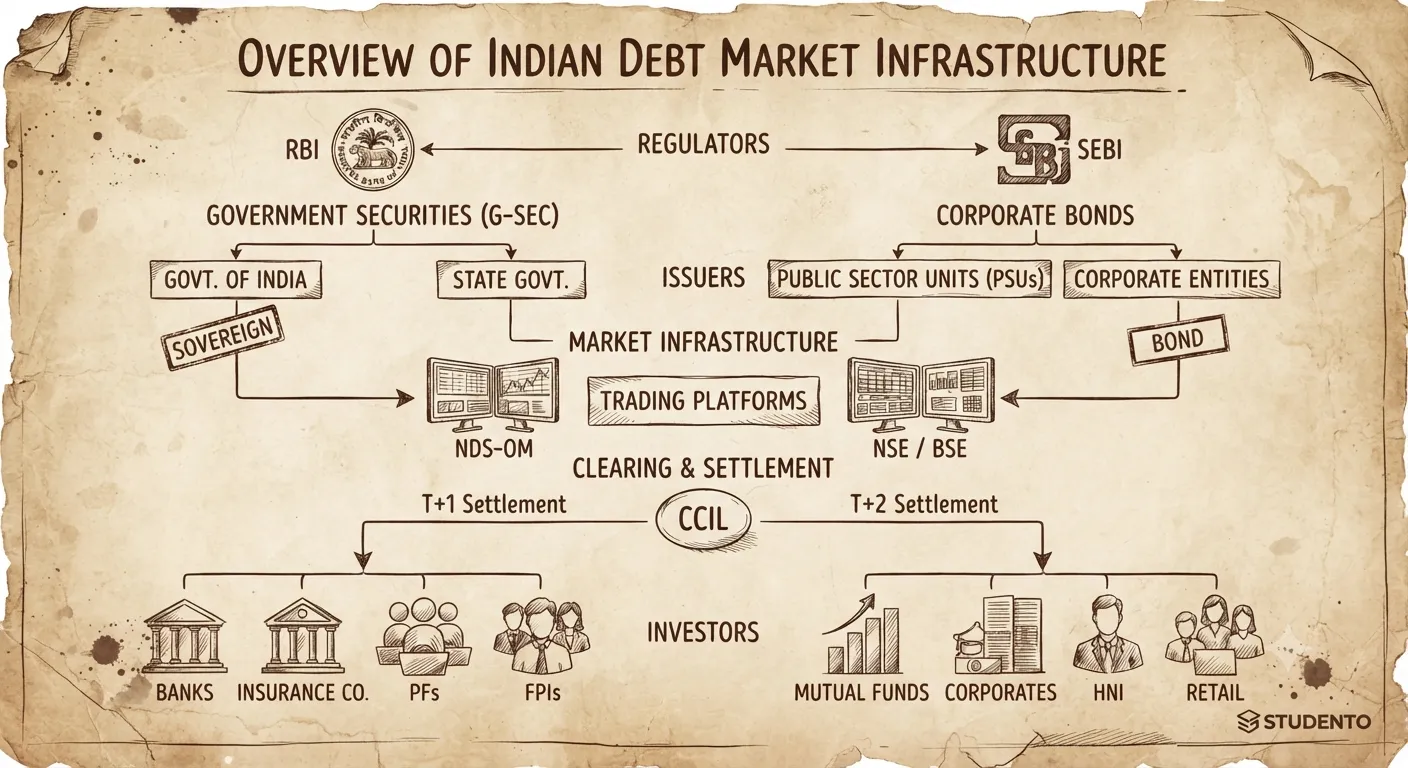
📌 Corporate Bond Market in India: The Journey of a Budding Capital Market Segment
While the equity market has flourished into a massive global asset hub, the corporate bond market remains a vital but still-evolving pillar of the Indian capital market infrastructure. It represents a massive untapped resource for long-term project finance across industrial sectors.
Current State of Market Liquidity and Participation
In the current financial landscape, the corporate bond market is frequently described as being in a budding phase. Despite its massive structural potential, it remains largely illiquid, showing limited active participation from diverse everyday stakeholders. Much of the trading activity is currently driven by short-term arbitrage opportunities rather than long-term investment depth.
- (i) The Development Paradox: It is highly surprising that while India has established world-class markets for equities and equity derivatives with robust infrastructure, the corporate bond side lags behind.
- (ii) Infrastructure Parity: The high-quality infrastructure present in the government bond market has not yet fully translated into a similar level of vibrancy for everyday corporate debt trading.
Regulatory Milestones and the Impact of SEBI Reforms
The year stands as a major watershed moment for the transparency of the Indian bond market. Before this period, data regarding corporate bond turnover was largely anecdotal, keeping regulators and institutional investors in the dark without a centralized reporting framework.
The 2007 Reporting Revolution
The Securities and Exchange Board of India (SEBI) introduced sweeping reforms for reporting the over-the-counter (OTC) bond market. This made tracking transactions simpler. Yet, daily volumes remain modest, averaging around with a value of approximately USD 80 million.
Analyzing Turnover Ratios and Global Context
Globally, corporate bond markets are inherently less liquid than equities, and India follows this global trend closely. Interestingly, in , India's corporate turnover ratio reached 70%, outperforming several East Asian bond markets. However, as noted in the ADB Working Paper Series No.22, the small total stock of outstanding bonds keeps the secondary market limited.
📌 Government Securities (G-Sec) Market: From Captive Audience to Competitive Market
The transformation of the G-Sec market represents one of the most significant successes of the post-liberalization era in India. It turned a rigid, state-controlled system into an active arena for modern sovereign debt management.
Post-1991 Reforms and the Changing Role of SLR
The real momentum for the government securities market was triggered by the New Economic Policy of 1991. This era marked the transition from a controlled economy to a market-linked financial system.
- (i) The SLR Mechanism: Historically, the Statutory Liquidity Ratio (SLR) served as a tool for the government to pre-empt bank resources, creating a captive market.
- (ii) Administered Rates: In the pre-reform era, securities were often issued at administered interest rates rather than competitive ones.
- (iii) Phased Reduction: Following economic reforms, the SLR was gradually reduced to its statutory minimum of 25% to allow banks more freedom in lending. (Note: While 25% was the historical statutory floor under early reform acts, modern RBI policy has progressively rationalized the SLR much lower, down to 18% in recent years).
Transparency and Modern Auction Mechanisms
Today, the G-Sec market is characterized by high transparency and efficiency, moving away from its origins as a mandatory investment pool for commercial banks.
- (i) Market-Determined Rates: Current market borrowings of the central government are managed through auctions at market-determined rates.
- (ii) Price Discovery: These initiatives have broadened and deepened the market, ensuring efficient price discovery for sovereign debt.
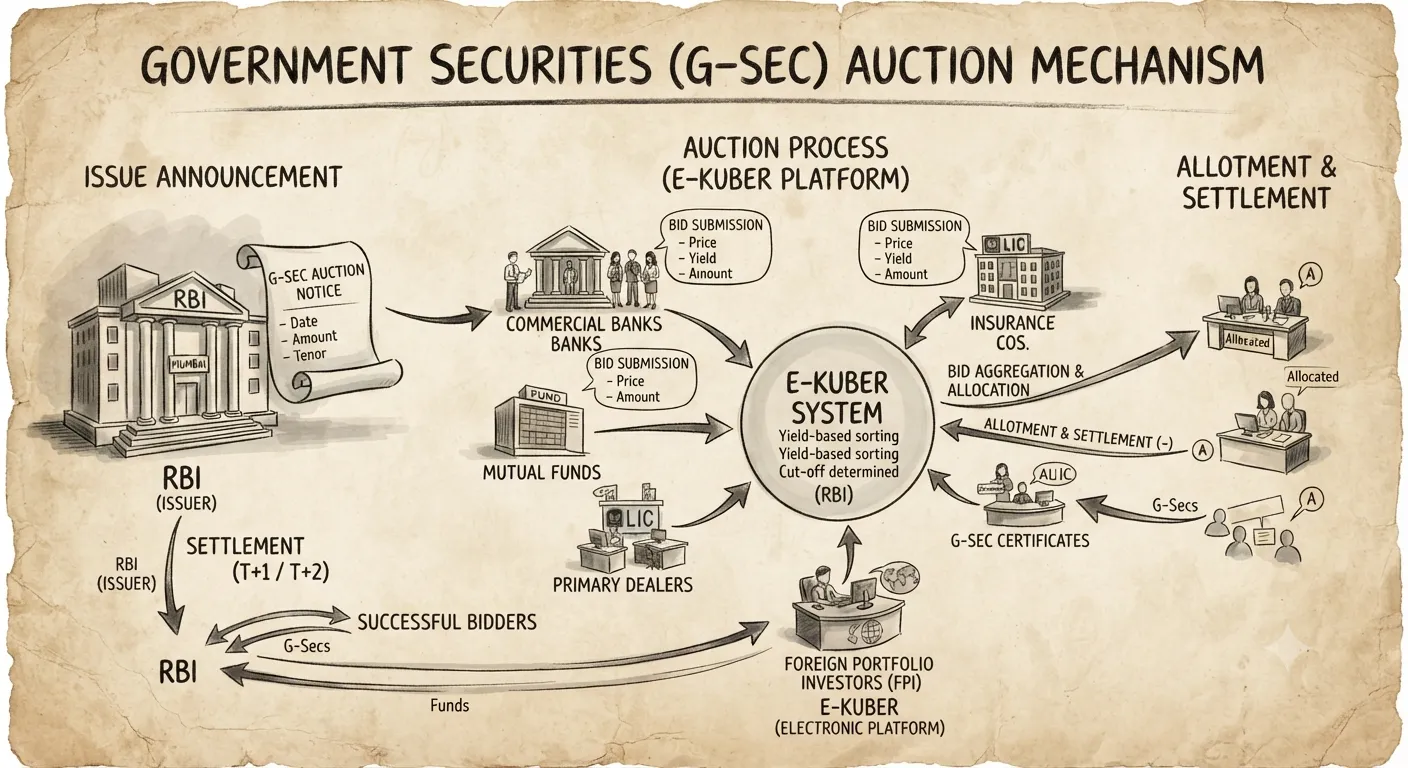
📌 Selective Reforms in Government Securities Market
The landscape of Indian financial markets underwent a radical shift to enhance transparency and liquidity. The journey of modernizing the Indian debt market began with a move away from rigid controls toward a dynamic, market-oriented environment. By introducing systemic changes, the government sought to create a robust framework for both sovereign and private debt.
Foundational Shifts in Price Discovery and Monetisation
One of the most significant leaps in the G-Sec market was the removal of administered interest rates, which were replaced by a modern auction-based price discovery system to reflect true market demand. This was a pivotal moment in Indian economic history.
- (i) Fiscal Discipline: The automatic monetisation of the fiscal deficit, once common through ad hoc Treasury Bills, was gradually phased out to ensure better fiscal responsibility.
- (ii) Role of Intermediaries: To strengthen the market, Primary Dealers (PDs) were introduced, acting as dedicated market makers to provide constant liquidity.
- (iii) Settlement Safety: The implementation of the Delivery versus Payment (DvP) system ensured that transparency and security were maintained in every trade.
Liquidity Management and Modern Monetary Instruments
The RBI introduced several tools to manage the ebb and flow of money in the economy, moving toward short-term liquidity adjustment strategies that define current monetary policy.
Liquidity Adjustment Facility (LAF) and Repo Operations
Repurchase Agreements (repos) were initiated, eventually leading to the launch of the Liquidity Adjustment Facility (LAF). LAF functions through repo and reverse repo auctions, serving as a dual tool for liquidity management and interest rate signalling in the overnight market.
Market Stabilisation and Treasury Benchmarking
The Market Stabilisation Scheme (MSS) gave the RBI expanded powers to manage surplus liquidity effectively. The Treasury Bill became a cornerstone for liquidity control and served as a critical benchmarking tool for the broader economy.
Diversification of Debt Instruments and Derivatives
To attract a wider range of investors, the government expanded the variety of securities available, moving beyond traditional bonds.
- (a) New Bond Variants: Introduction of Zero Coupon Bonds, Floating Rate Bonds, and Capital Indexed Bonds tailored to different risk appetites.
- (b) Risk Management Tools: The launch of Exchange-traded interest rate futures and OTC derivatives, such as Interest Rate Swaps and Forward Rate Agreements (FRAs), allowed for better hedging.
📌 Primary Market in Corporate Debt
The primary segment for corporate debt in India has evolved into a specialized niche dominated by large institutional players. It acts as the primary gateway for corporate capital accumulation across the domestic landscape.
The Dominance of Private Placements
In India, the primary corporate debt market functions largely as a private placement market rather than a public one. This allows large corporates to raise capital quickly from sophisticated investors without the lengthy disclosures required for public retail offerings.
- (i) Investor Profile: Securities are mostly placed with wholesale investors, including banks, financial institutions, and mutual funds.
- (ii) Historical Statistics: In , data showed that approximately 92% of all funds raised through corporate debt securities utilized the private placement route.
- (iii) Market Shift: There has been a notable decline in public issues, as firms prefer the speed and cost efficiency of the private route for raising debt capital.
📌 Secondary Market in Corporate Debt
Secondary trading provides the necessary exit routes and liquidity for corporate bond holders through advanced exchange technology. This platform helps turn long-term debt commitments into tradable corporate instruments.
Electronic Trading and Listing Groups
The secondary market for corporate debt relies heavily on electronic order-matching platforms. The BSE (Bombay Stock Exchange) plays a vital role here by offering a structured environment for trading Corporate Debt Securities.
- (i) BSE BOLT System: Trading is facilitated via the well-known BOLT system, ensuring efficient execution of orders.
- (ii) The F Group: At the BSE, the F Group is specifically dedicated to listing debt instruments from Development Financial Institutions, PSUs, and public limited companies.
Types of Corporate Debt Securities in India
Investors in the Indian market have access to a variety of corporate debt securities, each offering different levels of security and conversion options:
- Non-Convertible Debentures (NCDs): Pure debt instruments without any option to convert them into equity shares later on.
- Convertible Debentures: Instruments that can be Partly or Fully Convertible into equity shares at a pre-determined date.
- Specialized Bonds: Includes Secured Premium Notes, Deep Discount Bonds, and Debentures with Warrants.
- Public Sector Offerings: Trading of PSU Bonds and Tax-Free Bonds remains a staple choice for conservative institutional investors.
📌 Structural Barriers to Corporate Debt Market Development
The journey of India's financial evolution is deeply tied to the growth of its debt instruments and market liquidity. Understanding the context of the corporate debt market requires looking at how institutional frameworks and private placements have shaped the current economic environment. This narrative explores the shift from restricted trading to a more transparent, exchange-based system.
Analyzing Market Segmentation and Liquidity Constraints
The development of the corporate debt market in India has historically lagged behind other financial market segments. This stagnation is primarily due to deeply rooted structural factors that have prevented the market from reaching its full potential. While primary issuances appear high on paper, they do not tell the full story of market health.
- (i) High volumes in primary markets are largely driven by public sector financial institutions rather than diverse private enterprises.
- (ii) The heavy reliance on private placements limits the diversity of the overall investor base.
- (iii) Most transactions are geared toward institutional investors, leaving retail participation minimal.
Secondary Market Impact
The secondary market remains underdeveloped and suffers from low liquidity. Price discovery is hindered by the lack of frequent, active trading in the corporate bond segment.
📌 The Patil Committee Recommendations and Policy Action
To break the deadlock in the bond market, the government introduced a high-level expert group to draft a roadmap for future growth. The resulting proposals directly shaped modern regulatory interventions.
The High Level Committee on Corporate Bonds and Securitisation
Commonly referred to as the Patil Committee, this body was constituted by the Government of India to identify the specific inhibiting factors preventing an active corporate debt market. The committee’s findings became the blueprint for modern debt market reforms, gaining wide acceptance from both the RBI and SEBI.
- (i) Primary Issuance: Focus on rationalising the primary issuance process to make it far more efficient.
- (ii) Exchange Trading: Facilitating the transition of exchange trading for bonds to ensure better accessibility.
- (iii) Transparency: Increasing disclosure and transparency standards to build investor confidence.
- (iv) Settlement: Strengthening the clearing and settlement mechanism specifically for the secondary market.
📌 Trade Reporting and Digital Trading Platforms
Infrastructure development through reporting platforms has been a cornerstone in making the debt market more visible to regulators and investors. These technical upgrades bridges the information gap between market players.
The Role of BSE, NSE, and FIMMDA in Market Data
In a move to centralize data, the Bombay Stock Exchange (BSE), National Stock Exchange (NSE), and FIMMDA launched dedicated trade reporting platforms. This was a massive step toward transparency in bond trading, ensuring that even Over-the-Counter (OTC) transactions are captured and disseminated to the public via the FIMMDA website.
- (a) All exchange-based trades are automatically captured by respective reporting systems.
- (b) OTC segment trades can be voluntarily reported on any of these three major platforms.
- (c) Since , BSE and NSE have operated order-driven trading platforms.
- (d) Despite these platforms, the majority of actual trading volume still resides within the OTC segment.
📌 SEBI’s Streamlining Measures for Market Efficiency
Regulatory oversight by SEBI has focused on technical standardisation to make corporate bonds as easy to trade as government securities. By smoothing out these details, they have successfully lowered structural entry barriers.
Standardization and Digital Payment Integration
SEBI has implemented several critical measures to streamline corporate bond market activity. By aligning corporate bond practices with government securities, the regulator has lowered entry barriers for various participants and ensured that interest and redemption payments are handled with modern digital precision.
- Key Regulatory Adjustments:
- (i) Reduction of the shut period to match the current standards of government securities.
- (ii) Lowering the standard trading lot to a far more accessible Rs. 1 lakh.
- (iii) Standardising the day count convention for uniform interest calculation.
- Mandatory Payment Systems:
To ensure security and speed, issuers must now use Electronic Clearing Services (ECS), Real Time Gross Settlement (RTGS), and National Electronic Funds Transfer (NEFT) for all investor payouts.
- Key Regulatory Adjustments:
⚡ Quick Revision Capsule: Debt Market Structure Comparison
A concise comparison between the Government Securities (G-Sec) Market and the Corporate Debt Market in India.
| Feature / Parameter | Government Securities (G-Sec) Market | Corporate Debt Market |
|---|---|---|
| Primary Issuer Base | Central & State Governments | Private Corporations, PSUs, & DFIs |
| Primary Issuance Mode | Market-driven auctions managed by RBI | Dominantly private placements (~92%) |
| Secondary Liquidity | Highly liquid with active price discovery | Relatively illiquid; low daily turnover |
| Key Regulators | Reserve Bank of India (RBI) | Securities & Exchange Board of India (SEBI) |
| Settlement & Reporting | Delivery versus Payment (DvP) via RBI | BSE, NSE, & FIMMDA digital reporting platforms |
📝 Summary
The Indian debt market ecosystem highlights a tale of two distinct sectors. The Government Securities market has transitioned into a highly transparent, auction-driven arena with robust liquidity controls managed by the RBI. Conversely, the Corporate Debt market, dominated heavily by private placements and wholesale institutional investors, continues its gradual structural evolution. Through institutional frameworks like the Patil Committee and strict regulatory interventions by SEBI since , the system is consistently moving toward better trade transparency, lower transaction lots, and modernized electronic settlement infrastructures.
🚀 Quick Revision Points
Essential facts to review before examinations:
- (i) The New Economic Policy of 1991 sparked the shift from administered interest rates to competitive market-led auctions for G-Secs.
- (ii) The Statutory Liquidity Ratio (SLR) was historically used to command bank resources, though modern reforms phased it down significantly to give banks more commercial flexibility.
- (iii) Corporate debt raising is overwhelmingly dominated by the private placement route, which accounted for roughly 92% of funds raised in .
- (iv) SEBI’s reporting mandates transformed OTC tracking by routing trading data through centralized BSE, NSE, and FIMMDA platforms.
- (v) Technical clearing standardizations included reducing standard trading lot sizes to Rs. 1 lakh and introducing mandatory ECS, RTGS, and NEFT payment routes.
- 💡 Exam Tip: When answering questions on Indian debt markets, clearly contrast the auction-driven price discovery of G-Secs with the private-placement dominance of corporate bonds, and highlight SEBI's 2007 reporting reforms as the major turning point for OTC transparency.
❓ Frequently Asked Questions (FAQ)
Q1: What major structural shift did the 1991 Economic Policy bring to the G-Sec market?
A1: It triggered the transition from a captive market with government-administered interest rates to a transparent, market-driven auction system for price discovery.Q2: Why is the secondary corporate bond market in India considered illiquid?
A2: The primary corporate debt space relies heavily on private placements with wholesale institutional investors. This leaves retail participation low and limits active daily trading volume on the secondary exchanges.Q3: What role did the Patil Committee play in reforming India's corporate debt sector?
A3: The Patil Committee acted as the main blueprint for debt market modernization. It recommended rationalising primary issuances, increasing transparency standards, and clearing settlements efficiently to boost investor confidence.Q4: How did SEBI improve operational efficiency for corporate bonds after 2007?
A4: SEBI standardized trading elements by lowering the trading lot size to Rs. 1 lakh, uniforming day count conventions, minimizing shut periods to match G-Sec standards, and making payouts via RTGS, NEFT, and ECS mandatory.

