Explore the fascinating evolution of stock exchanges in India, a journey from the historic founding of the Bombay Stock Exchange in to the modern digital era. This detailed study of market capitalization and securities trading is essential for students and exam preparation in finance and economics. The story of the Indian capital market is one of resilience and rapid modernization, starting from a handful of brokers under a banyan tree to the sophisticated electronic systems we see today. This evolution highlights how regulatory bodies and technology have reshaped the investment landscape for millions.
🎯 In this chapter, you will understand:
- The historic path from early stock brokers to formal trading exchanges in India.
- How regulatory actions by SEBI consolidated regional exchanges across the country.
- The role of screen-based electronic trading and satellite links in solving price gaps.
- The major growth in market valuation, trading volume, and total investor turnover.
💡 Why this topic matters: Knowing how Indian stock markets developed helps students understand modern financial systems, national pricing rules, and digital trading technology.
🧠 Core Idea: Strong regulation by SEBI and advanced electronic trading transformed fragmented regional stock markets into a single, efficient national financial network.
Development of Stock Exchanges in India: A Journey of Financial Transformation
The historical narrative of India's financial markets begins with a transition from fragmented regional trading to a unified national powerhouse. The transformation relies heavily on balancing regulatory structure with modern operational setups.
- The Historical Narrative of India's Financial Markets
The formal system traces its roots back to the early organization of native share brokers. Over time, localized networks faced changes that forced them to adopt strict monitoring systems to protect the expanding base of regular investors.
- (i) The narrative traces back to the formalization of trading and the pivotal role of the Bombay Stock Exchange.
- (ii) It explores the regulatory intervention by SEBI that streamlined the number of active exchanges.
- (iii) It examines the statistical explosion in market capitalisation and investor participation over two decades.
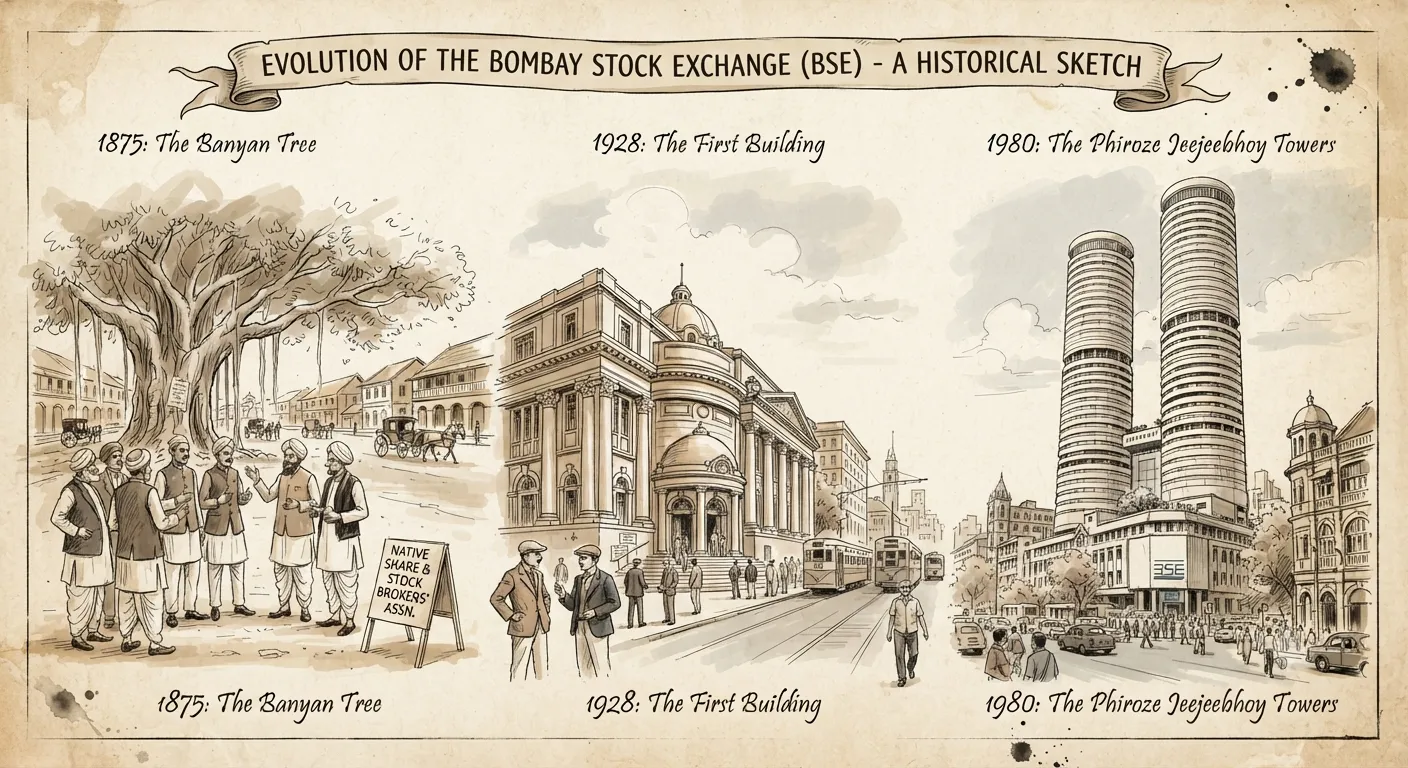
The Genesis and Regulatory Evolution of Indian Stock Markets
A deep look into the early structures of Indian finance and the subsequent consolidation of trading platforms under national oversight reveals clear operational patterns.
The Rise of BSE and the Path to Market Consolidation
The foundations were laid long ago when the Bombay Stock Exchange (BSE) initiated formal trading activities in . As the oldest exchange in Asia, it set the precedent for organized finance in the region. However, as the market matured, the need for regulatory efficiency became paramount.
- (i) Historically, there were 22 stock exchanges in India operating to serve various regional interests.
- (ii) By , a significant shift occurred as the Securities Exchange Board of India (SEBI) moved to derecognize underperforming entities.
- (iii) As a result, the number of functional exchanges declined to 19, following the closure of The Magadh, Mangalore, Hyderabad, and Saurashtra Kutch exchanges.
Overcoming Fragmentation: The Era Before 1994
Analyzing the challenges of regional disparities shows the difficulties investors faced when trying to complete inter-city trades efficiently before the mid-1990s.
Bridging the Gap Between Regional Markets and Mumbai
Before the pivotal year of , the stock market structure in India was heavily localized. The BSE held a dominant position, but geographic barriers meant that investors in other regions did not have equal access to the same opportunities.
- (i) Fragmentation led to significant price discrepancies between Mumbai and regional stock centers.
- (ii) Restricted order flow hindered the process of efficient price discovery.
- (iii) Research by Shah and Thomas (1997) indicates that national connectivity eventually unified the capital market.
The Technological Revolution in Indian Securities
How online screen-based trading and satellite communication democratized access to the financial markets remains a landmark study in modern economic infrastructure.
Modernizing the Secondary Market Through Advanced Technology
The NSE played a revolutionary role by introducing satellite communication, ensuring that every trading member, regardless of location, had equal access to the market. This era marked the end of physical floor shouting and the beginning of the digital age.
- (i) BSE and the Delhi Stock Exchange followed suit, expanding trading terminals across the nation.
- (ii) The introduction of arbitrage opportunities helped in drastically reducing pricing discrepancies across different cities.
- (iii) The Indian securities market underwent a rapid metamorphosis driven by online screen-based trading and advanced technology.

Statistical Explosion: Growth and Market Trends
A detailed breakdown of the massive surge in listed companies and market valuation shows a historical pattern of intense commercial expansion between 1990 and 2010.
The Astronomical Rise of Market Capitalisation and Listings
Between and , the Indian stock market saw a boom in corporate participation. The number of listed companies jumped from 5,968 to approximately 10,000, signaling a new era of corporate financing.
- (i) Market capitalisation grew nearly 11 times during this transformative decade.
- (ii) BSE saw its market cap skyrocket from Rs. 90,836 crore in to a staggering Rs. 61,65,619 crore by .
- (iii) NSE, establishing its dominance, grew from Rs. 3,63,350 crore in to Rs. 60,09,173 crore by .
Index Performance and Share Delivery Trends
The BSE Sensex and S&P CNX Nifty served as the barometers for this growth, reflecting the wealth creation occurring within the Indian economy.
- (i) The BSE Sensex average increased from Rs. 1,050 crore to Rs. 15,585 crore over the study period.
- (ii) The S&P CNX Nifty average followed a similar trajectory, rising from Rs. 364 crore to Rs. 4,658 crore.
- (iii) The actual quantity of shares traded surged from 5,04,149 lakh in to 33,42,947 lakh in .
Investment Inflow and Annual Turnover Analysis
Evaluating the liquid nature of the markets and the rising confidence of domestic and global investors highlights the overall security changes over the years.
Comparing Turnover and Net Investment Success
The liquidity of the Indian capital market is best showcased by its annual turnover. Despite global fluctuations, the net investment in Indian markets reached new heights by the end of the first decade of the 21st century.
- (i) NSE turnover demonstrated immense scale, jumping to Rs. 35,77,412 crore by .
- (ii) Net investment in Indian capital markets witnessed a significant rise to Rs. 1,10,718.27 crore in .
- (iii) The value of shares delivered saw a massive leap, reaching Rs. 12,28,612 crore in , up from Rs. 1,36,225 crore earlier in the decade.
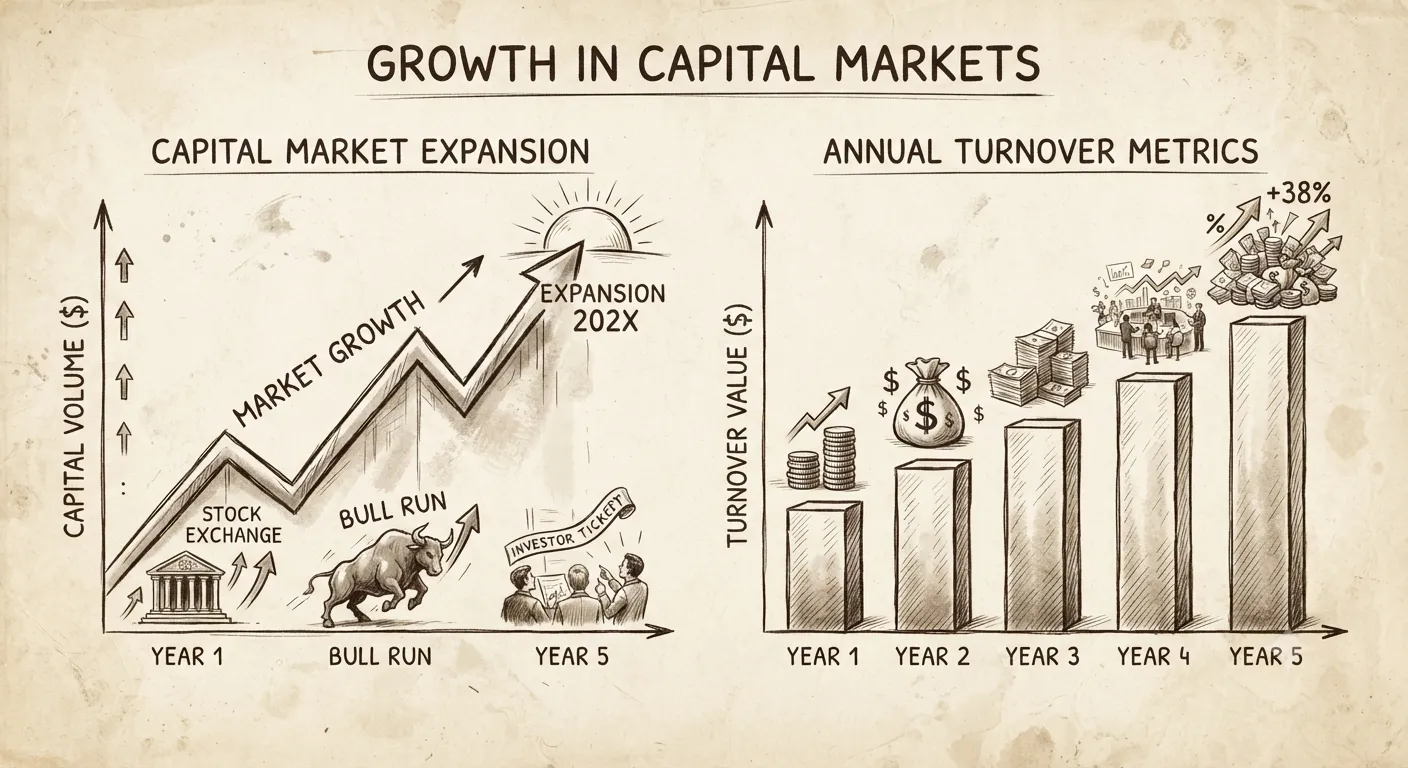
⚡ Quick Revision Capsule: Key Milestones of Indian Stock Market Growth
This quick comparison highlights the major milestones, regulatory moves, and growth numbers that shaped India's stock exchanges over the decades.
| Growth Milestone / Feature | Key Historical Details | Impact on Indian Capital Markets |
|---|---|---|
| Founding of BSE | Established in as Asia's oldest organized exchange platform. | Created the groundwork for formal share trading and corporate investment in India. |
| SEBI Consolidation | Derecognized inactive exchanges, reducing operational count from 22 down to 19 by . | Improved market oversight by clearing out underperforming regional trading hubs. |
| Electronic Trading () | NSE launched satellite links and screen terminals across the country. | Ended floor shouting, solved price differences between cities, and gave equal access. |
| Listing & Market Cap Boom | Listed firms reached ~10,000; total market cap expanded 11 times from to . | Unlocked large corporate capital and broadened market participation across the nation. |
| Valuation Expansion by | Both BSE Sensex and S&P CNX Nifty exchanges passed Rs. 60 lakh crore each. | Demonstrated strong investor confidence, deep market liquidity, and massive economic scale. |
📝 Summary
Understanding the Development of Stock Exchanges in India is vital for students aiming to grasp the mechanics of economic growth. The transition from the Bombay Stock Exchange in to a SEBI-regulated, technologically advanced system highlights the transparency and market capitalisation strength of modern India. This historical progress remains a cornerstone for any capital market analysis or exam preparation.
🚀 Quick Revision Points
Essential facts to review before examinations:
- (i) The BSE was founded in as Asia's oldest stock exchange, paving the way for structured finance.
- (ii) SEBI consolidation initiatives scaled operational hubs down from 22 regional stock exchanges to 19 active ones by .
- (iii) The shift brought satellite linkups and electronic screens, resolving deep regional price discrepancies.
- (iv) Market values expanded heavily by , with both major national indices pushing past Rs. 60 lakh crore each in total valuation.
❓ Frequently Asked Questions (FAQ)
Q1: When was formal stock trading established in India?
A1: Formal market trading began with the establishment of the Bombay Stock Exchange (BSE) back in .
Q2: How did SEBI streamline the domestic market network by 2010?
A2: SEBI derecognized struggling regional networks, which lowered the total number of operational stock exchanges from 22 down to 19 systems.
Q3: What major structural change occurred in 1994 to eliminate price fragmentation?
A3: The introduction of screen-based trading and satellite communication systems enabled unified, real-time national pricing networks.
Q4: What were the registered market caps for the BSE and NSE by the 2009–10 financial year?
A4: The BSE market cap climbed to Rs. 61,65,619 crore, while the NSE market cap reached Rs. 60,09,173 crore.