This detailed analysis explores the Role of Financial System in Economic Development, highlighting how a robust capital market and key financial reforms act as the backbone of national growth. For students and exam aspirants, understanding these regulatory frameworks and resource allocation mechanisms is vital for mastering economic theory and practice.
🎯 In this chapter, you will understand:
- How the financial system channels savings into productive investments across the nation.
- The structural differences between primary and secondary capital markets.
- The historical impact of the 1991 economic reforms and SEBI's regulatory oversight.
- How capital markets create liquidity, lower risk, and support sustainable economic growth.
💡 Why this topic matters: A strong financial pipeline transforms idle domestic savings into factories, jobs, and national infrastructure, driving sustainable long-term economic growth.
🧠 Core Idea: The financial system links individual savers with business innovators, balancing risk and allocating money where it creates the greatest value for the economy.
The Strategic Role of the Financial System in Driving National Economic Development (–)
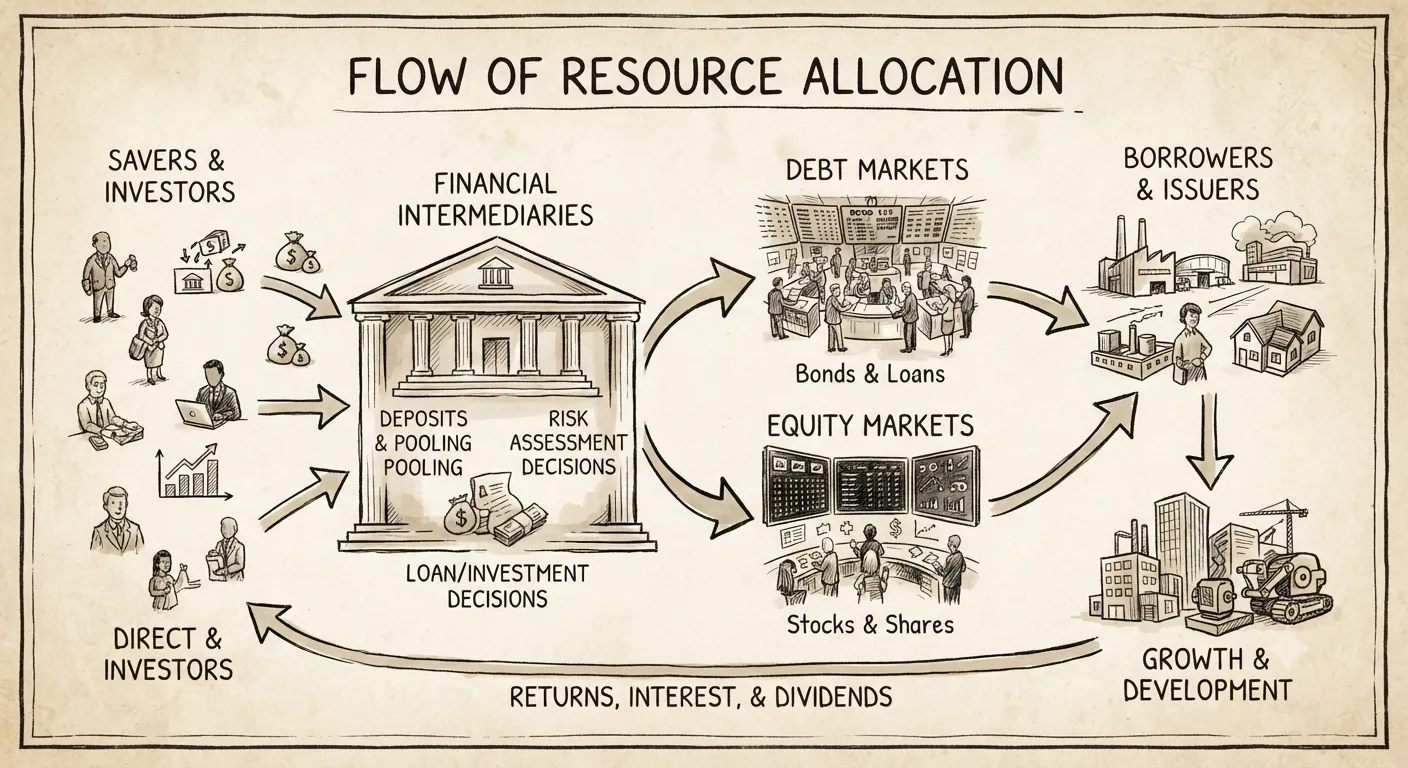
Think of a well-oiled financial system as the circulatory system of a modern economy. It makes sure that every single rupee saved finds its way to the most productive destination. The journey of economic growth starts right here—by bridging the gap between everyday savers and business innovators. When liquid assets move smoothly, a nation does not just store its wealth; it actively multiplies it through smart, planned investments.
- Efficient Allocation of Resources: An efficient financial system acts as a smart pipeline. It picks up idle funds from surplus areas and channels them directly into industrial sectors that need capital to grow.
- The Core Financial Trinity: The whole architecture stands firm on three pillars: financial markets, trusted financial intermediaries, and a diverse range of financial instruments tailored to match what different investors look for.
- Managing Market Uncertainties: A modern economic setup relies heavily on diverse intermediaries to handle different risk profiles. This setup keeps the economy stable and resilient, even when market cycles get rough and unpredictable.
The Vital Importance of an Efficient Financial Infrastructure
If a country wants to break free from stagnation and successfully liberalize its economy, it needs a dynamic financial setup first. You cannot build a modern commercial powerhouse on a fragile foundation; the infrastructure itself must be transparent, quick, and highly reliable to handle the weight of global transactions.
The Indian Financial Sector and Progressive Policies
In India, the financial sector has undergone a massive makeover. Today, it stands proud with vibrant equity and debt markets alongside prudent banking norms that protect the hard-earned money of regular citizens and large corporations alike.
- (i) Embracing progressive liberal policies has opened doors to a global approach for managing domestic wealth.
- (ii) A relentless push for absolute transparency has turned Indian banking into a global benchmark for staying strong during international economic downturns.
Catalyzing Productive Transformation and Investment Growth
The real magic of a financial system is its ability to push an economy all the way to its maximum production frontier. It does this by making capital readily available and affordable for businesses that want to expand, scale, and build.
Transforming Wealth into Productive Capital
The system actively encourages regular investors to shift away from non-financial assets and move toward liquid financial instruments. Instead of just hoarding precious metals, locked real estate, or keeping idle cash at home, people are guided to invest in shares, corporate bonds, and mutual fund units.
- (i) This intentional shift optimizes the total wealth of the nation, turning dormant savings into active factories, machinery, and national infrastructure.
- (ii) By offering deficit-spending units quick and easy access to capital, the system effectively multiplies the total volume of investments across the country.
- (iii) Crucial financial backbones like insurance, smart hedging, and formal guarantees bring down the cost of finance and reduce the investment risks that entrepreneurs face daily.
Capital Market Dynamics and the Legacy of Financial Reforms
The capital market is the true engine room for long-term financial assets. It provides the heavy-duty, long-term funding required to build massive national projects, expressways, and heavy industries that take years to break even.
Structural Segmentation: Primary vs. Secondary Markets
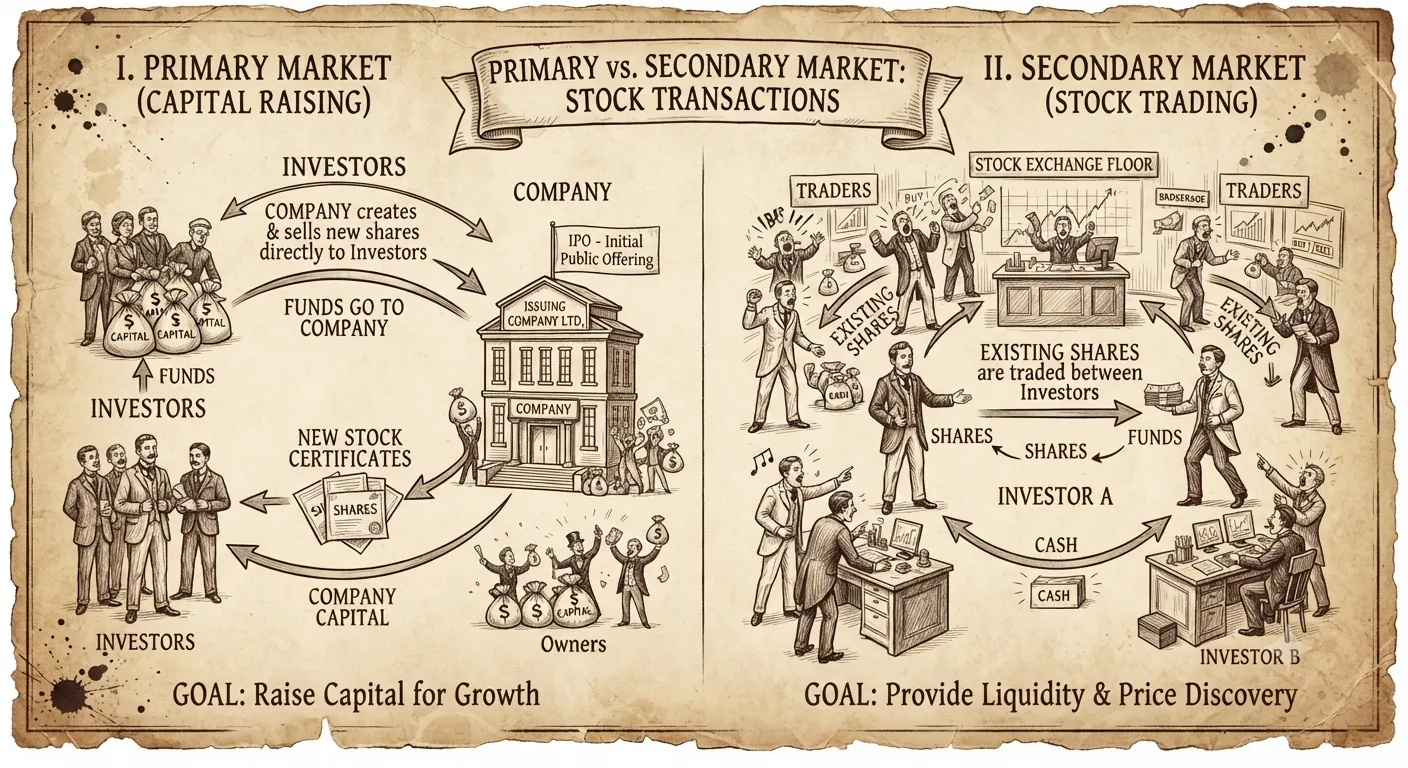
The capital market is essentially a tale of two halves: the birth of new securities in the Primary Market through underwriting, and their ongoing lifecycle inside the Secondary Market via active stock exchanges.
- (a) Primary Market: This is the main gateway for corporations and governments to raise fresh capital straight from the public.
- (b) Secondary Market: This arena provides the critical exit route and liquidity that keeps the investment wheel turning without hitting any speed bumps.
The Turning Point: Post-1991 Reforms and SEBI's Vigilance
Following the intense balance of payments crisis, India set out to completely dismantle a broken, fragmented system. Back then, state-owned banks held over 90% of all assets and interest rates were tightly locked by government mandates.
- (i) The Securities and Exchange Board of India (SEBI) was given statutory teeth to act as a powerful shield for everyday investors, prioritizing fraud prevention and market transparency.
- (ii) Modernization introduced thriving derivatives markets and relaxed old capital controls, letting domestic firms tap into global funding pools easily.
- (iii) Key lessons from the – Asian Financial Crisis helped fortify the Indian system against global contagion effects, putting a clear focus on operational flexibility and financial viability.
The Multifaceted Functions and Social Impact of Capital Markets
Look beyond the cold numbers and complex charts, and you will see that the capital market builds real social and economic harmony. It links everyday retail savers with industrial giants, giving everyone a shared stake in the country's financial growth story.
Liquidity, Valuation, and Operational Efficiency
The market introduces the true power of liquidity—the freedom to convert an asset into cash almost instantly—while discovering a fair transaction price driven by real-time demand and supply forces.
- (i) It spreads critical financial news at lightning speed, allowing for the quick valuation of complex corporate instruments.
- (ii) It completely democratizes wealth by encouraging wider participation from regular small-scale investors to massive institutional financial institutions.
- (iii) High-speed communication networks have dramatically slashed transactional costs and shortened settlement timings, making market entry easy for everyone.
Mobilisation of Savings and Capital Formation
The market acts as an economic double-engine by pulling in forgotten savings and turning them into real, physical infrastructure.
- (i) Mobilisation of Savings: It breathes new life into idle monetary resources, steering them toward productive investments in essential sectors like agriculture and industry.
- (ii) Acceleration of Capital Formation: By funding cutting-edge research and core infrastructure, it serves as a primary engine for employment generation and nationwide productivity.
Investment Avenues and Strategic Regulation
A healthy market balanced by strong rules creates a safe space where investors have plenty of choices and fraudsters have nowhere to hide.
- (i) Investment Avenues: It serves up a rich menu of options including corporate equities, mutual funds, and customized insurance policies offering strong, competitive returns.
- (ii) Proper Regulation: It makes sure the allocation of capital is both quantitative and qualitative, keeping the entire nation focused on balanced, sustainable economic growth.
⚡ Quick Revision Capsule: Indian Financial System & Capital Markets
Use this summary matrix to quickly review the key components, functions, and landmark reform milestones of the Indian financial framework.
| Pillar / Aspect | Core Function / Description | Economic Impact |
|---|---|---|
| Primary Market | Direct issuance of new shares, bonds, and debentures by corporations or governments. | Raises fresh capital for expansion, infrastructure, and industrial production. |
| Secondary Market | Trading existing financial securities among investors on stock exchanges. | Provides liquidity and continuous price discovery for assets. |
| Post-1991 Reforms | Abolished tight government rate controls and empowered SEBI as a market regulator. | Protected retail investors from fraud and opened doors to global capital. |
| Resource Allocation | Moving money from idle personal savings into active corporate and industrial sectors. | Accelerates national capital formation, employment, and overall GDP growth. |
| Market Regulation | Statutory oversight by SEBI to ensure transparency, fair pricing, and compliance. | Shields the domestic economy from systemic shocks and global financial crises. |
📝 Summary
A resilient, clear-cut financial system and an open capital market are absolutely non-negotiable for economic development. By understanding how resource allocation works and looking back at the historic reforms starting in , students can clearly see how capital moves nations forward. This entire framework secures a continuous availability of funds, shielding our businesses from harsh market risk while preparing India for high global competitiveness and steady institutional strengthening.
🚀 Quick Revision Points
Essential facts to review before examinations:
- (i) A robust financial system shifts idle funds from surplus sectors directly to capital-starved industrial zones via an integrated pipeline.
- (ii) The system encourages a critical shift away from non-financial assets (like hoarding gold or raw land) into active financial instruments (shares, bonds, mutual funds).
- (iii) The Primary Market handles initial capital-raising through fresh underwriting, while the Secondary Market provides essential liquidity via stock exchanges.
- (iv) Post-1991 Reforms broke down a rigid, state-dominated banking monopoly and empowered SEBI to guarantee investor protection and market transparency.
- 💡 Exam Tip: Focus on the structural differences between primary and secondary markets, and memorize how post-1991 SEBI reforms transformed investor safety and capital mobilization.
❓ Frequently Asked Questions (FAQ)
Q1: How does a financial system accelerate national capital formation?
A1: It gathers small, scattered, and idle savings from individuals and pools them into large capital blocks. These blocks are then channeled into high-yield investments, infrastructure projects, and research, which directly drives industrial production and jobs.Q2: What is the main structural difference between primary and secondary capital markets?
A2: The Primary Market is where corporations and governments issue brand new securities to raise fresh capital directly from the public. The Secondary Market is the stock exchange where investors buy and sell existing securities among themselves, providing crucial liquidity.Q3: Why were the post-1991 capital market reforms so critical for India?
A3: Before , state banks held over 90% of assets under rigid government control. The reforms introduced statutory powers to SEBI to prevent scams, opened up derivatives trading, eased capital controls for global funding, and protected the economy from international financial crises.