Welcome to www.studento.co.in
Disclaimer: We does not sell, advertise, or facilitate the sale of any books or physical products.
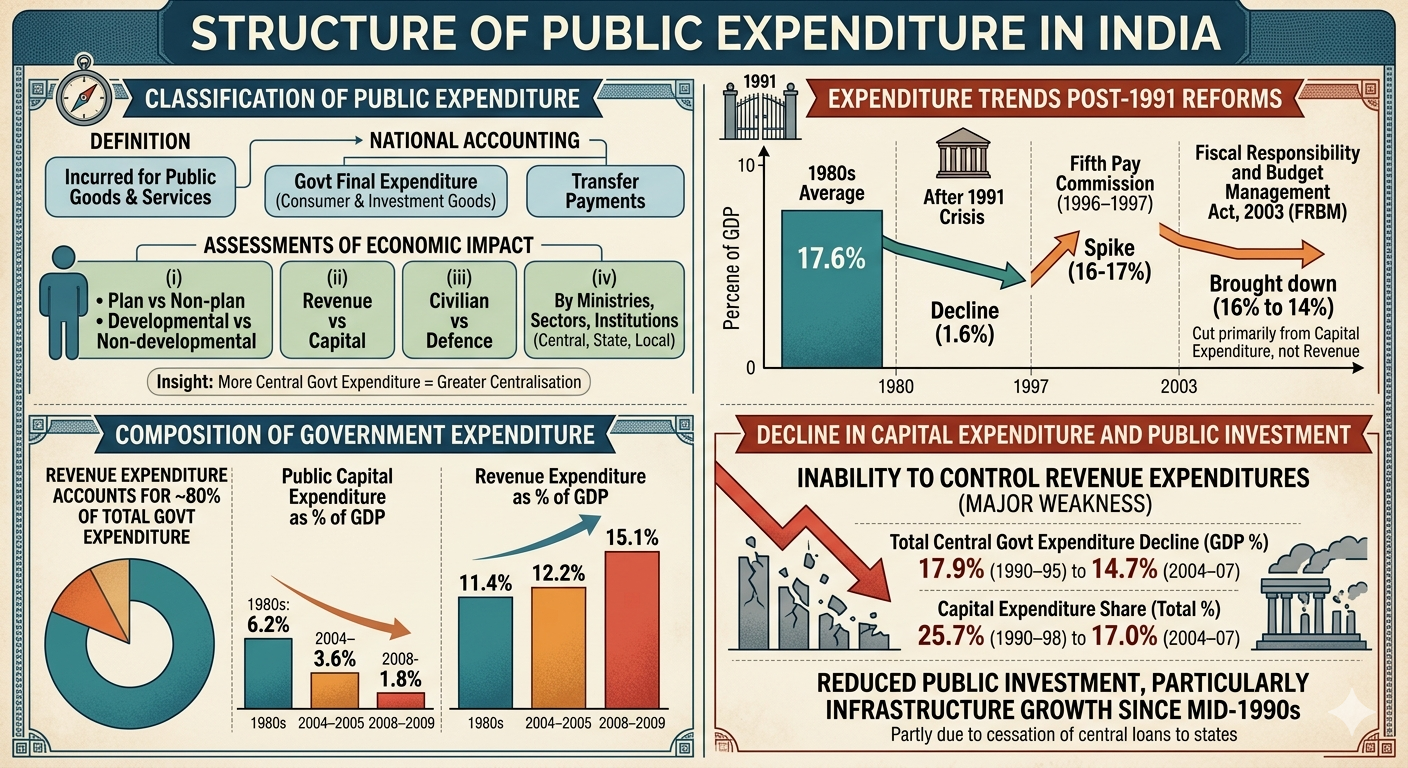
Public expenditure is incurred to provide public goods and services. In national accounting, a distinction is made between government final expenditure on consumer and investment goods and transfer payments.
It is classified in various ways to assess its economic impact:
(i) Plan vs Non-plan and developmental vs non-developmental
(ii) Revenue vs Capital expenditure
(iii) Civilian vs Defence expenditure
(iv) By ministries, sectors, and institutions like Central Government, State Governments, and Local Authorities
More central government expenditure may reflect greater centralisation of decision-making.
During the 1980s, the central government's average expenditure was 17.6% of GDP.
After the 1991 BoP crisis and macroeconomic stabilisation, it declined by 1.6%.
The Fifth Pay Commission (1996–1997) led to a spike, restoring expenditure levels to 16–17% of GDP.
The Fiscal Responsibility and Budget Management Act, 2003 (FRBM) brought expenditure down from 16% to 14% of GDP.
However, this cut came primarily from capital expenditure, not revenue expenditure.
Revenue expenditure accounts for about 80% of total government expenditure.
Public capital expenditure as % of GDP:
(i) 6.2% in the 1980s
(ii) 3.6% in 2004–2005
(iii) 1.8% in 2008–2009
Revenue expenditure as % of GDP:
(i) 11.4% in the 1980s
(ii) 12.2% in 2004–2005
(iii) 15.1% in 2008–2009
A major weakness in fiscal policy has been the inability to control revenue expenditures.
Following fiscal stabilisation in the 1990s, both tax reforms and expenditure reforms were introduced.
Total Central Government expenditure declined from 17.9% of GDP (1990–95) to 14.7% (2004–07).
Capital expenditure dropped from 25.7% (1990–98) to 17.0% (2004–07) as a share of total expenditure.
This decline was partly due to cessation of central loans to states, previously classified as capital expenditure.
The cut in capital expenditure resulted in reduced public investment, particularly affecting infrastructure growth since the mid-1990s.
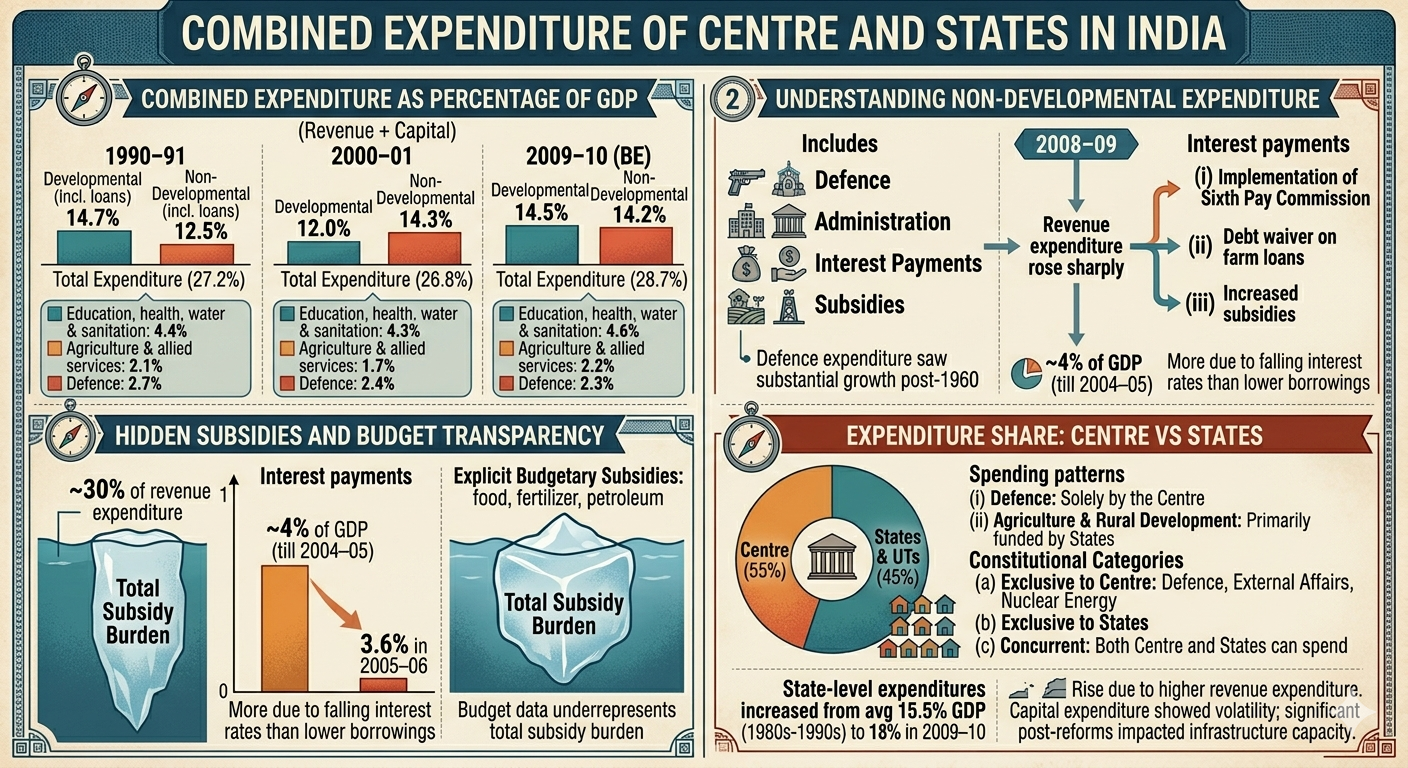
1990–91
(i) Developmental Expenditure (gross, incl. loans): 14.7%
(ii) Non-Developmental Expenditure (gross, incl. loans): 12.5%
(iii) Total Expenditure (i + ii): 27.2%
Breakdown:
- Education, health, water & sanitation: 4.4%
- Agriculture & allied services: 2.1%
- Defence: 2.7%
2000–01
(i) Developmental Expenditure: 12.0%
(ii) Non-Developmental Expenditure: 14.3%
(iii) Total Expenditure: 26.8%
Breakdown:
- Education, health, water & sanitation: 4.3%
- Agriculture & allied services: 1.7%
- Defence: 2.4%
2009–10 (BE)
(i) Developmental Expenditure: 14.5%
(ii) Non-Developmental Expenditure: 14.2%
(iii) Total Expenditure: 28.7%
Breakdown:
- Education, health, water & sanitation: 4.6%
- Agriculture & allied services: 2.2%
- Defence: 2.3%
It includes items that do not directly contribute to economic development, such as defence, administration, interest payments, and subsidies.
Defence expenditure saw substantial growth post-1960.
Revenue expenditure rose sharply in 2008–09 due to:
(i) Implementation of Sixth Pay Commission
(ii) Debt waiver on farm loans
(iii) Increased subsidies
Interest payments formed ~30% of revenue expenditure, ~4% of GDP (till 2004–05), declining to 3.6% in 2005–06.
This was more due to falling interest rates than lower borrowings.
Budget data underrepresents total subsidy burden as many subsidies are embedded in intermediate goods and services.
Explicit budgetary subsidies include food, fertilizer, and petroleum, but form a small share of actual subsidy expenditure.
State-level expenditures increased from an average of 15.5% of GDP in the 1980s–1990s to 18% in 2009–10.
This rise was due to higher revenue expenditure.
Capital expenditure showed more volatility; a significant drop occurred immediately post-reforms, impacting infrastructure capacity.
The Centre accounts for ~55% of public expenditure; States and UTs account for ~45%.
Spending patterns differ:
(i) Defence spending is solely by the Centre
(ii) Agriculture & Rural Development are primarily funded by States
Constitutional categories of expenditure:
(a) Exclusive to Centre: defence, external affairs, nuclear energy
(b) Exclusive to States
(c) Concurrent: areas where both Centre and States can spend
Please login to comment and rate.