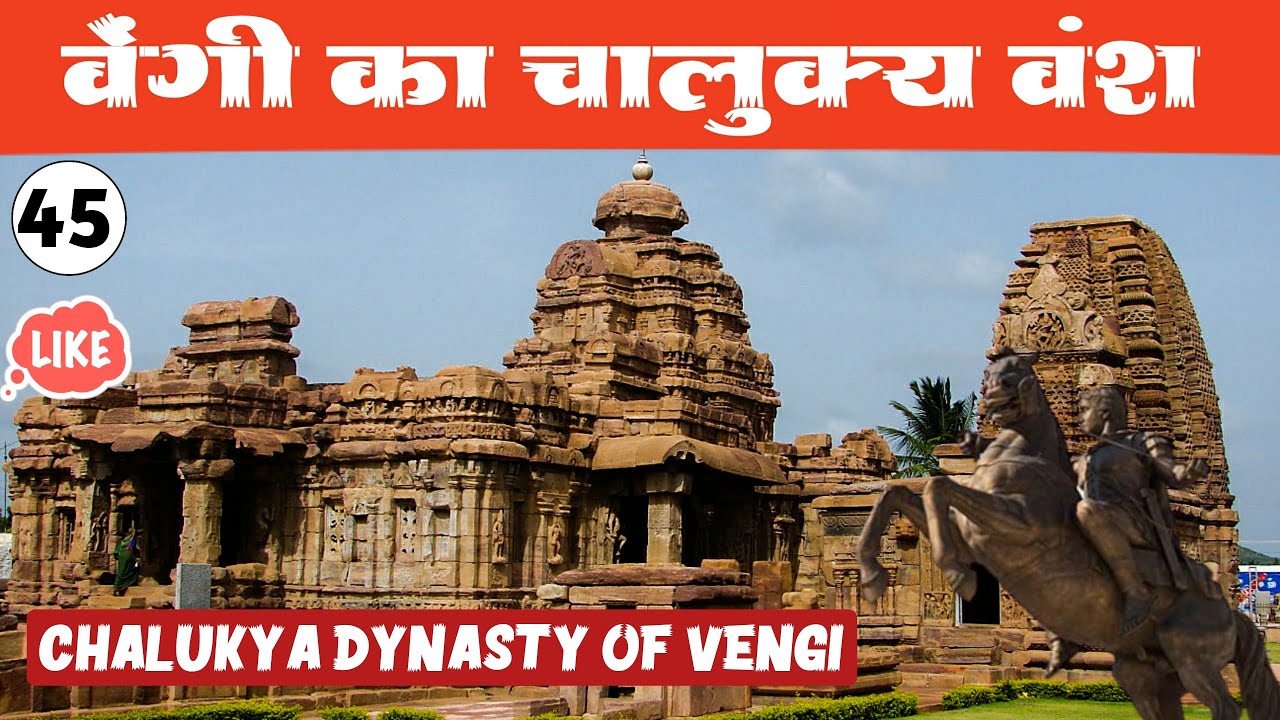
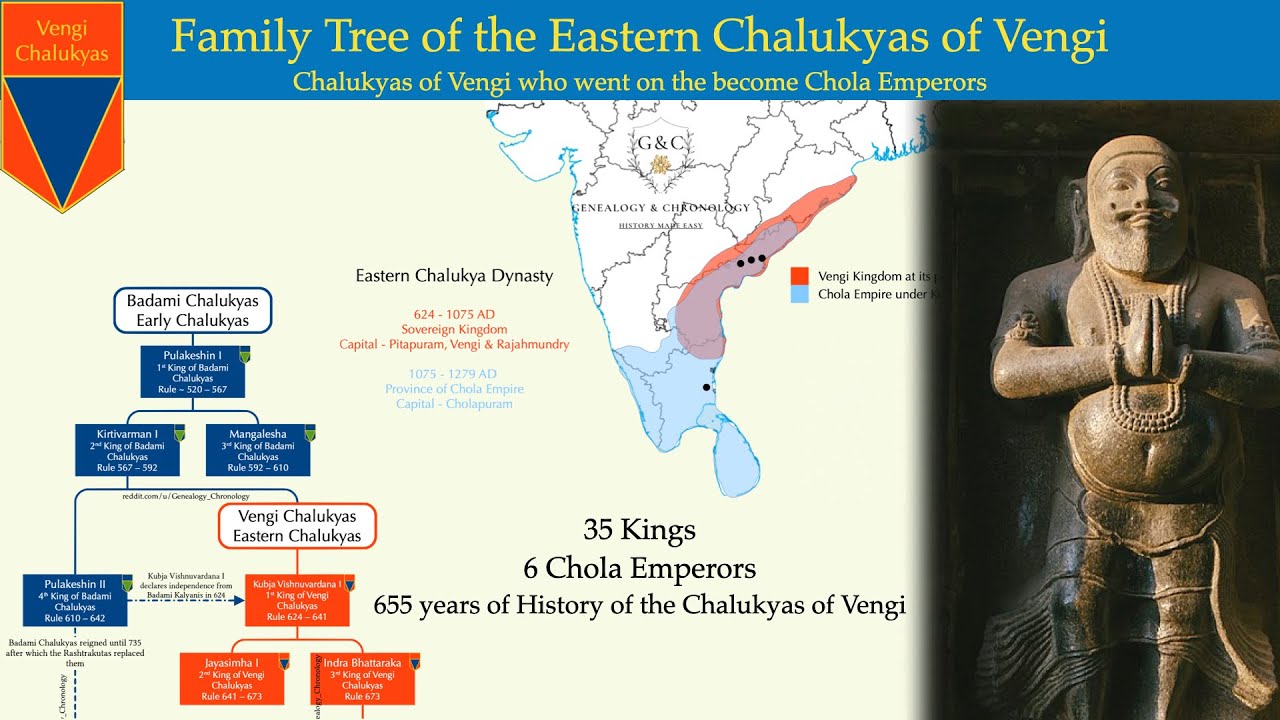
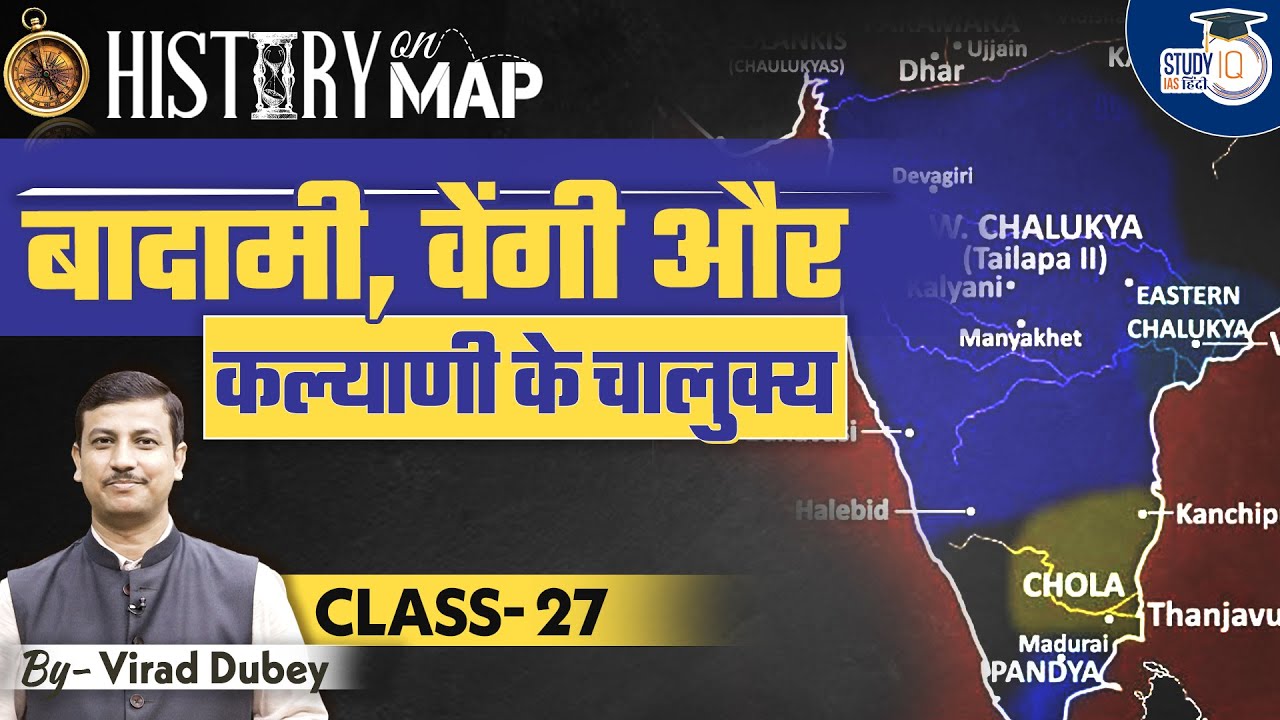
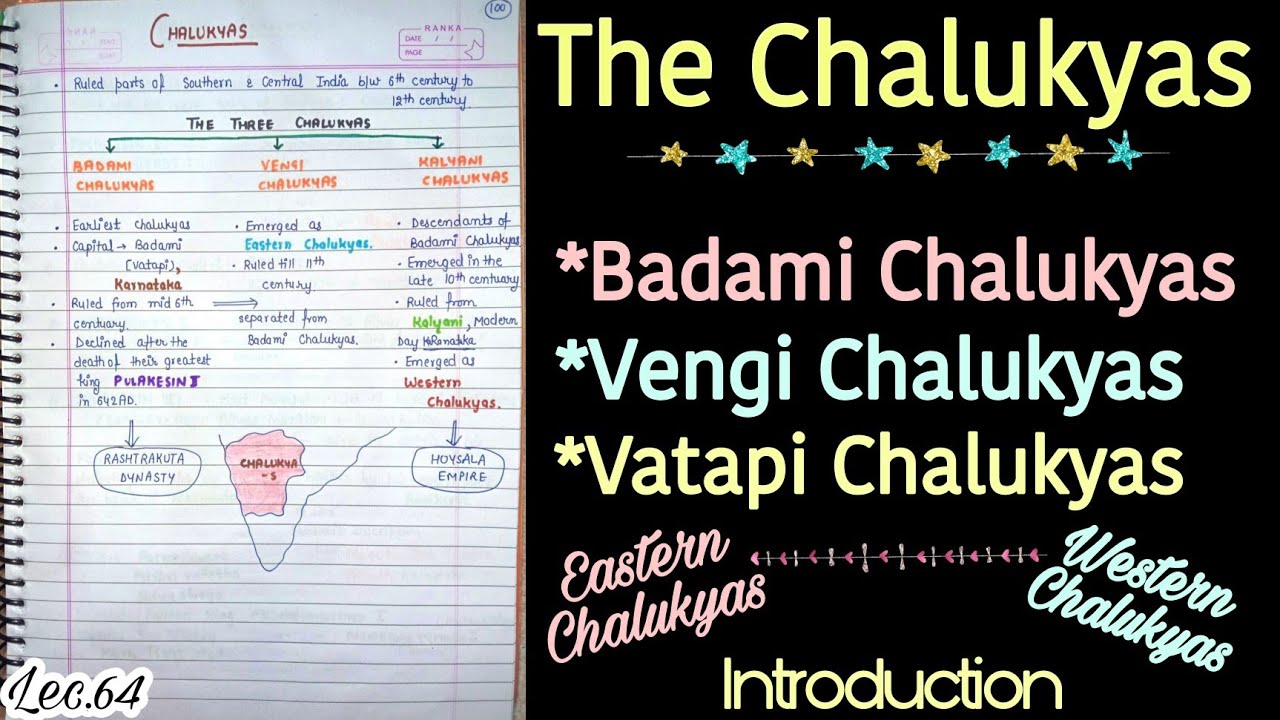
The Eastern Chalukyas of Vengi were a powerful offshoot of the legendary Chalukyas of Badami. They represent an incredibly vital chapter in South Indian history, establishing a sovereign presence that governed the coastal Andhra region for nearly four continuous centuries. This highly influential dynasty was originally founded by Kubja Vishnuvardhana, the tactical brother of Emperor Pulakesin II, who was granted control over Kalinga and Vengi following highly successful military expansions. Studying this dynasty is highly essential for students preparing for comprehensive history and civil service examinations. Their legacy showcases the major transition of political authority in the Deccan, the institutional development of Telugu culture and literature, and the deeply intricate socio-political dynamics that shaped Southern India from the 7th to the 12th centuries.
In this chapter, you will understand:
- The historic migration and emergence of the Vengi line from the main Badami empire.
- The political timeline, structural shifts in capitals, and key military confrontations with neighbors.
- The unique mythological origins, lineage claims, and verified social standing of the rulers.
- The deep cultural impacts, especially regarding the patronage and golden era of the Telugu language.
Why this topic matters: This historical phase outlines how the coastal Andhra territories gained a distinct political and cultural identity separate from the Western Deccan, laying the concrete foundation for classical Telugu literary traditions and regional governance paradigms that influenced subsequent medieval kingdoms.
Core Idea: The kingdom of Vengi began as an administrative governorship under the Badami Chalukyas but rapidly evolved into a completely independent royal house due to core power vacuums. Despite relentless multi-front wars with the Rashtrakutas, Cholas, and Western Chalukyas, they preserved regional stability for hundreds of years before their territory ultimately integrated into Chola alliances and later succumbed to the expanding Kakatiya power.
The Fascinating Origin Story and Enduring Legacy of the Eastern Chalukyas of Vengi (624 AD)
The establishment of this royal lineage marks a significant milestone where a military division turned into a permanent, localized administrative center that redefined local dynamics.
- The Eastern Chalukya dynasty emerged from the military redistribution of the vast Badami empire, officially starting their rule in the Vengi region.
The historical genesis of the Eastern Chalukya dynasty, also widely celebrated in epigraphs as the Chalukyas of Vengi, is directly tethered to the expansive imperial house of the Chalukya family of Badami. Their autonomous journey opened when the grand empire controlled by Pulakesin II distributed its administrative weight to secure far-flung boundaries.
- (i) The ultimate foundation was laid when Pulakesin II, directly acknowledging the immense valor and unmatched conquest abilities of his biological brother, Kubja Vishnuvardhana, formally entrusted him with the administration of the newly annexed eastern zones of Kalinga and Vengi.
- (ii) This strategic act of delegation, originally designed to consolidate military control over the eastern seaboard, unexpectedly set the stage for a highly powerful and independent royal house that would autonomously govern the coastal Andhra region.
- (iii) To elevate their royal status and build an unassailable legacy, later inscriptions from the 11th century started connecting the Eastern Chalukyas to the prestigious Lunar dynasty, explicitly asserting their descent from the legendary Pandavas and the celestial Moon to solidify an unchallenged divine right.
The Historical Context and Cultural Flourishing under Vengi Chalukyas in South India
As sovereign rulers, this royal line cultivated a rich socio-political environment that facilitated localized governance and massive intellectual growth across their territories.

Dynastic Evolution: From Governors to Sovereign Rulers in Andhra
The Eastern Chalukyas governed massive swaths of South India continuously from the 7th to the 12th centuries, utilizing local shifts to build an empire.
- (i) The early phase saw them successfully running the territory as independent monarchs until approximately 1001 CE, after which their diplomatic position changed, causing them to transition into highly powerful feudatories closely allied with the Blossoming Medieval Cholas until 1189 CE.
- (ii) Their primary political headquarters shifted over the years to counter strategic threats, beginning at Pishtapura (modern Pitapuram), moving directly to Vengi (near modern Eluru in Pedavegi), and eventually establishing deep roots at Rajamahendravaram (modern-day Rajahmundry).
- (iii) The highly sensitive geographic positioning of the Vengi domain made it an immediate buffer zone and target during major military struggles, particularly between the competing regional titans: the Cholas and the Western Chalukyas.
Eastern Chalukyas Origin and the Tale of Kubja Vishnuvardhana
The official independence of the branch was a direct consequence of structural political shifts inside the core Western Deccan family.
- (a) The complex annexation of the Vengi region was initially accomplished by the legendary Badami emperor, Pulakeshin II, during his highly aggressive imperial rule spanning 610–642 CE. After achieving total success, his brother Kubja Vishnuvardhana assumed command as governor in 624 CE.
- (b) The Path to Independence: A massive turning point unfolded right after Pulakeshin II lost his life in the devastating Battle of Vatapi against the invading Pallavas. Seeing the immediate breakdown within the central Badami administration, Kubja Vishnuvardhana quickly moved to declare himself an independent sovereign.
- (c) Mythical Lineage Claims: The Eastern Chalukyas retained their ancient ancestral association with the Manavya Gotra and proudly claimed the title of Haritputras ("sons of Hariti"), matching the heritage records preserved in the Timmapuram plates. By the 11th century, they incorporated elements linking their house directly to legendary figures like Budha, Pururava, and Udayana.
The Legend of Vijayaditya and the Rise of Vishnuvardhana
Traditional royal histories include fascinating narratives detailing moments of great struggle followed by a triumphant reclamation of ancestral rights.
- (i) Local dynastic lore states that an early ancestor named Vijayaditya was tragically killed in a fierce battle against the powerful ruler Trilochana Pallava, triggering a severe governance crisis.
- (ii) His heavily pregnant widow found safe sanctuary and complete protection under the care of a learned sage named Vishnubhatta Somayaji in the settlement of Mudivemu.
- (iii) The child born from this hidden lineage, named Vishnuvardhana, grew into a brilliant warrior, ultimately executing campaigns to reclaim his rightful heritage and establish lasting Eastern Chalukya influence across the Deccan.
Political Instability and the Resurgence under Gunaga Vijayaditya III
External pressures often tested the structural integrity of the Vengi kingdom, requiring strong rulers to emerge and stabilize the borders.
Early Years of Chalukya Rule and Rashtrakuta Invasions (641–705 CE)
The timeline between 641 CE and 705 CE witnessed major internal power contests within the Vengi administration, with stable periods achieved only under exceptional monarchs like Jayasimha I and Mangi Yuvaraja.
- (i) This era directly overlapped with massive shifts across the Deccan plateaus, where the rising Rashtrakutas of Malkhed completely overthrew the dominant Western Chalukyas of Badami.
- (ii) The fluid leadership inside Vengi made the kingdom an attractive target, bringing down a series of highly disruptive military invasions from the aggressive Rashtrakuta forces.
- (iii) This systemic vulnerability continued for years until the crucial coronation of Gunaga Vijayaditya III in 848 CE. Following the passing of the famed Rashtrakuta monarch Amoghavarsha, Vijayaditya III acted decisively, asserting absolute independence and restoring true military dominance to Vengi.
Decline of the Dynasty and the Rise of the Kakatiya Power
The eventual fading out of the Eastern Chalukya sovereign command was an inevitable development as new political forces consolidated power in neighboring zones.
- (i) As the old Rashtrakuta empire faded from center stage, the Kakatiyas, who originally served as dedicated regional governors under the Western Chalukyas, systematically carved out their own sovereign space.
- (ii) These rising Kakatiya commanders crushed and absorbed various minor Chalukya branch offices operating across the Telangana landscape, continuously shrinking the traditional Vengi sphere of influence.
- (iii) By the termination of the 12th century, the Eastern Chalukyas saw their sovereign authority completely dissolve, ending their historically long administrative run and allowing the Kakatiyas to claim preeminence over the Deccan.
Quick Revision Capsule: Prominent Eastern Chalukya Rulers
Use this organized chronological tracking tool to review the succession and major landmarks of the prominent Vengi kings:
| Monarch Name | Reign Duration | Primary Contribution & Historic Milestones |
|---|---|---|
| Kubja Vishnuvardhana I | 624 – 641 AD | Dynastic Founder; established independent sovereign administrative roots following Badami victories. |
| Jayasimha I | 641 – 673 AD | Guided the newly formed kingdom safely through its initial vulnerable consolidation decades. |
| Vishnuvardhana III | 719 – 755 AD | Acted as a crucial stabilizing force amidst ongoing early territorial disputes. |
| Vijayaditya I Bhattaraka | 755 – 772 AD | Expanded structural administrative networks and strengthened internal fort bases. |
| Gunaga Vijayaditya III | 849 – 892 AD | Celebrated military genius; successfully broke Rashtrakuta pressure and restored imperial glory. |
| Bhima I Dronarjuna | 892 – 921 AD | Successfully maintained sovereign border security and sponsored artistic production. |
| Vimaladitya | 1011 – 1018 AD | Managed shifting foreign policy during a period of heavily rising Chola structural alliances. |
| Rajaraja Narendra I | 1018 – 1061 AD | Legendary cultural patron; commissioned the landmark Telugu translation of the Mahabharata. |
Mythological Origins and Kshatriya Status of the Chalukya Dynasty
To bolster their political legitimacy, early courts recorded unique origin legends, drawing from distinct northern and southern narratives.
Northern Tradition: The Birth from Brahma's Palm
This cosmic line of thinking, notably recorded in a 1051 AD inscription from the Gujarat Chalukyas, provides a direct divine lineage framework.
- (i) The primary myth claims that the original ancestor of the family line emerged from the Chuluka, which refers to the small hollow space created in the hand of the creator god Brahma.
- (ii) A highly popular rendering of this celestial event is found in Bilhana's Vikramankadevacarita, where the god Indra personally requested Brahma to create a legendary class of peerless warriors to clear evil from the world.
Southern Tradition: The Ayodhyapura and Deccan Migration Narrative
Widely preserved inside classical Kannada literature, this perspective traces a migration path down from ancient northern urban hubs.
- (a) The acclaimed classical poet Ranna, writing in his work Gadayuddha, traces the family tree back to King Satyashraya, who ruled the historic northern city of Ayodhyapura.
- (b) His descendant, Jayasimha (also noted as Vishnuvardhana), is credited with pushing back early Rashtrakuta elements and embedding the Chalukya flag firmly into the Deccan plains.
- (c) The Revival Tale: The historical records inside the Kauthem grant of Vikramaditya V specify that the family held sway over Ayodhya for generations before marching south. Their fortunes were dynamically revived when Jayasimhavallabha defeated King Indra, the son of Krishna, securing their base.
Debate on Origins: Dravidian Connections versus Northern Legends
The classic assertions of a pure northern origin came into focus primarily during the 11th century AD, generating healthy academic conversations among historians regarding their true geographic roots.
- (i) Southern Theory: A large body of historical experts strongly concludes that the Chalukyas were entirely indigenous, arising naturally within the southern Deccan landscape.
- (ii) Dravidian Etymology: The oldest structural inscriptions refer to the family name using regional variations like Chalitki, Calki, Saluki, or Salki, which are linguistically linked to native Dravidian roots.
- (iii) Epigraphic Evidence: A highly critical clue found inside an early Ikshvaku Prakrit record mentions a high-ranking army general named Khandachalitki-Remmanaka, confirming the name existed in the south long before northern myths were recorded.
Caste Identity and Kshatriya Status of the Chalukyas
The elite status of the family is heavily verified by multiple contemporary external accounts and strict ritual performances recorded during their peak years.
- (a) Vedic Rituals: Early records from the 7th century AD confirm their recognized status. Pulakesin I, inside his famous Badami fort inscription dated 543-544 AD, recorded his performance of great orthodox sacrifices including the Ashvamedha, Agnistoma, and Vajapeya.
- (b) Foreign Testimony: The legendary Chinese traveling monk Xuanzang, who systematically documented his journey across India in the 7th century AD, explicitly stated that the great ruler Pulakesin II belonged to the valid Kshatriya caste.
The Early History and Transformative Conquests of Badami Chalukya Pulakesin II
The administrative creation of the Vengi kingdom is best understood by tracking the rapid rise of the primary imperial house based out of Badami.
Founding and Ascendancy of the Chalukyas of Badami
The verifiable history of the main parental branch kicks off under the guidance of Jayasingha Vallabha, who set up the primary baseline inside the Bijapur district.
- (i) The family attained true imperial standing under Pulakesin I, who performed the paramount horse sacrifice to announce his sovereign presence.
- (ii) Fortification of Vatapi: In the year Saka 465 (corresponding to 543-544 AD), Pulakesin I successfully captured and built an unassailable fort on the hills of Vatapi, making it the central engine of the family's expanding realm.
- (iii) His tactical maneuvers brought adjacent regional chiefs under control, making the Chalukyas the primary political force across the Western Deccan.
The Reign of Kirtivarman I and the Kalachurya Defeat
The subsequent tenures of Kirtivarman I and Mangalesha expanded the geographic boundaries of the kingdom across key Deccan corridors.
- Kirtivarman I's Campaigns: Inscriptions like the Mahakuta pillar inscription claim sweeping victories over wide territories. However, the famous Aihole inscription realistically tempers these claims, focusing his permanent structural victories on the Nalas, Mauryas, and the Kadambas.
- Mangalesha's Expansion: After Kirtivarman I passed away in Saka 500 (578-579 AD), his brother Mangalesha managed the throne effectively for over three decades, securing huge victories over the Kalachuryas.
- The Civil War: This stable administration ended in conflict when Kirtivarman's son, the future emperor Pulakesin II, organized a major internal revolt, resulting in the defeat and passing of his uncle Mangalesha on the battlefield.
The Transformative Accession and Conquests of Pulakesin II (609–610 AD)
The official coronation of Pulakesin II in Saka 531 (609-610 AD) introduced an era of massive imperial growth, stabilizing internal systems and widening boundaries.
- (i) Consolidation and Initial Victories: He quickly suppressed local revolts led by Appayika and Govinda, reduced the Kadambas at Vanavasi, and brought the Gangas and Alupas into line.
- (ii) The Harsha Encounter: A defining moment in ancient Indian history was his absolute victory over the northern emperor Harsha Vardhana near the Reva River, preventing northern imperial expansion into the south and making Pulakesin II the undisputed master of the Deccan.
- (iii) Southern Campaigns and Imperial Reach: Turning his focus eastward, he brought Kosala and Kalinga into his imperial fold, eventually pushing Pallava forces back to their walls at Kanchi. This created an empire that stretched clearly from the Arabian Sea to the Bay of Bengal.
Administrative Legacy and the Birth of the Eastern Chalukyas
Managing such an immense domain required deep logistical organization, leading to a targeted distribution of regional responsibility among trusted family circles.
- (i) To ensure complete institutional loyalty, Pulakesin II placed close relatives in key border locations, sending Buddhavarsa to Aparanta and positioning Dharashraya Jayasimha near the Nasik region.
- (ii) The most significant administrative assignment was the permanent transfer of the eastern coastal territories to his brilliant military brother, Kubja Vishnuvardhana, as a direct reward for his vital role in conquering the eastern seaboard.
- (iii) Formation of the New Line: This crucial assignment served as the concrete birth of the sovereign Eastern Chalukya line. This house would proudly manage the coastal Andhra region for four full centuries, leaving a major imprint on South Indian history.
Summary
The historical run of the Eastern Chalukya dynasty remains a highly essential chapter in South Indian history. Their four-century management of the Vengi kingdom provided a crucial bridge, linking the political currents of the Northern Deccan with the southern imperial worlds of the Cholas. Beginning in the 7th century AD as a strategic governorship assigned to Kubja Vishnuvardhana by his brother Pulakesin II, this royal house successfully weathered intense Rashtrakuta invasions and internal successions. Under visionary monarchs like Rajaraja Narendra I, their court became the primary incubator for Telugu culture, literature, and classical arts, creating an enduring cultural identity that outlasted their political authority when the kingdom eventually dissolved under the rising Kakatiyas.
Quick Revision Points for Students
Keep these critical historical parameters in mind for examination clarity:
- (i) Core Founder: The dynasty was independently initiated by Kubja Vishnuvardhana in 624 CE.
- (ii) Capital Migrations: The primary seat moved over time from Pishtapura to Vengi, and finally to Rajamahendravaram.
- (iii) Literary Benchmark: Rulers like Rajaraja Narendra I sponsored the translation of the Mahabharata, initiating the classical age of Telugu literature.
- (iv) Ultimate Successors: Their territorial presence completely faded by the end of the 12th century, paving the way for the Kakatiyas to claim total control.
- Exam Tip: Civil Service questions frequently target the cross-regional conflicts of Vengi. Always remember that the Vengi kingdom acted as a vital strategic buffer zone between the Western Chalukyas and the Cholas, and its alignment often shifted the balance of power in South India.
Frequently Asked Questions (FAQ)
Q1: Who was the ultimate founder of the Eastern Chalukyas of Vengi, and how did they get power?
A1: The dynasty was founded by Kubja Vishnuvardhana in 624 CE. He was given the governorship of the eastern territories of Kalinga and Vengi by his brother, the Badami Emperor Pulakesin II, following successful military conquests. He later declared independence during a power breakdown in the parent state.Q2: Which Eastern Chalukya ruler is most celebrated for cultural and literary contributions?
A2: Rajaraja Narendra I (1018–1061 AD) is the most celebrated patron of culture. He famously sponsored the poet Nannaya to translate the epic Mahabharata into the Telugu language, marking a monumental milestone in classical Telugu literature.Q3: What caused the ultimate political decline of the Vengi kingdom?
A3: Their decline was caused by continuous multi-front wars, heavy internal succession disputes, and a growing dependence on the Chola empire. This general political vacuum allowed their former vassals and neighbors, the Kakatiyas, to systematically reduce their territory and emerge as the next major power by the end of the 12th century.