The political landscape of North India in the witnessed a monumental transformation from small tribal settlements to powerful, organized monarchies known as Mahajanapadas. At the core of this shift was the introduction and widespread application of iron technology across the fertile Gangetic plain. Iron tools allowed communities to clear dense forests, practice intensive agriculture, and yield significant food surpluses. These surpluses nurtured growing urban populations, funded standing armies, and laid the groundwork for centralized state governance. Among the rival kingdoms of the era, the Magadha Empire emerged as the most formidable power, setting the precedent for pan-Indian imperial unification.
In this chapter, you will understand:
- The transition from tribal polities to settled territorial kingdoms during the 6th century B.C.
- The political geography and strategic positioning of the Sixteen Mahajanapadas.
- The military campaigns, diplomatic tactics, and dynasties that drove Magadhan expansion.
- The geographic, economic, and social factors that ensured Magadha's ultimate dominance over its rivals.
Why this topic matters: Understanding the rise of Magadha is essential for mastering ancient Indian political history, as it marks the foundational transition from regional tribal chiefdoms to India's first centralized imperial structures.
Core Idea: Driven by iron technology, agricultural surplus, natural mineral wealth, and shrewd leadership from rulers like Bimbisara and Ajatasatru, Magadha systematically annexed surrounding kingdoms to establish the political centerpiece of ancient India.
Political Landscape of Magadha Empire – Rise of Dominant Territorial States (6th Century B.C.)
During the , northern India underwent a structural shift from semi-nomadic tribal chiefdoms (janas) to established territorial kingdoms (janapadas and mahajanapadas). The widespread adoption of iron technology served as the primary catalyst for this socio-political evolution.
The Sixteen Mahajanapadas – Foundational Early Territorial States of Ancient India
Early Buddhist texts like the Anguttara Nikaya and Jain scriptures list sixteen major territorial states across the subcontinent. Among these, four kingdoms—Magadha, Kosala, Vatsa, and Avanti—emerged as the primary contenders for regional hegemony.
Geography and Strategic Features of the Mahajanapadas
Each Mahajanapada occupied a distinct geographic zone with unique economic and defensive characteristics that directly influenced its political lifespan.
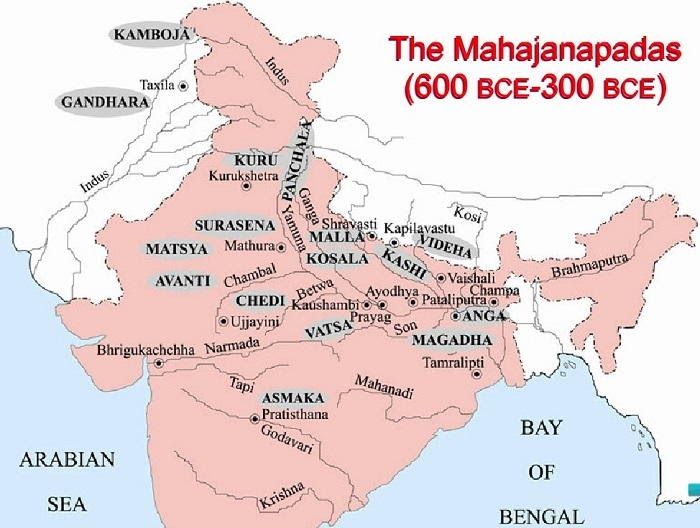
Map of 16 Mahajanapadas showcasing their geographical spread across Northern India. - (i) Magadha: Located in modern South Bihar, covering the districts of Patna, Gaya, and Shahabad. Its original capital was hill-encircled Rajgir (Rajagriha), later shifted to the river confluence of Pataliputra.
- (ii) Kosala: Positioned in modern eastern Uttar Pradesh with its capital at Sravasti. It included the sacred city of Ayodhya and held authority over the autonomous Sakya republic of Kapilavastu, home of Gautama Buddha.
- (iii) Anga: Located east of Magadha in modern Monghyr and Bhagalpur districts. Its capital, Champa, was a major commercial center until its early annexation by Magadha.
- (iv) Kasi: Centered around Varanasi, renowned for cotton textiles and commercial wealth. It was eventually annexed by Kosala after prolonged conflicts.
- (v) Vatsa: Situated along the Yamuna River in central India with its capital at Kausambi, a prosperous hub for trans-regional trade.
- (vi) Avanti: A powerful western kingdom split into two regions: northern Avanti with its capital at Ujjain, and southern Avanti centered at Mahishmati.
Expansion of the Magadha Empire under Dynamic Early Rulers
Magadha's transformation from a local principality into an expansive empire was spearheaded by ambitious rulers who combined strategic military campaigns with astute matrimonial alliances and administrative innovations.
Notable Magadhan Rulers, Their Strategies, and Imperial Consolidation
The political consolidation of Magadha was achieved through successive dynasties that systematically eliminated rival powers across North India.
- (i) Bimbisara (Haryanka Dynasty): Ruled for over five decades and established Magadhan supremacy by annexing Anga to gain control over eastern river trade. He secured Magadha's western and northern borders through strategic matrimonial alliances with the princesses of Kosala, Vaishali, and Madra.
- (ii) Ajatasatru (Haryanka Dynasty): Son of Bimbisara, he pursued aggressive territorial expansion. He defeated the Lichchhavis of Vaishali after a long 16-year war using novel siege weapons like the rathamusala (chariot with mace) and mahasilakantaka (catapult). He also annexed Kasi and fortified Rajgir against potential invasions from Avanti.
- (iii) Udayin (Haryanka Dynasty): Successor to Ajatasatru, he strategically moved the capital to Pataliputra, situated at the confluence of the Ganga and Son rivers, providing defensive natural water barriers and trade control.
- (iv) Sisunagas and Nandas: The Sisunaga dynasty permanently destroyed the long-standing rivalry with Avanti. Subsequently, the Nanda dynasty built a vast empire stretching across northern India, sustained by a massive standing army and centralized revenue systems.
The Cumulative Factors Behind Magadha’s Enduring Success
Magadha's ultimate victory over rival Mahajanapadas was not accidental; it resulted from an unmatched combination of natural geography, mineral resources, military tactics, and socio-economic adaptability.
Magadha's Strategic Strengths: The Unparalleled Advantages for Imperial Rise
A multi-faceted matrix of structural advantages enabled Magadha to sustain continuous imperial expansion over several centuries.

Strategic advantages of Magadha including iron deposits, natural river fortification, and elephant corps. - (i) Geographic & Resource Richness: Magadha was located near abundant rich iron ore deposits in Southern Bihar (modern Jharkhand), supplying raw material for superior tools and weapons. Its capitals enjoyed natural defenses: Rajgir was encircled by five hills, and Pataliputra was a true water fort (jala-durga).
- (ii) Military Innovations: Magadha was the first state in ancient India to deploy war elephants on a large scale. Elephants enabled troops to cross riverine terrains, clear dense forests, and storm enemy fortifications.
- (iii) Economic Prosperity: The fertile alluvial soil of the Gangetic plain produced heavy agricultural yields. Control over major river routes enabled the state to collect trade tolls and taxes, building a prosperous treasury.
- (iv) Social Adaptability: Located on the cultural periphery of orthodox Vedic society, Magadhan culture was flexible and open to unorthodox ideas, fostering pragmatism, social mobility, and religious reform movements like Jainism and Buddhism.
Quick Revision Capsule on Magadha Empire
Key summary of the major dynasties, rulers, and milestones in the rise of the Magadha Empire:
| Dynasty / Element | Key Rulers / Feature | Historical Contribution / Impact |
|---|---|---|
| Haryanka Dynasty | Bimbisara & Ajatasatru | Annexed Anga, defeated Lichchhavis, fortified Rajgir, and initiated territorial expansion. |
| Capital Shift | Udayin | Transferred capital to Pataliputra for superior trade access and natural water defenses. |
| Sisunaga Dynasty | Sisunaga | Defeated and annexed Avanti, ending a century-old conflict between the two regional powers. |
| Nanda Dynasty | Mahapadma Nanda | Created a vast centralized empire with immense wealth and a formidable standing army. |
| Key Catalysts | Iron & Elephants | Iron tools boosted farming surplus; war elephants provided decisive battlefield superiority. |
Summary
The political evolution of northern India during the laid the bedrock of imperial statecraft in the Indian subcontinent. Driven by the transformative impact of iron technology, agricultural productivity expanded rapidly, providing the material base for urbanization and central administration. Among the Sixteen Mahajanapadas, Magadha systematically outmaneuvered its rivals—Kosala, Vatsa, and Avanti—through strategic diplomacy, geographic advantages, natural mineral wealth, and military innovations like the elephant corps. Under successive lines of rulers from the Haryanka to the Nanda dynasties, Magadha established a powerful model of centralized imperial rule that directly paved the way for the Mauryan Empire.
Quick Revision Points / Core Checkpoints
Essential facts to review before examinations:
- (i) The 6th century B.C. marked the rise of Sixteen Mahajanapadas across northern India.
- (ii) Bimbisara founded Haryanka dominance by annexing Anga and securing matrimonial alliances.
- (iii) Ajatasatru defeated the Lichchhavis of Vaishali using siege weapons like the rathamusala and mahasilakantaka.
- (iv) Udayin established Pataliputra as the imperial capital at the Ganga-Son river confluence.
- Exam Tip: Always emphasize the role of iron ore deposits in South Bihar and war elephants when answering questions on why Magadha succeeded over Kosala, Vatsa, and Avanti.
Frequently Asked Questions (FAQ)
Q1: What role did iron technology play in the rise of the Mahajanapadas?
A1: Iron technology enabled deep forest clearing and deep plowing in the fertile Gangetic basin. This drastically raised agricultural production, creating food surpluses that supported non-farming urban populations, regular taxation, and standing armies.Q2: Why was the shift of capital to Pataliputra strategically significant?
A2: Pataliputra was situated at the confluence of the Ganga, Son, and Gandak rivers. This created a natural water fort (jala-durga) that was easy to defend and provided direct control over riverine commercial traffic.Q3: How did Magadha's military differ from other Mahajanapadas?
A3: Magadha was the first major Indian kingdom to use war elephants on a massive scale. Elephants allowed Magadhan armies to break enemy formations, clear thick jungle tracks, and storm fortified structures far more effectively than traditional horse cavalry.