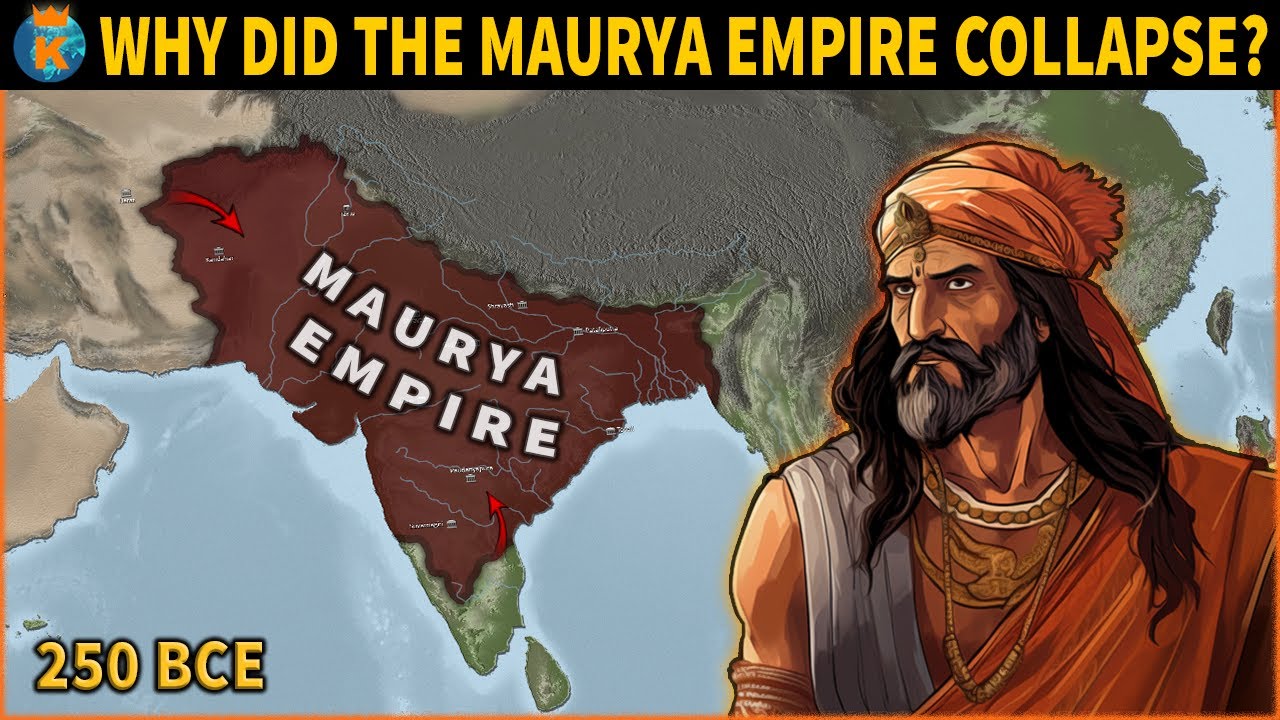
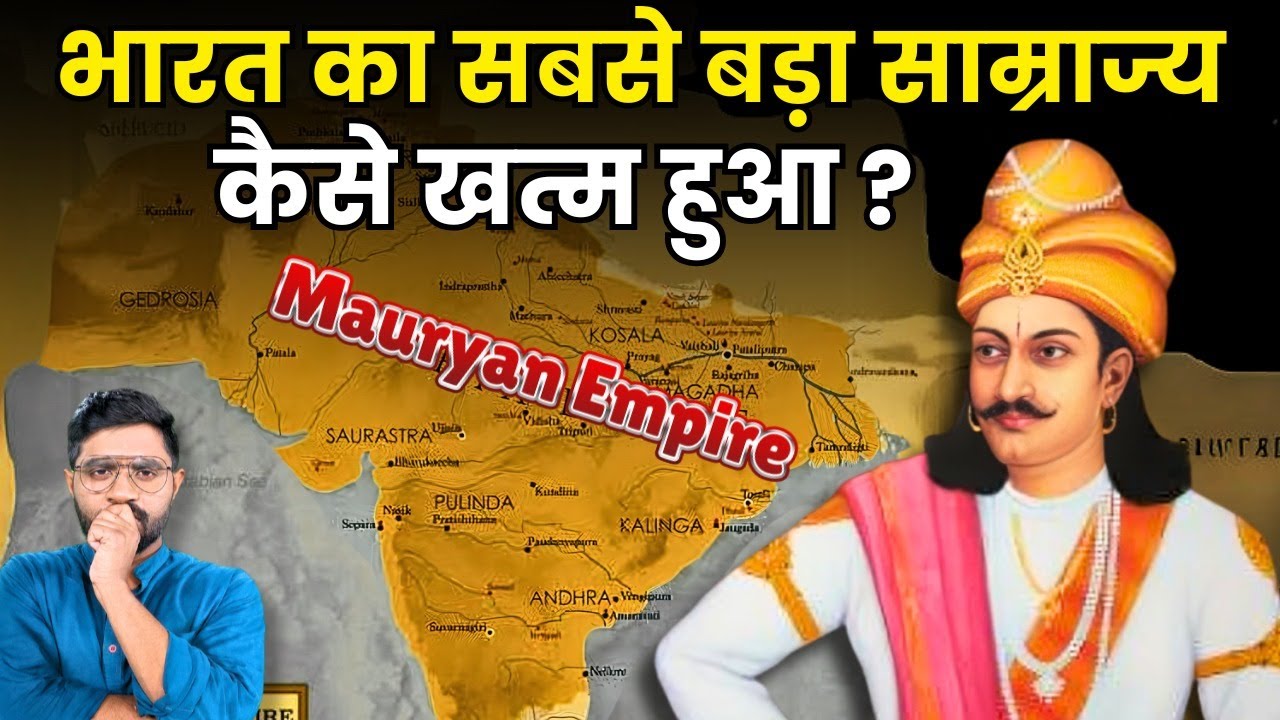
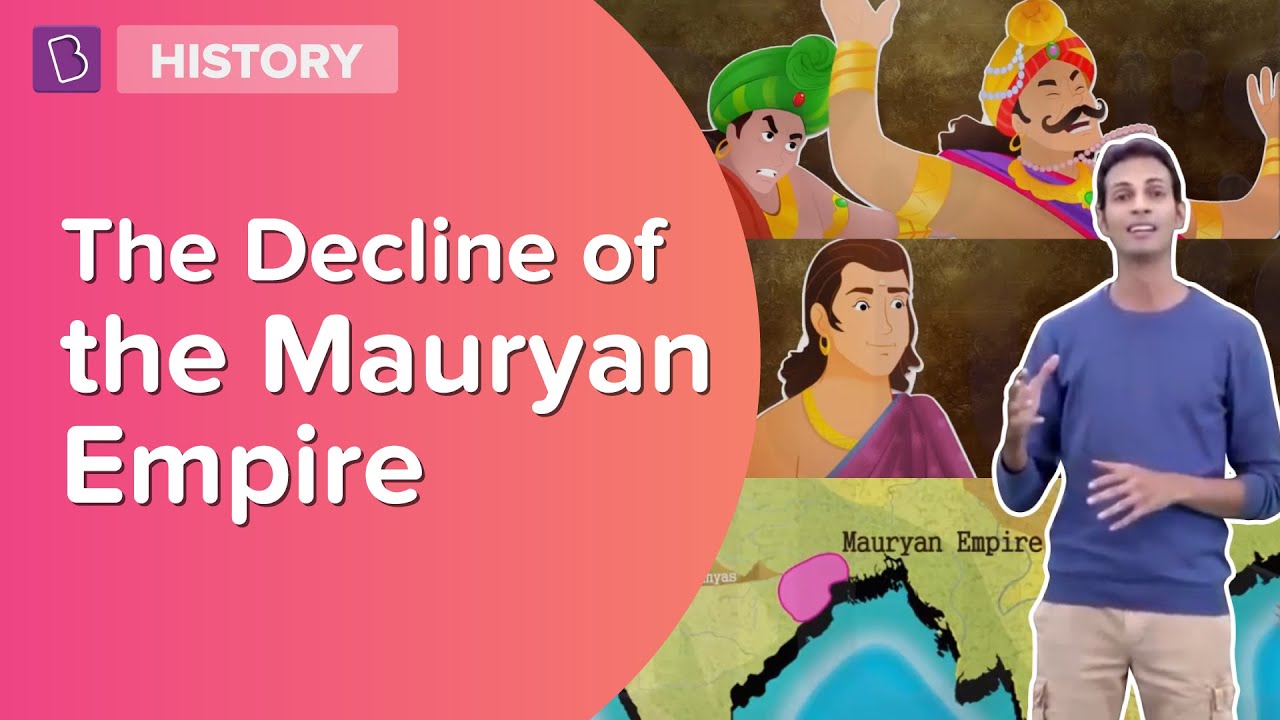
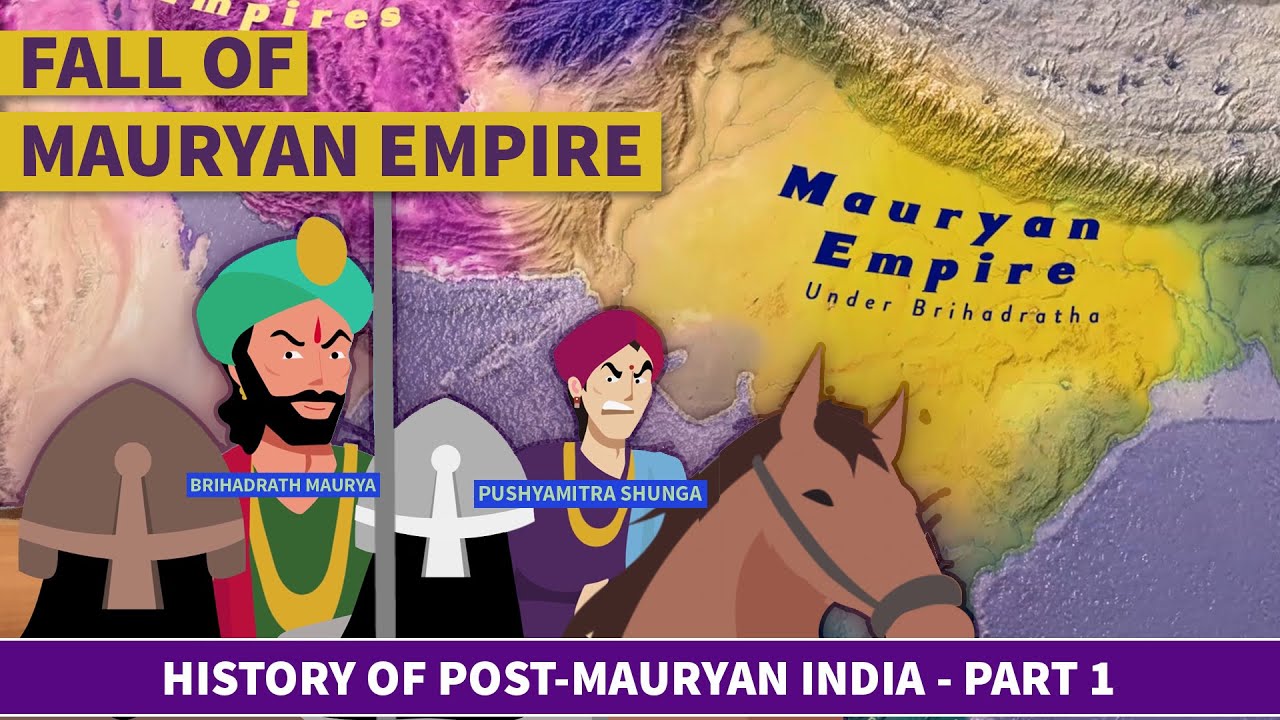
The fall of the Mauryan Empire and the rise of post-Mauryan society marked a major turning point in ancient Indian history. After reaching its peak under Emperor Ashoka, the empire began to break apart following his death in . Weak rulers, internal conflict, and financial trouble slowly eroded central authority. The empire officially ended in when Pushyamitra Shunga assassinated the last Mauryan king, Brihadratha, and established the Shunga Dynasty. This transition reshaped regional politics and led to important developments in religion, trade, literature, and art.
In this chapter, you will understand:
- The key administrative, economic, and military reasons behind the Mauryan collapse.
- How regional successor kingdoms emerged after the empire fragmented.
- The growth of Mahayana Buddhism and theistic Hindu traditions.
- Major advancements in ancient Indian literature, medicine, science, and architecture.
Why this topic matters: This period explains how central authority collapsed and gave rise to decentralized regional rule, fostering diverse religious movements, foreign trade exchanges, and enduring legal and artistic systems across the Indian subcontinent.
Core Idea: The Mauryan Empire collapsed due to weak leadership after Ashoka, economic pressures, and regional instability. While central political power fractured, society remained active and saw significant growth in devotional religious traditions, classical literature, legal codification, and trade contacts.
Disintegration of the Mauryan Empire: Reasons and Post-Mauryan Cultural Shift (232–185 BCE)
The Mauryan political system relied heavily on a strong central authority. Established by Chandragupta Maurya around , the empire expanded across vast territories. However, maintaining central control over such a large area proved difficult once top-level leadership weakened.
Downfall and Causes of the Ancient Mauryan Empire Post-Ashoka
The decline of the empire was caused by systemic failures across administration, finance, and border defense, culminating in the complete end of Mauryan rule by .

Reasons for the Decline of the Mauryan Empire Succession Crisis and the Era of Weak Rulers
The central governance framework depended on capable monarchs like Chandragupta and Ashoka. After Ashoka died in , later kings lacked the political skill and military strength needed to govern effectively.
- Ineffective rulers failed to command loyalty or maintain direct control over far-off provinces.
- Power vacuums at the center encouraged provincial governors to break away and assert independence.
Internal Conflicts and the Dissolution of Central Authority
Royal power struggles and administrative breakdowns gradually reduced the empire's reach across outlying regions.

Geographical Extent of the Mauryan Empire at Its Peak - The vast territory required active, central oversight, which diminished noticeably after Ashoka.
- Internal rivalries weakened central control over border areas, making the empire increasingly unstable.
Economic Strain and Financial Instability
Supporting a large standing army and an extensive bureaucracy created heavy financial strain on the imperial treasury.
- High administrative and defense costs led to increased taxation, creating public discontent.
- Declining trade revenues and lower agricultural yields further weakened state finances.
External Invasions and the Hastening of Collapse
As central military strength waned, foreign powers capitalized on the situation to launch border invasions.
- Incursions by Greeks and Greco-Bactrians along the northwestern frontier exposed military weaknesses.
- External pressure combined with internal instability sped up the collapse of imperial power.
The Final Collapse and the Emergence of Successor States
In , the last Mauryan ruler Brihadratha was assassinated during a military parade by his commander-in-chief, Pushyamitra Shunga.

Successor States After the Decline of the Mauryan Empire - This coup brought an end to the dynasty and established the Shunga Dynasty in central India.
- The empire broke into smaller regional states, opening a new chapter of regional politics and cultural interactions.
Post-Mauryan Society: Cultural and Religious Developments in Ancient India
The post-Mauryan period from to saw significant cultural, religious, and literary changes despite political fragmentation.
- Political diversity allowed local traditions to flourish while absorbing cultural ideas from incoming foreign groups.
The Rise of Mahayana Buddhism and Theistic Concepts
Buddhism underwent major transformations, moving toward devotional practices supported by trade guilds and foreign rulers.
- Mahayana Buddhism (the Great Vehicle) emerged with a focus on the Bodhisattva ideal, contrasting with traditional Hinayana Buddhism.
- Texts like the Milindapanha (dialogues between King Menander and Nagasena) and Buddhacharita by Asvaghosha emphasized devotion and relic veneration.
- Sanskrit became widely used for Mahayana texts, helping these teachings spread across Asian trade routes.
Emergence of Popular Hinduism: Vaishnava and Shaiva Traditions
Vedic traditions transformed into popular devotional Hinduism centered around personal faith and deity worship.
Core Tenets of New Theism
The focus shifted toward devotion to primary deities, mainly Vishnu in Vaishnavism and Shiva in Shaivism.
- Personal devotion (bhakti) became the primary path to spiritual salvation, replacing elaborate rituals.
- Rulers like the Kushans featured images of Shiva on their coinage, reflecting royal patron support.
Codification of Brahmanical Law: The Dharmashastras of Manu
Scholars collected and organized social and legal traditions into structured texts called the Dharmashastras.
The Authoritative Manusmriti
Composed between and , the Manusmriti became a prominent legal reference of the period.
- It laid out principles regarding social structure (Varna) and stages of life (Ashrama).
- The text defined legal systems, social duties, and civil administration rules.
Advancements in Secular Literature, Science, and Arts
This period recorded notable achievements across literary, scientific, architectural, and artistic fields.
Literary Growth: Sanskrit and Tamil Traditions
Literary output grew rapidly in both northern and southern regional languages.
- Grammatical works like the Mahabhashya by Patanjali advanced classical Sanskrit studies.
- In South India, Sangam literature provided details on early Tamil society, trade, and governance.
Scientific and Medical Progress
Scholars made distinct advancements in medicine, astronomy, and mathematics.
- Medical scholars like Charaka and Susruta compiled foundation texts on Ayurveda and surgery.
- Astronomers refined mathematical calculations, trigonometric concepts, and planetary models.
Artistic and Architectural Evolution
Sculpture and monument construction expanded with distinct regional styles.
- Buddhist architecture grew through complex stupa designs, such as the famous Sanchi Stupa.
- Three distinct sculpture styles developed: the Greco-Roman influenced Gandhara School, the native Mathura School, and the narrative-focused Amaravati School.
Quick Revision Capsule
A quick overview of key political changes, religious movements, and cultural highlights from the post-Mauryan era:
| Historical Category | Key Elements & Developments | Historical Significance |
|---|---|---|
| Political Shift | Assassination of Brihadratha (); emergence of Shungas, Kanvas, Satavahanas, and Kushans. | Transition from central imperial rule to regional states. |
| Religious Evolution | Rise of Mahayana Buddhism; development of Vaishnavism and Shaivism. | Focus shifted from complex rituals to personal devotion (bhakti). |
| Legal Codification | Composition of the Manusmriti (). | Structured ancient Indian social codes and civil legal frameworks. |
| Literary Progress | Mahabhashya by Patanjali, Buddhacharita by Asvaghosha, and Tamil Sangam literature. | Enriched classical Sanskrit and regional Tamil literary traditions. |
| Art & Architecture | Development of Gandhara, Mathura, and Amaravati schools of art; expansion of stupas like Sanchi. | Blended local traditions with foreign stylistic influences. |
Summary
The disintegration of the Mauryan Empire in brought an end to early India's most centralized state. Succession disputes, economic strain, and external border pressure caused the imperial administration to break down. However, the post-Mauryan period that followed was culturally active and dynamic. Regional kingdoms encouraged trade, while religion evolved through devotional Hinduism and Mahayana Buddhism. At the same time, legal texts like the Manusmriti were recorded, medicine advanced through Charaka and Susruta, and distinctive art styles took shape across the subcontinent.
Quick Revision Points
Key facts to remember for exam preparation:
- (i) The Mauryan Empire officially ended in when Pushyamitra Shunga killed king Brihadratha.
- (ii) Mahayana Buddhism introduced the Bodhisattva ideal and used Sanskrit for key scripture texts.
- (iii) The Manusmriti established social frameworks, duty codes, and legal principles during this transitional era.
- (iv) The Gandhara School integrated Greco-Roman artistic techniques into native Indian themes.
- Exam Tip: Remember that the collapse of the Mauryan Empire led to political decentralization, but it was also an era of cultural and economic growth rather than decline. Focus on the core differences between the Gandhara, Mathura, and Amaravati art schools for history exam questions.
Frequently Asked Questions (FAQ)
Q1: What was the main cause of the Mauryan Empire's decline after Ashoka?
A1: The empire declined due to weak successors, administrative fragmentation over distant provinces, financial strain from maintaining a massive army, and foreign invasions along the northwest border.Q2: How did Buddhism change during the post-Mauryan period?
A2: Buddhism split into two major traditions: Mahayana, which introduced the Bodhisattva concept, image worship, and Sanskrit scriptures; and Hinayana, which preserved earlier orthodox teachings.Q3: What are the main features of the Gandhara School of Art?
A3: The Gandhara School merged Greco-Roman artistic methods with Buddhist subjects, creating realistic sculptures of Buddha with detailed drapery and features.