The Post-Mauryan Period spanning from to stands as a foundational phase in ancient Indian history. After the central authority of the Mauryan Empire fragmented, new regional forces stepped in to shape the political narrative. Native dynasties like the Shungas and Kanvas seized control in the north, while the Satavahanas grew powerful in the south and the Chedi Kingdom took root in Kalinga. Meanwhile, waves of invaders from Central Asia entered from the northwest, introducing new cultural elements. Despite the political shifts, this era saw economic expansion, bustling maritime trade with the Roman Empire, and deep artistic contributions seen in rock-cut caves, early temples, and monumental stupas like Bharhut and Sanchi.
In this chapter, you will understand:
- The political succession following the collapse of the Mauryan Empire.
- The rise of indigenous Brahmin rulers like the Shungas and Kanvas.
- The expansion and architectural achievements of King Kharavela in Kalinga.
- Key developments in Post-Mauryan art, temple structures, and guild-based trade.
Why this topic matters: It forms a core portion of ancient history curricula, explaining how regional identities, trade networks, and religious traditions developed prior to the Gupta era.
Core Idea: The Post-Mauryan era replaced centralized imperial rule with dynamic regional powers, vibrant international trade, and major advancements in Sanskrit literature, stupa construction, and early Hindu temple architecture.
Post-Mauryan India: Political Fragmentation, Regional Kingdoms, and Foreign Incursions (2nd Century BC - 3rd Century AD)
The disintegration of the imperial Mauryan administration around transformed the political structure of the Indian subcontinent. Deprived of a central sovereign, distinct regional kingdoms asserted their authority while external groups moved into the borderlands.
- The collapse of Mauryan central power opened doors for local leaders and foreign powers.
During its peak under Ashoka, the Mauryan Empire spanned vast territories extending up to Kandahar in modern-day Afghanistan. As administrative control weakened after Ashoka, provincial governors broke away. This shift allowed both internal military commanders and outside migrating groups to build independent domains across India.
- (i) The northwestern frontiers suffered repeated incursions by foreign tribes migrating from Central Asia, including the Indo-Greeks, Shakas, Parthians, and Kushanas.
- (ii) Across the core Gangetic plains, military officer Pushyamitra Shunga established a new ruling lineage, while the coastal region of Kalinga asserted its full sovereignty.
- (iii) Throughout southern India, the Satavahana Dynasty consolidated vast territories, establishing a strong regional counterpart to northern rulers.
Shunga Dynasty (185 BC - 73 BC): Brahmanical Rule and Cultural Patronage
Taking control over former Mauryan heartlands, the Shunga Dynasty established its authority across central and northern India. Governed from primary centers like Pataliputra and Vidisha, their rule ushered in a renewed focus on traditional Vedic rites.
Pushyamitra Shunga (185 – 149 BCE): Founder, Military Defender, and Hindu Revivalist
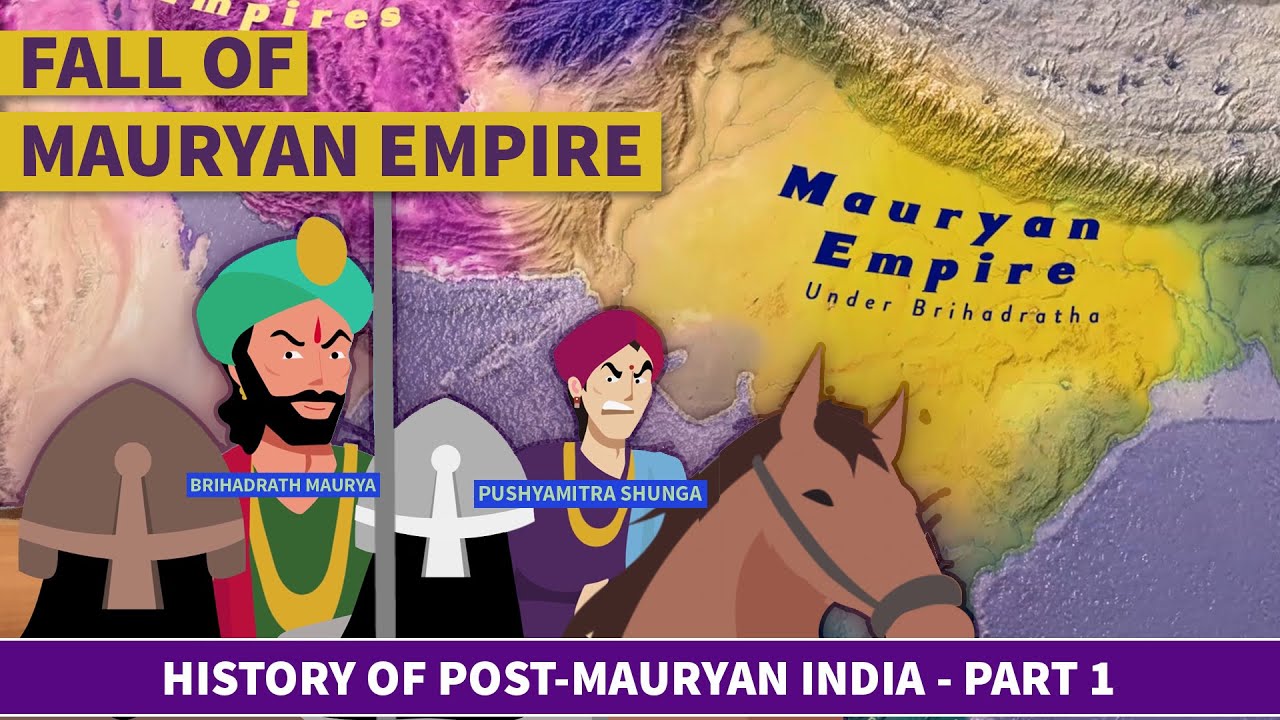
The Shunga line began when Pushyamitra Shunga, the commander-in-chief (Senapati) of the Mauryan forces, overthrew the final Mauryan king, Brihadratha. His reign was defined by active territorial defense and a public revival of traditional Vedic rituals.
- (i) He successfully defended the fertile Gangetic Valley from external pressures, turning back major campaigns led by Indo-Greek leaders from Bactria.
- (ii) To mark his political authority and restore Vedic ceremonies, he conducted two Ashwamedha Yagyas (horse sacrifices), as recorded in Dhandeva’s Ayodhya Inscription.
- (iii) While devoted to traditional Brahmanical practices, he also extended support to monumental Buddhist art, funding stone railing expansions and carving works at the Bharhut Stupa.
- (iv) His court was home to the grand grammarian Patanjali, creator of the Mahabhasya, and his rise to power was later narrated in Harshacharita by Banabhatta.
Agnimitra (149 – 141 BC) and the Glory of Kalidasa
Pushyamitra was succeeded by his son Agnimitra, whose royal court life and campaigns became celebrated centuries later in classical Sanskrit drama.
- (i) He serves as the central protagonist in the famous play Malavikagnimitra, authored by the renowned playwright Kalidasa.
Decline of Shunga Dynasty and Transition to Kanva Rule
Later Shunga rulers, including Vasumitra, Vajramitra, and Bhagabhadra, struggled to maintain central authority over their territories, leading to internal court instability.
- (i) The final Shunga king, Devabhuti, was killed through a court conspiracy engineered by his minister Vasudeva Kanva, ending Shunga dominance around .
Kanva Dynasty (73 BC - 28 BC): A Brief Successor Brahmin Rule
Following the fall of the Shungas, the Kanva Dynasty assumed control over what remained of the northern empire, administering their lands mainly from Pataliputra and Vidisha.

Foundation, Rulers, and Historical Records of the Kanvas
Established by Vasudeva Kanva, this lineage maintained Brahmin governance in northern India for roughly 45 years. Historical accounts written by Bana in the outline this political transition, connecting the family lineage to Sage Saubhari.
- (i) Primary rulers who followed included Bhumimitra and Narayana, before the lineage ended with Susharman.
- (ii) Inscribed copper coins bearing the name of Bhumimitra recovered in the Panchala region confirm their administrative presence in northern zones.
- (iii) The short-lived Kanva kingdom ended when Susharman was defeated by southern forces associated with the Andhra or Satavahana expansion led by Balipuccha.
Chedi Kingdom in Kalinga: The Rise of Mahameghavahana Power
As central Mauryan control vanished, Kalinga (modern-day Odisha) emerged as a formidable sovereign state under the Mahameghavahana Dynasty (also known as the Chedi or Cheta family).
Foundation and Identity of the Cheta Vamsa
According to regional traditions, this royal line was established by King Abhichandra, who built his primary capital at Suktimati-Puri along the banks of the Suktimati River.
- (i) The rise of the Mahameghavahanas highlights how regional kingdoms developed strong localized governance after imperial authority dissolved.
King Kharavela: The Greatest Ruler and Patron of Jainism
The most celebrated sovereign of Kalinga was King Kharavela, who ruled during the . He expanded Kalinga's power through military campaigns while providing patronage to Jainism.
The rock-cut Udayagiri and Khandagiri Caves in Odisha, carved as dwellings for Jain monks during King Kharavela's rule. - (a) The primary biographical record of his reign is the famous Hathigumpha Inscription carved on the Udayagiri Hills near Bhubaneswar.
- (b) Written in the Brahmi script and beginning with the sacred Jain Namokar Mantra, the inscription documents his military victories, public works, and religious gifts.
- (c) The lineage continued after Kharavela, as shown by records referring to his successor Kudepasiri in the nearby Mancapuri Cave Inscription.
Art, Architecture, and Cultural Integration in Post-Mauryan India
The Post-Mauryan era was a golden period for creative arts, rock-cut architecture, stupa enrichment, and the beginnings of structural Hindu temples.
Udayagiri and Khandagiri Caves: Jain Shelters and Structural Art
Carved into sandstone hills during the , the Udayagiri and Khandagiri twin caves near Bhubaneswar provided residential cells and prayer spaces for itinerant Jain monks.
- (i) Among these rock-cut structures, the two-story Ranigumpha Cave stands out for its detailed relief carvings depicting royal processions, natural scenes, and daily life.
Development of Stupa and Early Temple Architecture
Stupa building expanded rapidly. Existing earthen or brick mounds received stone encasements, ornate railings (vedikas), and sculpted gateways (toranas).
- Stupa Innovations: Major Buddhist sites like Bharhut and Sanchi in Madhya Pradesh were upgraded with carved stone gateways during the Shunga period. Farther south, the Amaravati Stupa and Nagarjunakonda Stupa in Andhra Pradesh featured distinctive white marble-like limestone bas-reliefs.
Relief carvings from the Bharhut Stupa gateway showing early narrative Buddhist stone art under Shunga patronage. Early Temple Structures and Architectural Layouts
This period laid the groundwork for structural Hindu temples, transitioning from open-air altars to permanent shelters for images of deities.
- (i) Early temples included a basic layout consisting of a inner sanctuary, an entrance hall, and a shaded porch.
- (ii) Key early temple remains have been identified at Deogarh in Uttar Pradesh, as well as Eran, Nachna-Kuthara, and Vidisha in Madhya Pradesh.
- (iii) Three main layout forms developed: Nirandhara (temples without a circumambulatory path), Sandhara (temples with an enclosed path or pradakshinapatha), and Sarvatobhadra (temples accessible from four entrances).
- Stupa Innovations: Major Buddhist sites like Bharhut and Sanchi in Madhya Pradesh were upgraded with carved stone gateways during the Shunga period. Farther south, the Amaravati Stupa and Nagarjunakonda Stupa in Andhra Pradesh featured distinctive white marble-like limestone bas-reliefs.
Religious, Social, and Literary Transformations
Sanskrit emerged as the primary language for high literature, court records, and religious texts during this era.
Brahmanical Traditions and Social Structure
Royal support for traditional rites led to a major resurgence of Vedic customs, alongside shifts in daily social structure.
- (i) Public rituals like the Ashwamedha and Rajasuya were performed by kings to declare political sovereignty.
- (ii) Social divisions grew more defined through codified texts such as the Manusmriti.
- (iii) Foreign communities entering India—such as the Indo-Greeks and Kushanas—were integrated into the broader social fabric through religious adaptation and intermarriage.
Literary Contributions and Script Evolution
Scholars produced foundational works in grammar, philosophy, and dramatics.
- (a) The grammarian Patanjali wrote the monumental grammatical commentary Mahabhasya and codified mind-body practices in the Yoga Sutras.
- (b) The Brahmi script evolved into regional stylized variants, linking Mauryan letterforms to later classical alphabets.
Economic Growth, Guild Systems, and International Trade Routes
The Post-Mauryan era experienced economic expansion driven by organized artisan associations and long-distance trade.
Merchant Guilds and Market Operations
Trade and craft guilds (shrenis) controlled production standards, set prices, and provided banking services to members. Guild leaders held high social status in urban centers like Mathura, famous for fine textiles like shataka cloth.
- (i) Key commercial titles included the Shreshti (head of a local guild), the Sarthavaha (caravan leader guiding overland trade), and the Jyestha or Vanijgramo (overseer of large merchant corporations).
Overland Highways and Roman Maritime Trade
Road networks connected interior production hubs directly to coastal ports.
- (a) The Uttarapatha highway linked northern markets to northwestern trade centers, while the Dakshinapatha ran southwards across the Deccan.
- (b) Navigators harnessed the seasonal monsoon winds to sail across the Arabian Sea, sparking a booming trade with the Roman Empire that brought vast amounts of gold and silver coins into India in exchange for luxury spices, silks, and fine cottons.
Quick Revision Capsule: Post-Mauryan Kingdoms
A summary overview of key Post-Mauryan dynasties, their primary geographic domains, and historical contributions:
| Dynasty / Power | Primary Region & Capital | Key Historical Contribution |
|---|---|---|
| Shunga Dynasty | Magadha & Malwa (Pataliputra / Vidisha) | Restored Vedic rituals; expanded Bharhut Stupa; defended against Indo-Greek forces. |
| Kanva Dynasty | Eastern & Central India (Pataliputra) | Short Brahmin rule established by Vasudeva Kanva following the end of Shunga rule. |
| Chedi Dynasty | Kalinga (Suktimati-Puri / Bhubaneswar) | Led by King Kharavela; built Hathigumpha record; provided major patronage to Jainism. |
| Satavahanas | Deccan Plateau (Pratishthana) | Consolidated southern trade routes; commissioned artistic works at Amaravati. |
| Indo-Greeks & Kushanas | Northwestern India & Gandhara | Introduced gold coinage; fostered Gandhara art style; opened Silk Road connections. |
Summary
The Post-Mauryan Period was far from an era of decline; it was a vibrant age of political restructuring and cultural growth. The end of centralized Mauryan authority gave rise to creative regional dynasties like the Shungas, Kanvas, Satavahanas, and Chedis. Overland highways and Indian Ocean sea routes linked Indian craft guilds to international markets across the Mediterranean and Central Asia. The period saw a lasting revival of Sanskrit scholarship, major additions to Buddhist stupas, the carving of Jain rock-cut shelters, and the earliest foundations of structural temple architecture that set the stage for classical Indian civilization.
Quick Revision Points
Key facts to remember for history examinations:
- (i) Pushyamitra Shunga founded the Shunga Dynasty around 185 BC by overthrowing the last Mauryan ruler Brihadratha.
- (ii) King Kharavela of Kalinga left the famous Hathigumpha Inscription in Brahmi script on the Udayagiri Hills.
- (iii) The grammarian Patanjali authored the Mahabhasya during the Shunga rule.
- (iv) Monsoon wind navigation led to a profitable trade boom between Indian ports and the Roman Empire.
- Exam Tip: Remember the distinction between early temple layouts: Nirandhara (no circumambulatory path), Sandhara (with an enclosed path), and Sarvatobhadra (accessible from all four cardinal directions). These terms frequently appear in architectural history questions.
Frequently Asked Questions (FAQ)
Q1: What caused the political fragmentation of India after the Mauryan Empire?
A1: Weak central leadership after King Ashoka, combined with vast territorial distances, allowed regional military leaders and provincial governors to break away and create independent ruling lines.Q2: Who was King Kharavela and why is he historically significant?
A2: He was the greatest sovereign of the Mahameghavahana Dynasty in Kalinga during the 1st century BCE. His achievements, military campaigns, and patronage of Jainism are recorded in the Hathigumpha Inscription.Q3: What role did merchant guilds (shrenis) play during the Post-Mauryan era?
A3: Guilds organized manufacturing, established product quality controls, trained apprentices, functioned as local banks, and funded major artistic and religious monuments.