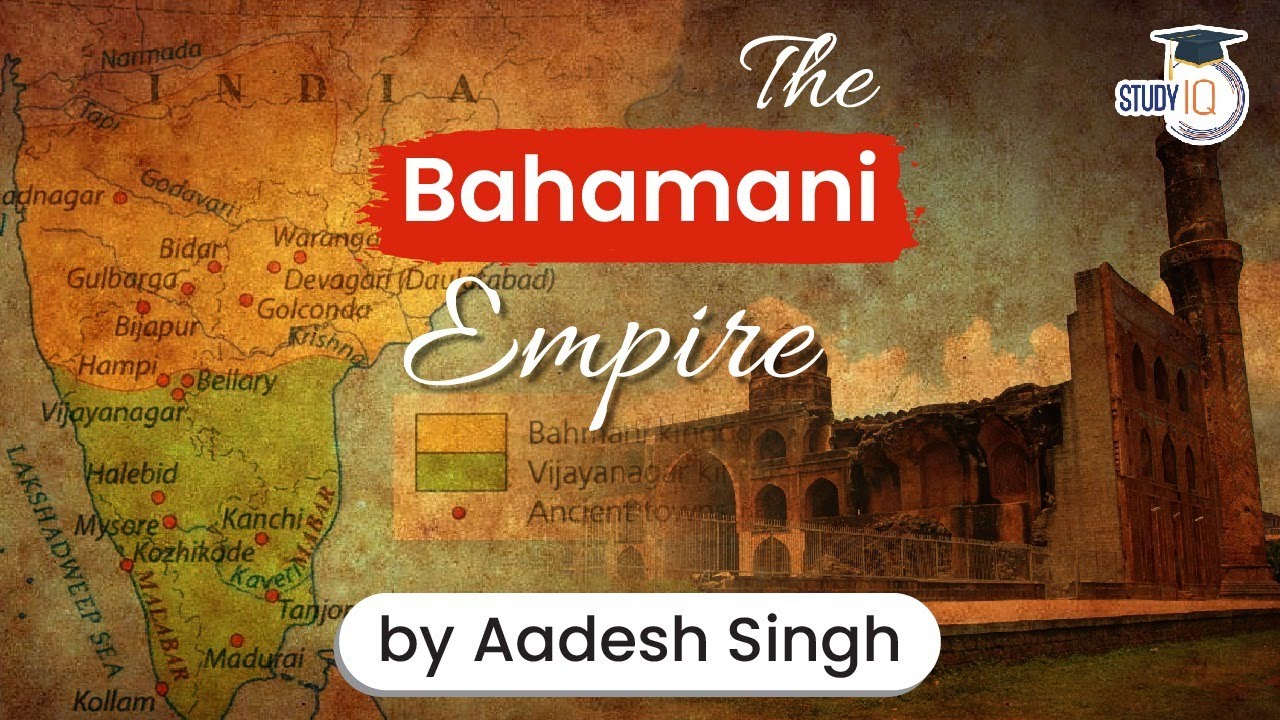
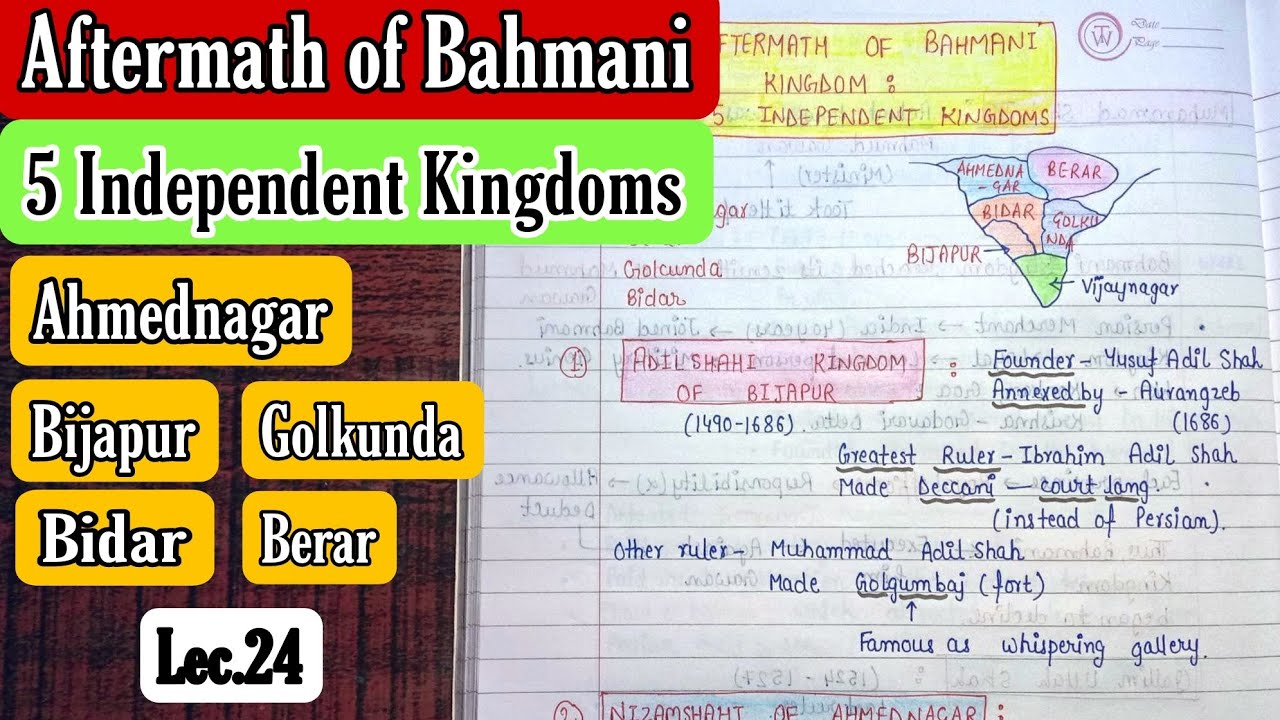
The Deccan region saw the birth of powerful regional kingdoms like Ahmadnagar, Bijapur, and Golconda after the breaking up of the Bahmani kingdom. This period in the is very important for students learning about Deccan politics. It shows how the Marathas rose to become essential military helpers and administrators. It also shows how local powers and Mughal influence shaped the history of southern India, giving clear insights for exam preparation.
🎯 In this chapter, you will understand:
- How the break-up of the Bahmani Kingdom led to the birth of three main Deccan sultanates.
- The key conflicts and shifting alliances between Ahmadnagar, Bijapur, and Golconda.
- How the Marathas moved from local soldiers to powerful administrators and leaders.
- The impact of Mughal expansion on southern politics and administration.
💡 Why this topic matters: Understanding 16th-century Deccan history helps explain how local governance structures formed and set the stage for the later rise of the Maratha Empire under Shivaji.
🧠 Core Idea: Constant competition among the Deccan Sultanates made them rely heavily on local Maratha military force and administrative talent, creating a major shift in power across southern India.
Emergence of Powerful Regional Kingdoms in the Deccan and Growing Maratha Influence (16th Century)
The end of the large Bahmani kingdom led to the creation of three independent Deccan sultanates. These states constantly fought for land, which gave the Marathas a chance to become essential political and military leaders.
During the , these sultanates focused on expanding their borders, building temporary alliances, and competing with one another. Soon, they also had to react to the growing Mughal power from the north.
- (i) After the final fall of the Bahmani kingdom, three main states emerged: Ahmadnagar, Bijapur, and Golconda. These states quickly established control over large areas of the Deccan.
- (ii) These Deccan sultanates joined forces briefly to fight the last big southern empire, Vijayanagara. They defeated Vijayanagara at the historic Battle of Bannihatti (popularly known as the Battle of Talikota) in , changing the political landscape of South India.
Post-Victory Conflicts and Deep-Rooted Rivalries Between Ahmadnagar and Bijapur
The unity among the sultanates did not last long after their victory over Vijayanagara. Ahmadnagar and Bijapur soon restarted their old fights, focusing mainly on taking control of rich areas like Sholapur.

Territorial Rivalries Over the Strategically Important Sholapur Region
Controlling Sholapur was a main cause of disagreement between Ahmadnagar and Bijapur. The area had rich farmland and held great strategic value, keeping both states in near-constant war.
- (i) Both rulers claimed ownership of Sholapur because it was fertile and sat right on their borders, leading to regular armed fights.
- (ii) Neither long military campaigns nor political marriage alliances between ruling families could settle this dispute, showing how deep their regional competition ran.
Expansionist Territorial Ambitions and Internal Power Struggles in the Deccan
Each regional sultanate tried to expand its land and strengthen its internal power. This created ongoing internal disputes and led to frequent changes in defensive and aggressive partnerships.
Ahmadnagar’s Expansionist Drive and Claims to the Bahmani Legacy
Ahmadnagar was located in the north and claimed high status because it was close to the old Bahmani capital. It tried to expand northward toward Berar, bringing it into conflict with other nearby powers.
- (i) Ahmadnagar worked to capture Berar in the northern Deccan, claiming they were the rightful heirs to the original Bahmani rulers.
- (ii) Their expansion plans were opposed by Bijapur and the Sultanate of Gujarat, both of which wanted control over the rich Konkan coast and the lands of Berar.
Bijapur and Golconda Clash Over the Naldurg Territory
The two southern sultanates, Bijapur and Golconda, also fought directly over key border positions instead of building a united front.
- (i) Bijapur and Golconda fought frequently over the fort and territory of Naldurg, making the political situation in the Deccan even more unstable.
Influence of Mughal Expansion on the Deccan Political Scenario
When the Mughal Empire expanded southward and took control of Gujarat, a powerful new factor entered Deccan politics. This changed how the sultanates planned their moves and made alliances.
The Mughal Conquest of Gujarat in 1572 and the New Political Dynamic
With Mughal armies near their borders, the Deccan rulers had to rethink their strategy and turn their attention toward weaker lands in the south.
- (i) The quick takeover of Gujarat in by Emperor Akbar created a new security threat for the Deccan states.
- (ii) To adapt, Ahmadnagar took control of Berar and made a deal with Bijapur. Both agreed to focus their expansion southwards into areas formerly held by Vijayanagara.
- (iii) The Sultanate of Golconda also expanded southward, taking advantage of the political weakness in the eastern lands.
Rise of the Marathas as Key Actors in Deccan Politics
The Marathas, who traditionally worked in military service and local village administration, grew into important political leaders within the Deccan sultanates.
Initial Role of Marathas under the Bahmani Kingdom
The Marathas first gained administrative and military experience while serving within the administrative system of the Bahmani state.
- (i) In the beginning, Marathas served as irregular cavalry troops called bargirs or military auxiliaries in the Bahmani armies.
- (ii) Local tax collection was managed mainly by Deccani Brahmans, while local Maratha landholders, known as deshmukhs or zamindars, built up their economic power in the countryside.
Deccan Sultanates’ Strategic Integration Policy Towards the Marathas
Realizing the military skill and administrative experience of the Marathas, the rulers of the Deccan began recruiting them directly into state service during the middle of the .
Ibrahim Adil Shah I of Bijapur and the Policy of Maratha Integration
The ruler of Bijapur actively brought Maratha officers into his administration to secure their military backing and support.
- (i) Ibrahim Adil Shah I of Bijapur, who took power in , recruited over 30,000 Maratha soldiers into his armed forces.
- (ii) He also gave Maratha leaders positions in the tax administration and government offices, giving them a direct interest in supporting the sultanate.
Prominent Maratha Families and Their Rising Status in Deccan Politics
Many Maratha families used opportunities provided by the sultanates to secure military ranks (mansabs), land grants (jagirs), and key administrative positions.
Old and Established Maratha Families
Several traditional families formed the early leadership of the Maratha elite, having earned land and respect under earlier rulers.
- (i) Established families like the More, Nimbalkar, and Ghatge families first gained status under the Bahmani rulers.
- (ii) They kept their military ranks (mansabs) and land grants (jagirs) under the new regional states, maintaining strong local influence.
New Maratha Families and the Rise of the Bhonsales
State integration policies allowed new families to rise quickly, including the family line that later produced Shivaji.
- (a) New families like the Bhonsales (including the Ghorpade branch) and the Dafles (including the Chavans) gained land and status under Bijapur.
- (b) Educated leaders also earned high government positions; for example, Kankoji Naik was given the top position of Peshwa (Prime Minister) by the rulers of Ahmadnagar.
Maratha Influence on Mughal Administrative Policies
The system of working with local Maratha leaders (deshmukhs) shaped how the Mughal Empire governed as it expanded into southern India.
Impact on Mughal Administration and Integration Strategies
The Mughals noticed how effectively the sultanates worked with local leaders and decided to use similar methods themselves.
- (i) Seeing the success of these regional setups, Emperor Akbar and later Mughal rulers brought Maratha leaders directly into their own official ranking system (mansabdari system).
⚡ Quick Revision Capsule: Deccan Sultanates & Maratha Integration
Use this reference table to review key historical events, regional powers, and Maratha developments in the 16th century:
| Historical Event / Subject | Key Sultanates & Figures | Historical Significance |
|---|---|---|
| Breakup of Bahmani Kingdom | Ahmadnagar, Bijapur, Golconda | Created three major regional successor states in the Deccan plateau. |
| Battle of Talikota () | Allied Deccan Sultanates vs. Vijayanagara | Defeated the Vijayanagara Empire, opening southern territory for expansion. |
| Sholapur & Border Fights | Ahmadnagar vs. Bijapur | Long struggle over fertile border lands that could not be solved by war or marriage. |
| Mughal Conquest of Gujarat () | Emperor Akbar | Brought Mughal power to the Deccan doorstep, pushing sultanates to expand southward. |
| Maratha Administrative Integration | Ibrahim Adil Shah I, Bhonsale & More families | Gave Marathas regular army posts, land grants (jagirs), and key governance roles. |
📝 Summary
The was a major transition period for the Deccan region. After the fall of the Bahmani kingdom, three main successor states—Ahmadnagar, Bijapur, and Golconda—took control. Though they united briefly to defeat Vijayanagara in , continuous disputes over border areas like Sholapur kept them divided. As the Mughal Empire expanded south after capturing Gujarat in , these sultanates relied increasingly on local Maratha leaders. Rulers like Ibrahim Adil Shah I gave Maratha leaders army posts and land grants (jagirs). Prominent families such as the Bhonsales and Nimbalkars gained valuable administrative and military experience, setting the stage for the growth of Maratha power in Indian history.
🚀 Quick Revision Points
Essential facts to review before examinations:
- (i) Three major sultanates emerged from the Bahmani kingdom: Ahmadnagar, Bijapur, and Golconda.
- (ii) The united sultanates defeated Vijayanagara at the Battle of Talikota in .
- (iii) Sholapur was a main point of conflict between Ahmadnagar and Bijapur, while Naldurg was fought over by Bijapur and Golconda.
- (iv) Ibrahim Adil Shah I of Bijapur integrated over 30,000 Maratha soldiers into his military force starting in .
- 💡 Exam Tip: Remember that Marathas originally held administrative roles as local landholders (deshmukhs) and irregular troops (bargirs) before gaining major rank (mansabs) under the Sultanates and Mughals.
❓ Frequently Asked Questions (FAQ)
Q1: Which three main kingdoms emerged after the Bahmani kingdom broke up?
A1: The three primary kingdoms were Ahmadnagar, Bijapur, and Golconda.Q2: What was the significance of the Battle of Talikota in ?
A2: The allied Deccan Sultanates defeated the Vijayanagara Empire, ending its major dominance in South India and shifting power balances across the region.Q3: How did Deccan rulers like Ibrahim Adil Shah I involve the Marathas in governance?
A3: They recruited thousands of Maratha soldiers into their armies and appointed Maratha leaders to administrative posts and tax positions, giving them land grants (jagirs) and military ranks (mansabs).