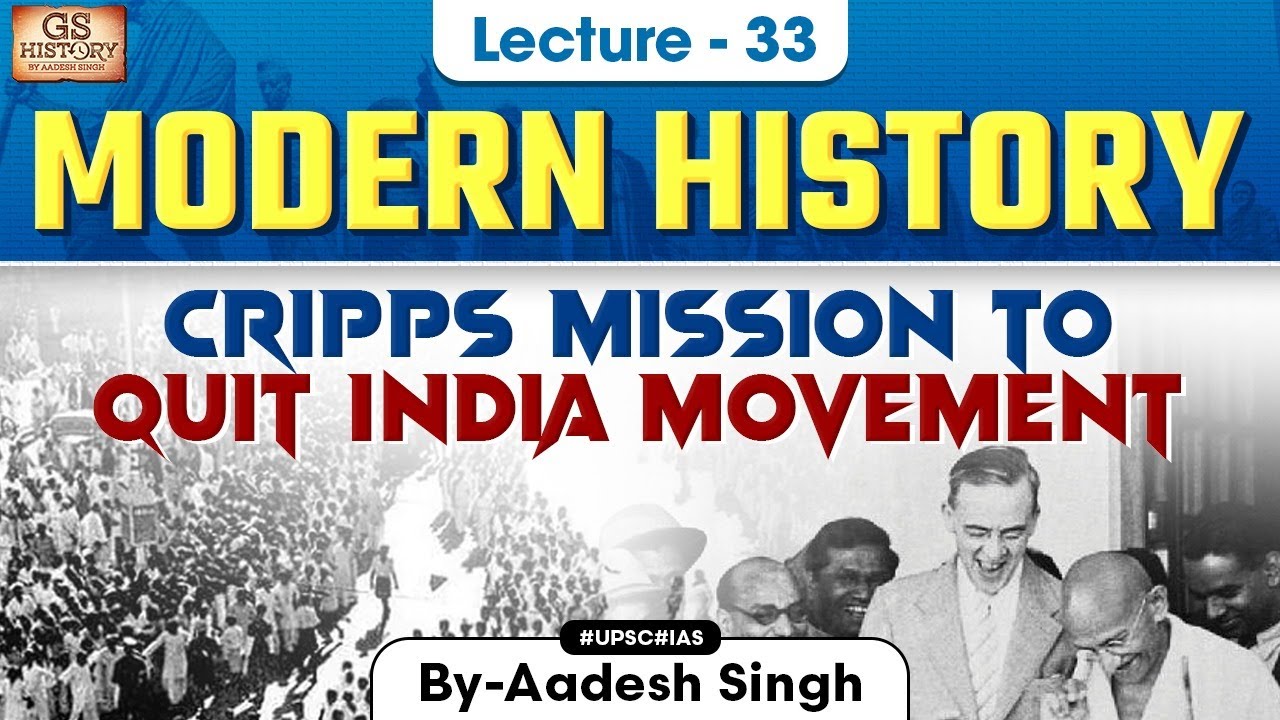
The Cripps Mission of 1942 was a major British initiative during . It tried to get Indian cooperation by promising dominion status after the war. The plan included a constituent assembly, a step toward future independence, and more local power for provinces. However, it failed because the Indian National Congress, the Muslim League, and minority groups all rejected it. This failure became a crucial moment in the Indian freedom struggle and remains an important topic for students and competitive exams.
🎯 In this chapter, you will understand:
- The wartime reasons behind sending the Cripps Mission to India in .
- The main constitutional offers made to Indian leaders.
- Why major political parties and leaders rejected the proposals.
- How this political deadlock led straight to the Quit India Movement.
💡 Why this topic matters: It marks the first time Britain admitted that Indians should write their own constitution.
🧠 Core Idea: Britain offered future self-rule to get wartime help, but Indian leaders rejected conditional promises without immediate power.
The Cripps Mission of 1942: Proposals, Political Deadlock, and the Struggle for Indian Sovereignty
Because of Japanese military threats and pressure from global allies, the British government sent Sir Stafford Cripps to negotiate a wartime agreement with Indian leaders.
This mission was not just a friendly gesture. It was a vital step because Britain faced military setbacks in Asia and urgently needed India's resources for the Allied forces.
- (i) The main cause was the rapid advance of Japan across South-East Asia. As nearby territories fell, a sudden invasion of India became a genuine threat to the British Raj.
- (ii) Strong pressure came from Allied partners, especially the USA, USSR, and China. They urged British Prime Minister Winston Churchill to resolve the Indian political stalemate and secure full military support.
- (iii) Indian leaders were ready to help fight against fascism, but only if power was transferred immediately and complete independence was guaranteed right after the war.
Strategic Framework and Constitutional Proposals of the Cripps Mission
Sir Stafford Cripps presented a plan to balance British wartime control with Indian demands for self-government. While it allowed an Indian-written constitution, it also included terms that risked dividing the nation.

Core Proposals of the Indian Union and the Constituent Assembly
The mission aimed to settle the legal setup of India after the war, combining limited autonomy with ongoing British supervision.
- (i) The main offer was an Indian Union with dominion status, allowing self-rule in internal matters while staying in the British Commonwealth.
- (ii) A constituent assembly would form after the war to write a new constitution. Members would be partly elected by provincial assemblies and partly appointed by princely rulers.
- (iii) Britain agreed to accept the new constitution under two specific conditions:
The Provision for Provincial Non-Accession
- (i) Any province that disliked the new constitution could leave the union and form its own independent government with its own rules.
- (ii) This option opened a path toward partition and indirectly acknowledged the demand for a separate state of Pakistan.
Treaty Obligations and Safeguarding Minorities
- (i) A formal treaty between Britain and the assembly would outline the exact transfer of power.
- (ii) The treaty promised specific protections for religious and social minorities in the new nation.
- (iv) During the war, defense remained under total British command, and the Governor-General kept full power, leaving Indians with limited administrative roles.
The Shift in Constitutional Policy and Political Implications
Despite its flaws, the offer changed official British policy by admitting that Indians themselves should draft their future constitution.
- (i) For the first time, Britain acknowledged that constitution-making belonged in Indian hands rather than being decided in London.
- (ii) The opt-out clause for provinces was significant because it introduced the idea of partition into official negotiations.
- (iii) The definition of dominion status expanded, giving a free India the choice to leave the Commonwealth if desired.
- (iv) It offered immediate, though minor, administrative changes by adding more Indians to the temporary executive council.
Analysis of the Multi-Party Rejection and Failure of the Mission
The mission failed because no party found acceptable common ground. Congress felt it offered too little control, while the Muslim League felt it did not guarantee a separate state.
Indian National Congress: Demands for Full Sovereignty
- (i) Congress rejected dominion status, demanding immediate and total freedom from British rule.
- (ii) Leaders opposed unelected princely representatives, seeing them as British allies rather than people's representatives.
- (iii) The provincial opt-out clause was viewed as a danger to national unity that could break India into smaller parts.
- (iv) The lack of immediate power transfer and keeping defense in British hands made the plan seem empty.
The Muslim League and the Demand for Pakistan
- (i) The League opposed a single Indian Union, fearing it would lead to dominant majority control.
- (ii) They criticized the setup of the drafting assembly and how decisions would be made.
- (iii) They rejected the proposal because it did not explicitly guarantee a separate independent state of Pakistan.
Reactions from Liberals, Sikhs, and Depressed Classes
- (i) Liberal leaders like Tej Bahadur Sapru saw the opt-out clauses as a threat to security and national unity.
- (ii) The Sikh community opposed the plan, fearing partition would divide Punjab and harm their interests.
- (iii) The Depressed Classes, led by Dr. B.R. Ambedkar, worried that a divided country would leave them without strong rights or protections.
⚡ Quick Revision Capsule: Key Positions on Cripps Offer
Here is a quick look at how different political groups responded to the Cripps Mission in :
| Party / Group | Main Objection | Core Demand |
|---|---|---|
| Indian National Congress | Rejected post-war dominion status and provincial opt-out option | Immediate transfer of power and total independence |
| Muslim League | Disliked single union structure without explicit partition terms | Clear creation of Pakistan and self-determination rights |
| Sikh Community | Feared partition would divide Punjab and weaken their community | Protection of Punjab's territorial integrity |
| Depressed Classes | Feared lack of central safeguards against social domination | Guaranteed constitutional rights and equal safeguards |
| Liberals (Tej Bahadur Sapru) | Opposed non-accession clauses that allowed provinces to break away | A unified India with strong security measures |
Contemporary Perspectives: Views of Churchill and Maulana Azad
The differences between British intentions and Indian expectations show clearly in key statements from that time.
- (i) Winston Churchill showed his imperial stance, famously declaring: “I have not become His Majesty’s first Minister to preside over the liquidation of the British Empire.” This comment made many doubt if Britain really meant to give up control.
- (ii) Maulana Abul Kalam Azad pointed out the dangers of accepting vague offers, stating: “The Cripps offer gave us nothing. Accepting it would have left us powerless to renew struggle if Britain went back on its word. India’s opportunity for freedom arising from the war should not be wasted on empty promises.”
- (iii) The strict "take it or leave it" approach from Stafford Cripps, along with changing statements, caused many to view the mission as propaganda meant for wartime allies.
Conclusion: The Historical Legacy and the Path to the Quit India Movement
The Cripps Mission of remains a key event in modern Indian history. It was the first time Britain officially accepted that Indians should write their own constitution. However, offering dominion status instead of independence and allowing provinces to break away caused major disagreements. When the talks failed, disappointment turned into active protest. This outcome led directly to the Quit India Movement later that year, making this event a critical landmark for study and examination prep.
📝 Summary
Sent in during wartime challenges, the Cripps Mission tried to secure Indian support with future promises. It offered post-war self-rule and a constitution-writing body, but left defense in British hands and allowed provinces to leave the union. Major parties rejected the proposal, causing negotiations to break down and leading directly to the Quit India Movement.
🚀 Quick Revision Points
Essential facts to review before examinations:
- (i) Led by Sir Stafford Cripps in to gain Indian support during .
- (ii) Offered post-war dominion status and an elected constituent assembly.
- (iii) Included an opt-out clause that allowed provinces to form separate unions.
- (iv) Rejected by Congress, Muslim League, and minority leaders for different reasons.
- 💡 Exam Tip: Remember that Mahatma Gandhi famously described the Cripps proposal as a "post-dated cheque on a crashing bank."
❓ Frequently Asked Questions (FAQ)
Q1: Why was the Cripps Mission sent to India in 1942?
A1: Britain needed Indian support during World War II due to advancing Japanese forces and pressure from Allied powers like the USA and USSR.Q2: Why did the Indian National Congress reject the offer?
A2: Congress wanted immediate independence and real control over defense, while opposing the clause that allowed provinces to leave the union.Q3: How did the failure of the Cripps Mission impact the freedom struggle?
A3: Its failure ended negotiations for temporary power-sharing, causing widespread frustration that led directly to the Quit India Movement in .