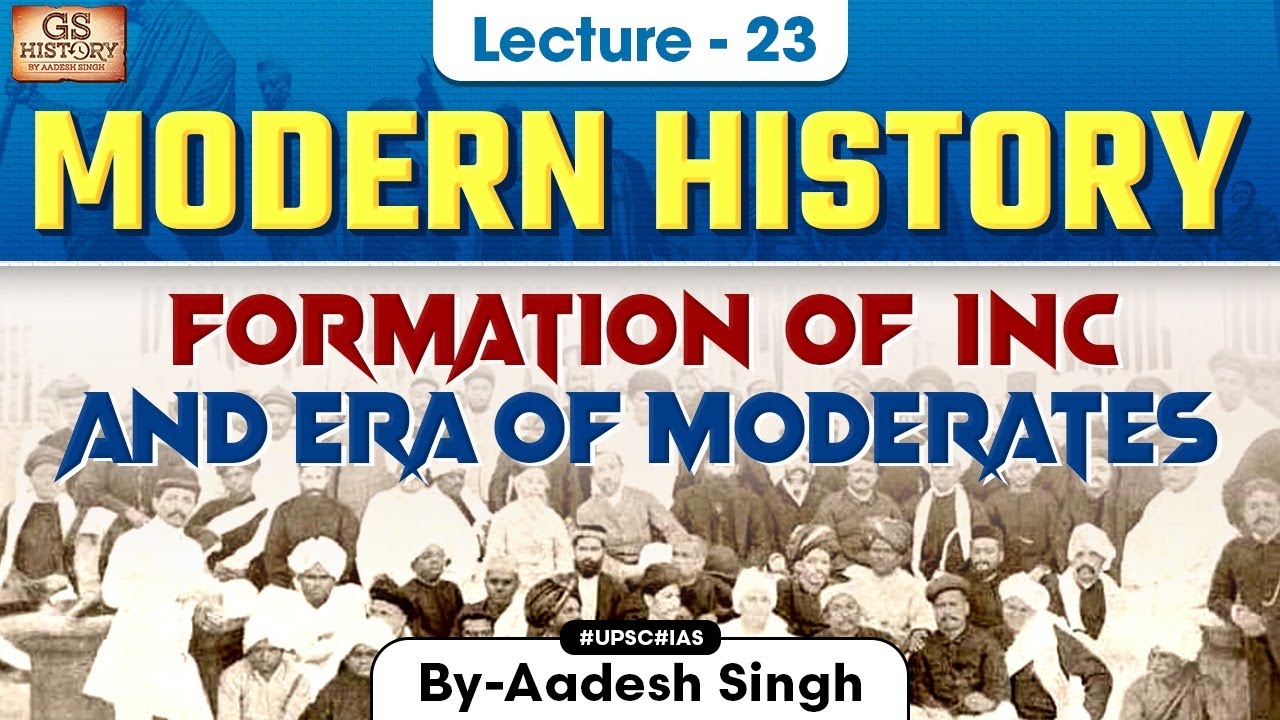
The Indian National Congress (INC), established in , played a vital role in shaping the Indian freedom struggle. Its early creation, goals, and the debate surrounding its foundation show how nationalist politics grew in colonial India. Learning about its leaders, ideas, and goals is essential for students studying history and polity.
🎯 In this chapter, you will understand:
- How the Indian National Congress was formed in and who led it.
- The earlier organizations that helped build national awareness.
- The debate around the 'Safety Valve' theory.
- The main political, social, and economic goals of the INC.
💡 Why this topic matters: It marks the start of an organized, nationwide movement that united people across different regions against colonial rule.
🧠 Core Idea: Educated Indians and progressive leaders built a common political platform to express grievances, educate citizens, and work toward national unity.
Historical Foundation and Aims of the Indian National Congress: The Genesis of Indian Nationalism (1885)
The emergence of an all-India political organization in the late 19th century showed a growing national awareness, resulting in the birth of the INC.
The formation of the INC was not an isolated event. It came from steady work by Indian intellectuals and a retired British official to create a platform for national conversation. This step changed the course of the anti-colonial movement in India.
- (i) The foundation rests on political work and mobilization across various parts of India during the late and early .
- (ii) Educated leaders realized that small, local protests could not change colonial policies, making a single national body necessary.
- (iii) This step matters because it gave Indians their first organized national group to share grievances and hopes with the British government.
The Historical Journey Toward the Foundation of the Indian National Congress
The effort to build a unified political voice reached its peak in , guided by A.O. Hume and supported by educated Indians across the country.

The Landmark Session: Establishment of the INC in 1885
In late , the INC held its first historic meeting at Gokuldas Tejpal Sanskrit College in Bombay, starting a new period in Indian political life.
- (i) Organizational Lead:A.O. Hume, a retired British civil servant, organized the session to give Indians a peaceful way to share their political views.
- (ii) Representative Participation: A total of 72 delegates from different places and professions came together to discuss India's future.
- (iii) Leadership:Womesh Chandra Bonnerjee served as the president of this first assembly and led the early discussions.
Evolution of Political Platforms: Predecessors of the INC
The INC built upon work done by earlier Indian National Conferences, which had already started bringing nationalist feelings together across regions.
- (i) Earlier Initiatives: Important meetings held in and acted as building blocks for the INC, creating a shared purpose among leaders.
- (ii) Key Architects: Prominent figures like Surendranath Banerjea and Ananda Mohan Bose led these earlier meetings and helped prepare the ground for a nationwide body.
Distinguished Leadership and the Inclusion of Women in the INC
The Congress brought together outstanding thinkers of the time and gradually welcomed women into national political conversations.
- (i) Prominent Presidents: The group was guided by leaders such as Dadabhai Naoroji, Badruddin Tyabji, Pherozshah Mehta, and Gopal Krishna Gokhale.
- (ii) Gender Milestone in 1890: A major moment came when Kadambini Ganguly, the first female graduate of Calcutta University, spoke at the session, showing women's rising role in public life.
The Broader Movement: Nationalist Activities Beyond the INC
While the INC was the primary national stage, love for the nation was also nurtured through other local and regional effort channels.
- (i) Local Engagement: Regional groups held local meetings to address regional concerns while staying focused on national objectives.
- (ii) The Power of the Press: Local newspapers and patriotic writings helped spread nationalist ideas to a broader public, creating cultural support for independence.
Analyzing the Controversy: The Aims, Objectives, and Debates Surrounding the INC
Historians still study why the INC was created, contrasting the 'Safety Valve' theory with the real national desires of the Indian people.
The 'Safety Valve' Controversy: Intentions and Interpretations
Scholars debate whether the INC was started as a smart tactical move by the British or as a natural rise of Indian patriotic feeling.
- (i) The Core Theory: One common view claims A.O. Hume, with approval from Lord Dufferin, set up the INC as a 'safety valve' to stop another large uprising like the one in by giving Indians a peaceful outlet for anger.
- (ii) Radical and Marxist Critiques: Leaders like Lala Lajpat Rai and Marxist writer R.P. Dutt agreed with this view, arguing the INC was made to protect British rule by keeping public energy focused on mild political petitions.
- (iii) The Modern Perspective: Modern historians like Bipan Chandra disagree with this idea, showing that the INC was a real effort by educated Indians to build a democratic movement for their country.
Strategic Vision: The Core Aims and Objectives of the INC
From the beginning, the INC followed clear goals aimed at bringing diverse people together and questioning colonial rule.
Political Mobilization and Ideological Framework
The Congress worked to establish a clear, democratic method for the independence struggle.
- (a) To build a democratic movement that would invite citizens to take part in political life.
- (b) To teach citizens about their political rights and show how colonial policies affected daily life.
- (c) To set up a central office to guide and coordinate nationalist work across the country.
- (d) To build friendship and cooperation among political workers from different regions.
- (e) To create and share clear ideas that directly challenged British arguments for ruling India.
Building National Unity and Economic Cohesion
A key aim of the group was to move past internal differences and present a united front.
- (a) To bring people together around shared economic and political demands that benefited all Indians.
- (b) To strengthen national unity across differences in religion, caste, and language.
- (c) To build and support a lasting feeling of Indian nationhood.
⚡ Quick Revision Capsule: Foundation of Indian National Congress
A quick summary of facts, figures, and key details about the formation of the INC in :
| Aspect | Key Details | Historical Significance |
|---|---|---|
| Founding Date | Start of organized national political activity in India. | |
| First Venue | Gokuldas Tejpal Sanskrit College, Bombay | Brought together 72 delegates from across regions. |
| Key Founder & President | A.O. Hume (Organizer), W.C. Bonnerjee (President) | Combined administrative guidance with Indian political leadership. |
| Early Milestones | Kadambini Ganguly addressed the session | Marked the early entry of women into formal national politics. |
| Major Debate | 'Safety Valve' theory vs. Genuine Nationalism | Debates whether creation was a British safety plan or true Indian nationalism. |
📝 Summary
The Indian National Congress, formed in , marked the start of organized nationalist politics in India. Led by experienced thinkers and supported by women leaders, it provided a platform for sharing anti-colonial ideas, strengthening national unity, and building a shared feeling of Indian nationhood. While its origin sparked debates like the 'safety valve' theory, modern scholars highlight its true position as the leading force in India's freedom struggle.
🚀 Quick Revision Points
Essential facts to review before examinations:
- (i) Established in in Bombay with 72 delegates.
- (ii) W.C. Bonnerjee served as the first President; A.O. Hume played a key role in organizing it.
- (iii) Preceded by the Indian National Conferences led by Surendranath Banerjea and Ananda Mohan Bose.
- (iv) Kadambini Ganguly became the first woman to address an INC session in .
- 💡 Exam Tip: Focus on the difference between the 'Safety Valve' theory (Lala Lajpat Rai, R.P. Dutt) and modern historical views (Bipan Chandra) for essay and polity questions.
❓ Frequently Asked Questions (FAQ)
Q1: When and where was the Indian National Congress founded?
A1: The INC was founded in at Gokuldas Tejpal Sanskrit College in Bombay.Q2: What was the 'Safety Valve' theory?
A2: It was the idea that A.O. Hume and British officials started the INC to give Indians a peaceful outlet for anger, preventing another revolt like .Q3: Who were some key early leaders of the INC?
A3: Early leaders included W.C. Bonnerjee, Dadabhai Naoroji, Badruddin Tyabji, Pherozshah Mehta, and Gopal Krishna Gokhale.