A clear understanding of the rules surrounding the Language provisions for courts and legislations set out in the Constitution of India helps make sure our legal system works smoothly everywhere without confusion. These important laws, along with the Official Language Act of 1963, guide how our higher legal system works in the Supreme Court and High Courts. They also protect linguistic minorities who speak different regional languages, while encouraging the planned development of Hindi for nationwide communication, benefiting students and UPSC aspirants who are studying for national competitive examinations.
🎯 In this chapter, you will understand:
- Why English was chosen as the initial primary language for all high-level court hearings and written official laws across India.
- How a State Governor can allow the use of Hindi or regional languages in High Courts with approval from the President.
- How the Official Language Act of 1963 allowed valid official Hindi translations for bills, laws, and ordinances.
- The special protections created for minority language speakers and how the Eighth Schedule grew to include 22 scheduled languages over time.
💡 Why this topic matters: India is home to hundreds of different languages. Having clear constitutional rules for courts and state lawmaking ensures every citizen gets fair treatment in court while keeping legal documents accurate and understandable everywhere.
🧠 Core Idea: The Constitution of India keeps English as the main language for high courts and official legal acts to prevent misunderstandings. At the same time, it gives state governments simple choices to use regional languages and protect minority rights.
🏛️ Language Rules for Courts and Laws under the Indian Constitution
India's law system relies on carefully planned language rules. These rules maintain total clarity in court judgments and make sure every official law passed by Parliament or state assemblies means the exact same thing to everyone across the country.
When India became an independent democratic republic, changing from older colonial rules to a modern local system required practical rules. The constitutional steps below established the main groundwork for legal work across the nation:
- (i) The default foundation states that until Parliament passes a new law, English stays as the primary language for all high-level judges and lawyers.
- (ii) Keeping this continuity makes sure that past court judgments, past legal decisions, and international legal links remain simple to follow without confusion.
- (iii) This constitutional mandate directly applies to spoken arguments inside courtroom hearings as well as every written official document produced for the nation.
📜 Constitutional Provisions for Courts and Laws
The rules inside the Constitution of India created a reliable baseline setup where English functions as the clear voice of higher courts and the official written text for all lawmaking bodies.

The Use of English in Higher Courts and Bills
The Constitution of India states that until Parliament decides differently, specific legal tasks must be conducted in English only to prevent mistakes in legal meaning.
- (i) Judicial Hearings: Every spoken hearing and written case inside the Supreme Court and every High Court must be done in English.
- (ii) Written Laws: The main authoritative text of every bill, act, ordinance, executive order, rule, regulation, and local bye-law at central and state levels must be written in English.
The Role of the Governor and State Languages
While English acts as the nationwide standard, the Constitution gives flexible options for local state languages through the special duties of the state Governor, under national supervision.
- (i) The Governor of a state, after receiving permission from the President, can allow the use of Hindi or any official state language during High Court hearings.
- (ii) Important Exceptions: Even when hearings happen in a regional language, final court judgments, decrees, and orders must still be published in English unless Parliament passes a special law changing this rule.
- (iii) State Assembly Freedom: A state legislature can decide to write its local bills in its regional language; however, an official English translation must always be published alongside it as the legal standard.
⚙️ Changes Brought by the Official Language Act of 1963
To build a helpful bridge between English and the growing usage of Hindi, Parliament passed the Official Language Act of 1963. This act created simple rules for official translations and government use.
Details of the Official Language Act 1963
This law updated how authoritative translations are handled across government offices and court halls in India.
- (i) Official Translations: Any Hindi translation of central acts, government ordinances, or administrative rules published under the authority of the President is legally accepted as an official authoritative text.
- (ii) Parliamentary Papers: Every legal bill presented in Parliament must carry a clear Hindi translation attached to it so everyone can read it easily.
- (iii) State Level Rules: In several states, Hindi translations of local state laws and ordinances are required by law to help local citizens understand their rights.
Regional Languages in High Courts
Specific state High Courts have taken practical steps to bring local languages into daily legal arguments.
- (a) State Governors, with approval from the President, can allow court judgments in Hindi or state languages, as long as an official English translation is attached.
- (b) States Using This Rule: States like Uttar Pradesh, Madhya Pradesh, Bihar, and Rajasthan already allow Hindi during proceedings in their High Courts.
Why the Supreme Court Uses Only English
Unlike state High Courts, the highest court in the country maintains a uniform language practice for all citizens across India.
- (i) The Supreme Court of India does not allow regional languages in its proceedings; all petitions, petitions arguments, and written judgments must be in English.
- (ii) Key Court Decision (): In a famous historical court case in , a citizen tried to present a habeas corpus petition written only in Hindi. The court turned it down because the constitutional language of the Supreme Court is strictly English.
🛡️ Rights and Protections for Linguistic Minorities
The Constitution of India acts as a protective shield for people whose mother tongue is different from the majority language spoken in their state or across the country.
Safeguards for Minority Language Groups
To protect people from linguistic discrimination, the Constitution provides clear, simple pathways to ask for help and get a proper education.
- (i) Right to Submit Grievances: Every citizen has the basic right to send an official complaint or petition to any government officer in any language spoken in India. No officer can refuse a petition just because it is not in the official language.
- (ii) Primary School Teaching: State governments are required to offer primary school lessons in the mother tongue for young children from minority language families. The President can give direct instructions to states to ensure this rule is followed.
- (iii) Special Monitoring Officer: A dedicated Special Officer for Linguistic Minorities is selected by the President to check how minority safeguards are working and send detailed reports directly to Parliament and state leaders.
🗣️ Growth of Hindi and the Eighth Schedule
The central government carries a constitutional duty to support the growth of Hindi as a shared language that connects people across different regions and cultures in India.
The Union's Duty to Grow the Hindi Language
Under Article 351, the Union Government is instructed to spread and improve Hindi so it can act as a simple common language (lingua franca) connecting India's rich traditions.
- (i) Growing Vocabulary: Hindi is encouraged to naturally welcome words, speech habits, and expressions used in Hindustani and other regional languages listed in the Eighth Schedule.
- (ii) Primary Source: While accepting words from various regional languages, Hindi mainly draws its core technical words and vocabulary from Sanskrit.
Languages in the Eighth Schedule
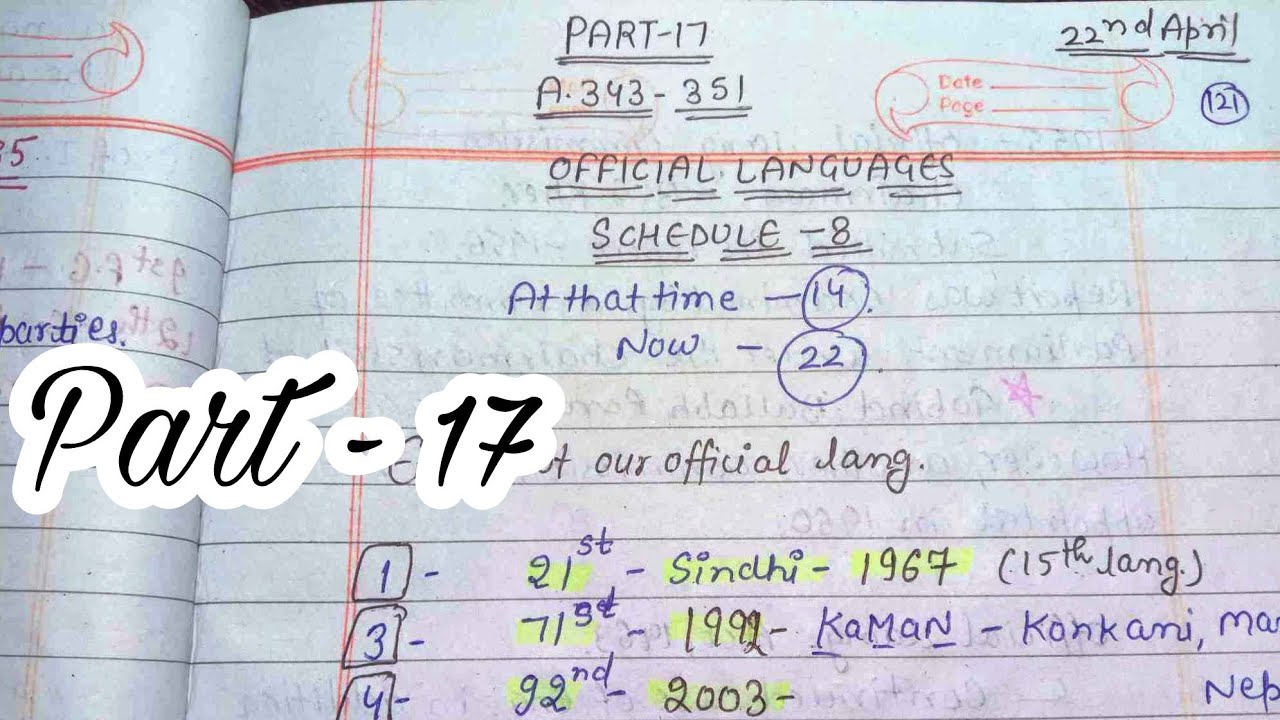
The Eighth Schedule of the Constitution started with 14 original languages and expanded to include 22 languages by , showing respect for India's regional diversity.
The 22 Official Scheduled Languages
The 22 official languages listed under the Eighth Schedule are:
- (i) Assamese, Bengali, Bodo, Dogri, Gujarati, Hindi, Kannada, Kashmiri, Konkani, Maithili, Malayalam, Manipuri, Marathi, Nepali, Odia, Punjabi, Sanskrit, Santhali, Sindhi, Tamil, Telugu, and Urdu.
Timeline of Language Additions
Over the years, several official constitutional amendments added new regional languages to this schedule:
- (a) (21st Amendment): Added Sindhi to the list.
- (b) (71st Amendment): Added Konkani, Manipuri, and Nepali.
- (c) (92nd Amendment): Added Bodo, Dogri, Maithili, and Santhali.
Main Goals of Adding Languages
Adding languages to the Eighth Schedule accomplishes two main goals:
- (i) It gives these regional languages official representation on the Official Language Commission.
- (ii) It allows Hindi to draw fresh words, idioms, and expressions from these languages to enrich its vocabulary.
⚡ Quick Revision Capsule: Language Rules & Constitutional Directives
This quick review table highlights the primary constitutional articles, rules, and language directives for easy exam revision.
| Category / Feature | Key Constitutional Provision | Primary Purpose & Rules |
|---|---|---|
| Supreme Court Language | Article 348(1) | Must operate strictly in English for all arguments, petitions, and final judgments. |
| High Court Regional Options | Article 348(2) | The Governor can allow Hindi or state languages with approval from the President. |
| Legislative Acts & Bills | Article 348(3) | State laws can use local languages, but an official English translation must always be published. |
| Minority Education Protection | Article 350A | Requires states to offer primary education in the child's mother tongue. |
| Hindi Language Growth | Article 351 | Directs the Union to spread Hindi, taking words from Sanskrit and scheduled languages. |
📝 Summary
In summary, understanding the Language provisions for courts and legislations helps explain how the Constitution of India protects legal accuracy while respecting linguistic diversity. By keeping English as the accurate language for higher courts, supporting linguistic minorities through mother-tongue primary education, and expanding the Eighth Schedule from 14 to 22 languages through amendments in , , and , India balances national unity with regional culture. This essential topic, supported by the Official Language Act of 1963, remains fundamental for legal scholars and civil service students.
🚀 Quick Revision Points
Essential facts to review before examinations:
- (i) English stays as the main working language for top courts and written central laws until Parliament changes the law.
- (ii) Governors can approve Hindi or state languages in High Courts with permission from the President.
- (iii) Every citizen can submit official complaints to government offices in any Indian language.
- (iv) The Eighth Schedule contains 22 recognized languages after key constitutional amendments in , , and .
- 💡 Exam Tip: Remember that while a High Court can conduct oral arguments in Hindi or a state language, its official final written judgments must always include an authoritative English version unless Parliament enacts a specific law.
❓ Frequently Asked Questions (FAQ)
Q1: Can a High Court handle legal cases in a regional language?
A1: Yes. The Governor of a state, after getting approval from the President, can allow the use of Hindi or any official state language in High Court proceedings.Q2: Can someone file a petition in the Supreme Court in Hindi?
A2: No. The Supreme Court operates exclusively in English under Article 348. As ruled in , petitions filed only in Hindi are not accepted.Q3: How many languages are listed in the Eighth Schedule of the Indian Constitution?
A3: There are currently 22 languages in the Eighth Schedule. It started with 14 languages and expanded through amendments under the Constitution of India.