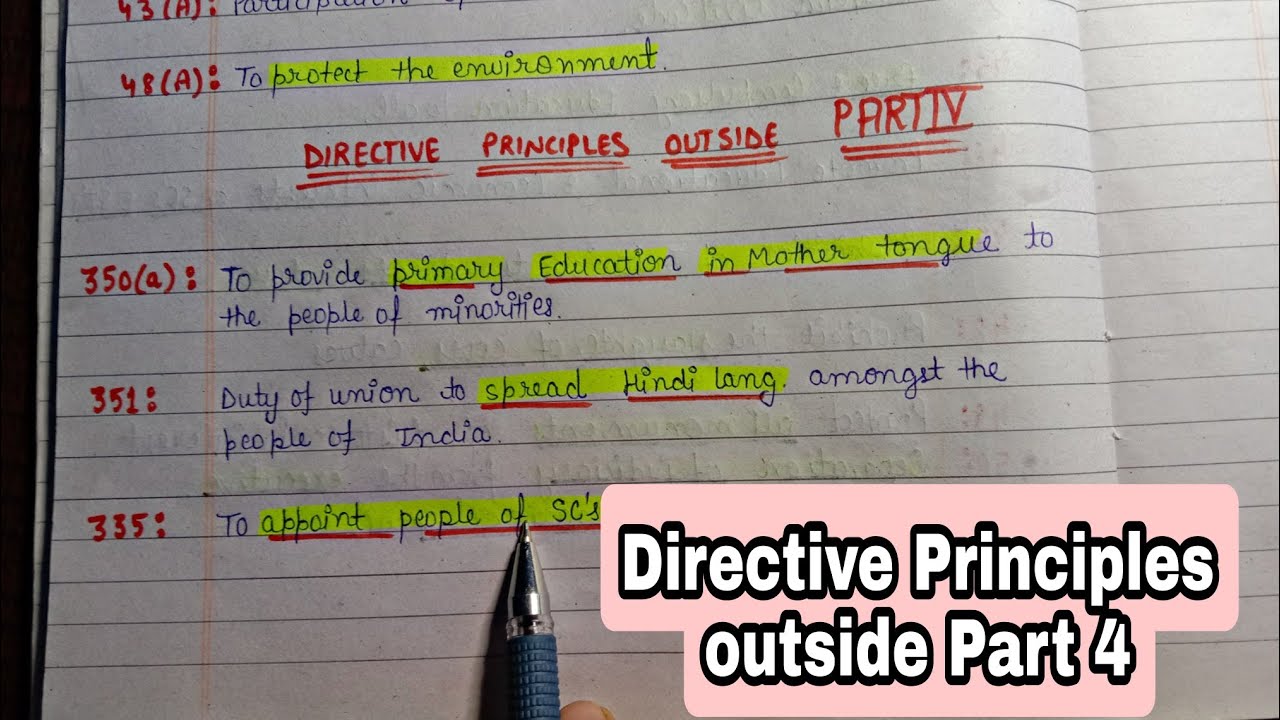
Explore the deep significance of Directives Outside Part IV within the Indian Constitution. This guide highlights crucial provisions like Article 335, Article 350-A, and Article 351, which were established in for comprehensive student exam preparation and building strong legal literacy across India.
🎯 In this chapter, you will understand:
- How constitutional directives exist outside Part IV to guide national policy.
- The specific rules governing public job claims for Scheduled Castes and Scheduled Tribes under Article 335.
- The importance of primary education in mother tongue and the promotion of Hindi.
- The complete article-by-article breakdown of DPSP from Article 36 to Article 51.
💡 Why this topic matters: It shows how the makers of our Constitution ensured that fair governance, minority rights, and cultural protection were spread across the entire framework, not just kept in one single section.
🧠 Core Idea: Apart from Part IV, other specific articles act as moral and administrative duty guidelines for the government to create a fair, equal, and helpful society for every citizen.
Directives Outside Part IV: Exploring Constitutional Mandates and DPSP 1950
When our country's founding leaders created the Indian Constitution, they wanted to make sure the government always works to help people live better lives. To do this, they included special instructions called Directive Principles of State Policy (DPSP). Most of these rules are placed together in Part IV of the Constitution. However, the framers realized that certain important matters—like local languages and social fairness—needed to be placed in other sections too. Therefore, they embedded additional mandates across various parts to ensure a complete and balanced growth of our nation's social and cultural fabric.
- (i) These directives function as extra guiding lights for the executive leaders and law-making assemblies.
- (ii) They help connect daily administrative work with the larger dream of building a caring welfare state.
- (iii) Just like the main DPSP rules, these extra instructions reflect the aspirational soul of the Indian Constitution.
Overview of Extraneous Constitutional Directives
Running a vast and diverse country like India requires guidance in many different areas. The writers of the Constitution knew that good governance could not be restricted to a single chapter. Because of this, they placed vital instructions in several other chapters to give clear guidance on specific topics like job fairness, early school learning, and national language development.
Expansion of Governance Principles
In addition to the Directive Principles contained in Part IV of the Constitution, certain other directives are enshrined in various other Parts. These directives demand equal focus and commitment from policymakers who make laws and 🌐 law students who study them.
- (i) These provisions ensure that the helpful spirit of the DPSP is spread throughout the entire document.
- (ii) They address specific needs in different areas, such as minority rights, regional languages, and fair government hiring.
Detailed Examples of Such Constitutional Directives
To understand how these extra directives work in everyday life, we can look at three main articles: Article 335, Article 350-A, and Article 351. These specific articles give clear instructions to the State about maintaining social justice and preserving our rich culture.

Social Equity and Administrative Efficiency
India's journey toward true social justice requires giving fair opportunities to communities that were historically left behind. This involves giving proper weight to the Claims of Scheduled Castes (SCs) and Scheduled Tribes (STs) to public services, ensuring their voices are represented in government offices.
Article 335 and Public Appointments
Under Article 335, found in Part XVI of the Constitution, the government must consider the employment claims of Scheduled Castes and Scheduled Tribes whenever it hires people for government jobs in the Union or State offices.
- (i) The government must actively think about these claims when making selections for official posts.
- (ii) At the same time, this must be balanced while ensuring administrative efficiency is maintained so that government functions smoothly and effectively.
Linguistic Rights and Primary Education
Learning in one's home language makes understanding complex concepts much easier for young children. Preserving the mother tongue is considered vital for the healthy mental development and cultural connection of every child in India.
Instruction in Mother Tongue under Article 350-A
According to Article 350-A, which was added to Part XVII of the Constitution, every state government and local authority must try its best to provide proper facilities for primary education in the native language of the children.
- (i) States and local officers must work hard to set up primary schools that teach in regional native tongues.
- (ii) This rule is targeted to help the mother tongue of children from linguistic minority groups so they do not lose their cultural heritage.
Cultural Integration and Language Promotion
India is a land of many languages and traditions. To help people from different regions communicate easily with one another, the central Union government was given the responsibility of growing a shared language that respects India's diversity.
Development of the Hindi Language under Article 351
As written in Article 351 in Part XVII, it is the clear duty of the Union government to promote the spread and growth of the Hindi language across the nation.
- (i) The Union must actively encourage the development and use of Hindi.
- (ii) The main objective is for Hindi to act as a unifying medium for India's composite cultural heritage, drawing words and styles from all Indian traditions.
The Judiciary's Stance on Non-Justiciable Directives
An important fact about these extra constitutional directives is that they are non-justiciable. This means that a citizen cannot go to a court of law to demand that the government be punished simply because a directive has not yet been fully turned into a law. Even though they cannot be enforced directly by courts, these rules carry high moral authority and guide judges when they interpret laws.
Significance of Harmonious Construction
The Judiciary (our court system) has stated many times that even though these directives are non-justiciable, they are still fundamental to running the country wisely.
- (i) They are treated as equally significant by the judiciary when judges read and explain constitutional laws.
- (ii) Judges use the legal rule of harmonious construction so that all parts of the Constitution work together smoothly to fulfill the grand vision of the founding fathers.
⚡ Quick Revision Capsule: Directives Outside Part IV & DPSP Overview
This revision table summarizes the major directives found outside Part IV alongside key DPSP articles for quick study.
| Article Number | Constitutional Location | Core Focus & Mandate |
|---|---|---|
| Article 335 | Part XVI (Special Provisions) | Considers claims of Scheduled Castes and Scheduled Tribes in government job appointments while maintaining administrative efficiency. |
| Article 350-A | Part XVII (Official Language) | Directs states to provide primary school education in the mother tongue for children belonging to linguistic minorities. |
| Article 351 | Part XVII (Official Language) | Instructs the Union government to promote and develop the Hindi language to reflect India's composite culture. |
| Articles 36 - 37 | Part IV (DPSP) | Defines the State and declares that directive principles are non-justiciable but fundamental in governance. |
| Articles 38 - 51 | Part IV (DPSP) | Covers social welfare, living wages, village panchayats, uniform civil code, environment protection, and international peace. |
Directive Principles of State Policy — Article-wise Breakdown
To help students build a complete picture, here is the full breakdown of Articles 36 to 51 from Part IV that define how the Indian State should build a healthy and fair society.
Fundamental Framework (Articles 36 - 40)
These starting articles set up the basic rules, defining what the State is and outlining its core duty to maintain social order for the public good.
- (i) Article 36 — Gives the definition of the "State" for all rules inside Part IV.
- (ii) Article 37 — States the Application of Directive Principles as fundamental guidelines for making laws, even though courts cannot force them.
- (iii) Article 38 — Directs the State to secure a social order promoting the welfare of the people by reducing inequalities in income and status.
- (iv) Article 39 — Lists key principles of State policy, such as ensuring adequate livelihood for all citizens and equal pay for equal work.
- (v) Article 39A — Guarantees equal justice and directs the government to offer free legal help to vulnerable and poor citizens.
- (vi) Article 40 — Directs the government to organize village panchayats and give them powers to act as self-governing local units.
Social Welfare and Labor Rights (Articles 41 - 45)
This middle group of articles focuses on helping working people, ensuring fair treatment in jobs, and providing learning opportunities for children.
- (i) Article 41 — Promotes the right to work, education, and public help during sickness, old age, or disability.
- (ii) Article 42 — Requires the State to make rules for just and humane working conditions and maternity leave for mothers.
- (iii) Article 43 — Works toward securing living wages and decent working conditions for all agricultural and industrial workers.
- (iv) Article 43A — Encourages steps so that workers can participate in managing industrial companies.
- (v) Article 43B — Encourages the voluntary formation and professional management of co-operative societies.
- (vi) Article 44 — Encourages the nation to work toward establishing a uniform civil code for all citizens across India.
- (vii) Article 45 — Urges the State to provide early childhood care and education for all children until they reach six years of age.
Health, Environment, and Global Peace (Articles 46 - 51)
The final set of articles focuses on protecting community health, looking after nature, safeguarding ancient heritage, and building peaceful relations with other countries.
- (i) Article 46 — Works to promote the educational and economic rights of Scheduled Castes, Scheduled Tribes, and weaker sections while protecting them from social injustice.
- (ii) Article 47 — Directs the State to raise nutrition levels and public health standards and ban harmful drinks or drugs.
- (iii) Article 48 — Guides the modern and scientific organization of agriculture and animal farming.
- (iv) Article 48A — Mandates the protection and improvement of the environment, including the safety of forests and wildlife.
- (v) Article 49 — Mandates the protection of national monuments and heritage sites from damage or destruction.
- (vi) Article 50 — Directs the State to keep the judiciary separate from the executive branch to maintain clear independence.
- (vii) Article 51 — Encourages the promotion of international peace and security, respectful treaty relations, and peaceful settlement of international disputes.
📝 Summary
The detailed study of Directives Outside Part IV alongside standard DPSP principles is essential for understanding the comprehensive governance model of India that began in . For students, mastering these fundamental provisions in Articles 36 to 51, Article 335, Article 350-A, and Article 351 is crucial for academic and competitive success. They highlight our nation's unwavering pledge toward social justice, cultural diversity, and international harmony.
🚀 Quick Revision Points
Essential facts to review before examinations:
- (i) Directives Outside Part IV carry equal moral weight as standard DPSP provisions in guiding state policy.
- (ii) Article 335 balances SC/ST employment rights with administrative efficiency in public posts.
- (iii) Article 350-A safeguards primary schooling in the child's mother tongue for linguistic minorities.
- (iv) Article 351 directs the Union to promote Hindi as an inclusive medium reflecting India's composite culture.
- 💡 Exam Tip: Always remember that while Directives Outside Part IV are non-justiciable (cannot be enforced by court orders), judges frequently use them under the rule of harmonious construction to explain the true meaning of statutory laws!
❓ Frequently Asked Questions (FAQ)
Q1: What are Directives Outside Part IV?
A1: They are specific constitutional instructions given to the government that are located in parts of the Constitution other than Part IV, such as Articles 335, 350-A, and 351.Q2: Are these extra directives enforceable in court?
A2: No, like the main DPSP, they are non-justiciable, meaning you cannot force the government to implement them through a lawsuit, but they remain fundamental in guiding law-making.Q3: How does Article 350-A help linguistic minority children?
A3: It instructs state and local authorities to provide adequate facilities for instruction in their native mother tongue during primary education as mentioned in Part XVII.