Explore the intricate statutory framework of the Zonal Councils and the North-Eastern Council, established under laws enacted between and . These legal frameworks help distinct state governments talk to one another, share resources smoothly, and resolve disagreements peacefully. This detailed guide is essential for students preparing for competitive examinations who wish to understand cooperative federalism—the practice where the central government and state governments join hands as equal partners to protect national unity and foster balanced economic growth across every corner of the country.
🎯 In this chapter, you will understand:
- How statutory bodies created by parliament differ from constitutional bodies.
- The structural makeup and leadership of India's five major Zonal Councils.
- How geographic, economic, and cultural factors decide regional boundaries.
- The special development and security focus of the North-Eastern Council established in .
💡 Why this topic matters: India is vast and diverse. Without structured platforms for state leaders to sit together, small regional disputes over rivers, borders, or trade could disrupt national harmony.
🧠 Core Idea: Zonal Councils serve as advisory bridges that bring neighboring states together to solve shared problems through friendly discussion rather than expensive legal battles.
The Evolution and Impact of Zonal Councils and North-Eastern Council in India (1956-1971)
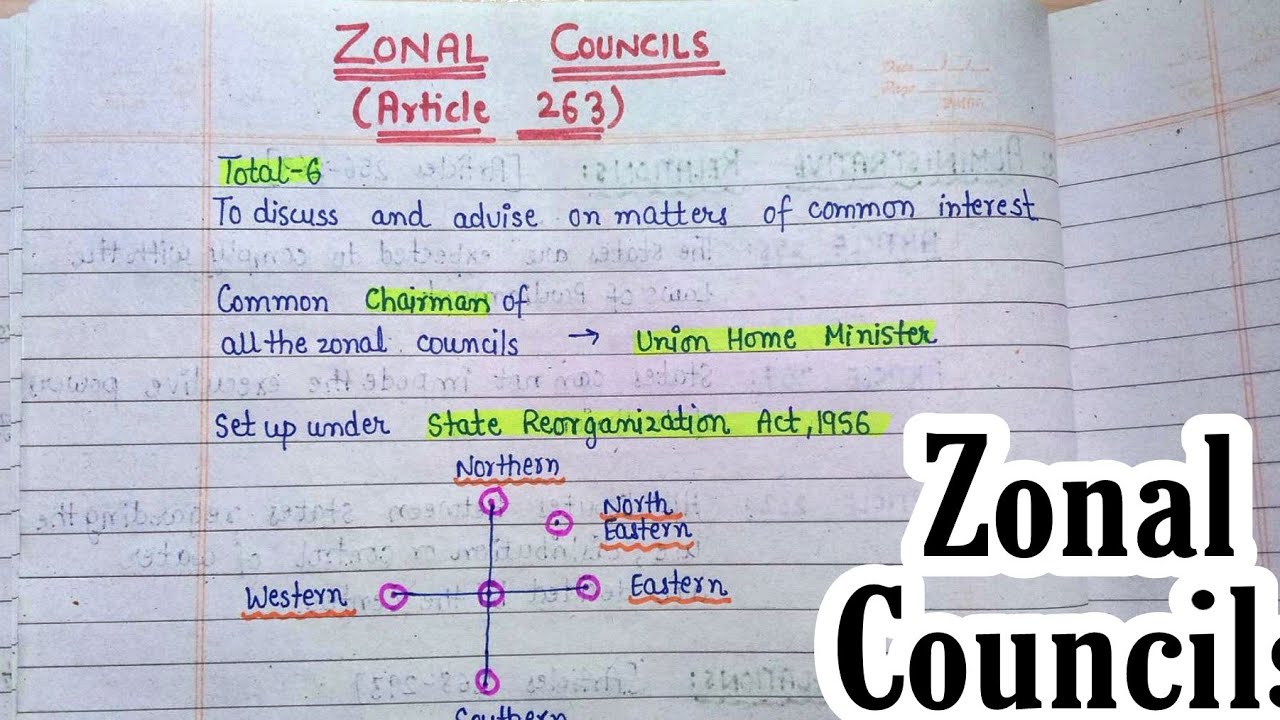
The story of India's internal coordination began right after independence when leaders realized that state borders, while necessary for local governance, should never turn into barriers that slow down trade, movement, or societal growth. To solve this challenge, the Zonal Councils were birthed as statutory entities under the landmark law known as the States Reorganisation Act, 1956. Unlike constitutional bodies that derive their existence directly from the text of the Constitution, these councils were created by an ordinary Act of Parliament. This legal setup ensured that five newly defined geographical zones—the Northern, Central, Eastern, Western, and Southern zones—could function as friendly, cooperative units within the larger Indian democratic tapestry.
- (i) The States Reorganisation Act, 1956 served as the primary legal foundation for establishing these five advisory councils.
- (ii) These bodies were designed to be purely deliberative and advisory, focusing carefully on the common economic, administrative, and social needs of neighboring regions.
- (iii) The division of the country into zones was guided by careful geographical and social logic to encourage balanced development.
The Structural Logic and Composition of Zonal Councils
To ensure that these councils were not merely symbolic talk shops, a high-powered membership structure was devised. By inviting top decision-makers—such as Union Ministers, State Chief Ministers, and senior administrative officers—to sit around the same table, the councils ensure that high-level policy agreements can quickly turn into real-world action on the ground.

Factors Influencing the Formation of Zones
The mapping of the Northern, Central, Eastern, Western, and Southern zones was a meticulous process carried out during . It required deep analysis of how the land, natural resources, transport links, and human populations interact across state lines while firmly upholding national integrity.
- (i) Natural Divisions: Taking full account of physical features like mountains, plains, and natural landscapes.
- (ii) Infrastructure: Analyzing shared river systems, power grids, and transportation pathways that link neighboring states.
- (iii) Sociocultural Ties: Respecting cultural practices, language backgrounds, and historical connections between citizens.
- (iv) Security and Economy: Balancing economic growth, regional law and order needs, and internal security duties.
The Administrative Hierarchy and Leadership
The operational leadership of every Zonal Council was specifically structured to maintain a balance of power between the central Union government and the individual state governments. This balanced formula guarantees that big states and small states receive equal respect during discussions.
- (i) The Chairperson: The central Home Minister of India serves as the ex-officio Chairman for all Zonal Councils.
- (ii) Vice-Chairmanship: Chief Ministers of member states hold this position on a one-year rotational basis.
- (iii) State Representation: Each state sends its Chief Minister and two other cabinet ministers selected by the Governor.
- (iv) Territorial Inclusion: Administrators or Lieutenant Governors of member Union Territories serve as full members.
The Role of Non-Voting Advisors
Besides political leaders, technical experts participate in meetings without voting rights to offer scientific advice and economic data:
- (i) A nominee from the Planning Commission (now replaced by NITI Aayog) provides developmental insights.
- (ii) The Chief Secretary of each member state offers deep administrative guidance.
- (iii) The Development Commissioner of each state assists in tracking infrastructure projects.
Functional Objectives: Fostering Harmony and Progress
The Zonal Councils were built with an inspiring vision: to help citizens and political leaders look past narrow local boundaries and embrace a broader spirit of national integration. They provide a regular platform where state leaders can discuss everyday challenges openly and build long-lasting trust.
Matters of Deliberation and Recommendation
The councils operate as a unified forum where neighboring states can sort out administrative difficulties, share expertise, and arrive at a consensus without taking matters to court.
- (i) Economic Planning: Aligning joint road building, power line expansions, and agriculture schemes across borders.
- (ii) Minority Rights: Protecting the rights of linguistic minorities living in neighboring states.
- (iii) Conflict Resolution: Resolving boundary line disputes, toll issues, and inter-state bus or transport permits.
Broad Objectives for National Stability
In addition to resolving day-to-day disputes, these councils safeguard the general administrative health and democratic strength of the entire nation.
- (a) Emotional Integration: Bringing citizens of different regions together to build mutual trust and goodwill.
- (b) Curbing Regionalism: Preventing extreme narrow-mindedness based on region, state boundaries, or local languages.
- (a) Post-Reorganisation Balance: Helping states adjust smoothly after territorial reorganization so growth stays on track.
- (d) Policy Uniformity: Allowing state and central authorities to design similar social welfare and tax policies.
- (e) Major Projects: Pooling financial and technical resources to construct large dams, canals, and highway corridors.
- (f) Political Equilibrium: Maintaining a healthy, balanced partnership between central authority and state autonomy.
The North-Eastern Council: A Specialized Development Framework
Because the northeastern border region faces distinct geographical hurdles, isolated terrain, and sensitive international frontiers, Parliament passed a specialized legislative intervention to cater directly to these easternmost states.
The NEC Act of 1971 and its Constituents
The North-Eastern Council was created separately from the framework. It came into being through a dedicated piece of legislation named the North-Eastern Council Act, 1971 to serve the unique development needs of the northeastern region.
- (i) Member States: Represents eight northeastern states: Assam, Manipur, Mizoram, Arunachal Pradesh, Nagaland, Meghalaya, Tripura, and Sikkim (added in ).
- (ii) Specialized Mandate: While handling general developmental duties like Zonal Councils, it places heavy emphasis on regional security and border infrastructure.
Unified Planning and Public Order
The NEC goes a step further than traditional councils by acting as a regional planning agency that creates a cohesive growth strategy across state borders.
- (a) Regional Plan: Creating master plans for shared power plants, regional airports, highway networks, and specialized colleges.
- (b) Security Review: Regularly reviewing collective measures taken by states to maintain public order and frontier peace.
⚡ Quick Revision Capsule: Zonal Councils vs. North-Eastern Council
Here is a quick comparison table to help students recall essential legal and operational facts during rapid exam preparation:
| Feature | Zonal Councils (5 Zones) | North-Eastern Council (NEC) |
|---|---|---|
| Primary Legislation | Enacted under the States Reorganisation Act, 1956 | Enacted under the North-Eastern Council Act, 1971 |
| Legal Character | Statutory body (Advisory nature) | Statutory body (Advisory & Regional Planning Agency) |
| Leadership Structure | Chaired by Union Home Minister; Vice-Chairmanship rotates yearly among Chief Ministers | Chaired by Union Home Minister (or nominated Minister); includes Governors and Chief Ministers |
| Geographical Scope | Covering Northern, Central, Eastern, Western, and Southern regions | Covering 8 northeastern states (Assam, Meghalaya, Manipur, Nagaland, Tripura, Arunachal Pradesh, Mizoram, Sikkim) |
| Primary Focus | Inter-state river/border disputes, transport links, economic policies | Integrated regional economic planning, transport connectivity, and public order/security |
📝 Summary
Understanding the role of the Zonal Councils and the North-Eastern Council is vital for students learning how India manages its immense regional diversity. Born out of statutes in and respectively, these advisory platforms convert potential inter-state friction into productive teamwork. By upholding the principles of cooperative federalism as highlighted in academic texts like Indian Polity, these institutions ensure smooth economic progress, administrative unity, and long-term political stability across all states and Union Territories.
🚀 Quick Revision Points
Essential facts to review before examinations:
- (i) Zonal Councils were established by an Act of Parliament (States Reorganisation Act, 1956), making them statutory bodies.
- (ii) There are five original Zonal Councils: Northern, Central, Eastern, Western, and Southern.
- (iii) The Union Home Minister serves as the common Chairman for all five Zonal Councils.
- (iv) The North-Eastern Council was established under a separate law, the North-Eastern Council Act, 1971, and includes eight member states.
- 💡 Exam Tip: Remember that Zonal Councils are NOT constitutional bodies (unlike the Inter-State Council created under Article 263). They are statutory bodies created by ordinary law!
❓ Frequently Asked Questions (FAQ)
Q1: Are Zonal Councils created directly by the Constitution of India?
A1: No. Zonal Councils are statutory bodies created by an ordinary Act of Parliament—the States Reorganisation Act, 1956.Q2: Who presides over the meetings of the Zonal Councils?
A2: The central Union Home Minister acts as the common Chairman for all Zonal Councils, ensuring a strong link with the central government.Q3: Is the North-Eastern Council part of the 1956 Zonal Council setup?
A3: No. The North-Eastern Council was created under its own specific law, the North-Eastern Council Act, 1971, to handle the unique development and security needs of the region.