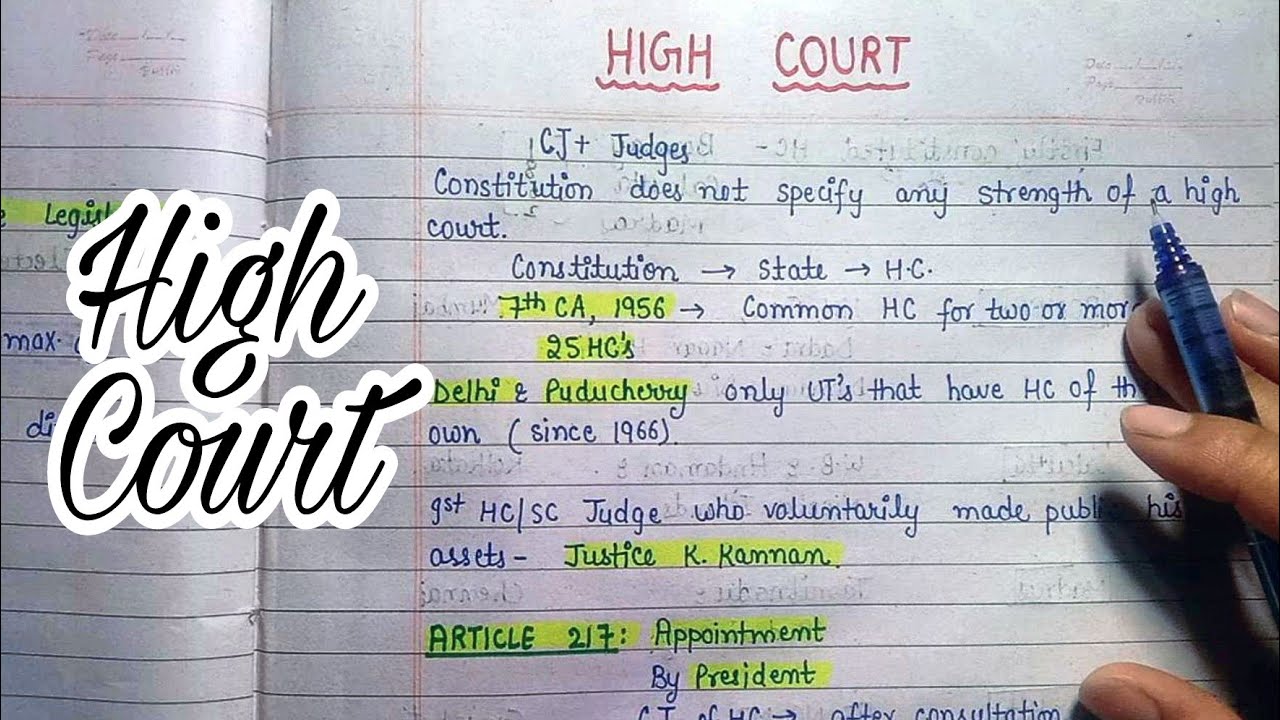
This comprehensive guide explains the Articles related to High Courts in the Indian Constitution. These provisions are found in Part VI of the Constitution and mainly cover . They explain how State High Courts are created, who becomes their judges, what powers they have, and how they help citizens get justice. Understanding these articles is very important for students and competitive-exam aspirants because High Courts form a major part of India’s Judiciary System.
🎯 In this chapter, you will understand:
- Why every state needs a High Court and how High Courts are established under Article 214.
- How High Court judges are appointed, what qualifications they need, and how their service conditions are protected.
- How the Constitution manages judicial transfers, acting judges, additional judges, and retired judges.
- Why the power to issue writs and supervise lower courts makes High Courts powerful guardians of justice.
💡 Why this topic matters: High Courts are the highest judicial institutions in most states. They protect the rights of citizens, review important legal questions, control the working of subordinate courts, and ensure that the government also follows the law. Without a strong High Court system, people would find it much harder to challenge unfair actions or get quick legal relief.
🧠 Core Idea: The Constitution gives High Courts a special position in the Indian judicial system. They are independent courts of record, they can issue writs to protect rights, and they supervise the courts below them. Articles 214 to 231 together create a strong and organised state-level judiciary.
Articles Related to High Courts at a Glance
The architectural framework of the Indian State Judiciary is built upon a series of constitutional mandates that ensure the independence and efficiency of legal redressal. Beginning with the fundamental requirement of a judicial presence in every state, the Constitution outlines the structure, personnel, and vast powers of the High Courts to ensure justice is accessible to all citizens.
The High Court is the highest court in a state’s judicial system. It hears important appeals, protects fundamental rights, and supervises lower courts. The Constitution gives it clear rules so that it can work independently and fairly.
- (i) Establishment of a robust state-level judicial hierarchy starting from Article 214.
- (ii) Defining the relationship between the Union Territories and the State High Courts.
- (iii) Outlining the procedural mandates for appointments and jurisdictional limits.
The Foundational Structure and Judicial Appointments
This section explains how a High Court is born and the strict standards set for the people who become its judges. A High Court is not just an ordinary government office; it is a constitutional institution. Therefore, the Constitution carefully defines its existence, dignity, composition, appointment process, oath, salary, and retirement rules.
Articles 214 to 216: The Existence and Composition of State Courts
The journey of state justice begins with Article 214, which says that there shall be a High Court for each state. This provision ensures that people in every state have a powerful court nearby to hear serious legal matters and appeals. It also helps maintain a uniform judicial structure across the country, while allowing each state to have its own main court for local justice.
Under Article 215, every High Court is a court of record. This means that its judgments, orders, and proceedings are preserved as permanent legal records. These records can be used as evidence and may be treated with great respect in future cases. Being a court of record also gives a High Court the power to punish for contempt of itself. In simple words, if a person insults the court, disobeys its orders, or tries to lower its dignity, the High Court can take action against that person.
Article 216 explains the composition of a High Court. Every High Court consists of a Chief Justice and other judges as the President may consider necessary from time to time. This flexible system is useful because the number of judges can change according to the workload of a state. A state with many pending cases may need more judges, while a smaller state may need fewer judges.
- (i) Mandatory presence of a High Court in states for localised justice.
- (ii) Preservation of judicial dignity through Court of Record status.
- (iii) Flexible composition based on the workload of the specific state.
Articles 217 to 221: Eligibility, Oaths, and Financial Security
The integrity of the bench is protected through Article 217, which deals with the appointment, tenure, and conditions of service of a High Court judge. A judge of a High Court is appointed by the President after consultation with the Chief Justice of India, the Governor of the concerned state, and, in the case of appointment of a Chief Justice, the Chief Justice of the High Court concerned. These consultations are important because they help ensure that only suitable and experienced persons are chosen for such an important position.
Article 218 extends certain provisions relating to the Supreme Court to the High Courts. This creates uniformity between the two levels of the judiciary. It means that some rules which apply to Supreme Court judges also apply to High Court judges, helping both courts function with similar constitutional discipline.
Before a judge can start work, Article 219 requires the judge to make an oath or affirmation before the Governor of the state or a person appointed by the Governor. Through this oath, the judge promises to perform duties faithfully, uphold the Constitution, and do justice without fear or favour. This oath reminds judges that their first duty is to the Constitution and the people.
Article 220 places a restriction on permanent High Court judges after retirement. A permanent judge cannot practise in the same High Court after retirement. This rule protects the independence and fairness of the court. If retired judges could immediately appear as lawyers before their former colleagues, it could create doubts about influence or partiality.
Finally, Article 221 protects the financial independence of judges. It provides for their salaries, allowances, and pensions. These amounts are charged on the Consolidated Fund of the State, and they cannot be varied to the disadvantage of a judge after appointment. This financial security is important because a judge should be able to give fair decisions without worrying about salary cuts or pressure from the government.
Detailed Aspects of Judicial Office
The rules for judges are designed to make the judiciary independent, experienced, and free from political pressure. A judge must have strong legal knowledge, good conduct, and the ability to decide cases fairly. Once appointed, the judge receives protection in salary and service conditions so that justice is not influenced by fear.
- (i) Article 217 ensures judges are appointed by the President after consultation with the Chief Justice of India.
- (ii) Article 221 ensures that judicial compensation cannot be varied to a judge’s disadvantage after appointment.
Administrative Flexibility and Specialized Appointments
The Constitution provides mechanisms to handle administrative vacancies and the dynamic transfer of judicial expertise across state lines. Courts must continue working even when a Chief Justice is absent, a judge is transferred, or the number of pending cases becomes very high. For this reason, the Constitution gives the President special powers to manage judges and maintain smooth judicial administration.
Articles 222 to 224A: Managing Judicial Vacancies and Expertise
To balance judicial expertise across India, Article 222 empowers the President to transfer a judge from one High Court to another. This power helps distribute experienced judges where they are needed. It also allows the government and judiciary to manage vacancies and changing workloads in different states. However, such transfers must follow constitutional safeguards so that judges are not punished or pressured through unfair transfers.
When the office of the Chief Justice of a High Court is vacant, or when the Chief Justice is unable to perform duties because of absence or illness, Article 223 allows the President to appoint an acting Chief Justice. This ensures that the court always has a leader and that important administrative and judicial work does not stop.
To manage heavy caseloads, Article 224 allows the appointment of additional judges and acting judges. Additional judges may be appointed for a limited period when there is a temporary increase in the business of the High Court or when there are arrears of cases. Acting judges may be appointed when a permanent judge is absent or unable to perform duties. These arrangements keep the court functioning without unnecessary delay.
Article 224A provides another practical solution. It allows retired judges of a High Court to be requested to sit and act as judges of that court. This provision uses the experience of retired jurists to clear backlogs and dispose of pending cases more efficiently. It is especially helpful when the court needs extra help but does not want to make new permanent appointments immediately.
- (i) Facilitating the movement of judicial talent under Article 222.
- (ii) Ensuring continuity of court leadership during absences through acting Chief Justices.
- (iii) Utilizing the experience of retired jurists for efficient case disposal under Article 224A.
The Scope of Jurisdiction and Constitutional Authority
High Courts are not merely appellate bodies; they are the guardians of the Constitution within their respective territories. They can hear appeals, protect fundamental rights, supervise lower courts, and deal with important questions of constitutional interpretation. These powers make High Courts one of the strongest parts of the Indian justice system.
Articles 225 to 228: Powers of Writ and Supervision
Article 225 maintains the jurisdiction of existing High Courts. In simple words, the powers that a High Court enjoyed before the Constitution came into force continue after the Constitution begins, subject to the provisions of the Constitution. This continuity is important because it prevents confusion and ensures that courts can keep performing their established functions.
Article 226 is one of the most important provisions for High Courts. It gives them the power to issue writs for the enforcement of fundamental rights and for any other purpose. The main writs are habeas corpus, mandamus, prohibition, certiorari, and quo warranto. Through these writs, a High Court can protect a person from illegal detention, direct a public authority to perform its duty, stop a lower court from acting beyond its power, review an illegal order, or question a person’s right to hold a public office.
This power is broader than the writ power of the Supreme Court under Article 32 because a High Court can use writs not only for fundamental rights but also for other legal rights. This makes High Courts easily accessible protectors of justice for ordinary citizens.
Article 227 gives every High Court the power of superintendence over all courts and tribunals within the area over which it has jurisdiction. This means the High Court can oversee the working of district courts, subordinate courts, and tribunals. It can call for records, make rules, and ensure that justice is administered properly. However, this power is supervisory; it does not turn the High Court into an ordinary appellate court in every small matter.
Article 228 allows a High Court to withdraw a case from a subordinate court if the case involves a substantial question about the interpretation of the Constitution. After taking such a case, the High Court may decide it itself or return it to the lower court after settling the constitutional question. This ensures that important constitutional issues are decided by a higher and more experienced court.
Historical Context: Repealed Articles
Some articles connected with High Courts were removed from the Constitution through constitutional amendments. Students should remember them only for historical understanding, as they are no longer in force.
- (i) Article 226A (Repealed): Formerly restricted the High Court’s power to issue certain writs in relation to central laws.
- (ii) Article 228A (Repealed): Formerly dealt with the special procedure for deciding the validity of state laws in a particular manner.
Administration and Expansion to Union Territories
The final set of articles ensures the smooth operation of the court’s staff and the expansion of its reach. A High Court needs trained officers, proper records, financial support, and a clear jurisdictional area. The Constitution also allows judicial arrangements for Union Territories and permits two or more states to share one High Court when needed.
Articles 229 to 232: Expenses, UTs, and Common High Courts
Under Article 229, a High Court has control over its officers and servants. The Chief Justice of the High Court can make appointments and decide service conditions, subject to rules made by the Governor or other appropriate authority. The administrative expenses of the High Court, including salaries and allowances of its officers and servants, are charged on the Consolidated Fund of the State. This administrative independence helps the court perform its daily work without unnecessary interference from the executive.
Article 230 allows Parliament to extend the jurisdiction of a High Court to a Union Territory. It can also exclude the jurisdiction of a High Court from a Union Territory. This provision connects Union Territories with the existing judicial system and ensures that people living in these areas also have access to a High Court.
Article 231 provides a practical solution for states and Union Territories with smaller populations or lower judicial workloads. Parliament may establish a common High Court for two or more states, or for two or more states and a Union Territory. This arrangement saves resources and makes judicial administration more efficient. [68][647]
Article 232, which earlier dealt with interpretation, has since been repealed. Therefore, it is no longer a functioning part of the Constitution, but students may encounter it in older constitutional material or examination questions about repealed provisions.
- (a) Administrative independence regarding staff and budget under Article 229.
- (b) Shared judicial resources for smaller states via Article 231.
- (c) Seamless integration of Union Territories into the judicial map under Article 230.
⚡ Quick Revision Capsule: High Courts under Articles 214 to 231
The following table gives a quick view of the main constitutional provisions related to High Courts. It is useful for last-minute revision before examinations.
| Article | Subject | Simple Meaning |
|---|---|---|
| Article 214 | High Courts for states | There shall be a High Court for each state. |
| Article 215 | Court of record | Every High Court is a court of record and can punish for contempt of itself. |
| Article 216 | Composition of High Courts | Every High Court has a Chief Justice and other judges appointed by the President as needed. |
| Article 217 | Judges’ appointment and service | It deals with the appointment, tenure, and conditions of service of High Court judges. |
| Article 218 | Application of Supreme Court provisions | Certain provisions relating to the Supreme Court apply to High Courts also. |
| Article 219 | Oath or affirmation | High Court judges must take an oath before starting their duties. |
| Article 220 | Restriction after retirement | A permanent High Court judge cannot practise in the same High Court after retirement. |
| Article 221 | Salaries and pensions | Judges receive protected salaries, allowances, and pensions. |
| Article 222 | Transfer of judges | The President may transfer a judge from one High Court to another. |
| Article 223 | Acting Chief Justice | An acting Chief Justice may be appointed when the Chief Justice’s office is vacant or the Chief Justice is absent. |
| Article 224 | Additional and acting judges | These judges help manage extra workload, vacancies, or absence of regular judges. |
| Article 224A | Retired judges | Retired judges may be requested to sit in a High Court to help clear pending cases. |
| Article 225 | Jurisdiction of existing High Courts | Existing High Courts continue with their earlier jurisdiction, subject to the Constitution. |
| Article 226 | Power to issue writs | High Courts can issue writs for fundamental rights and other legal rights. |
| Article 227 | Superintendence | High Courts supervise all courts and tribunals in their jurisdiction. |
| Article 228 | Transfer of constitutional cases | A High Court may withdraw cases involving important questions of constitutional interpretation. |
| Article 229 | Officers and expenses | High Courts have administrative control over their staff and expenses. |
| Article 230 | Union Territories | Parliament may extend or exclude a High Court’s jurisdiction over a Union Territory. |
| Article 231 | Common High Court | Parliament may create one common High Court for two or more states or union territories. |
| Article 232 | Repealed provision | This article formerly dealt with interpretation but has been repealed. |
📝 Summary
The framework provided by Article 214 to Article 231 ensures that the High Courts remain the cornerstone of state-level justice. These provisions create a strong judicial structure in which every state has access to a High Court, judges are appointed and protected through clear constitutional rules, and courts can act quickly when citizens’ rights are threatened. For students, mastering the power to issue writs under Article 226 and the supervisory role under Article 227 is essential for understanding the Indian Judicial System. These articles collectively safeguard the Rule of Law and ensure that the judiciary remains a powerful, independent check on the other branches of government.
🚀 Quick Revision Points
Essential facts to review before examinations:
- (i) Article 214 provides for a High Court in each state, while Article 231 permits a common High Court for two or more states or union territories.
- (ii) Article 215 declares every High Court a court of record with the power to punish for contempt of itself.
- (iii) Article 226 gives High Courts the power to issue writs for fundamental rights and other legal rights.
- (iv) Article 227 gives High Courts supervisory control over subordinate courts and tribunals, while Article 228 allows them to deal with important constitutional interpretation cases.
- 💡 Exam Tip: Remember the difference between Article 226 and Article 32. Article 226 gives writ power to High Courts for fundamental rights and other legal rights, whereas Article 32 gives writ power to the Supreme Court mainly for enforcement of fundamental rights. Also remember that Article 227 is about supervision, not ordinary appeal.
❓ Frequently Asked Questions (FAQ)
Q1: Which articles of the Constitution deal with High Courts?
A1: Articles 214 to 231, located in Part VI of the Constitution, deal with High Courts in the states. Article 214 provides for a High Court in each state, and Article 231 allows a common High Court for two or more states or union territories. [644][648]Q2: What is the importance of Article 226?
A2: Article 226 gives High Courts the power to issue writs for the enforcement of fundamental rights and for any other legal right. This makes High Courts easily accessible protectors of citizens’ rights.Q3: What does “court of record” mean under Article 215?
A3: A court of record keeps permanent records of its proceedings and judgments. Under Article 215, every High Court is a court of record and has the power to punish for contempt of itself. [68]