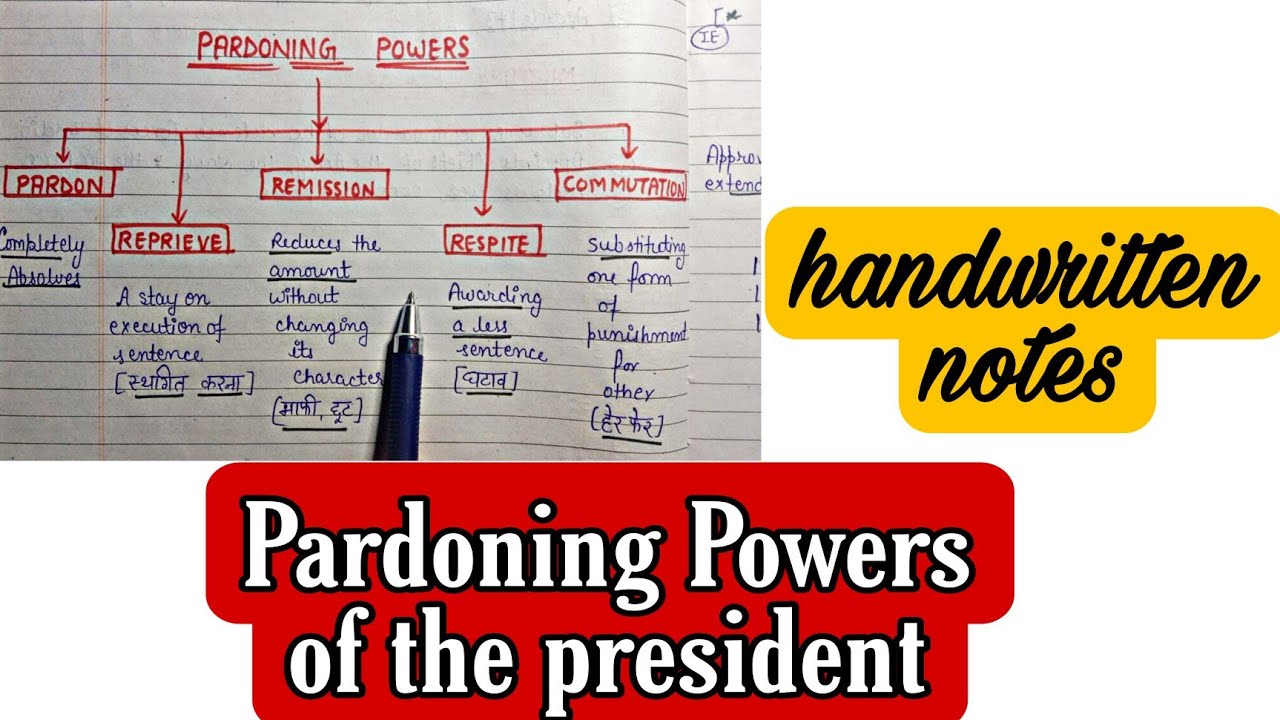
The Presidential Pardoning Power, given in Article 72 of the Constitution of India, is an important executive check on the judiciary. It allows the President to show mercy in certain serious cases, especially those involving Union law, court-martial sentences, and the death penalty. This power helps correct possible mistakes in the justice system and gives relief when a punishment may be too harsh. To understand this topic well, students must learn the five forms of clemency—Pardon, Commutation, Remission, Respite, and Reprieve—and compare them with the Governor’s limited mercy power under Article 161. These ideas are especially important for students preparing for Indian Polity and constitutional law examinations.
🎯 In this chapter, you will understand:
- The meaning and constitutional importance of the Presidential pardoning power under Article 72.
- The three special situations in which only the President can grant clemency.
- The differences between Pardon, Commutation, Remission, Respite, and Reprieve.
- The limits of the Governor’s mercy power under Article 161 and the Supreme Court’s rules for judicial review.
💡 Why this topic matters: The pardoning power is a final safety net in the justice system. Courts must follow law and evidence, but sometimes a punishment may appear too severe or a mistake may have occurred. This power allows the executive to provide humanitarian relief without changing the court’s original judgment through an appeal.
🧠 Core Idea: The President’s pardoning power is an independent executive power, not a court appeal. It can reduce, delay, change, or completely cancel the effect of a punishment in specific constitutional situations, but it must not be used unfairly or arbitrarily.
Analysis of Presidential Pardoning Power: Article 72 and Its Constitutional Significance
The power to grant mercy is a high executive power given to the President. Its main purpose is to correct possible miscarriages of justice and provide a final layer of humanitarian relief. In simple words, even after a court has given its final decision, the Constitution allows the President to look at the case from a mercy-based point of view. This does not mean that the President becomes a judge or reopens the case like an appellate court. Instead, the President considers whether the punishment should be softened, delayed, changed, or completely forgiven in the interest of justice and humanity.
This power originally comes from the old idea of the sovereign’s prerogative of mercy. In a constitutional democracy, this idea has been placed within the constitutional framework so that it can act as a safeguard against judicial inflexibility or error. Courts decide cases according to legal rules, evidence, and procedure. However, mercy decisions may also consider wider humanitarian circumstances. Therefore, the pardoning power works as a bridge between strict legal justice and compassionate executive action.
- (i) The ultimate authority for clemency comes from Article 72 of the Constitution of India. It empowers the President to grant pardons, reprieves, respites, or remissions of punishment. The President may also suspend, remit, or commute the sentence of a person convicted of an offence. [198]
- (ii) This right is not an appellate function. It is an independentexecutive power, exercised outside the judicial hierarchy. The President does not sit as a higher court to decide whether the trial court or higher court correctly interpreted the law.
- (iii) The President’s pardoning power is based on the belief that even the most careful judicial system can make an error. It provides a mechanism for the correction of judicial errors and can reduce punishments that appear unduly harsh in a particular case.
Scope of Article 72: The President's Exclusive Jurisdiction
The President’s clemency power is special because it covers three particular areas. In these areas, the President has exclusive jurisdiction, meaning the Governor cannot exercise the same complete power. These areas show the federal structure of India and the special position of the President in matters connected with the Union, the armed forces, and capital punishment. The power is not available for every possible case; it becomes relevant only when the punishment falls within one of the three constitutional categories mentioned in Article 72.

Three Grounds for Presidential Clemency
The power under Article 72 applies when the sentence or punishment relates to one of three specified categories. These categories make the President’s role especially important in serious and sensitive matters. They also explain why the Governor’s power is narrower than the President’s power.
- (a) The conviction is for an offence against a law relating to a matter to which the Union’s executive power extends. In simple terms, this generally means an offence under a Union law. For example, if the offence is connected with a subject controlled by the Union government, the President’s clemency power can apply.
- (b) The sentence is awarded by a court-martial. A court-martial is a military court that deals with offences committed by members of the armed forces. The President’s role here reflects the President’s position as the supreme commander of the armed forces. In such cases, the Governor has no jurisdiction.
- (c) The sentence involves the death penalty. This is the most serious punishment that a court can award. Article 72 gives the President the ultimate constitutional mercy valve in death-sentence cases, which is why this power is considered especially significant. [195]
Five Types of Pardoning Power: A Clemency Spectrum
The President can choose from a spectrum of five forms of clemency. Each form gives a different level of relief to the convict, depending on the facts and circumstances of the case. Some forms completely remove the punishment, while others only reduce it, change it, or postpone it. Understanding these five forms clearly is essential because examination questions often ask students to distinguish one form from another.
Detailed Breakdown of Clemency Forms
The terms Pardon, Commutation, Remission, Respite, and Reprieve define the exact nature and extent of the relief granted. Together, they give the Constitution flexibility in dealing with different kinds of punishments and different humanitarian situations.
- (i) Pardon: This is the most complete form of clemency. It completely absolves the convict of the crime. It removes both the conviction and the sentence, along with associated disqualifications. After a pardon, the person is effectively treated as if they were never convicted. For example, if a pardon removes a disqualification arising from conviction, the person may regain rights or opportunities that were lost because of the conviction.
- (ii) Commutation: This means replacing one punishment with a lighter or less severe form of punishment. For example, a death sentence may be commuted to rigorous imprisonment. Similarly, rigorous imprisonment may be commuted to simple imprisonment. Here, the nature of the punishment changes, but the idea of punishment continues in a milder form.
- (iii) Remission: This means reducing the period of the sentence without changing its basic nature. For instance, if a person is sentenced to two years of rigorous imprisonment, remission may reduce it to one year of rigorous imprisonment. The punishment remains rigorous imprisonment, but its duration becomes shorter. [195]
- (iv) Respite: This means awarding a lesser sentence than the one originally prescribed because of some special facts or circumstances. Common examples include the pregnancy of a female offender or the physical disability of the convict. Respite recognises that certain personal circumstances may make the original punishment inappropriate or excessively harsh.
- (v) Reprieve: This grants a temporary stay on the execution of a sentence, especially a death sentence. Its purpose is to give the convict enough time to seek a Pardon or Commutation from the President. A reprieve does not cancel the sentence; it only delays its execution for a temporary period.
The Governor’s Power of Mercy under Article 161: A Comparison
Like the President, the Governor of a state also has the power of mercy under Article 161. However, this power is limited by the state’s executive domain. The Governor can grant clemency only in relation to offences against laws relating to matters within the state’s executive power. Therefore, the Governor’s mercy power is similar in language to the President’s power, but its practical scope is narrower. [199]
This comparison is important because students often confuse the two powers. The President’s power extends to certain all-India and special categories, while the Governor’s power mainly concerns state-law offences. The Governor also cannot interfere in military justice and cannot grant a complete pardon in a death-sentence case.
Key Differences Between Presidential and Governor Pardons
The Governor’s power extends only to offences against state law. Importantly, the Governor lacks the President’s exclusive authority in two critical areas: court-martial sentences and complete pardons for death sentences.
- (i) Court-Martial Exclusion: The Governor has no authority to grant any form of clemency for sentences awarded by a court-martial, which is a military court. This area belongs exclusively to the President under Article 72.
- (ii) Death Sentence Limitation: The Governorcannot grant a complete Pardon for a death sentence. However, the Governor retains a concurrent power with the President to suspend, remit, or commute a death sentence. This means both authorities may act in these limited ways, but only the President can grant a full pardon in a death-sentence case.
Supreme Court Rulings: Judicial Review and Guiding Principles
The Supreme Court has played a major role in explaining the limits of the President’s pardoning power. It has clarified that the power is independent and executive in nature, but it is not completely beyond scrutiny. The Court has recognised that mercy must be exercised responsibly, fairly, and according to constitutional values. If the power is misused, the Supreme Court can examine the decision through limited judicial review. [193][202]
Principles of Judicial Review on Pardoning Power
The Court has consistently upheld the independent nature of the pardoning power. It has explained that the power is an executive function exercised on the advice of the Union Cabinet. At the same time, it is not immune from review if it is abused or exercised in an unfair manner.
- (i) No Right to Oral Hearing: A person seeking mercy has no constitutional right to an oral hearing before the President or the relevant authorities. The mercy petition is considered through the constitutional and administrative process, not through a courtroom-style hearing.
- (ii) Review of Evidence: The President can undertake an independent review of the evidence and material on record. This review may adopt a humanitarian or political perspective that differs from the court’s strict legal conclusion. However, this does not turn the President into an appellate judicial authority.
- (iii) Basis of Advice: This executive power is exercised based on the binding advice of the Union Cabinet, also called the Council of Ministers. The President acts according to constitutional practice and ministerial advice in exercising this power.
- (iv) Non-Arbitrary Exercise: The main constitutional check is that the Supreme Court can examine the President’s decision if it is found to be arbitrary, irrational, mala fide, or discriminatory. This prevents misuse of the mercy power while respecting the executive’s constitutional role. [193][205]
- (v) No Binding Guidelines: The Supreme Court has stated that it has no power to lay down guidelines for the manner in which the President or Governor should exercise this power. The power must remain flexible enough to respond to the special facts of each case.
- (vi) Validity of Acts: A subsequent mercy petition after an initial rejection does not automatically entitle the petitioner to a stay on the execution of the sentence. In other words, filing another petition does not by itself stop the punishment from being carried out.
⚡ Quick Revision Capsule: Presidential and Governor’s Clemency Powers
This table helps you quickly revise the main differences between the President’s mercy power under Article 72 and the Governor’s mercy power under Article 161. Focus on the scope, special powers, and limits of each authority.
| Aspect | President under Article 72 | Governor under Article 161 |
|---|---|---|
| Constitutional provision | Article 72 of the Constitution of India. | Article 161 of the Constitution of India. |
| Scope of offences | Covers offences against laws relating to matters within the Union’s executive power. | Covers offences against laws relating to matters within the State’s executive power. |
| Court-martial cases | The President can grant clemency in sentences awarded by a court-martial. | The Governor has no authority in court-martial cases. |
| Death sentence | The President can grant pardon, suspension, remission, or commutation in death-sentence cases. | The Governor cannot grant a complete pardon but may suspend, remit, or commute a death sentence. |
| Five clemency forms | Pardon, Commutation, Remission, Respite, and Reprieve. | Similar clemency forms are available, but only within the Governor’s constitutional limits. |
📝 Summary
The Presidential Pardoning Power under Article 72 is an essential constitutional safety net. It gives the nominal executive final authority over certain punishments, especially the death penalty and sentences from a court-martial. The five categories of clemency—Pardon, Commutation, Remission, Respite, and Reprieve—ensure flexible relief. The limited judicial review developed by the Supreme Court ensures that this important executive power is used responsibly and constitutionally. This topic is highly important for students of Indian Polity, particularly for questions on Article 72, Article 161, and the relationship between the executive and judiciary.
🚀 Quick Revision Points
Essential facts to review before examinations:
- (i) Article 72 gives the President the power to grant clemency, including pardon, reprieve, respite, and remission, and to suspend, remit, or commute sentences. [198]
- (ii) The President has exclusive jurisdiction over Union-law offences, court-martial sentences, and death sentences.
- (iii) Commutation changes the nature of punishment, while remission reduces the period of punishment without changing its nature.
- (iv) The Governor’s power comes from Article 161 of the Constitution of India and is limited to state-law offences; the Governor cannot grant a complete pardon for a death sentence. [199]
- 💡 Exam Tip: Remember the five clemency forms using their main effect: Pardon cancels, Commutation changes, Remission reduces, Respite lessens for special reasons, and Reprieve temporarily delays. Also remember that “court-martial” and “complete pardon in a death sentence” are President-exclusive areas.
❓ Frequently Asked Questions (FAQ)
Q1: Is the President’s pardoning power an appellate power?
A1: No. It is an independent executive power, not an appellate power. The President does not re-examine the case as a higher court; the President considers mercy and constitutional relief.Q2: Can the Governor pardon a death sentence completely?
A2: No. Under Article 161, the Governor cannot grant a complete pardon for a death sentence. However, the Governor may suspend, remit, or commute a death sentence along with the President’s concurrent power.Q3: Can the Supreme Court review the President’s pardoning decision?
A3: Yes, but only through limited judicial review. The Supreme Court may examine a decision if it is arbitrary, irrational, mala fide, or discriminatory, but it cannot lay down binding guidelines for exercising the mercy power under Article 72. [193][202]