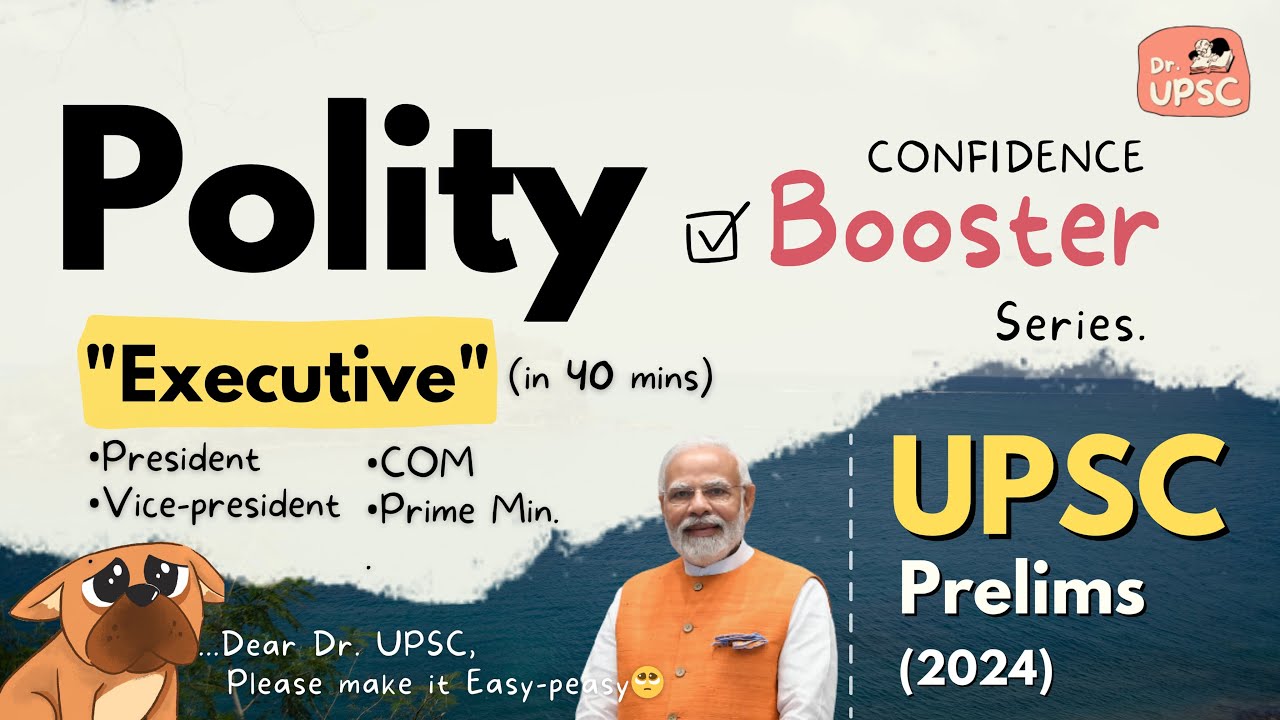
The Union Executive of India is one of the most important parts of the country’s parliamentary system. It is carefully explained in Articles 52 to 78 of Part V of the Constitution of India. At the centre of this system is the President of India, who is the formal head of the country and a symbol of national unity. The President is not chosen directly by all voters in a general election. Instead, the President is elected through an indirect process by an electoral college. This chapter explains who forms the electoral college, how the value of each vote is calculated, and how the single transferable vote system helps choose the President. These ideas are especially useful for students preparing for advanced Indian Polity and constitutional law examinations.
🎯 In this chapter, you will understand:
- The meaning and constitutional framework of the Union Executive.
- The five main components of India’s federal executive and their roles.
- Who can vote in the indirect election of the President of India.
- How vote values, the quota, and the single transferable vote system work.
💡 Why this topic matters: The election of the President shows how India balances democracy, federalism, and parliamentary government. It explains why both the Union and the States take part in choosing the head of the Indian State.
🧠 Core Idea: India follows a parliamentary system in which the President is the constitutional head, while the Prime Minister and Council of Ministers exercise real executive power. The President is elected indirectly to maintain this balance.
Delving into the Union Executive Framework and the Indirect Election of the Indian President
The Union Executive is the main machinery through which the Government of India runs the country and carries out its administration. It is led by the President, who acts as the supreme constitutional head of the nation. In simple words, the executive branch is the part of government that puts laws and policies into action. The Constitution does not leave this arrangement vague; it clearly explains the structure and powers of the Union Executive in Articles 52 to 78, which are placed in Part V of the Constitution, under the title “The Union.”
This framework brings together both nominal and real executive authority. The President holds the highest constitutional position, but the day-to-day work of governing is mainly carried out by the Prime Minister and the Council of Ministers. This division is intentional. It allows the country to have a respected head of state while also ensuring that elected representatives remain responsible for practical governance. The President is not only the constitutional head of the Indian State but is also regarded as the first citizen of India. The office stands for national unity, integrity, and solidarity.
Composition of the Union Executive: Key Pillars of Government
The Union Executive works as a team of important constitutional functionaries. The President is the titular head, meaning the formal or symbolic head of the State. The Prime Minister is the real head of the government because the Prime Minister leads the Council of Ministers and guides daily administration. These two roles work together with other key officers to make the executive branch complete. The Constitution designed this arrangement so that authority is shared in a balanced and organised way.
The Five Components of India's Federal Executive
The Union Executive is not made up of only one person. It is a multi-membered body in which every member has a special role. From the President to the Attorney General, each office helps in the working of the Indian State. Their powers and duties are connected, and together they keep the machinery of governance running smoothly.
- (i) The President: The President is the ceremonial and constitutional head of India. In theory, all executive power of the Union is vested in the President.
- (ii) The Vice-President: The Vice-President holds the second-highest constitutional office. The Vice-President can step in when the office of President becomes vacant and also serves as the ex-officio Chairman of the Rajya Sabha.
- (iii) The Prime Minister and the Council of Ministers: They form the real executive authority. They prepare government policies, implement decisions, and remain collectively responsible to the Lok Sabha.
- (iv) The Attorney General of India: The Attorney General is the chief legal advisor to the Government of India. The Attorney General appears on behalf of the government in the highest courts and protects the legal interests of the State.
The Complex Indirect Election Process of the President
The President of India is not elected directly by the people in the same way as Members of Parliament or State Legislators. Instead, the President is chosen indirectly by a specially constructed Electoral College. This method ensures that both the Union government and the States are represented in the election. Because State Legislators also vote, the process gives the presidential election a clear federal character. It prevents the choice of the President from depending only on the party or coalition that controls Parliament.
The indirect system also matches India’s parliamentary form of government. In such a system, the President is expected to act as the nominal executive, while the Prime Minister and Council of Ministers hold real power. Therefore, the method of electing the President is designed to reflect the federal and parliamentary nature of the Indian Constitution.
Who Forms the Presidential Electoral College?
The electoral college is the group of people who have the legal right to vote in the election of the President. It is carefully designed to represent the political will of the whole nation. It includes representatives from Parliament as well as from the State Legislative Assemblies. This makes the election broader than a simple vote by Members of Parliament alone.
- (a) Elected Members of Parliament: All elected members of the Lok Sabha, also called the House of the People, and all elected members of the Rajya Sabha, also called the Council of States, are part of the electoral college.
- (b) Elected Members of State Assemblies: All elected members of the Legislative Assemblies of the various States are included. They represent the popular mandate at the State level and bring the federal voice into the election.
- (c) UT Legislative Members: After the 70th Constitutional Amendment Act, the elected members of the Legislative Assemblies of the Union Territories of Delhi and Puducherry were also included. This change recognised their growing political importance.
Members Excluded from the Presidential Vote
It is very important to understand that not every member of Parliament or every member of a State Legislature can vote in the presidential election. The Constitution makes a clear distinction between elected and nominated representatives. It also excludes members of Legislative Councils. These exclusions help keep the electoral college focused on directly elected representatives.
- (i) Nominated members of Parliament do not have voting rights in the presidential election.
- (ii) Nominated members of State Legislative Assemblies also cannot vote in this election.
- (iii) Members of State Legislative Councils are completely excluded from the electoral college, whether they are elected or nominated.
- (iv) If a State Legislative Assembly is dissolved when a presidential election is due, its members lose their voting eligibility. However, this situation does not invalidate the election itself.
Principles of Uniformity and Parity in Vote Value Calculation
The presidential election does not treat every voter’s vote as having the same numerical value. Instead, it uses a weighted voting system. This means that the vote of an MLA or MP may carry a different value depending on the population they represent and the constitutional formula used. The purpose is to maintain fairness between large and small States and to protect the federal spirit of the Constitution.
The system seeks two important goals: uniformity and parity. Uniformity means that representation among the States should be as equal as practicable. Parity means that, as far as possible, the combined voting strength of the States should balance the voting strength of the Union. These principles prevent either the Centre or the larger States from dominating the election.
The Intricate Formula for Determining Vote Value
The vote value is calculated separately for MLAs and MPs. The formula may look difficult at first, but its purpose is simple: it links voting strength with population while maintaining balance between the Union and the States.
- (i) Value of an MLA’s Vote: The value of an elected member of a State Legislative Assembly, called an MLA, is found by dividing the State’s total population by the total number of elected members in that Assembly. The result is then divided by 1,000. The population used for this calculation is based on the .
- (ii) Value of an MP’s Vote: The value of an elected Member of Parliament, or MP, is calculated by taking the total vote value of all State MLAs and dividing it by the total number of elected Members of Parliament from both the Lok Sabha and the Rajya Sabha. This method helps create parity between the States and the Union.
The Voting System: Proportional Representation by Single Transferable Vote
The election of the President is conducted through a system officially called proportional representation by means of the single transferable vote. This is often shortened to STV. The system is designed to ensure that the winning candidate does not merely get the highest number of votes. The winner must secure an absolute majority of the total valid votes cast. In other words, the winning candidate must receive more than half of the total valid vote value.
Although the technical name can sound complicated, the basic idea is easy to understand. Every voter marks preferences instead of choosing only one candidate. If a voter’s first choice cannot win, the vote can move to the voter’s next preferred candidate. This process continues until one candidate crosses the required winning mark.
How the Single Transferable Vote System Works
Even though the term “proportional representation” is sometimes considered a misnomer for an election with only one seat, the process still uses preference-based voting. Each eligible voter in the electoral college casts a secret ballot and ranks the candidates according to preference.
- (a) Preference Marking: Each voter marks the candidates as first preference, second preference, third preference, and so on, using numbers such as 1, 2, and 3.
To win the election, a candidate must secure an absolute majority of the total valid votes cast. This required number is called the Quota. The quota is a vital part of the single transferable vote system because it ensures that the President receives broad support rather than only a small lead over other candidates.
- (i) The Basic Quota Formula (Half-Plus-One Rule): The minimum quota needed to win is calculated using the “half-plus-one” rule. This ensures that the winner has more than 50% of the total valid vote value. The formula is:
Quota = (Total Valid Votes / 2) + 1
- (ii) Formal Representation Rationale: This simple formula comes from the more formal mathematical expression used in proportional representation systems. In the formal context:
Quota = [Total Valid Votes / (Number of Candidates + 1)] + 1
Because the presidential election is for a single seat, and the formula seeks a winner who cannot be beaten by the remaining candidates, it effectively becomes the half-plus-one rule.
- (iii) Purpose: This strict Quota mechanism ensures that the elected President enjoys wide support. It gives legitimacy and constitutional weight to the head of the Union Executive.
- (i) The Basic Quota Formula (Half-Plus-One Rule): The minimum quota needed to win is calculated using the “half-plus-one” rule. This ensures that the winner has more than 50% of the total valid vote value. The formula is:
- (c) Vote Counting and Elimination: At first, only the First Preference votes are counted. If no candidate reaches the required quota in the first round, the candidate with the lowest number of first preference votes is eliminated.
- (d) Transfer of Votes: The ballot papers of the eliminated candidate are then examined. Their Second Preference votes are transferred to the remaining candidates. This process of elimination and transfer continues until one candidate finally secures the required quota.
Judicial Review and the Rationale for Indirect Election in India
The Constitution gives the highest court of the country the final authority to deal with disputes related to the presidential election. This provision protects the fairness and sanctity of the election. At the same time, the choice of an indirect election was not accidental. It was made because India follows a parliamentary form of government, where the real executive authority rests with the Prime Minister and the Council of Ministers.
Dispute Resolution and the Supreme Court's Final Say
To prevent political uncertainty and protect the dignity of the presidential office, all disputes connected with the President’s election are handled by the Supreme Court. This centralised arrangement ensures that election-related conflicts are resolved by the highest judicial authority in the country.
- (i) All challenges, petitions, and disputes relating to the presidential election are decided exclusively by the Supreme Court of India. Its decision is final and binding.
- (ii) The election cannot be challenged or set aside merely because the electoral college was incomplete, for example because one or more State Assemblies were dissolved.
- (iii) Even if the Supreme Court later declares an election void, the acts done by the person while serving as President before that declaration remain valid and legally binding.
Why an Indirect Presidential Election?
The Constituent Assembly chose indirect election even though some members supported direct election by the people. The main reason was to keep the office of President suitable for India’s parliamentary system. A directly elected President with a huge popular mandate could claim independent authority and create conflict with the government led by the Prime Minister.
- (i) Upholding the Parliamentary System: The President is meant to be a nominal executive, while real power is exercised by the Council of Ministers led by the Prime Minister. Direct election could make the President behave like the head of a semi-presidential system, leading to a clash of authority.
- (ii) Practicality and Cost: India has an extremely large electorate. Holding a separate nationwide direct election for a largely ceremonial head of State would be costly, cumbersome, and unnecessary.
- (iii) Federal Representation: By including State Legislators in the electoral college, the election represents both the Union and the States. This creates a broader federal base and prevents the election from being controlled only by the ruling party in Parliament.
⚡ Quick Revision Capsule: President’s Election and Union Executive
This quick revision capsule brings together the most examination-relevant points about the Union Executive, the electoral college, vote value, and the single transferable vote system.
| Topic | Key Provision or Explanation | Important Point |
|---|---|---|
| Union Executive | Described in Articles 52 to 78 of Part V of the Constitution. | The President is the constitutional head; the Prime Minister and Council of Ministers hold real executive authority. |
| Electoral College | Includes elected MPs, elected MLAs, and elected members of the Legislative Assemblies of Delhi and Puducherry. | Nominated members and members of State Legislative Councils cannot vote. |
| MLA Vote Value | Calculated as State population divided by elected MLAs, then divided by 1,000. | Population is based on the . |
| MP Vote Value | Total vote value of all State MLAs divided by the total number of elected MPs. | This maintains parity between the States and the Union. |
| Voting System | Proportional representation by means of the single transferable vote, through secret ballot. | The winner must secure the quota: (Total Valid Votes / 2) + 1. |
| Election Disputes | Decided exclusively by the Supreme Court of India. | The Supreme Court’s decision is final; an incomplete electoral college is not a ground to challenge the election. |
📝 Summary
The Union Executive, explained in Part V of the Constitution, is the foundation of India’s central governance system. It includes the President, Vice-President, Prime Minister, Council of Ministers, and Attorney General of India. The President is the constitutional head of the State and a symbol of national unity, while the Prime Minister and Council of Ministers exercise real executive authority. The President is elected indirectly by an electoral college consisting of elected MPs, elected MLAs, and elected members from Delhi and Puducherry. The election uses proportional representation by means of the single transferable vote, and the winning candidate must obtain the required quota. These arrangements protect federal balance, parliamentary responsibility, and constitutional stability.
🚀 Quick Revision Points
Essential facts to review before examinations:
- (i) The Union Executive is laid down in Articles 52 to 78 of Part V of the Constitution.
- (ii) The President is elected indirectly by an electoral college and is regarded as the first citizen of India.
- (iii) The value of an MLA’s vote is based on State population, elected MLAs, and the .
- (iv) The presidential election uses proportional representation by means of the single transferable vote, and disputes are decided finally by the Supreme Court under the constitutional framework.
- 💡 Exam Tip: Remember the difference between the nominal executive and the real executive. The President is the nominal or constitutional head, while the Prime Minister and Council of Ministers form the real executive. Also memorise the quota formula: (Total Valid Votes / 2) + 1.
❓ Frequently Asked Questions (FAQ)
Q1: Who elects the President of India?
A1: The President is elected by an electoral college consisting of elected members of both Houses of Parliament, elected members of State Legislative Assemblies, and elected members of the Legislative Assemblies of Delhi and Puducherry.Q2: Can nominated members vote in the presidential election?
A2: No. Nominated members of Parliament and nominated members of State Legislative Assemblies cannot vote. Members of State Legislative Councils are also excluded, whether elected or nominated.Q3: What happens if no candidate gets the required majority in the first count?
A3: The candidate with the lowest number of first preference votes is eliminated. The second preference votes from that candidate’s ballots are then transferred to the remaining candidates. This continues under the single transferable vote system until one candidate secures the required quota.