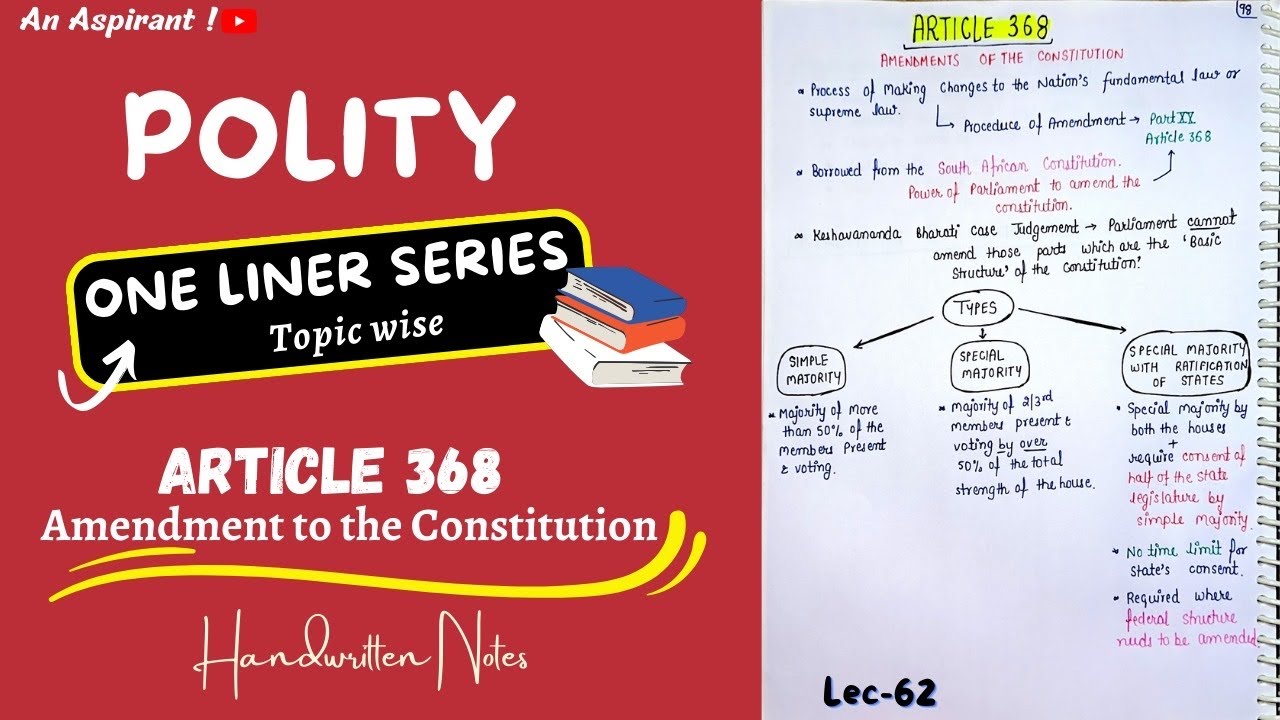
The Amendment of the Constitution of India is the formal process through which the country’s supreme law can be changed, updated, or improved. It allows India to respond to new political, social, and economic needs while protecting the values on which the nation was built. This process is mainly guided by Article 368, placed in Part XX of the Constitution. It carefully balances flexibility and rigidity, which is an important feature of India’s democratic and federal system. For students and civil-services aspirants, this topic explains how the Constitution has evolved over time and how its basic structure is protected from careless or harmful changes.
🎯 In this chapter, you will understand:
- Why the Constitution of India needs amendments.
- How Article 368 controls the amendment process.
- The step-by-step procedure for changing the Constitution.
- The importance of the basic structure doctrine.
💡 Why this topic matters: The Constitution is not a frozen document. As society changes, new problems and new needs appear. The amendment process helps Parliament respond to these changes without weakening democracy, federalism, or the rights of citizens.
🧠 Core Idea: India’s Constitution can be amended, but only through a careful and structured procedure. This keeps the Constitution useful for changing times while protecting its essential principles.
Amendment of the Constitution of India under Article 368 – Evolution, Process, and Significance
The Constitution of India provides a clear and organised method for making changes to itself. This method ensures that the Constitution remains useful in modern times while continuing to protect its foundational values. The makers of the Constitution understood that India is a large and diverse country, so its supreme law needed the ability to grow with its people.
India’s amendment system is neither completely flexible nor completely rigid. It allows necessary changes but prevents sudden or careless alterations. This balance helps the Constitution remain a living document that can serve every generation.
- (i) The Constitution of India allows changes to meet new socio-political challenges while protecting essential democratic ideals.
- (ii) The process is neither as flexible as in Britain nor as rigid as in the United States, making it a balanced constitutional model.
- (iii) Article 368, in Part XX, defines the power and procedure of Parliament to add, vary, or repeal provisions of the Constitution.
- (iv) The Supreme Court’s landmark judgment in Kesavananda Bharati v. State of Kerala in established the basic structure doctrine. It prevents Parliament from destroying or altering the essential features of the Constitution.
Procedure for Amendment under Article 368 – Step-by-Step Explanation
The amendment procedure under Article 368 is designed to prevent random or rushed changes. At the same time, it allows Parliament to make necessary constitutional improvements when there is broad legislative support. The process usually begins in Parliament, passes through special voting requirements, and may require approval from state legislatures in certain cases.
Initiation and Introduction of the Amendment Bill
A constitutional amendment begins only in the Union Parliament. This central role helps ensure that changes to the supreme law are made through a uniform national process rather than separately by individual states.
- (i) A constitutional amendment can be initiated only through a bill introduced in either House of Parliament: the Lok Sabha or the Rajya Sabha.
- (ii) State legislatures do not have the authority to propose or introduce a constitutional amendment bill.
- (iii) The bill may be introduced by either a minister or a private member, without needing prior Presidential approval or recommendation.
Special Majority and Voting Requirements
To stop a temporary political majority from easily changing the Constitution, Article 368 requires a special majority. This higher voting standard ensures that an amendment receives serious and widespread support in Parliament.
Specific Voting Thresholds
Each House of Parliament must approve the amendment bill separately. This ensures that both the Lok Sabha and the Rajya Sabha carefully examine the proposed change.
- (i) The amendment must receive a majority of the total membership of each House, meaning more than 50% of all members.
- (ii) It must also receive a two-thirds majority of the members present and voting in each House. [238][242]
Resolution of Disagreements
If the two Houses disagree, the Constitution does not provide an easy shortcut. Both Houses must independently pass the bill, which encourages discussion and compromise.
- (i) Both Houses must pass the amendment bill independently to ensure bicameral scrutiny.
- (ii) There is no provision for a joint sitting of both Houses if they disagree or reach a deadlock.
State Ratification and Federal Balance
India is a Union of States, so some amendments directly affect the relationship between the Union and the States. In such cases, the states must be consulted through their legislatures. This protects the federal balance and prevents the Union from changing state powers on its own.
- (i) Amendments involving changes in the distribution of powers or the representation of states need ratification by at least half of the state legislatures.
- (ii) For this purpose, state ratification requires only a simple majority of the members present and voting in the state assembly.
- (iii) Examples include amendments affecting Articles 54, 55, 73, 162, and 241, or any list in the Seventh Schedule.
Presidential Assent and Finalization
The final step is Presidential assent. Once Parliament completes the required procedure, the amendment bill is presented to the President of India. After assent, the proposed change officially becomes part of the Constitution.
- (i) Unlike ordinary bills, the President cannot return a constitutional amendment bill to Parliament for reconsideration.
- (ii) Under the Constitution (Twenty-fourth Amendment) Act, 1971, the President is bound to give assent once the required procedure is completed.
- (iii) After assent, the bill becomes a Constitution (Amendment) Act, and the Constitution is changed according to its terms.
Summary – Importance of Constitutional Amendment Process in India
The constitutional amendment procedure under Article 368 shows how India’s Constitution maintains a balance between stability and flexibility. It allows the Constitution to remain a living document that can respond to new needs, while protecting its basic structure from arbitrary changes. For students and competitive-exam aspirants, this topic is important because it explains the resilience of Indian democracy, the changing nature of governance, and the role of the judiciary in protecting constitutional supremacy through Part XX.
⚡ Quick Revision Capsule: Constitutional Amendment under Article 368
The table below gives a simple overview of the main stages and requirements involved in amending the Constitution of India.
| Stage | Main Requirement | Key Point |
|---|---|---|
| Introduction | Bill introduced in either House of Parliament | State legislatures cannot introduce the bill |
| Parliamentary Approval | Special majority in each House | Majority of total membership plus two-thirds of members present and voting |
| Deadlock | Both Houses must agree separately | No joint sitting is allowed for amendment bills |
| State Ratification | Needed for certain federal provisions | At least half of the state legislatures must approve |
| Presidential Assent | President must give assent | The bill then becomes a Constitution (Amendment) Act |
📝 Summary
The amendment process under Article 368 allows India’s Constitution to change with time while preserving its core democratic and federal character. Since , the Supreme Court’s basic structure doctrine has also limited Parliament’s amending power by protecting the Constitution’s essential features.
🚀 Quick Revision Points
Essential facts to review before examinations:
- (i) Article 368 is located in Part XX of the Constitution.
- (ii) A constitutional amendment bill can be introduced only in Parliament, not in a state legislature.
- (iii) A special majority means a majority of the total membership of each House and a two-thirds majority of members present and voting.
- (iv) The basic structure doctrine was established in Kesavananda Bharati v. State of Kerala in .
- 💡 Exam Tip: Remember the three major checks in the amendment process: special majority in Parliament, state ratification where required, and the basic structure limitation recognised by the Supreme Court.
❓ Frequently Asked Questions (FAQ)
Q1: Can state legislatures introduce a constitutional amendment bill?
A1: No. Only a bill introduced in either House of Parliament can begin the process of amending the Constitution under Article 368.Q2: What is a special majority?
A2: A special majority means a majority of the total membership of each House and also a two-thirds majority of members present and voting in that House.Q3: What is the basic structure doctrine?
A3: The basic structure doctrine says that Parliament can amend the Constitution but cannot destroy or alter its essential features. This principle emerged from Kesavananda Bharati v. State of Kerala in .